








L2 vs L1: Ethereum Community Erupts in Scalability Roadmap Debate
TechFlow Selected TechFlow Selected
L2 vs L1: Ethereum Community Erupts in Scalability Roadmap Debate
Should Ethereum prioritize L1 or L2 development?
 Navigating Web3 tides with focused insights
By Yangz, Techub News
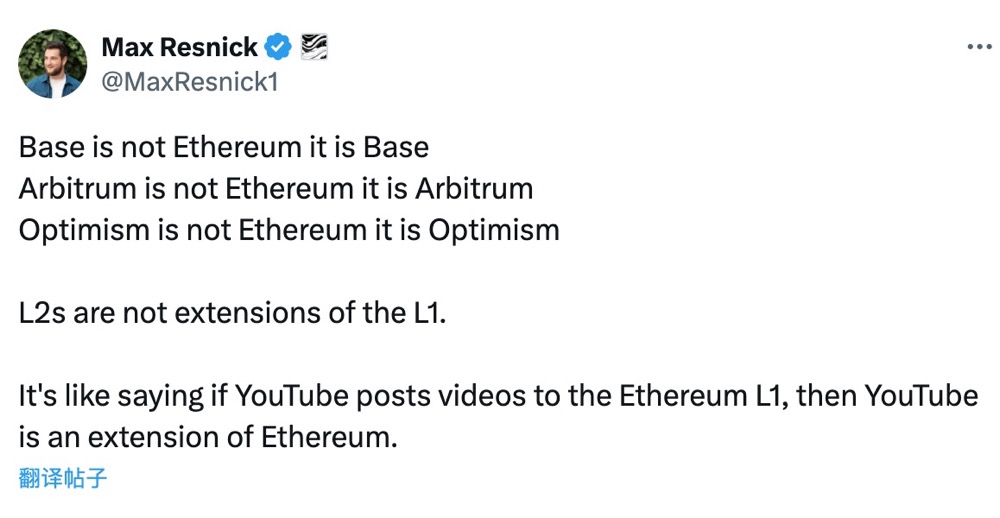
Recently, some researchers, represented by Max Resnick, Head of Research at blockchain research firm SMG, have proposed a controversial idea: "L2s are not Ethereum, and L2s are not Layer 1 (L1) extensions." Perhaps due to its blunt phrasing—and the perceived attempt to sever the relationship between L2s and L1—this view sparked heated debate on Crypto Twitter (CT). Some agreed, while others dismissed it as "nonsense." Both sides held firm, with no clear resolution.
To be honest, when I first encountered this topic, I didn't grasp the core of the dispute and thought it seemed somewhat absurd. However, after thoroughly reviewing various perspectives, I realized that the real point of contention is actually about whether Ethereum should prioritize developing its L1 or L2 under current conditions.
Make Eth L1 Great Again
Setting aside semantic debates over the word "extension," those supporting the "L2 is not Ethereum" stance are essentially dissatisfied with Ethereum's current strategy of scaling via L2s.
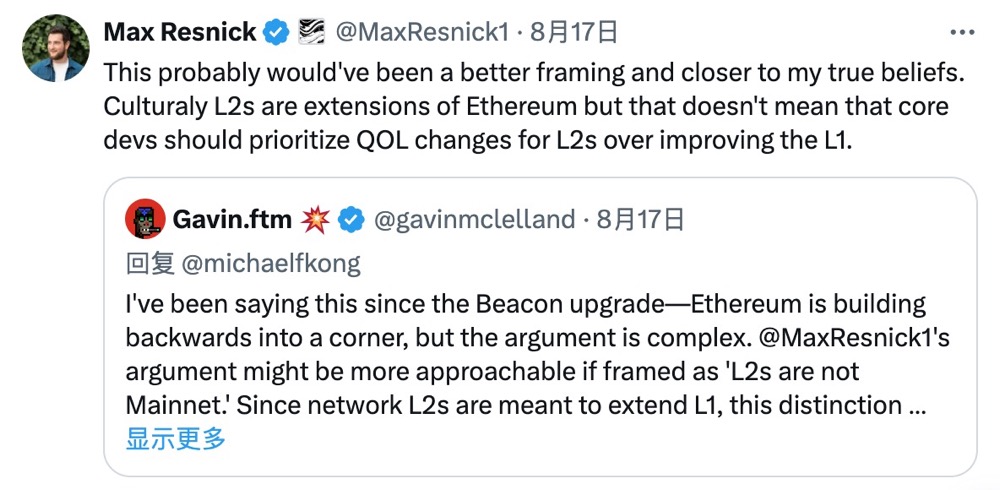
Max Resnick sarcastically remarked that viewing L2s as Ethereum's extension is akin to claiming "if YouTube publishes videos on Ethereum, then YouTube could also be considered an extension of Ethereum." However, perhaps due to "poor phrasing," Max later retweeted a post stating "Ethereum has been regressing since the Beacon Chain upgrade," saying it better reflected his true opinion. Max clarified, "Culturally, L2s are extensions of Ethereum—but that doesn’t mean core developers should prioritize L2s over improving the L1." He also shared Paradigm’s March article on Ethereum state growth (which concluded that state growth won’t be a major bottleneck for Ethereum scalability in the short, medium, or long term), implying that Ethereum’s current reliance on L2s for scaling is unwise. Instead, he believes Ethereum should aggressively develop its L1 to achieve its ultimate vision.
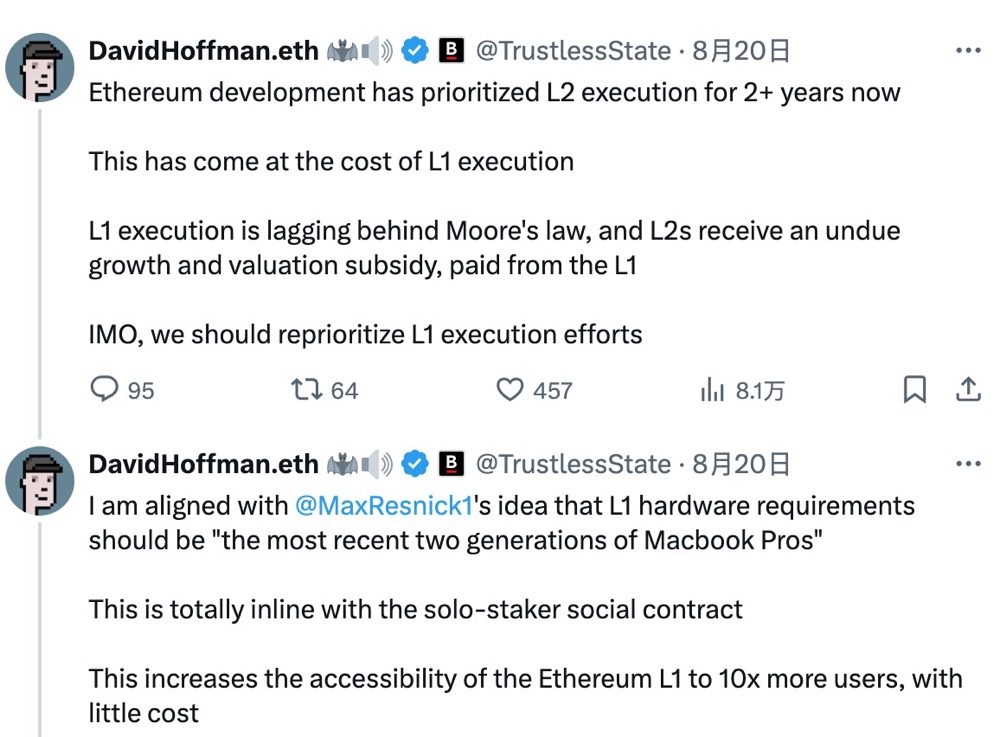
Similar to Max, Bankless co-founder David Hoffman also called for a shift in Ethereum’s development priorities. Hoffman stated, "Ethereum development has prioritized L2 execution for over two years—at the expense of L1 execution. We should re-prioritize work on primary execution." He argued, "L1 hardware should be at least equivalent to 'the last two generations of MacBook Pro,' which would increase accessibility to Ethereum L1 tenfold at minimal cost."
However, unlike Max, regarding the literal question of whether "L2s are Ethereum extensions," Hoffman considers the answer highly subjective. In his view, "L2s aren't 1:1 extensions of Ethereum. Ethereum intentionally granted L2s significant freedom and autonomy, and they do extend Ethereum to some extent. If L2s were perfect 1:1 replicas, they’d be too rigid to reach their full technical and social potential."
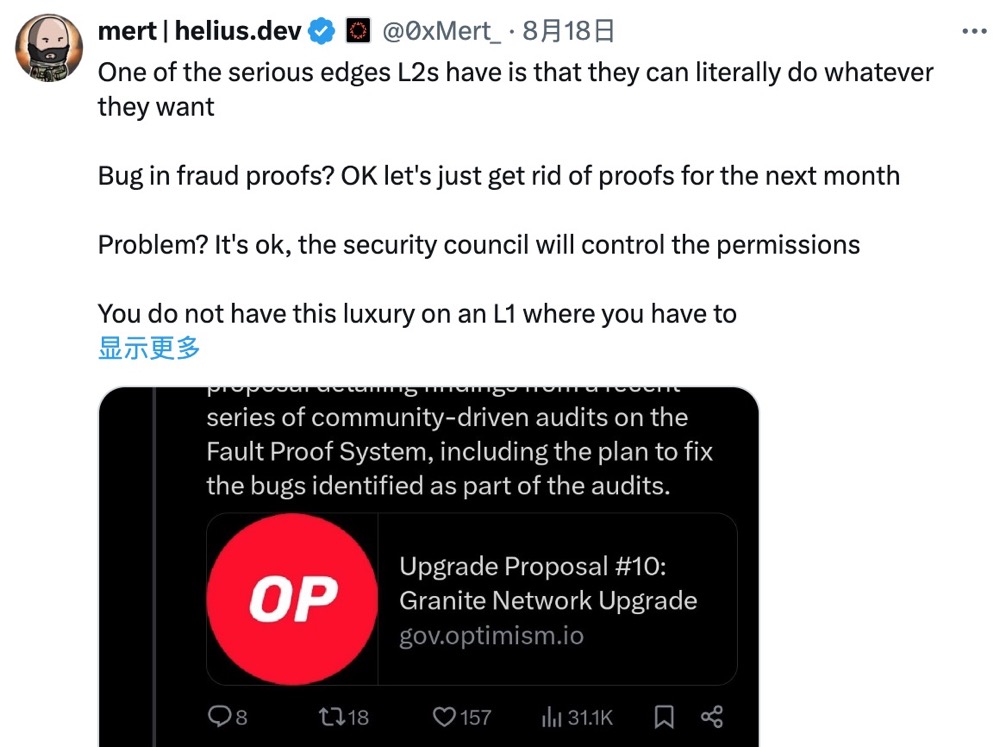
Beyond the "Make Eth L1 Great Again" narrative, this debate has drawn mockery from certain projects in Solana’s ecosystem—Ethereum’s competitor. Mert Mumtaz, co-founder and CEO of Helius Labs, used Optimism as an example to highlight flaws in Ethereum’s L2 model. Mert mocked, "A notable 'advantage' of L2s is that they can do whatever they want. Found a bug in fraud proofs? No problem—we’ll fix it next month. Another bug? Don’t worry, the central security council will just take control. On L1, you’d have to release a software upgrade and beg governance token holders to adopt it."
Loose Friends > Competitive Enemies
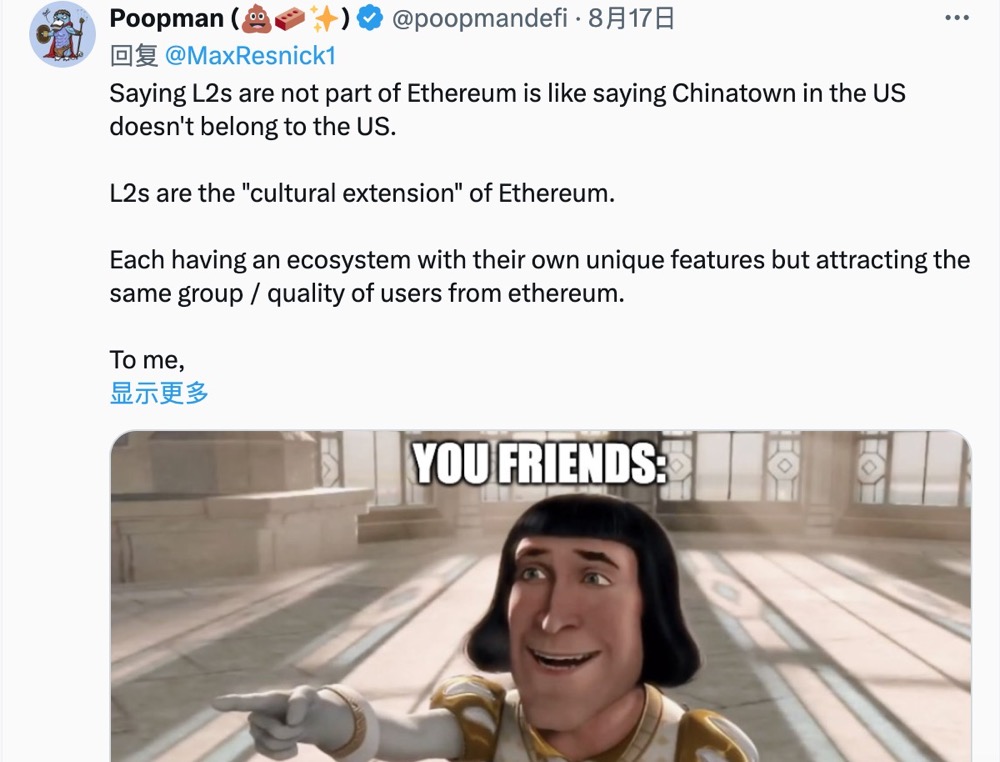
Much like debating, arguing against widely accepted beliefs often feels uphill. Those firmly believing "L2s are L1 extensions" tend to express their views more directly. Sassal.eth, founder of The Daily Gwei, bluntly stated, "L2s *are* Ethereum. Anyone who claims otherwise has the intellectual capacity of a toddler." Similarly, DCinvestor suggested skeptics reflect on why these chains chose to become L2s rather than independent L1s. @poopmandefi of Ouroboros Research compared it to Chinatown in the U.S.: "Saying L2s aren’t part of Ethereum is like saying Chinatown isn’t part of America. L2s are cultural extensions of Ethereum. They each have unique ecosystems, but attract similar user bases and qualities as Ethereum itself." In Poopman’s view, as long as L2s use ETH for gas fees, they are undeniably part of Ethereum.
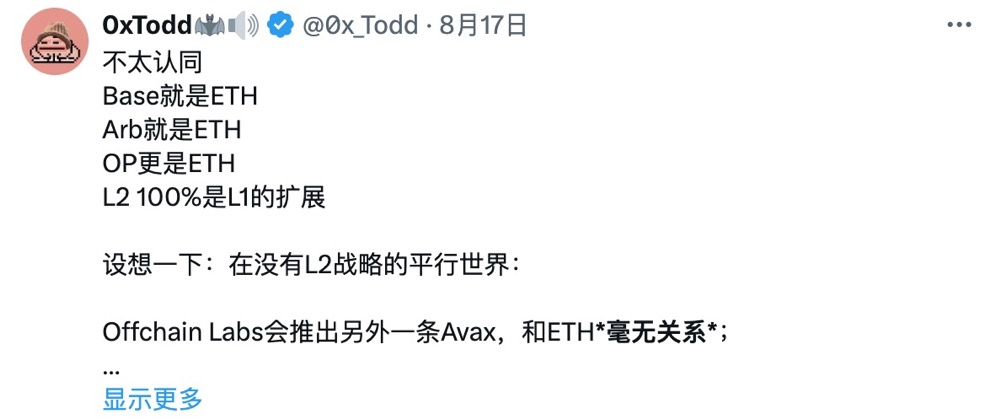
Beyond surface-level arguments, this camp also offers deeper insights. @0x_Todd, who firmly asserts "L2s are 100% L1 extensions," provides another perspective by examining Ethereum’s strategic adoption of L2s in recent years. Using Altlayer (founded by former creators of the so-called "Ethereum killer" Zilliqa) as an example, 0xTodd noted, "The L2 program turned potential competitors into at least loose parts of its own ecosystem." He explained, "In a parallel world without an L2 strategy, Offchain Labs might’ve launched another Avax unrelated to ETH; OP developers might’ve built another Polkadot; Coinbase would’ve issued its own chain—all completely separate from ETH." Meanwhile, "BN would keep shouting that BSC surpasses ETH instead of launching opBNB; OK would push OKT instead of X Layer; Bybit would naturally launch Bit Chain, and Bitget would launch Get Chain."
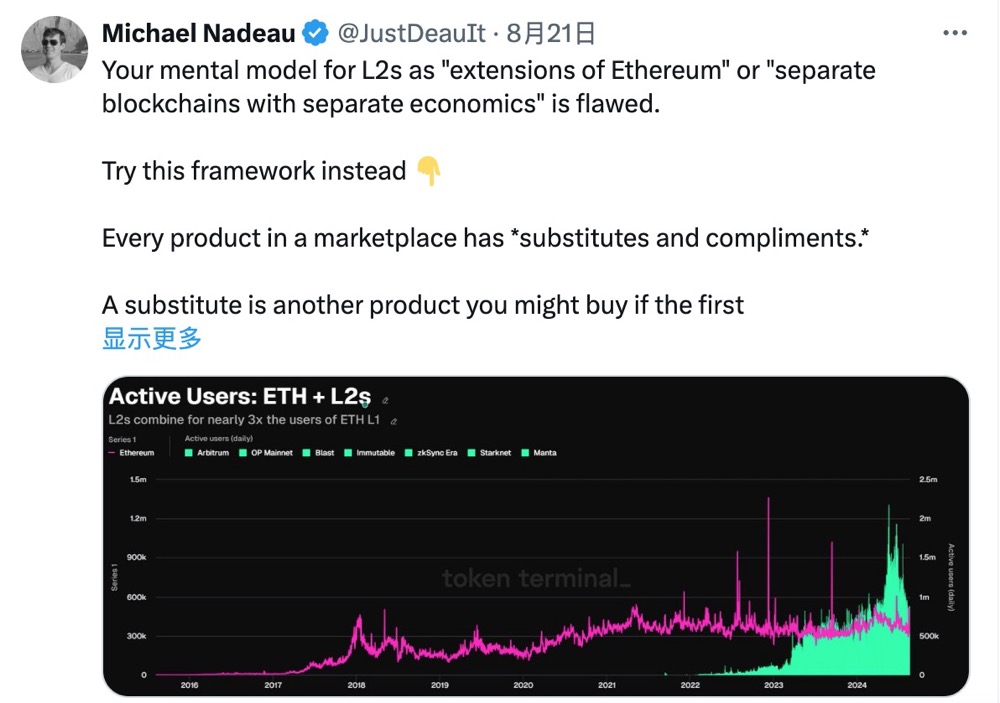
Additionally, Michael Nadeau, founder of The DeFi Report, used the economic concepts of "substitutes" and "complements" to illustrate the L2-Ethereum relationship. Michael explained that every product has substitutes and complements—for instance, chicken is a substitute for beef, while cars and gasoline are complements. All else equal, when the price of a complement drops, demand for the original product increases. Accordingly, L2s are complements to Ethereum—they increase demand for Ethereum (since their gas fees are paid in ETH) and cannot exist without it (relying on Ethereum for security). This means that as L2 costs decrease, demand for Ethereum (and ETH assets) should rise. Michael concluded, "In the long run, increased demand for ETH is what truly matters." Thus, developing L2s makes perfect sense.
Conclusion
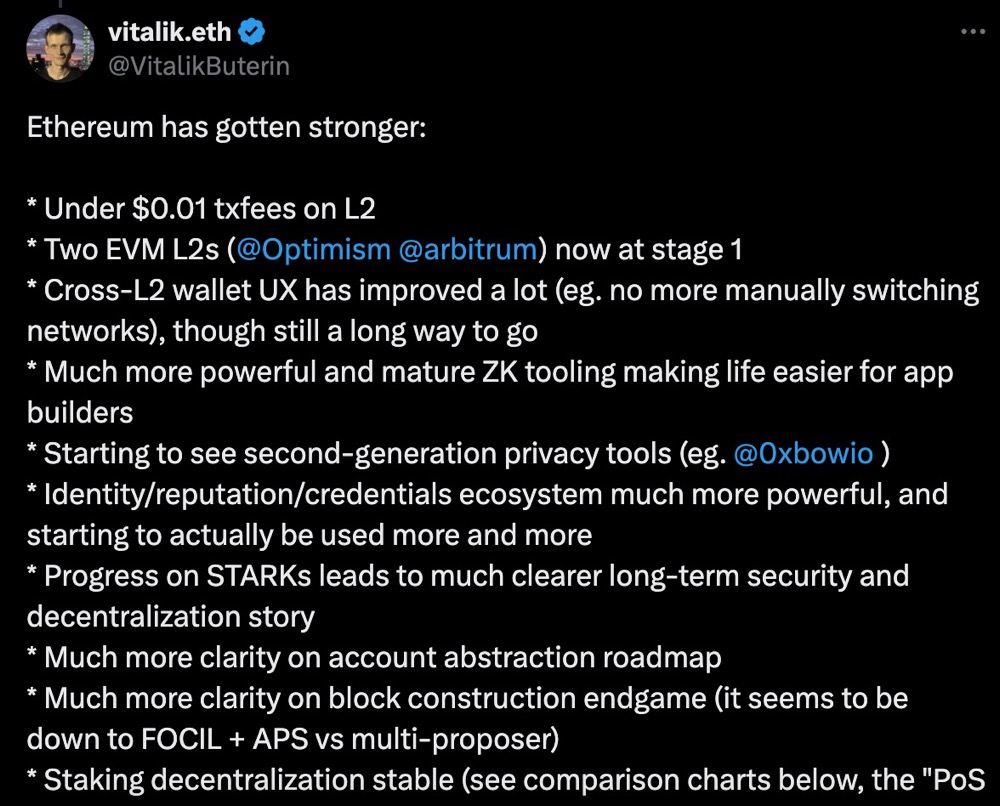
When it comes to whether Ethereum should currently focus more on L1 or L2 development, perhaps Vitalik’s recent high praise for Ethereum’s ecosystem progress already provides the answer. Indeed, the "Make Eth L1 Great Again" narrative might offer a psychological boost for Ethereum amid recent stagnation. But I believe L2 and L1 shouldn’t be framed as opposing forces. As Ethereum developer Ryan Berckmans questioned in response to David Hoffman’s argument: "While L2s don’t directly scale the L1, if we successfully move all low-value transactions to L2s, and L1 becomes cheap enough for the next thousand companies to issue tokens—were L2s really developed 'at the expense of L1 execution'?"
Will simply stirring conflict really make Ethereum great again? Or has Ethereum always been great—and never needed to be made great again?
Join TechFlow official community to stay tuned
Telegram:https://t.me/TechFlowDaily
X (Twitter):https://x.com/TechFlowPost
X (Twitter) EN:https://x.com/BlockFlow_News
 @News_Techub






