
The Most Profitable L2: Why Can Base Earn $180,000 Per Day?
TechFlow Selected TechFlow Selected
The Most Profitable L2: Why Can Base Earn $180,000 Per Day?
Priority fees are the primary source of Base's revenue, accounting for 86% of its total revenue.
 Navigating Web3 tides with focused insights
Author: Zack Pokorny
Translation: Luffy, Foresight News
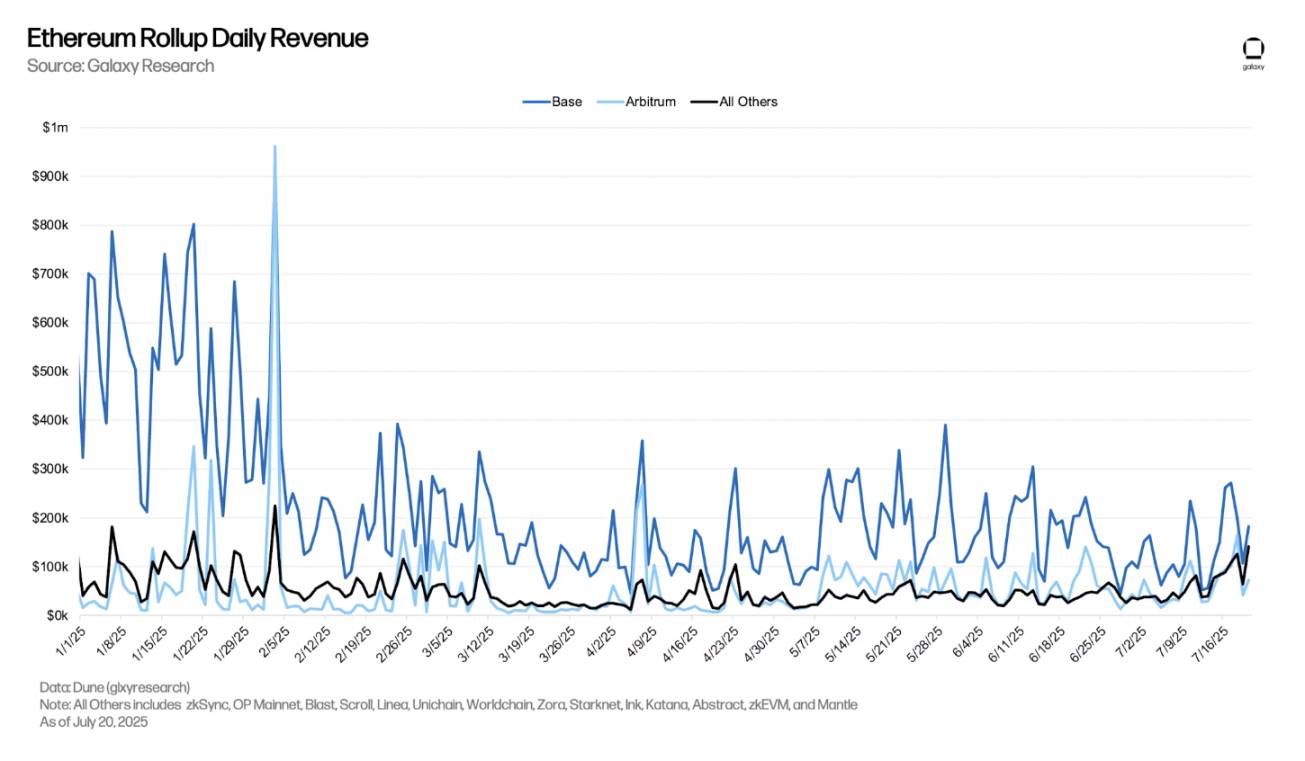
Base, developed by cryptocurrency exchange Coinbase, is the highest-earning platform among Ethereum Layer 2 (L2) networks, often generating more daily revenue than all other top Rollup projects combined. Over the past 180 days, Base's average daily revenue reached $185,291, far surpassing Arbitrum’s second-place $55,025.
Clearly, Base has become a consistently high-revenue platform—but what drives its economic activity? What advantages does Base possess over other leading L2s that enable it to generate such high value?
This report explores Base's fee structure and highlights the activities driving its revenue growth. We find that Base’s transaction ordering mechanism and decentralized exchange (DEX) activity are key drivers.
Base’s Transaction Ordering Mechanism
Transaction ordering on Base is determined by two variables:
-
Time of transaction submission (latency);
-
Fees paid by the sender relative to transaction complexity (economic incentive).
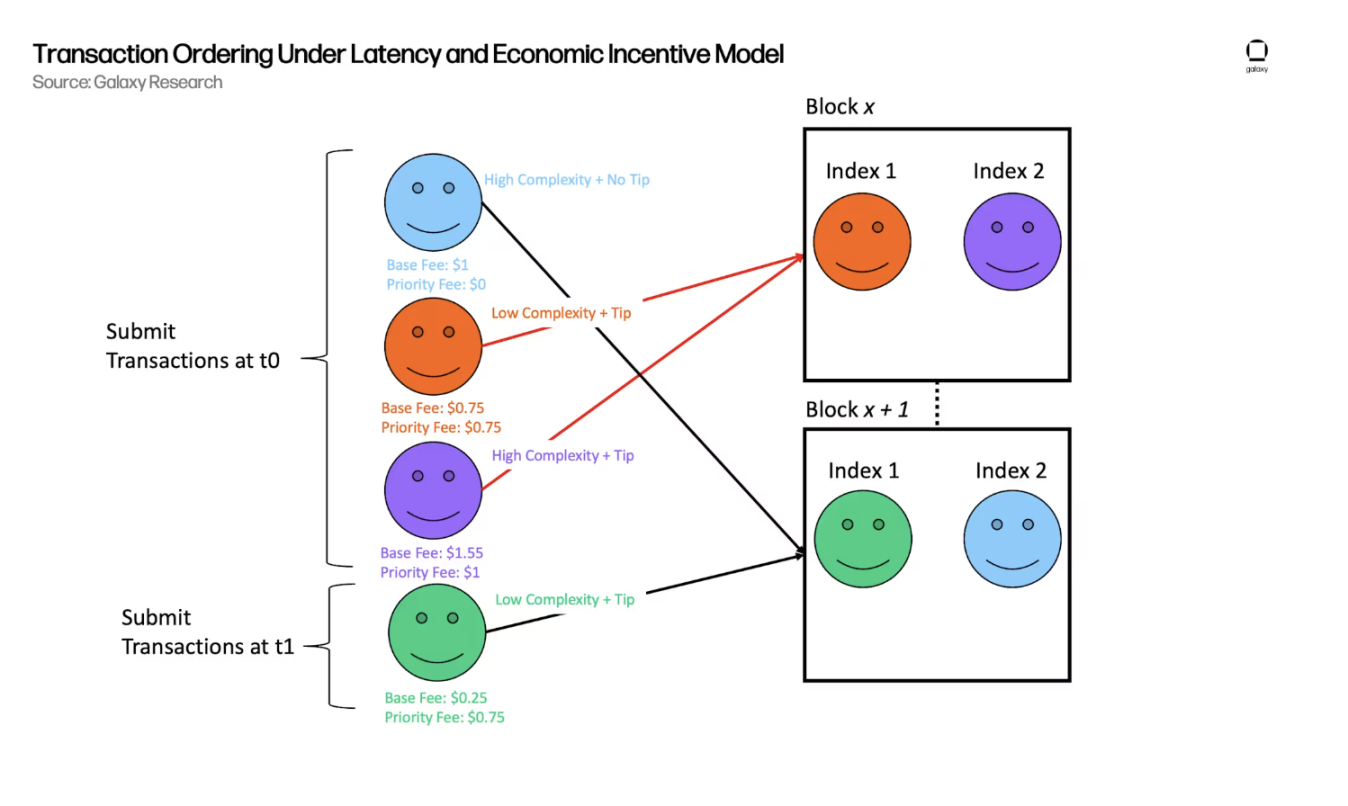
This mechanism resembles how logistics companies like UPS operate: packages are dispatched in user-submitted order, while senders can pay extra for "express" delivery to get faster service. The priority fee mechanism creates a dynamic auction market, consistent with Ethereum’s EIP-1559 fee model, balancing delivery time against economic incentives.
Specifically, transactions on Base include a “base fee” (lowercase “b”—do not confuse with the chain name) and a priority fee: all users must pay the base fee when submitting transactions, while the priority fee is optional and used only to accelerate execution.
But how does the sequencer decide which “express” transaction to prioritize? It does not consider total fees directly, but instead focuses on the bid per unit of Gas (required computational resources)—that is, the cost-effectiveness of the resources required versus the revenue generated.
Let’s use the logistics example again: suppose a delivery truck has limited space (similar to a block’s Gas limit), and the driver (the sequencer) wants to maximize tip income within that limited space. There are two packages:
-
A large package with a base shipping cost of $50 but only a $10 priority tip, taking up half the truck’s space;
-
A small package with a base cost of just $20 and the same $10 priority tip, occupying very little space.
Although the large package has a total fee $30 higher than the small one, the driver will still prioritize loading the smaller package because it offers better value per unit of space used.
Base’s sequencer follows the same logic, prioritizing transactions with the highest priority fee per unit of Gas, ensuring that blocks with the most expensive computation are also the most profitable. Therefore, when two users submit transactions simultaneously, regardless of complexity or total fee, the transaction with the higher priority fee per unit of Gas is more likely to be included earlier in the block.
The diagram below illustrates this process:
Why Does This Matter? How Is Base Different From Competing Chains?
Base’s EIP-1559-style fee model creates an ongoing public market auction for block space, allowing users to directly bid based on transaction urgency and profitability. As a result, although latency competition still plays a role, economic incentives allow the sequencer’s revenue to grow directly with demand for block space and the profitability of on-chain transactions.
This contrasts sharply with Arbitrum’s primary sequencing mechanism. Arbitrum uses a strict “first-come, first-served” (FCFS) model where users compete primarily on latency rather than economic cost. In this model, the main competition isn’t who pays more, since all users pay the same per-Gas fee and there is no priority fee system—instead, it’s about who can deliver their transaction to the sequencer fastest. This leads to a “latency race,” where professional participants invest in low-latency infrastructure to ensure their transactions are processed first. Under these conditions, Arbitrum’s fees grow only with overall demand and cannot effectively reflect the profitability or urgency of individual transactions.
In April 2025, Arbitrum launched Timeboost, aiming to create a more flexible FCFS system that allows the sequencer to earn revenue similar to priority fees. In practice, Timeboost adds an express lane for transaction execution on Arbitrum, where users can bid to use the lane for a limited time. Users entering the fast lane receive near-instant execution, while others continue under FCFS with only a 200ms delay added to compensate for the priority access. While Timeboost introduces a form of priority bidding, compared to Base’s priority fee model, its mechanism is more predictive than reactive. Bidders must forecast potential total earnings during a future time window and place bids based on estimates. This means Arbitrum receives a fixed fee from winning bidders regardless of actual earnings during that period. This proactive fixed-rate model is less effective than a reactive system—where users bid individually per transaction—at capturing the value of sudden high-profit opportunities.
How Much Revenue Does Base Generate?
Over the past 180 days, Base’s average daily revenue was $185,291. In comparison, Arbitrum averaged $55,025 per day, and the combined average daily revenue of 14 other Ethereum L2 networks was $46,742.
Year-to-date, Base has generated $33.4 million in total revenue, Arbitrum $9.9 million, and the other 14 L2s $8.4 million.
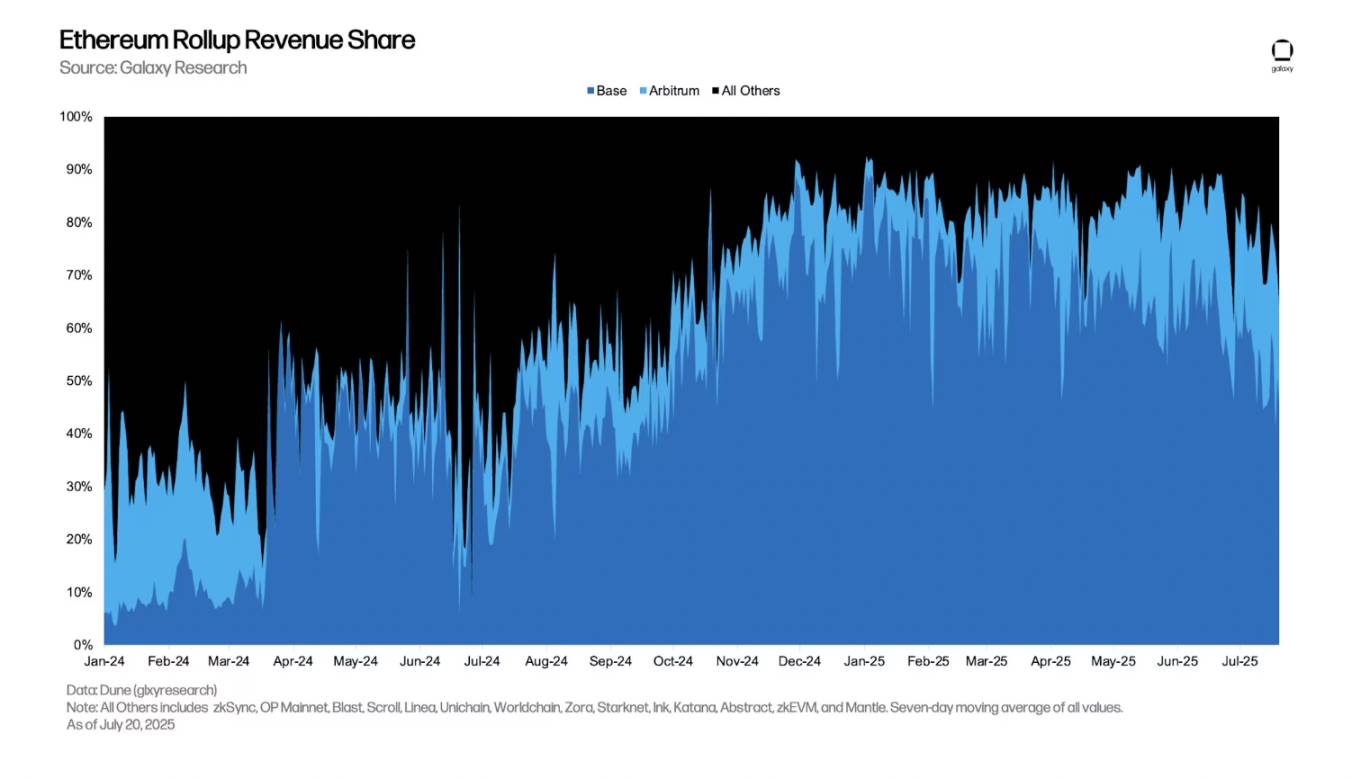
Relatively speaking, over the past 180 days, Base accounted for 64% of the total revenue across the top 15 Ethereum L2 networks ranked by total value secured. Its share has grown significantly over the past year, rising by 48 percentage points from a 7-day moving average daily share of 37% in July 2024. As of July 20, due to increased activity on other chains, Base’s share of Ethereum Rollup revenue had declined to 49.7%.
The Importance of Priority Fees
Transaction fees on Base consist of two main components plus an optional priority fee:
-
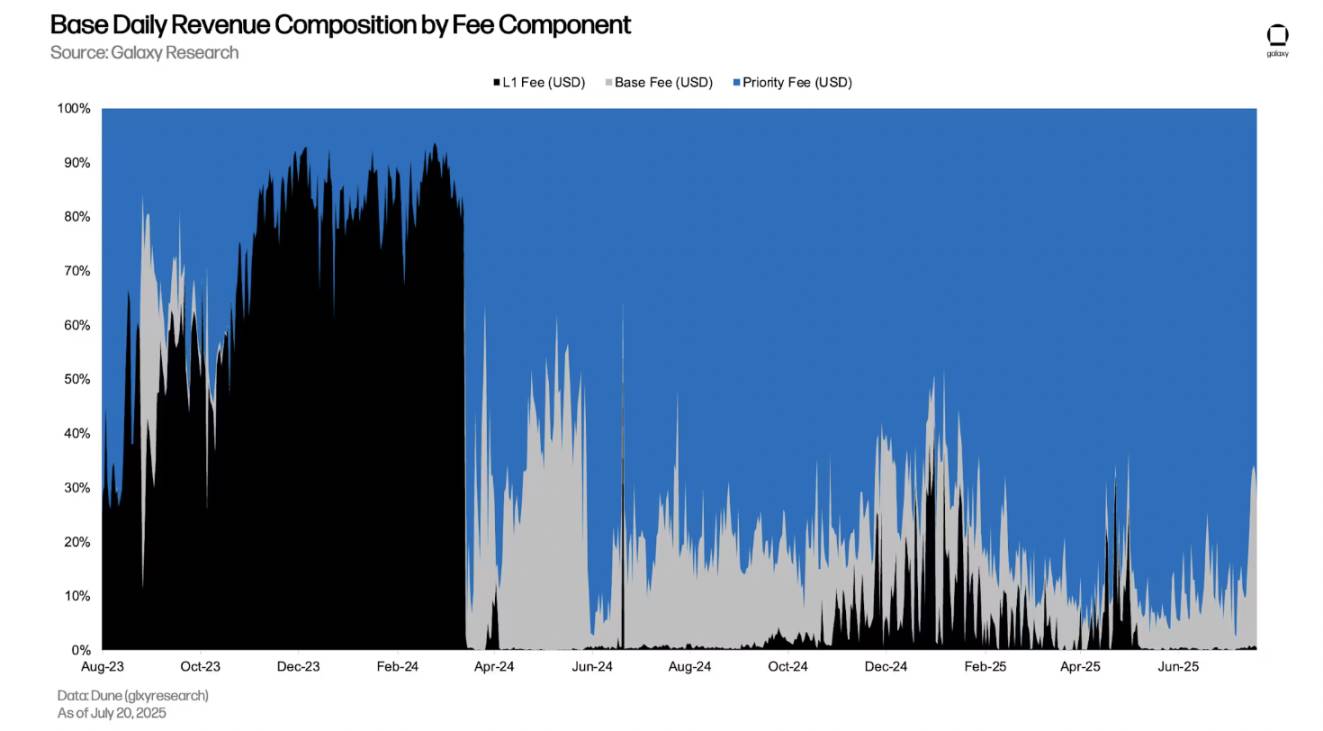
L1 Fees: Cover the cost of batching and submitting L2 transactions to the Ethereum mainnet. After Ethereum’s Pectra upgrade in March 2024 introduced “blobs” via EIP-4844, L1 fees for Base (and L2s generally) dropped significantly. Submitting batch data via blobs is far more economically efficient than using call data within L1 transactions.
-
Base Fee: A mandatory fee for executing transactions on Base. Set by the protocol and fluctuating based on the previous block’s space usage—the busier the network, the higher the base fee; otherwise, it decreases.
-
Priority Fee: An optional fee, also known as a “tip,” used to prioritize transaction execution. Priority fees help transactions secure earlier positions in a block or ensure inclusion in the current block rather than being delayed. A block can contain thousands of transactions executed in slot order. Typically, the first slot in a block holds the highest value, as transactions here execute first and are unaffected by later ones.
Priority fees are the primary source of Base’s revenue, driven by user bidding for accelerated execution. Over the past 180 days, Base’s average daily revenue from priority fees reached $156,138, accounting for 86.1% of its total daily revenue.
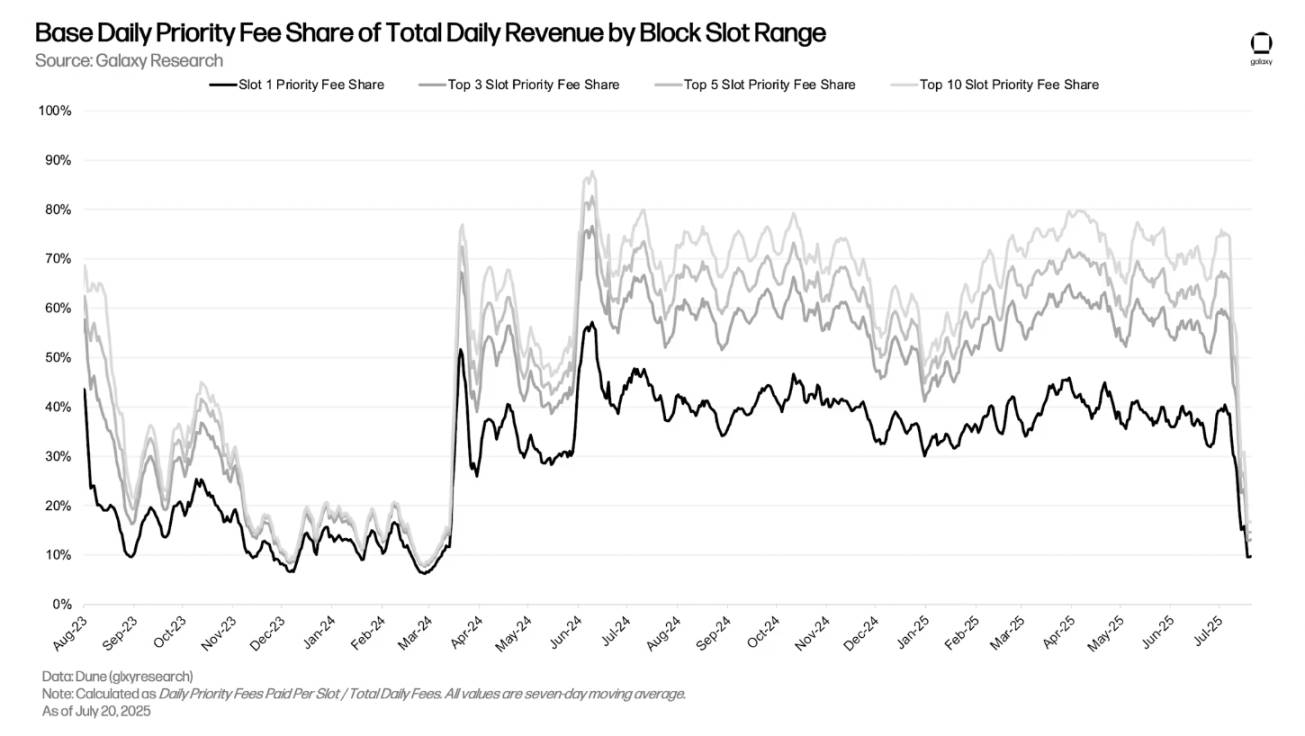
Specifically, priority fees from the top slots in Base blocks are major contributors to sequencer revenue, as users compete for positions near the block’s top. Since 2025, transactions in the very first slot alone have contributed 30% to 45% of daily revenue. Meanwhile, the top 10 slots per block have collectively contributed 50% to 80% of daily revenue. However, in the weeks after July 5, the share of top-slot priority fees in total daily revenue dropped significantly. This is due to two factors: 1) Increased traffic raised base fees, diluting the revenue share from priority fees; and 2) The implementation of “Flashblocks” on July 16 (explained in detail below) caused high-priority transactions to land in lower slots within confirmed blocks (but, as we’ll see, this isn’t necessarily negative).
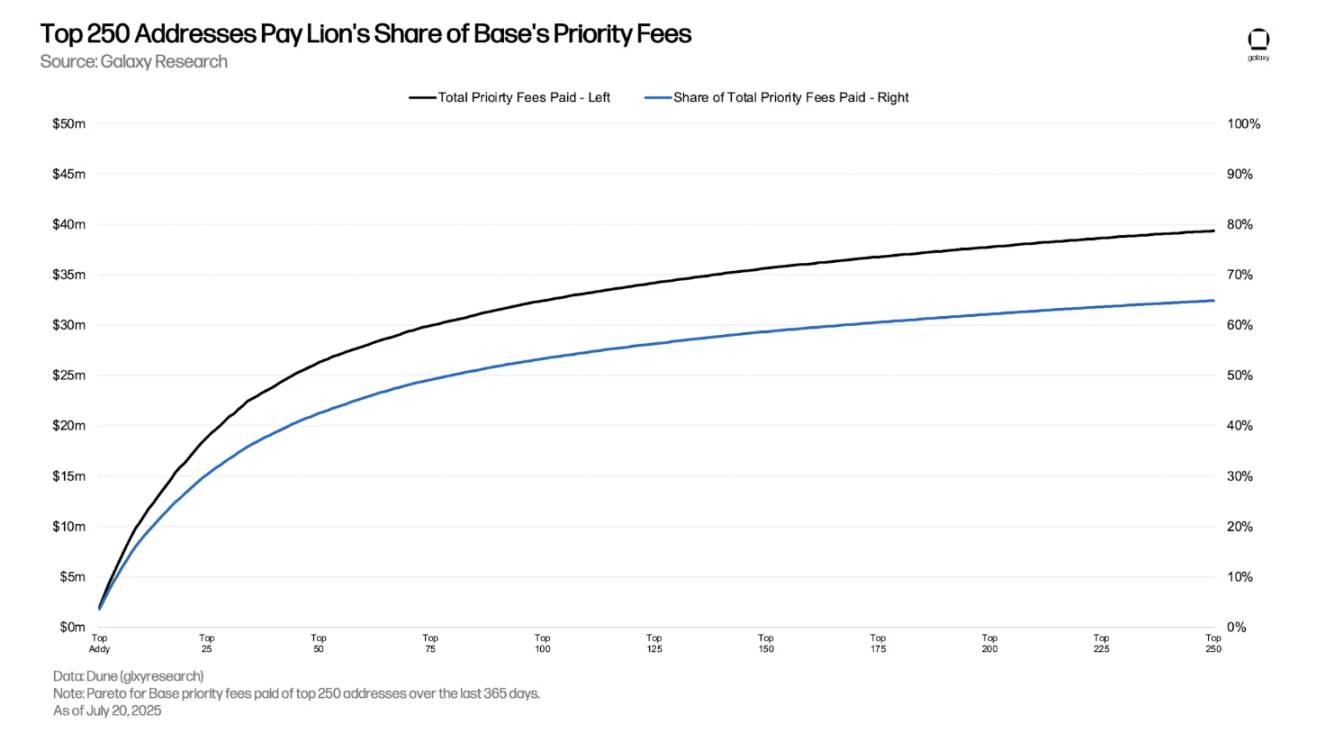
Priority fees come predominantly from a small number of addresses—over the past year, 64.9% of priority fees originated from just 250 addresses. The top address alone paid 3.6% of all priority fees during this period, equivalent to $1.99 million when valued at the ETH price at the time of payment.
What Are Flashblocks?
Developed by Flashbots, Flashblocks aims to improve transaction processing speed on Base. To achieve this, it introduces “sub-blocks”—high-confidence pre-confirmations of partial block segments created approximately every 200 milliseconds. For example, a block may consist of three distinct sub-segments, allowing users to receive pre-confirmation of their transactions before the full block is finalized on-chain at the standard 2-second interval. This enables end users to experience near-instant transaction finality even with unchanged block intervals, resulting in a smoother, more responsive user experience.
Why is this crucial for analyzing Base’s fee distribution by slot? Because from a transaction ordering perspective, each “sub-block” is effectively treated as a new block. Thus, a high-priority fee transaction might appear in a lower slot of the overall “confirmed block” but sit at the top of a “pre-confirmed sub-block.”
The diagram below shows the difference in priority fee distribution across the first 200 block slots before and after Flashblocks deployment. Black bars represent the share of priority fees per slot; blue lines show the cumulative share across all slots up to that point (Pareto distribution).
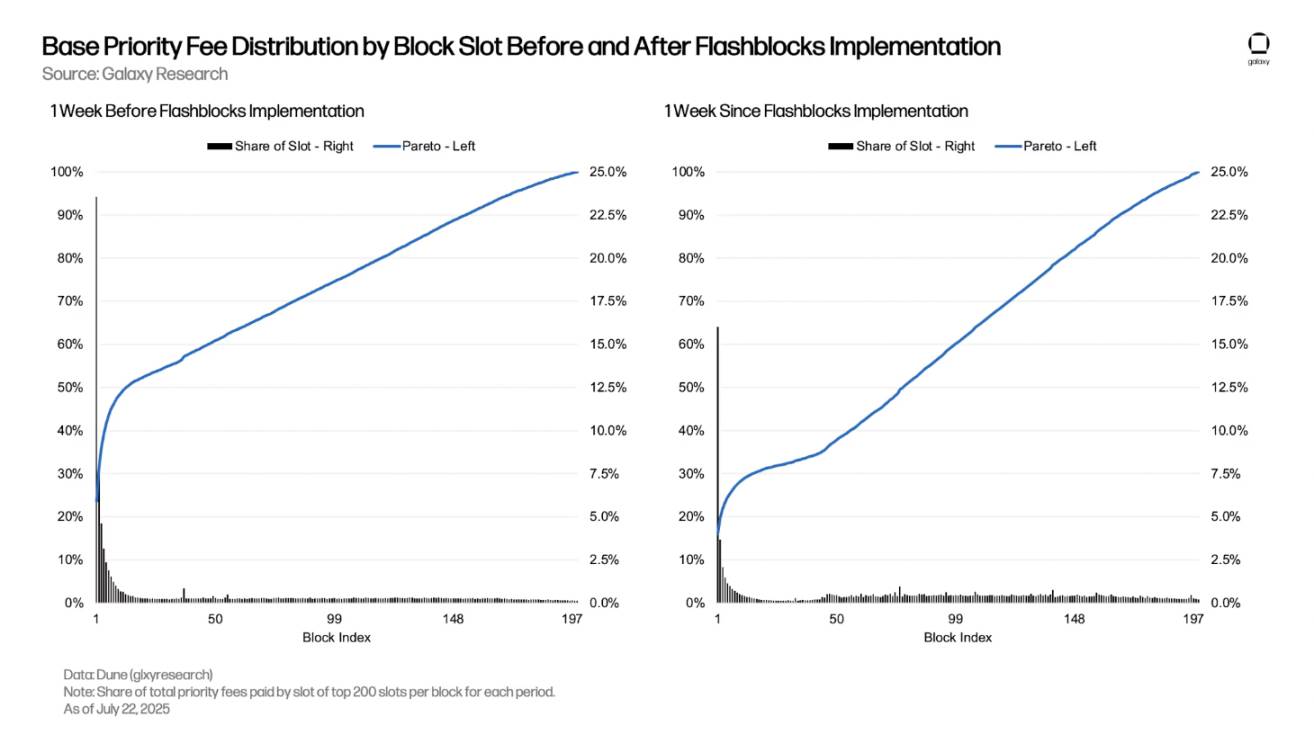
In the week before Flashblocks, the Pareto curve rose sharply within the first 10 slots, then grew linearly toward slot 200. By contrast, in the week after Flashblocks, the curve remained flatter at lower slots and only began rising steeply around slot 50 of each block—indicating that high-priority fee transactions are now landing in later slots of confirmed blocks.
Impact of DEX Trading
DEX activity on Base is highly active. Among all Ethereum L2 networks, Base has the highest daily DEX trading volume, accounting for 50% to 65% of L2 DEX volume, and holds the highest total value locked (TVL) in DEXs (excluding perpetual futures DEXs).
Vibrant DEX activity is a major reason why priority fees on Base remain high. Between 50% and 70% of the total fees collected daily by Base’s sequencer come from priority fees on DEX trades. However, since July 7, the share of DEX transaction fees in total daily fees has dropped from 67% to just 34%. This is due to two reasons: 1) Rising base fees diluted the proportion of priority fees; and 2) Increased on-chain competition for block space forced users to pay priority fees for non-DEX transactions.
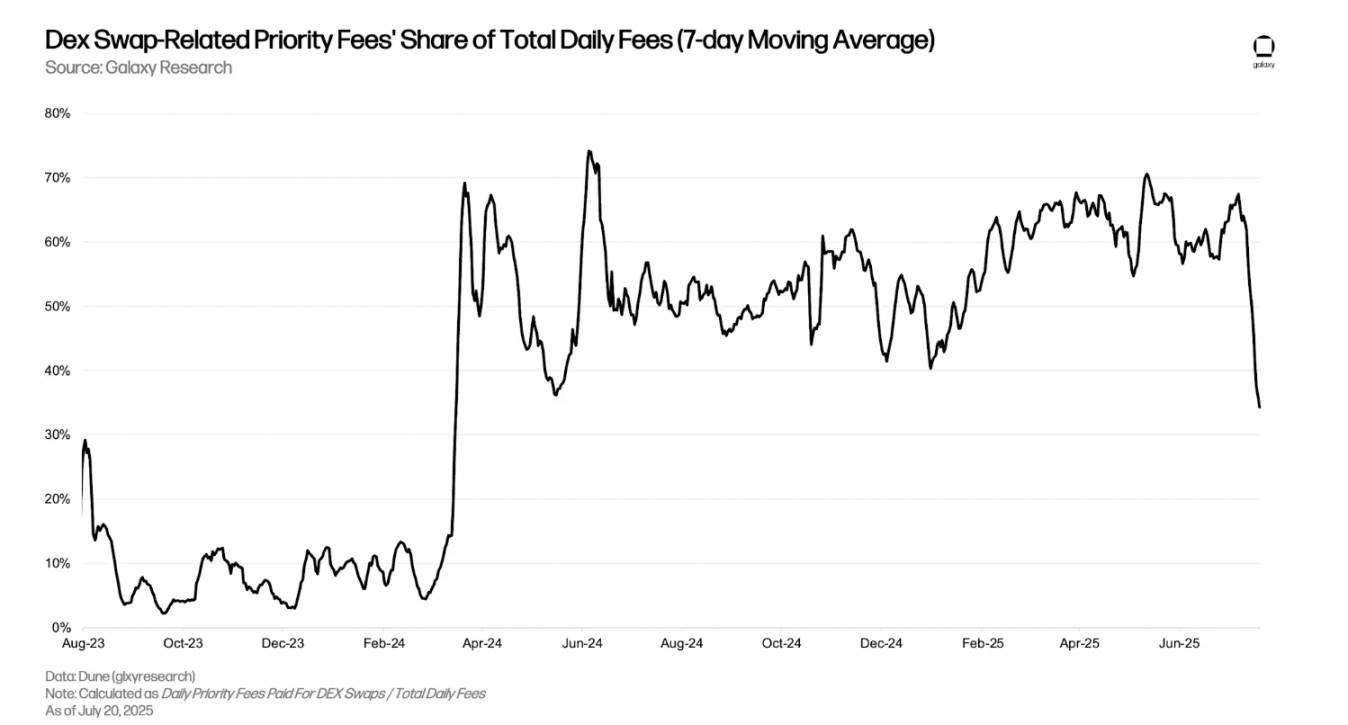
Since 2025, DEX trades in the very first slot have contributed 30% to 35% of daily priority fee revenue, while DEX trades in the top three slots have contributed 50% to 62% of total daily priority fees. Recently, the share of DEX priority fees in top slots has declined due to intensified overall on-chain competition increasing non-DEX priority fees, and the implementation of Flashblocks causing high-priority DEX trades to land in lower block slots.
Conclusion
Through our analysis of Base’s DeFi and revenue structure, we find:
-
Priority fees constitute the vast majority of revenue;
-
Over the past year, more than 60% of priority fees came from just 250 addresses;
-
High DEX trading volume and TVL;
-
Priority fees from DEX trades contribute nearly three-quarters of total priority fees.
These points indicate that maximum extractable value (MEV) transactions, especially competitive activities like DEX arbitrage, are significant sources of revenue for Base’s sequencer. The EIP-1559-style fee model adopted by the sequencer is the direct mechanism enabling this: it transforms block space competition from inefficient latency-based races into efficient economic auctions.
By charging priority fees to users willing to pay for urgent inclusion, this model allows the sequencer to capture and monetize the competitive value of block space more effectively than traditional “first-come, first-served” or purely latency-driven systems.
Join TechFlow official community to stay tuned
Telegram:https://t.me/TechFlowDaily
X (Twitter):https://x.com/TechFlowPost
X (Twitter) EN:https://x.com/BlockFlow_News
 @galaxyhq