








The Rise of Telegram: A Maverick Geek, Cryptocurrency, and the Fervent Dream of Freedom
TechFlow Selected TechFlow Selected
The Rise of Telegram: A Maverick Geek, Cryptocurrency, and the Fervent Dream of Freedom
Telegram founder Pavel Durov was arrested this morning and faces charges including terrorism, fraud, and money laundering, with Elon Musk and others expressing support for the Telegram founder.
 Navigating Web3 tides with focused insights
Written by: Mario Gabriele, The Generalist
Translated by: Dopamine Alien, RockFlow
As one of the world's most successful social media platforms, Telegram has the following core business characteristics:
Telegram is the fastest-growing app in the world. At least, in certain dimensions. A 2021 report showed that no mainstream app grew its monthly active users faster than social apps. Telegram now has approximately 600 million users.
It has built a strong reputation for security. Although Telegram does encrypt messages, most communications are not truly end-to-end encrypted or fully private. Yet, this hasn’t damaged the company’s narrative. It excels at counter positioning.
Crypto comes with risks. In 2018, an ICO (initial coin offering) injected $1.7 billion into Telegram’s treasury. Unfortunately, the U.S. Securities and Exchange Commission (SEC) deemed it an unregistered securities sale. This setback disrupted Telegram’s development timeline and led to unconventional financial arrangements.
Competitions are an effective hiring tool. Few companies seem to attract as many talented engineers as Telegram. Its success partly stems from its use of competition. The company frequently holds bounties to improve its product and hires the most talented participants.
It still hasn't found a business model. Telegram has supported payments since 2017 and recently experimented with ads. But neither has "taken off" yet. To reach profitability, Durov’s team may look to WeChat and other apps for inspiration.
Behind the business, Telegram’s origin story blends some of the world’s most thrilling and mysterious elements—rebellious tech prodigies, battles against state control, empires of wealth rising and collapsing, rebuilding abroad, cryptocurrency, and above all, Pavel Durov’s unwavering passion for freedom. This article provides a detailed account of Telegram’s fascinating journey—enjoy.
Table of Contents
1. The VK Story
- Chasing Facebook
- VK’s Rise
- Money Mania
- Game of Power
- April Fools’ Day
2. The Telegram Story
- At the Eye of the Storm
- The Art of Balance
- TON’s Troubles
- Uneasy Bonds
- New Heights
In October 2021, during Facebook and other major platforms' 24-hour outage, Telegram gained 70 million new users. Ubiquitous social media numbs us to such massive figures, but real-world comparisons help: this number exceeds the populations of South Africa, France, and Thailand; it’s just slightly less than two Canadas combined.
This shows Telegram is a globally scaled social app capable of sweeping through entire countries within a day.
The timing of this event is equally significant. On the morning of October 5, 2021, Facebook failed, and Instagram, Messenger, and Oculus all went offline for six hours. In search of connection, stimulation, or simply a better, more humane social platform, millions flocked to Telegram, founded by the charismatic Russian entrepreneur Pavel Durov.

Figure: Pavel Durov, the handsome soul of Telegram
Telegram feels like the antithesis of Facebook, thanks to its focus on security branding—though this also masks other advantages. Yes, Telegram has earned a reputation for privacy, but it’s also simply a better social platform. While it may still trail WhatsApp (~2 billion users) in active users (~600 million), it offers far more features.
Of course, Durov has faced setbacks. A botched initial coin offering (ICO) brought $1.7 billion in capital to fund the company’s blockchain ambitions, yet achieved nothing. Telegram argues the SEC is to blame for this failure. Only when questioned about its inability to build a viable business model does it turn inward. A decade later, profitability still seems distant.
The result is a complex, sometimes impractical company—excelling in product quality, thriving as a challenger in competitive environments. In chess, the “Russian Opening” is a sequence characterized partly by mirroring opponents and launching counterattacks. In many ways, Pavel Durov appears to follow a similar approach.
In this article, we’ll explore Telegram’s past and future, covering:
Founding VKontakte.
Before attempting to build a better WhatsApp, Pavel Durov created Russia’s version of Facebook. While Zuckerberg’s story is compelling, Durov’s is even more thrilling.
Creating Telegram.
After being ousted from his former company, Durov began building Telegram. To grow the app, he had to contend with FBI interference and SEC aggression.
Unconventional fundraising.
Durov adopted non-traditional methods to fund Telegram, avoiding venture capital. He paid much of the development cost himself and turned to ICOs and bond issuances.
Let’s begin.
01 The VK Story
Pavel Durov is the second son of Albina Durova and her husband Valery Semenovich Durov, a respected historian of Roman history. Though born in St. Petersburg, Pavel spent much of his childhood in Turin. The family only returned to Russia after Valery Semenovich Durov accepted the position of chair of the linguistics department at St. Petersburg University (SPbU).
Undoubtedly intelligent, Pavel was the less outstanding of the Durov brothers. Nikolai, four years older, displayed extraordinary mathematical talent from a young age.
Nikolai competed in the International Mathematical Olympiad during adolescence, winning several gold medals. He was also a gifted computer scientist who passed this interest to his younger brother, who showed talent in product-building. At age 11, Pavel created a derivative of Tetris. Later, he and Nikolai completed a strategy game set in ancient China called Lao Unit.
Pavel wasn’t an obedient student. The boy sitting in the front row to see the blackboard better earned good grades but often challenged teachers he deemed incompetent. He enjoyed showcasing his superior intellect, especially in computing. Once, he changed the school computer’s screensaver to a teacher’s photo captioned “Must die.” Despite repeated attempts to lock Pavel out of the system, he always seemed to find a way back in. This odd behavior wasn’t limited to teachers; one classmate said he could never tell whether Pavel was serious or mocking him when they spoke.
Despite his interest in programming, Pavel followed in his father’s footsteps when entering university. He not only enrolled at SPbU but also focused on linguistics. To meet Russia’s conscription requirements, he studied propaganda, Sun Tzu’s Art of War, and tactics Napoleon believed in. Over time, Pavel realized how much his country valued information control.
Beyond academics, Pavel pursued side ventures, including Durov.com. This initial blog platform evolved into a space where college students uploaded papers and exchanged ideas. Pavel used pseudonyms to argue multiple positions on the site, often posting deliberately provocative statements—such as praising Hitler. He later explained:
“Sometimes I had to stir things up. If users agree with you, you feel on top of the world, but they leave. If you argue with them, humiliate them, they come back to prove you wrong.”
Pavel’s deep understanding of online social dynamics attracted over 2.7 million visitors to the site. This not only gave his ideas wide reach but also reflected a strong demand for online socialization at the time. When this budding entrepreneur considered his next move, this insight proved invaluable.
Chasing Facebook
In 2006, Slava Mirilashvili logged onto a Russian news site and was surprised to see the face of his old classmate Pavel Durov. His friend was featured for creating a popular forum for university students. (For clarity, we refer to Slava Mirilashvili as “Slava” to distinguish him from his father, who is also part of the story.)
Slava had witnessed Facebook’s rise up close. Of course, the social network had been founded in Boston two years earlier. On Durov’s forum, he saw the potential for a social network targeting the Russian market.
Slava tracked down Durov’s address, and the two rekindled their friendship. Their conversation quickly turned to the potential of emerging social networks, and Lev Leviev, a McGill University graduate, soon joined them.
That summer, months after graduating from St. Petersburg University, Durov registered a domain: vkontakte.ru. As the story goes, Durov quickly came up with the name VKontakte—meaning “in contact.”
To launch their project, the trio needed funding. Fortunately, they had an immediate source: Slava’s father, Mikhail Mirilashvili. The Georgian built a dazzling empire spanning real estate, oil, media, and gambling. Mirilashvili owned Europe’s largest slot machine network.
At his son’s urging, Mirilashvili capitalized VK in exchange for 60% ownership. Although Durov held only 20% (the remaining 20% split between Slava and Lev Leviev), he retained majority voting rights, reflecting the startup’s reliance on his vision. (Other sources claim each of the three graduates received 20%, with Mikhail Mirilashvili holding 40%.)
With money in the bank, VK entered the social product race. Like Facebook, VK initially targeted university students, growing campus by campus via invitation. Durov also encouraged sign-ups through competitions: users were incentivized to register as many friends as possible. Top referrers won a new iPod. This single tactic helped VK acquire tens of thousands of early users.
Soon, VK’s user count surpassed six digits. Just six months after launching its beta, VK became Russia’s second-largest social network, with over 100,000 users. A little over a year later, VK surpassed Odnoklassniki, reaching 1 million users.
VK’s Ascent
The company’s success seemed to stem from a blend of product insight and technical excellence.
From the start, Durov demonstrated foresight and pragmatism regarding VK’s product. Early versions heavily borrowed from Facebook, mimicking the American company’s color palette and features. But VK quickly forged its own path. For example, Durov felt Facebook didn’t do enough to make profile pages the default user setting—a choice perhaps better suited to the Russian market at the time.
Additionally, VK supported uploading video and audio files, including many copyrighted ones. This drew regulatory scrutiny, with a Russian TV company even suing for infringement. But it enriched the product—VK became like a pirated Netflix or Spotify, with users spending hours weekly watching videos on the site.
One early VK employee noted that even as VK matured, Pavel maintained high standards for product features. “Pavel set very high standards…for code quality, for final product quality. You had to meet these standards by any means.” Even minor stylistic decisions were often submitted to the CEO as VK grew.
VK also excelled technically. As the company scaled, supporting surging user numbers became increasingly challenging, especially when the site became a hacker target. Fortunately, Durov had an ace: his brother Nikolai. After earning a PhD in mathematics from SPbU in 2005, Nikolai continued doctoral studies in computer science (and math) at the University of Bonn. He built a robust technical backbone capable of handling millions of users and repelling attackers.
Money Mania
However, even the Durov brothers’ exceptional technical skills couldn’t keep up with growth demands. VK commercialized relatively early, encouraging users to buy in-app currency, send premium SMS, and play games. Starting in 2008, the company also experimented with website ads, though Pavel preferred keeping ads minimal to avoid harming user experience. A former VK employee said, “Customer-first was priority number one, always.”
Growth brought revenue, but rising server needs meant increasing costs. VK’s new backer became Yuri Milner, founder of DST Global.
Initially, accepting Milner’s cash wasn’t hard for Durov’s team. The venture capitalist offered the most funding on the best terms while letting VK operate as it wished. But over time, DST’s Russian assets were bundled into the Mail.ru Group (MRG). By early 2011, MRG held 32.5% and had the option to acquire another 7.5%—but wanted more. Dmitry Grishin, one of Milner’s deputies and general manager, stated, “It’s strategically correct for us to control social networks, or even better, acquire all shares. We’re communicating on this.”
Communication didn’t last long. Reportedly, although Durov visited MRG’s office to discuss acquisition, he gave his final answer on social media: posting a photo of a middle finger, captioning it his “official” response to Grishin, calling MRG a “dumpster.”
Despite the strong language, they couldn’t stop MRG from exercising its option, raising its stake to 40% and valuing VK at $1.5 billion. By then, the social network had 125 million user accounts across Russia and former Soviet states.
Game of Power
VK’s influence granted it great power, which by late 2011 proved burdensome. In December 2011, protests erupted across Russia over unfair parliamentary elections. In response, the country’s security agency FSB pressured VK to shut down seven opposition groups’ accounts and deliver positive messaging to users. In reply, Durov posted a photo of a husky in a hoodie sticking out its tongue on Twitter. This was his way of telling the world—and VK users—he wouldn’t yield to government pressure.
Soon after, a special police unit visited his apartment, though Durov refused entry. Surrounded by police, he decided to call his brother to explain what happened. As he later said, this moment sparked another successful product idea for VK: “I realized I had no secure way to communicate with him. That’s how Telegram started.”
Notably, after the special unit withdrew, the clash with the Kremlin elevated Durov’s fame, boosting his public standing—at least temporarily.
Government pressure persisted into the next year, possibly prompting Nikolai to leave VK. Young Durov, squeezed by businessmen and bureaucrats and losing his closest ally, remained volatile.
In one famous incident, Durov threw money out of VK’s office window. Allegedly, he had given a large bonus to one of the company’s VPs. When the employee replied that mission mattered more than money, Durov challenged him to prove it, suggesting he throw rubles onto Nevsky Prospekt, St. Petersburg’s bustling street. Though the VP agreed, Durov thought his execution lacked flair, so he took over—making paper airplanes from 5,000-ruble bills and letting them drift down to the rapidly gathering crowd. Durov later called it “one of the most interesting moments in our company’s history.”
Meanwhile, MRG continued fighting for control. By late 2012, Alisher Usmanov, the billionaire funding many of Milner’s and MRG’s activities, stated “specific negotiations” were underway. Usmanov tolerated no refusal—the Uzbek was absurdly wealthy and seen as a Kremlin ally.
Pressure continued into 2013. VK was criticized by the Recording Industry Association of America (RIAA) for piracy, hindering its ability to file for a public listing on Western exchanges.
April 2013 marked Pavel Durov’s worst April. On April 4, Novaya Gazeta dropped a bombshell—the Russian newspaper reported Durov and VK hadn’t resisted FSB demands but actively cooperated with the government to suppress civic resistance. To support these claims, the journal published communications between VK’s then-spokesperson, Durov, and senior government officials.
According to Novaya, Durov outlined cooperation with the FSB to colleagues, stating he had handed over thousands of users’ data. After initially denying the reports, VK’s spokesperson eventually admitted to collaboration; Durov continued denying the accusations against him.
Though Durov often appeared idealistic, driven by liberal leanings, he was also pragmatic. Long-term, he may have decided some government cooperation was necessary to protect VK’s independence.
Around the same time, police investigated him for allegedly fleeing the scene after driving a white Mercedes over a traffic officer’s foot. Fearing political retaliation, Durov began fleeing—some believe he fled to Italy, Switzerland, or St. Kitts and Nevis. On April 16, investigators stormed VK’s office, tearing open filing cabinets.
Wherever Durov was, on April 17 he received a call asking if he could confirm United Capital Partners (UCP) had purchased 48% of VK? Though unaware, it was true. The Mirilashvilis and Leviev sold their stakes to UCP—a firm rumored to have government ties—for $1.12 billion. Many believed UCP couldn’t fund such a massive acquisition without influential backing. Given corporate law granting existing shareholders first right of refusal, the Kremlin seemed to have forced a partial acquisition—even MRG later called it UCP’s “suspicious scheme.”
Perhaps sensing his time at VK was ending, Durov, shortly after the special unit visited his apartment, began focusing on the side project he’d started with Nikolai: a free, secure messaging service called Telegram, using a paper airplane as its logo, which had already amassed a sizable user base. By October 2013, it had over 100,000 daily active users and certain features surpassed WhatsApp. Despite this appeal, the Durov brothers envisioned the project as non-profit, funded by their new holding company Digital Fortress.
April Fools’ Day
In January 2014, Pavel Durov sold his remaining VK shares to MegaFon CEO Ivan Tavrin. By then, Durov must have reconciled with Usmanov, who partially owned the mobile operator. Months later, Tavrin sold his acquired shares to MRG, giving the company control of VK. Ultimately, Russia’s internet giant seized the country’s largest social network.
Although Durov remained CEO, he began growing discontent with UCP and MRG. On April 1 that year, he announced his resignation via his VK account. Many thought it was a (rather strange) April Fools’ joke.
Was it a joke? Eight years later, we’re still unsure. On April 3, Durov returned to social media, posting a “doge” meme, saying it was a prank. On April 21, he was genuinely fired—this time because he mistakenly retracted his resignation. Underneath flowed UCP’s dissatisfaction with Durov’s involvement in Telegram, which they saw as a competing project, accusing him of using VK funds to support Telegram.
Regardless, by month’s end, Durov shared a final update: he would go full-time on Telegram, seeking a new home for his team. On a Facebook post, he wrote:
What country or city do you think is best for us? Feel free to comment below. To give you an idea of our preferences, we dislike bureaucracy, police states, big government, war, socialism, and overregulation. We love freedom, strong judicial systems, small government, free markets, neutrality, and civil rights.
02 The Telegram Story
The Telegram story mirrors VK’s in many ways. Though the social app reached great heights quickly, it stirred considerable controversy. Since the Durov brothers began working on the project in 2012, Telegram has approached 600 million monthly active users and was the fastest-growing app in 2021. Throughout, Durov had to fend off the FBI, confront the U.S. Securities and Exchange Commission, and even strike uneasy truces with Russia’s power brokers.
At the Eye of the Storm
When Pavel Durov left Russia, he wasn’t short on money. Later reports suggest he departed with around $300 million and 2,000 bitcoins. At today’s prices, that’s roughly $87 million. This gave him ample funds to finance Telegram’s development and invest in citizenship on the Caribbean island of St. Kitts and Nevis. Alongside his brother Nikolai, appointed CTO, Pavel began growing Telegram.
Not everyone believed in the project’s promise, as it seemed like a WhatsApp clone with little innovation. But even early on, Telegram distinguished itself by offering a smoother interface, faster interactions, and supposedly more secure communication. This promise attracted users, and the company gained 35 million users within months of launch. After Facebook acquired WhatsApp for $21.8 billion in early 2014, Telegram’s contrasting stance became stronger.
The Art of Balance
By 2016, the company had amassed 100 million monthly active users (MAUs) with “zero marketing budget.” Still, Telegram often found itself at the center of controversy. The app’s privacy-focused features attracted not only security-conscious users but also extremist groups wanting to stay under the radar. Telegram struggled to control jihadist groups using the app and sufficiently moderate illegal content. Dissidents and journalists working in oppressive regimes also benefited.
Government agencies also caused conflict. It’s believed Russian police once pressured mobile carriers to intercept Telegram messages. Meanwhile, Durov claimed the FBI tried to bribe him and his developers to create a backdoor. As he put it, U.S. intelligence officers offered one Telegram engineer “tens of thousands of dollars”—hardly tempting, given Durov claimed all developers were millionaires.
Despite these obstacles, Telegram continued growing. Often, it was propelled by Facebook’s missteps. Whenever Facebook faltered or faced scandals over user data abuse, millions migrated to Durov’s product. As noted, Telegram often acts as a disruptor to Facebook, thriving on the American giant’s bleeding. The same applies to other traditional social tools. For instance, criticisms of the Korean app KakaoTalk in 2014 and 2019 drove users to Durov’s Telegram.
As public opinion and media narratives turned against existing, ad-driven products, Telegram kept growing. Its only apparent issue seemed to be a minor one—money.
TON’s Troubles
By 2018, Telegram had nearly 200 million users but lacked a reliable monetization method. Though Durov seemed to view his creation as a public good, revenue couldn’t sustain it. Moreover, Durov’s windfall from VK wouldn’t last forever; reportedly, the company’s costs reached $70 million in 2017.
Though Durov was known for disliking ads on VK, he certainly knew it was the most effective way to profit from social networks. But this playbook seemed ill-suited for Telegram. With its focus on privacy and security, Telegram couldn’t pass data to advertisers without violating its core promises. Revenue had to come from elsewhere.
Durov, an early Bitcoin investor, turned to the crypto space. In January, Telegram announced plans to launch the “Telegram Open Network” (TON), a new blockchain to support an in-app ecosystem. Durov, ever boastful, claimed it would “far surpass” existing blockchains like Bitcoin or Ethereum.
TON aimed to support payments and purchases, including those from third-party developers. Telegram raised $1.2 billion via an initial coin offering (ICO) to fund development. Participants included royalty from Silicon Valley—Sequoia Capital, Benchmark, Kleiner Perkins, and Lightspeed.
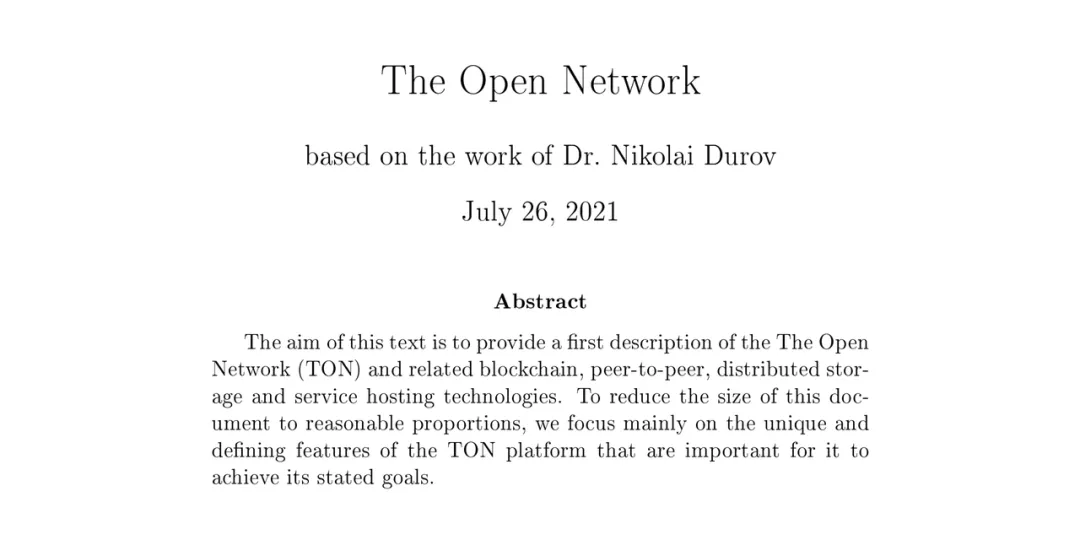
Figure: TON Project Whitepaper
At first glance, this was a masterstroke—a treasure chest of innovation based on bold ideas. Anton Rozenberg, a Telegram executive and former VK engineer, later noted:
Everything in this ICO seemed magical: Telegram managed to raise as much, or more, than the company’s valuation itself on a virtual project—with almost no commitments to investors and no equity loss.
One insider said Telegram’s foray into crypto prompted Facebook’s subsequent efforts. Like Libra (now Diem), Telegram’s attempt proved ill-fated. While core app growth snowballed, TON development stalled.
According to a former employee, Telegram told supporters that by September 2018, most initial construction was “90–95%” complete. A new year began, but TON remained unseen. In September 2019, Telegram released its experimental source code. In October, the SEC called.
The U.S. SEC determined the TON ICO sold unregulated securities, ordering the project to halt development. Stephanie Avakian, co-director of enforcement, said:
“Our emergency action aims to prevent Telegram from flooding the U.S. market with digital tokens we believe were illegally sold.”
TON’s launch was delayed again, then Durov surrendered. In May 2020, Telegram’s CEO announced he would abandon the project, blaming the SEC for TON’s death. The company had spent $405 million on development but never released a viable product. Frustrated, some investors considered lawsuits, claiming funds were misused and should’ve been allocated to Telegram, not the TON network.
Ultimately, Telegram returned 72% of funds to TON investors—$1.2 billion total. Many were frustrated not to receive Telegram equity. Non-U.S. investors could choose to convert refunds into loans, receiving 110% of their initial investment after a year, giving Durov breathing room to raise more funds. Telegram also paid the SEC an $18.5 million fine but did not “admit or deny the allegations.”
After separating from the project, Durov handed TON’s control to its “community.” Since the code was open-source, anyone could continue building on its architecture. Several derivatives emerged, including “Free TON” and “Toncoin.” The latter established itself as the spiritual successor and gained Durov’s endorsement by late 2021. Two independent developers now run the project. Development appears sporadic based on retrospective data. Still, the spin-off trades at a $4.4 billion market cap, $18.2 billion fully diluted. Free Ton has rebranded as Everscale and uses a different programming language from the original TON code.
When I asked a current Telegram employee about their view on TON, they noted it disrupted core product development and caused friction. They also conveyed the company’s separation from TON’s future. Despite Durov’s bold attempt, TON ultimately failed to solve monetization and capitalization. He adopted another unconventional approach.
Uneasy Bonds
By April 30, 2021, Telegram owed $700 million. By then, loans offered to ICO investors who chose Telegram’s offer would mature. Again, Telegram faced a funding crunch, and Durov admitted it needed “a few hundred million dollars annually” to operate.
With over 500 million active users, Telegram had no shortage of admirers. Reports indicated Western VCs proposed buying 5–10% stakes at $30 billion valuations; others estimated values closer to $40 billion.
But building VK taught Durov the dangers of bringing in outside investors. Having once been shuffled out of the CEO role, he wouldn’t let it happen again.
Instead of selling equity, Durov turned to debt. Last March, Telegram issued $1 billion in bonds at 7–8% annual interest. More importantly, if Telegram IPOs within three years of issuance, buyers can convert bonds to equity at a 10% discount to the public price. If it takes longer to go public, the discount steepens to 15–20%.
Buyers included Abu Dhabi’s sovereign wealth fund Mubadala Investment. As part of the deal, Durov committed to expanding Telegram’s regional presence, expected to open another office in the UAE.
Surprisingly, Mubadala’s bond purchase involved the Russian Direct Investment Fund (RDIF). In a secondary transaction, the Abu Dhabi firm reportedly sold $2 million in bonds to RDIF. Mubadala called the trade part of a joint venture between sovereign wealth funds. Given Durov’s tense relationship with his homeland’s authorities, Telegram expressed displeasure to a spokesperson:
“The Russian Direct Investment Fund is not on our list of investors to whom we sold bonds. We are not open to any transactions with that fund.”
Nevertheless, RDIF now has the right to obtain equity at below-Telegram’s potential IPO price. Though this may anger Durov, the fund’s participation also suggests, in some ways, Telegram’s CEO has won. Almost since the app’s inception, Russian authorities sought to control it. When Durov failed to meet their demands, the Kremlin banned the app for nearly two years before conceding in 2020. RDIF’s involvement in the bond sale signals the country sees Telegram as too big to ban.
Join TechFlow official community to stay tuned
Telegram:https://t.me/TechFlowDaily
X (Twitter):https://x.com/TechFlowPost
X (Twitter) EN:https://x.com/BlockFlow_News


