In-Depth Analysis of the Ronin Ecosystem Map and the Impact of DPoS Migration
TechFlow Selected TechFlow Selected
In-Depth Analysis of the Ronin Ecosystem Map and the Impact of DPoS Migration
Ronin has processed over $4.3 billion in NFT trading volume, with a long-term goal of becoming the primary hub for on-chain gaming.
 Navigating Web3 tides with focused insights
Authors: Armita & Benjamin Samahon
Translation: Mars Finance, Eason
Summary
-
Ronin is an EVM-compatible Layer-1 blockchain optimized for NFTs and gaming. The network aims to build a fully community-owned and community-supported Play-to-Earn (P2E) gaming ecosystem.
-
Ronin has strong appeal among both Web2 and Web3 gamers. As of this writing, it reached a peak of 1.6 million daily active addresses (DAA) in 2024. Notable games driving this trend include Pixels, Apeiron, and Axie Infinity Universe—the most popular NFT game by trading volume.
-
After the bridge hack in March 2022, Ronin migrated to a Delegated Proof-of-Stake (DPoS) consensus mechanism. Sky Mavis, the game studio behind Ronin, also expanded the number of validators from 9 to 24 and onboarded independent corporate operators.
-
Sky Mavis partnered with the popular Ragnarok game IP and 0x& to bring Ragnarok: Monster World into its ecosystem in Q3 2024.
-
Sky Mavis plans to integrate zero-knowledge Ethereum Virtual Machine (zkEVM), enabling games to permissionlessly launch and operate their own Layer-2 chains on the Ronin network using Polygon CDK.
Introduction to the Ronin Blockchain
Gaming on the Ethereum network faces several limitations. As the number of users on the network steadily grows, so do transaction volumes and gas fees. Increased competition for block space leads to network congestion. High gas prices and scalability issues make on-chain gaming transactions economically unfeasible, undermining player acquisition and retention.
The Ronin blockchain was specifically designed to solve these scalability challenges and facilitate the onboarding of hundreds of millions of future gamers onto blockchain-based platforms. Initially developed in 2021 by game studio Sky Mavis for the popular P2E game Axie Infinity, Ronin is now an EVM-compatible Layer-1 (L1) blockchain optimized for gaming and NFTs.
Currently, the most popular game on Ronin by daily active wallets (DAW) is Pixels, a free-to-play farming simulator. The game migrated from Polygon to Ronin in October 2023. To date, Ronin has processed over $11.4 billion in decentralized exchange (DEX) trading volume on Katana and more than $4.3 billion in NFT trading volume.
Ronin’s Evolution
Ronin's story begins with the rise of the popular P2E Web3 game Axie Infinity. Axie Infinity founders Trung Nguyen, Aleksander Leonard Larsen, and Jeffrey Zirlin met while playing Cryptokitties, one of the earliest games to use blockchain technology. The trio saw an opportunity to apply this innovation to address a fundamental issue in traditional gaming: economic value created by players is primarily retained by platform owners rather than the players themselves.
To tackle this problem, they founded game studio Sky Mavis in 2018 and developed Axie Infinity—a game where players can own and benefit from in-game assets. Their first major step was the April 2018 presale of Axie NFTs, allowing players to adopt Axies and receive custom rewards upon the official launch of Axie Infinity. This laid the foundation for the Ronin ecosystem, where player ownership is central.
As Axie Infinity grew in popularity, the team launched Axie Infinity’s native token AXS on Binance in November 2020. Originally issued as an ERC-20 token on Ethereum, AXS provides governance, staking, in-game functionality, and a share of the game economy. However, as the game gained traction on Ethereum, users began experiencing poor performance due to high gas fees and network congestion. The Axie Infinity founders created Ronin to resolve timing, scalability, and user experience issues on the Ethereum network.
Sky Mavis launched the network’s testnet on December 23, 2020, and the mainnet on February 1, 2021. In April 2021, Axie Infinity officially migrated from Ethereum to the Ronin Layer-1 blockchain. Following the transition, the AXS staking program launched in September 2021, allowing Axie Infinity players to earn rewards and participate in game governance. This empowered players to own and influence the direction of the game, creating a platform that transfers value from platform owners to players. At its peak, Axie Infinity had over 1 million on-chain and 2 million off-chain daily active players.
Despite a strong start, on March 29, 2022, the Ronin Bridge was hacked, resulting in the theft of 173,600 ETH and 25.5 million USDC—worth over $600 million at the time. The breach was only discovered a week later when a user attempted to withdraw 5,000 ETH but found it impossible.
The hacker exploited a vulnerability in the network, gaining control of private keys for four Sky Mavis validator nodes and the Axie DAO node. This access was enabled by a backdoor bug in the no-gas RPC node, which allowed the attacker to obtain signatures from the Axie DAO validator. The backdoor existed because the Axie DAO validator had previously been whitelisted to conduct free transactions during periods of high network activity. Although this whitelist was deactivated in December 2021, the Axie DAO validator’s IP address remained on the allowlist, allowing the hacker entry. With only nine validator nodes running at the time, the hacker—reportedly North Korea’s Lazarus Group—gained control of the majority of nodes and executed fraudulent withdrawals.
Binance recovered $5.8 million linked to the hack, and Chainalysis recovered $30 million. In June 2024, Norway’s Financial Crime Authority, Økokrim, announced the return of another $5.7 million and froze $40 million stolen in the attack.
Since the bridge hack, Ronin has enhanced decentralization by migrating to DPoS, forming strategic partnerships with independent enterprises to operate validators, and introducing rotating validators. Ronin has also welcomed new Web2 and Web3 games and studios, expanding the ecosystem beyond the core Axie Infinity franchise. As a result, the network has made a dramatic comeback in 2024, boasting a broader collection of games than ever before.
Technology Behind Ronin
Ronin initially used a Byzantine Fault Tolerant (BFT) Proof-of-Authority (PoA) consensus mechanism, where Sky Mavis designated a limited number of validators. This small validator set enabled faster transaction validation and higher throughput. However, it came with a significant drawback: the system placed high trust in the validator set, creating a single point of failure if validators colluded maliciously.
Therefore, in 2023, Ronin adopted Delegated Proof-of-Stake (DPoS) under BFT. This consensus mechanism allows anyone to register as a validator candidate, requiring a minimum stake of 250,000 RON (with bridge operators required to stake an additional 100 RON), valued at approximately $390,000 at the time of writing. Under DPoS, validator candidates compete to receive delegated RON from token holders. Every day at UTC 00:00, the top 10 candidates with the highest combined stake and delegation are selected as standard validators and contribute to consensus.
Standard validators validate transactions, generate new blocks, and earn operator rewards. These rewards are paid in RON tokens drawn from the “Rewards” allocation (25% of total token supply) and transaction fees included in each block. Delegators receive a portion of these rewards, minus a commission rate of 5% to 20%, which goes to the standard validator.
In addition to the 10 standard validators, Ronin has 12 governing validators contributing to consensus. These are selected through on-chain governance and operated by trusted independent enterprises, including notable ones such as Google Cloud, Nansen, Dapp Radar, and Stablenode. Token holders can still delegate their RON to governing validators to earn rewards, though this does not affect validator selection.
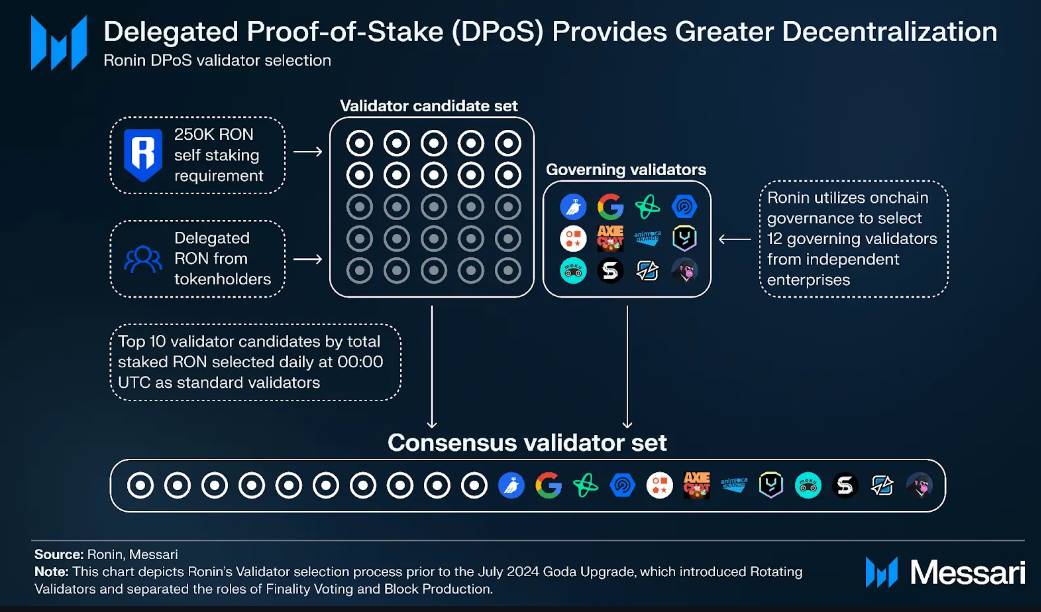
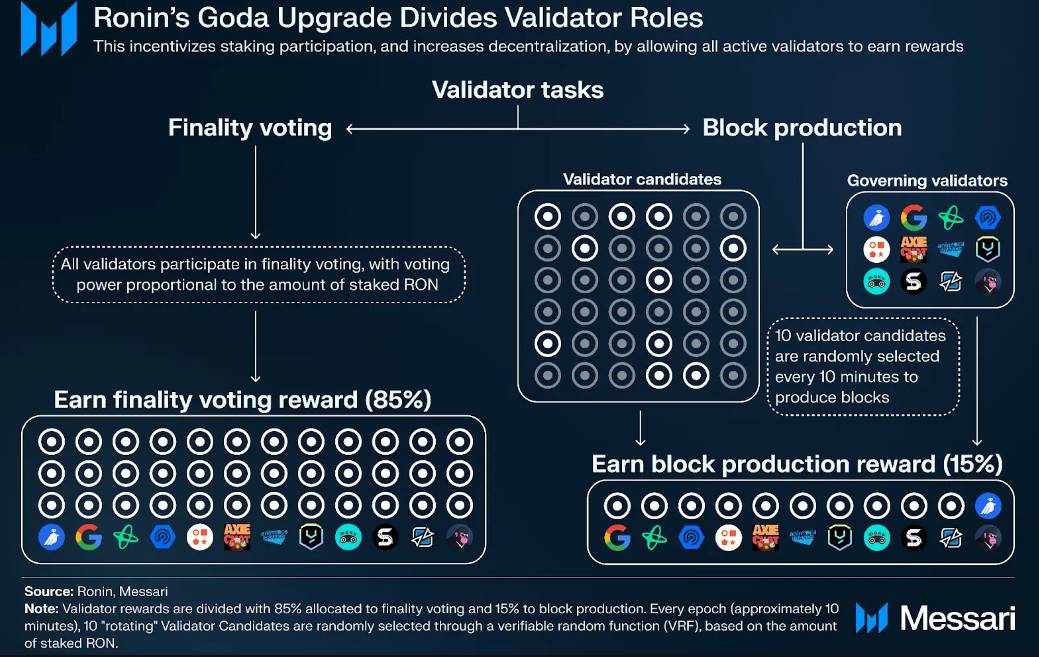
In July 2024, Ronin launched the Goda upgrade to enable all active validators to contribute to consensus and earn rewards. Under the previous DPoS version, only the top 10 validator candidates could contribute to consensus and earn rewards, incentivizing token holders to delegate RON to these top candidates to continue earning. This led to reduced delegation to other validators and discouraged new candidates due to high staking requirements. Thus, the prior DPoS model centralized the network by concentrating delegated RON among the top 10 candidates.
The Goda upgrade resolves this by separating final voting and block production tasks. All validators participate in final voting, earning 85% of the rewards, with voting power proportional to the amount of staked RON. For block production, Ronin introduced rotating validators who earn the remaining 15% of rewards. Each epoch (approximately 10 minutes), 10 validator candidates are randomly selected to produce blocks. This selection uses a Verifiable Random Function (VRF) that considers each candidate’s total RON. The 12 governing validators also produce blocks but do not rotate.
Misbehaving validators and bridge operators face penalties depending on the severity of misconduct. If a validator misbehaves and is penalized, delegators will not receive rewards that day, though their staked tokens remain unaffected. This promotes responsible network participation.
For double-signing validators, the validator will be jailed for 2^63 -1 blocks and barred from becoming a validator in the future. During jail time, the validator earns no commissions or staking rewards. Additionally, the validator will be slashed based on the minimum self-staked RON amount.
For unavailable validators, slashing penalties are tiered:
-
For Level 1 slashing penalty, if a validator misses more than 100 blocks in a day, they will not receive commissions or staking rewards.
-
For Level 2 validator penalty, if a validator misses more than 500 blocks in a day, they will not receive commissions or staking rewards that day. In addition, they will be slashed 1,000 self-staked RON and jailed for 57,600 blocks (about 2 days), during which they are prohibited from joining the validator set.
-
For Level 3 validator slashing penalty, if a validator misses more than 100 blocks on the same day, they will be slashed 1,000 self-staked RON. Additionally, they will be jailed for 57,600 blocks (about 2 days), have their post-release rewards canceled, and cannot unbond.
Similarly, for non-functional bridge operators, slashing penalties are tiered based on severity:
-
For Level 1 operator slashing penalty, if a bridge operator misses more than 10% of votes in a day, they will not receive bridge rewards.
-
For Level 2 operator slashing penalty, if a bridge operator misses more than 30% of votes in a day, they will not receive any rewards that day.
Each validator must also run a bridge. Standard validators use the Ronin Bridge to confirm deposits and withdrawals of tokens between Ronin and other EVM-compatible networks. The Ronin network also includes non-validator nodes and archive nodes. Non-validator nodes are full nodes that do not participate in consensus but stay synchronized with the ledger state and monitor the network. Applications use these nodes to query the blockchain, send transactions, and execute smart contracts. Archive nodes store more information than full nodes and retain all historical data from the blockchain. The corresponding data is significantly more intensive than what validators and non-validator nodes store, primarily serving tools like block explorers, wallet providers, and blockchain analytics.
Tokenomics
RON Overview
Ronin’s native token RON is used for security and Sybil resistance (staking by validators and delegators), and resource consumption (transaction fees and smart contract execution). The fixed total supply is 1 billion RON.
Initial Distribution
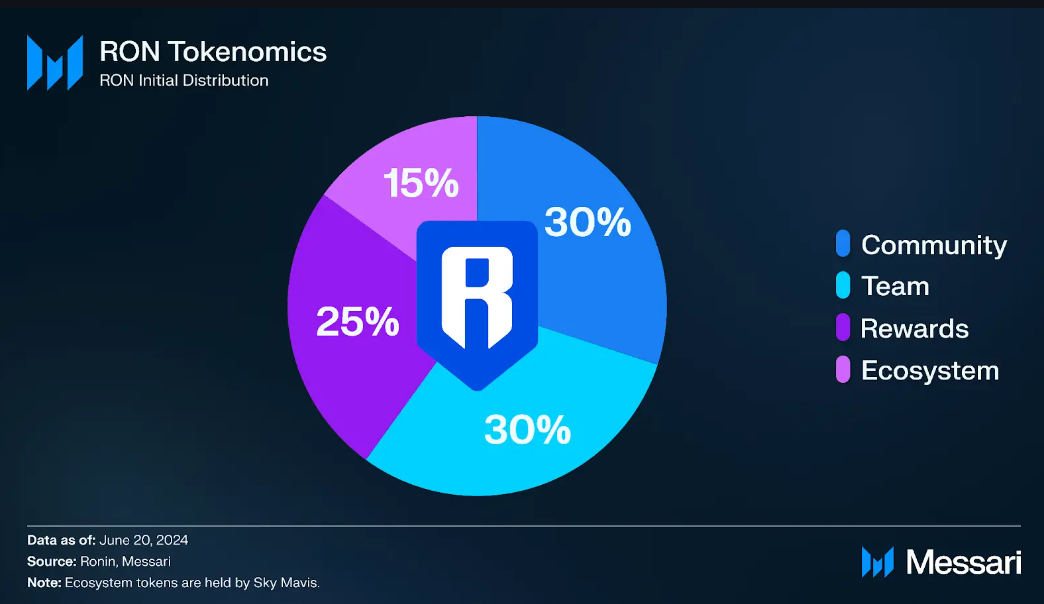
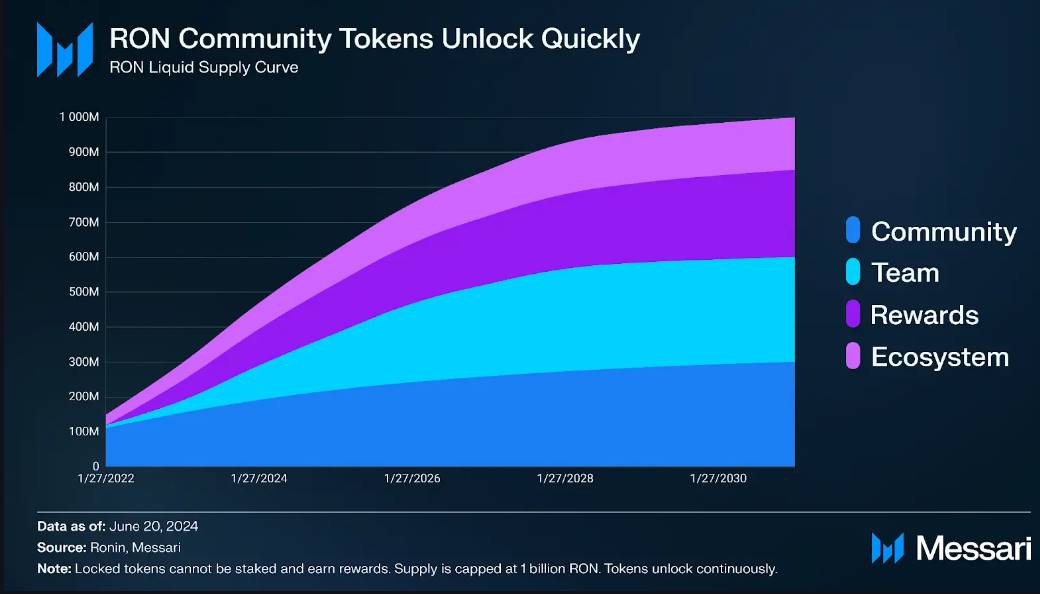
The initial token supply is divided into four main allocations: 30% to community, 30% to team, 25% to staking rewards, and 15% to ecosystem fund. RON tokens are continuously unlocked over time rather than released per block. Unlocking began on January 27, 2022, and the maximum supply would be fully unlocked after 108 months or 9 years if all scheduled unlocks were distributed.
RON serves several key utility functions within the Ronin ecosystem:
-
Medium of Exchange: RON is the payment currency for games, dApps, and NFT markets on Ronin and is paired with every token on the native DEX Katana.
-
Gas Fees: RON is used to pay for transactions on Ronin.
-
Staking: Users can stake or delegate RON to validators to participate in the DPoS consensus mechanism and earn rewards. These rewards come from the “Rewards” allocation (25% of token supply) and transaction fees. Since the Goda upgrade, 85% of these rewards go to all validators participating in final voting, and 15% go to validators selected each epoch for block production. Delegators receive all rewards minus a 5%-20% commission retained by validators. As of June 20, 2024, these rewards are paid in RON with annual yields ranging between 10% and 13%.
-
Game Revenue and Payments: Game studios on Ronin often integrate RON into their games as a primary revenue stream, including in-game purchases, actions, and NFT minting.
-
Special Incentives: RON token holders and stakers receive airdrops, whitelist opportunities, and allocations in token launches on projects built on Ronin.
In the future, RON token holders will be able to directly participate in governance and decide how Ronin’s treasury is used. However, this functionality is not yet live. The treasury accumulates 0.5% fees from swap transactions on Katana and NFT sales on Mavis Market, aimed at supporting the broader ecosystem’s growth. Currently, only governance and standard validators vote on proposals on behalf of RON delegators.
Network Activity
Usage
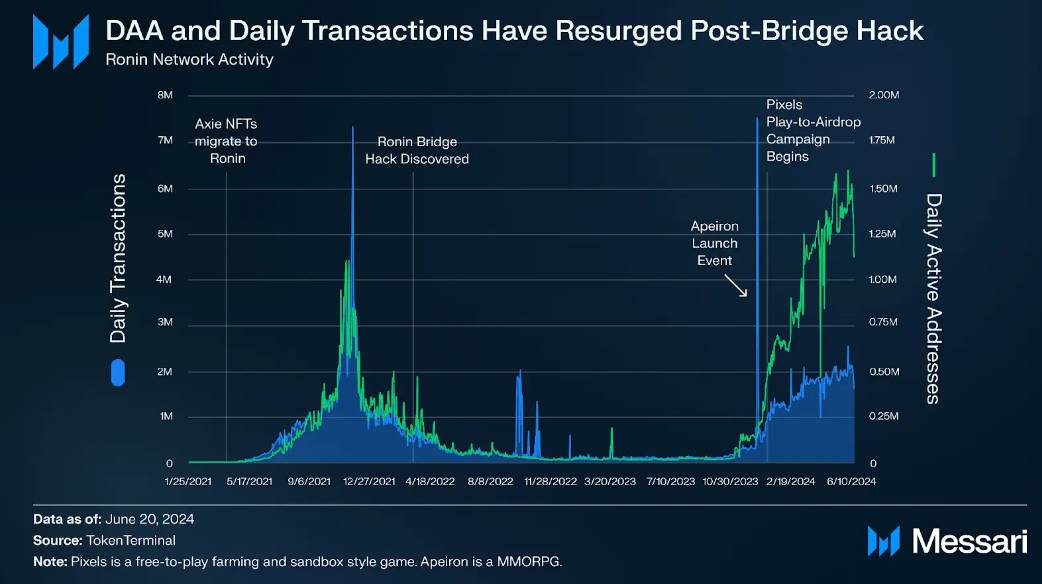
Network activity surged when Axie Infinity announced on April 28, 2021, that it would migrate its NFTs to Ronin. At the time, Ronin had only 361 daily active addresses (DAA) and 10,600 daily transactions. Two months later, on June 28, 2021, these metrics jumped to 32,800 DAA and 256,900 daily transactions—an increase of 8,986% and 2,324%, respectively. From there, Ronin continued growing, peaking at 1.1 million DAA and 7.3 million daily transactions in November 2021.
The influx of new players began straining the network, prompting Sky Mavis to whitelist Axie DAO to validate transactions—a decision that ultimately led to the March 2022 hack. Overfarming and rebalancing of in-game items caused the Axie Infinity craze to decline in 2022, reducing the game’s profitability. The Ronin bridge hack in March 2022 further cemented this downturn. Consequently, activity on Ronin declined sharply throughout 2022, falling from 311,200 DAA and 972,000 daily transactions on January 1, 2022, to just 10,300 DAA and 57,200 daily transactions on January 1, 2023.
However, network activity began rebounding at the end of 2023 and early 2024, driven by key partnerships from Sky Mavis, including new games like Apeiron and Pixels. Daily transaction volume on Ronin surged from 370,000 on December 17, 2023, to 7.5 million on December 18, 2023, following Apeiron’s migration and release. Apeiron is a unique game blending simulation, real-time strategy, and action RPG elements. Players take on the role of gods managing a planet, nurturing its inhabitants (called Doods), and engaging in battles—all while owning and trading in-game NFT assets. Apeiron welcomed players to Ronin through a formal launch event featuring daily login rewards, NFT mints, and gameplay demos.
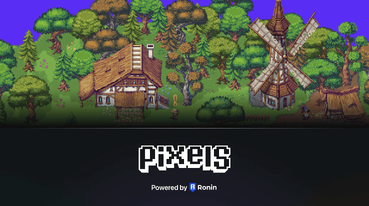
Pixels is another game that migrated from Polygon to Ronin in October 2023. Pixels is a massively multiplayer online (MMO) game integrating farming, exploration, and community building into an open-world experience. The game supports NFT Farm Land and Pixel Pet NFTs on both Mavis Market and OpenSea. In January 2024, Pixels launched Season 2 of its Play-to-Airdrop campaign for its in-game token PIXEL. Players complete tasks to earn badges and climb leaderboards. Top-ranked players in the token generation event will receive a reward of 250 million PIXEL.
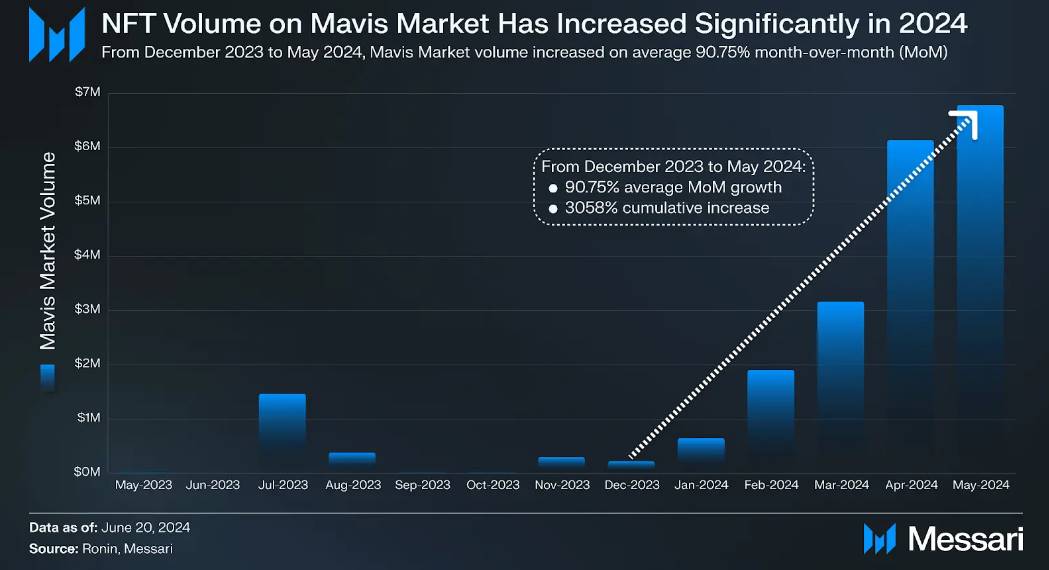
Ronin’s recovery in 2024 is evident in the substantial increase in NFT trading volume on Sky Mavis’ official NFT marketplace, Mavis Market. NFT trading volume on Mavis Market rose from $215,000 in December 2023 to $6.775 million in May 2024, averaging a 90.75% month-on-month growth and a cumulative increase of 3,058% over the period.
Security and Decentralization
Prior to the Goda upgrade, Ronin had 22 active validators; with the implementation of rotating validators, this number has increased to 24. The Nakamoto coefficient measures the degree of decentralization in a proof-of-stake network. It represents the minimum number of independent entities controlling more than one-third of the network’s staked native asset. Ronin’s Nakamoto coefficient is 7, indicating it is more decentralized than other PoS networks such as MultiversX (6), Polygon (4), and Ethereum (1).
A total of 209 million RON (worth $490 million as of June 20, 2024) is co-staked, representing 62.3% of the circulating supply. Locked tokens cannot be staked or earn rewards.
Ecosystem
Gaming and NFTs
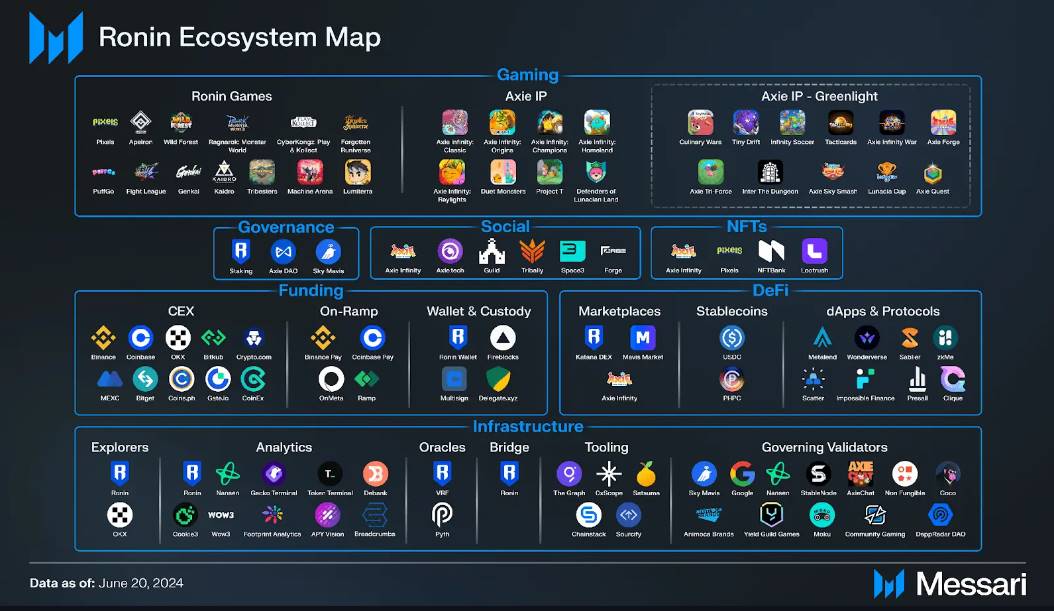
Ronin’s gaming ecosystem emphasizes player ownership. Therefore, NFTs are a crucial component of this mission. Mavis Market is Sky Mavis’ official marketplace for trading NFT collections beyond the Axie IP. The most popular collections on Mavis Market include CyberKongz Genkai and Apeiron Planets, with cumulative trading volumes of 1.1 million and 865,000 RON, respectively.
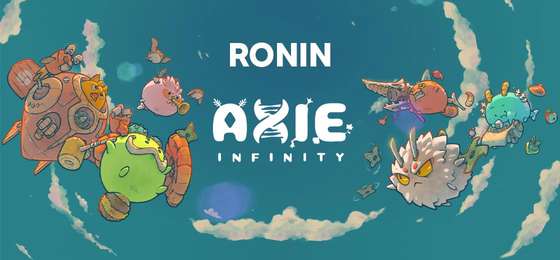
Axie Infinity remains the highest-volume NFT collection on Ronin, with a cumulative trading volume of $4.3 billion. However, it trades on the Axie Marketplace, not Mavis Market. Apeiron and Spark Suits Edition 01 (from the game Kaidro) rank among the top three highest-volume series on Ronin, though their cumulative volumes of $3.2 million and $2.7 million, respectively, fall far behind.
The Ronin ecosystem currently consists of 12 games on the Mavis Hub platform, the official application providing access to all Sky Mavis games. It features early-stage games supported by Sky Mavis and community-created games. In August 2023, Axie Infinity launched Mavis Hub Greenlight, a new home for game developers to directly share early versions of their Axie-related games with players via the Mavis Hub desktop app. Players can vote for their favorite early games and provide feedback to builders aiming to officially launch their products. This expands upon the original Axie Builder’s Program launched in April 2022, where community developers could apply for funding and support for games related to the Axie Infinity franchise. The latest game launched on Mavis Hub Greenlight is Axie Forge, released in June 2024. Axie Forge is a casual idle sports game inspired by Axie IP, where players train their Axies through mini-games to level them up.
Ronin hosts a range of additional games beyond the Sky Mavis platform. Notable titles include Pixels and Ragnarok: Monster World, expected to launch in Q3 2024.
Game developers wishing to launch on Ronin must first undergo a rigorous review process by Sky Mavis before deployment. This ensures tight integration with the ecosystem and prevents spam. By choosing to build on Ronin, developers gain access to the full suite of Solidity development tools enabled by EVM compatibility, such as Remix, Truffle, and Hardhat. Additionally, developers can access Sky Mavis’ SDKs and APIs for seamless integration with current Ronin products and services, including the Ronin Wallet, Ronin Name Service, application tracking, and Ronin JSON-RPC nodes. The Ronin Developer Console serves as the central hub for accessing Ronin documentation and APIs.
Several of Ronin’s most critical developer primitives are designed to support growth and help projects raise funds to build their gaming ecosystems. Supported by Impossible Finance, the Ronin Launchpad enables studios to publicly sell various assets. In March 2024, the popular Ronin game Apeiron successfully launched its APRS token via the platform, raising over $3 million from more than 11,500 participants. The Mavis Store is Sky Mavis’ official marketplace for purchasing in-game currency and assets. Game developers can integrate with the app to instantly access its large user base and simplify complex asset listings. Several games currently use the platform to support in-game purchases, including Axie Quest, Wild Forest, and Ragnarok: Monster World. A notable recent collection launched on the platform is Moki Genesis. Participants could mint an egg to hatch a Moki character. All 8,888 NFTs sold out in approximately two hours.
DeFi
Decentralized finance on Ronin primarily consists of critical infrastructure supporting on-chain gaming and NFT applications. One of the most important protocols is Katana, Ronin’s native DEX. The platform offers three services: liquidity provision, analytics monitoring, and swapping.
-
Liquidity Provision: Users can deposit into liquidity pools to provide trading liquidity. Depositors receive LP tokens and earn rewards generated from trading fees. As of June 20, 2024, the USDC-RON and AXS-RON liquidity pools offer the highest APRs at 33.68% and 43.49%, respectively. The WETH-RON and USDC-RON pools generate the most LP fees.
-
Analytics Monitoring: Users can monitor analytics on the Katana dashboard.
-
Swapping: Users can swap supported ERC-20 tokens such as Ronin (RON), Aprerios (APRS), Pixel (PIXEL), Axie Infinity Shard (AXS), Smooth Love Potion (SLP), and Yield Guild Games Token (YGG).
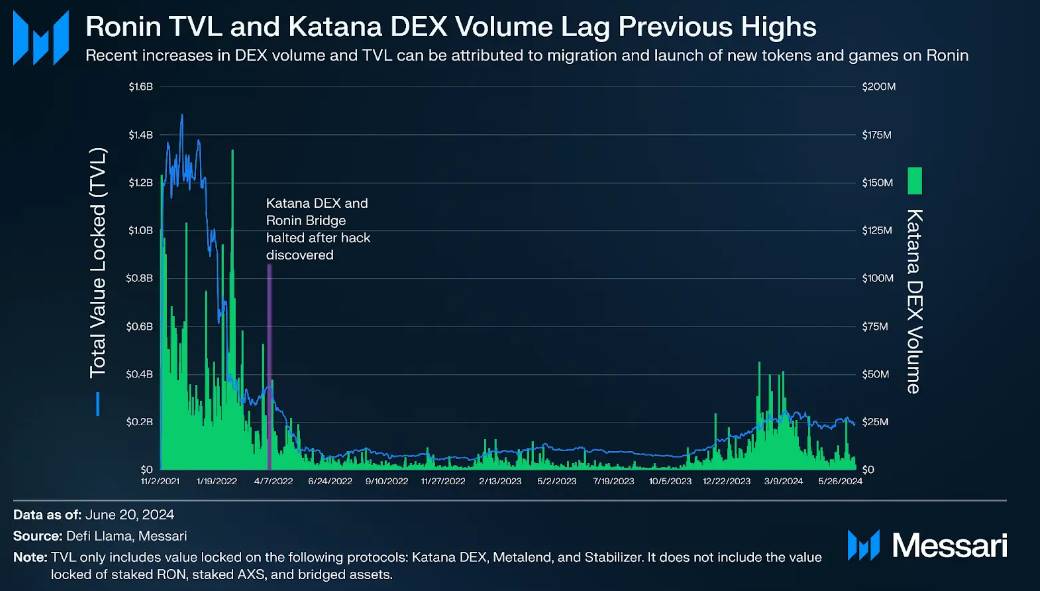
Katana’s TVL peaked at $1.49 billion on December 4, 2021, and DEX trading volume hit a record high of $175.77 million on February 10, 2022—coinciding with the peak of Axie Infinity, when AXS and SLP were highly traded assets. After the bridge hack, Katana’s TVL dropped sharply. On May 12, 2022, TVL fell below $100 million and remained below that level until briefly surpassing it on April 14, 2023. On December 4, 2023, Katana’s TVL once again exceeded $100 million and has stayed above that threshold since. Recent growth in TVL and DEX volume is largely due to the introduction of new tokens on Katana. By 2024, Ronin had doubled the number of supported assets on Katana to 12 by adding PIXEL, BANANA, YGG, APRS, ANIMA, and PHPC.
A significant new addition to Katana is the Philippine Peso Stablecoin (PHPC). Backed by centralized crypto exchange (CEX) Coins.ph and fully collateralized by cash and cash equivalents in Philippine bank accounts, the new stablecoin has received approval from the Bangko Sentral ng Pilipinas (BSP) for an exclusive pilot on Ronin. PHPC is also supported under BSP’s regulatory sandbox framework. This marks a major milestone for Ronin, making on-chain gaming more accessible to players in the Philippines and across the Asia-Pacific region.
Another key DeFi protocol on Ronin is MetaLend. MetaLend enables borrowers to take out overcollateralized loans using yield-generating assets without giving up custody. This is achieved through MetaLend’s valuation engine, which continuously recalculates asset values to ensure compliance with the protocol’s risk parameters. Borrowers provide collateral such as staked AXS, staked RON, and Axie Land NFTs. Lenders stake WETH, RON, or USDC in the protocol’s lending pool and receive receipt tokens to track their deposits and earned interest. As of June 20, 2024, lenders earn APRs ranging from 1.4% to 12.1%.
Borrowers pay a 1% fee on earnings from staked AXS and staked RON, with interest compounded daily. Borrowers can withdraw up to 30% and 50% of the current value of supported NFTs and tokens, respectively. Loans on MetaLend have no fixed repayment deadline. However, if collateral value drops or interest accrues beyond the maximum LTV, the protocol will liquidate assets to repay the loan.
Additionally, if a borrower exceeds their borrowing limit, MetaLend will list their collateral for sale at a 10% liquidation discount, allowing liquidators to repay up to 10% of the loan. Any surplus from selling larger assets (minus gas fees) is returned to the borrower. This liquidation strategy helps MetaLend mitigate risks during market downturns. As of June 20, 2024, MetaLend’s TVL stands at $1.37 million.
Roadmap
Technical Improvements
In recent months, Ronin has undergone significant technical improvements. In May 2024, Ronin partnered with zkMe to integrate its identity oracle into the chain, enabling novel privacy and security solutions. zkMe uses zero-knowledge proofs to verify user credentials without processing personal information. This collaboration will give game builders on Ronin the option to integrate authentication and KYC elements to help prevent fraud and prioritize user data protection.
In June 2024, Ronin announced plans to enable the zero-knowledge Ethereum Virtual Machine (zkEVM) on-chain by Q1 2025. This move will allow builders and game developers to permissionlessly deploy their Layer-2 chains on the Ronin network using Polygon CDK. This increases transaction volume and improves incentive alignment for RON token holders and the broader Ronin ecosystem. Just as the original Ronin chain was created to scale Axie Infinity, this upgrade will enable game-specific chains to be built atop Ronin.
For L2s launching on Ronin, meeting the 250,000 RON staking requirement to operate a validator node will intensify competition among delegators. As L2 sequencer fees accumulate in validators' hands, staking rewards will also increase. Thus, greater competition will lead to higher network decentralization.
On June 25, 2024, Ronin announced plans on its blog to implement the Goda upgrade, completed in July 2024. The upgrade includes the Trippp and Aaron hard forks, aimed at further enhancing Ronin’s decentralization.
The Trippp hard fork implements Rotating Validators (REP-0010), separating block production and final voting tasks to allow all validators to earn rewards. Starting July 3, 10 validators are randomly selected every epoch (10 minutes) to produce blocks. This enhances Ronin’s security by significantly increasing the number of active validators contributing to consensus.
The Aaron hard fork addresses a key limitation in the current Axie and Land smart contracts: the inability to upgrade them without resource-intensive migrations or creating new assets. With REP-0016, the Ronin validator community decided to hard fork the chain, updating contract bytecode and implementing the ERC-1967 Transparent Proxy standard. This change upgrades Axie and Land smart contracts without requiring intensive migrations or minting. Furthermore, these contracts will adopt the ownership delegation standard from REP-0015, extending the ERC-721 token standard on the Ronin blockchain. This adds greater flexibility to NFTs, allowing users to stake, collateralize, rent, and delegate their assets.
Growth Strategy
Since launching its first five games in 2023, an increasing number of independent games have migrated to Ronin, experiencing what the team calls the “Ronin Effect”: Ronin’s scalability and strong community drive significant growth.
Because Ronin caters to both Web2 and Web3 gamers, the ecosystem can attract multiple audiences to stimulate mass-scale growth. Notable examples include Pixels’ migration from Polygon to Ronin, where DAA surged sevenfold. When Kaidro migrated to Ronin, its first NFT mint saw over 100,000 new Ronin wallet installations, 230,000 new wallet addresses, and over 346,000 NFTs minted. Since migrating to Ronin, both Apeiron (APRS) and Wild Forest (WF) have successfully conducted token launches. Apeiron raised $18 million for APRS in just 3 minutes and 30 seconds during the Primeral community round. Over 17.2 million WRON ($74.5 million) was staked on Ronin Launchpad for the official APRS sale.
Ronin offers several programs dedicated to helping new game studios establish and succeed. Ronin Forge is an early-access program assisting experimental Web3 game studios in getting started on Ronin. The accelerator provides founders with technical materials, support from the Sky Mavis team, and up to $50,000 in RON funding. Other programs include the Axie Builder Program and Mavis Hub Greenlight, helping new developers and studios build around the Axie Infinity IP. There’s also the Axie Creator Program for content creators, highlighting and rewarding them through benefits and features on their social media channels. Axie Infinity has an ecosystem fund, currently managed by Sky Mavis’ core team and transitioning to a DAO. The fund has allocated 8% of the total AXS supply. AXS stakers can vote on funding recipients, with the mission of increasing value for the Axie Infinity community and fostering long-term growth. The Axie Governance Portal completed its first vote on AIP-001 in May 2024, signaling the fund’s future decentralization.
Ronin continues transforming its ecosystem into an open, creator-driven gaming economy that extends well beyond its own games. In recent months, the number of games launching on Ronin has surged. Within just a few months, the Ronin ecosystem welcomed Fight League, Puffverse, Kaidro, Ragnarok: Monster World, Lumiterra, and most recently, Forgotten Runiverse.
In April 2024, Ronin announced a strategic partnership with Ragnarok: Monster World, bringing the game to the network. Ragnarok is one of the most significant cross-media gaming IPs, with over 68 million players across all its games. This partnership reflects Ronin’s effort to bridge the gap between traditional Web2 and Web3 gamers and attract more mainstream players beyond the crypto space.
Lumiterra is a free-to-play cross-platform MMORPG and another major title transitioning to the Ronin blockchain. The game combines survival, crafting, and exploration, allowing players to battle NPC monsters, farm, craft items, and trade with others. Lumiterra uses RON as in-game currency and aims to provide Web3 gamers with a multifaceted experience, particularly through its integration with DeFi via Lumi Finance, a platform focused on sustainable yield. This migration marks a pivotal moment for Ronin, expanding its reach and deepening its presence in the Asian gaming market. The game is in early development, with a closed beta test (CBT) launching in July. The CBT will offer $1 million in prizes, including RON, in-game items, and whitelist spots for future Lumiterra NFT mints.
In July 2024, Ronin welcomed Forgotten Runiverse, a Web3 fantasy MMORPG set in a magical open world. In Forgotten Runiverse, players take on the role of wizards reviving forgotten runes through stories, animations, and artworks. Players can form guilds, embark on PvE expeditions, join monthly PvP leagues, and craft items by gathering resources, which can then be minted and traded on the Ronin blockchain. Following the closed beta test on July 31, a public gameplay event will be held, where players can earn special rewards and craft unique NFT items. Forgotten Runiverse also plans to support mobile gaming over time.
Conclusion
Ronin is an EVM Layer-1 blockchain optimized for gaming and NFTs. Created by Sky Mavis in 2021, it was designed to improve the user experience for the Axie Infinity franchise after Ethereum’s mainnet became congested. Ronin uses a DPoS consensus mechanism to secure the network, where all validators participate in final voting, and 10 validator candidates are randomly selected and rotated each epoch to produce blocks.
Since its launch, the chain has processed over $4.3 billion in cumulative NFT trading volume, with its protocols and DEX holding over $166 million in TVL. Ronin’s long-term goal is to become the primary hub for on-chain gaming. It aims to attract traditional Web2 gamers into its ecosystem by introducing innovative P2E game mechanics and promoting community-created and community-owned content. Ronin’s partnership announcement with Ragnarok: Monster World—a traditional Web2 gaming IP with over 68 million players across all its titles—demonstrates its commitment to bringing Web2 gamers into the Web3 space. With the upcoming release of zkEVM L2s, Ronin positions itself as a settlement layer for various games operating on its L2s, achieving high scalability for sustained growth.
Join TechFlow official community to stay tuned
Telegram:https://t.me/TechFlowDaily
X (Twitter):https://x.com/TechFlowPost
X (Twitter) EN:https://x.com/BlockFlow_News
 Messari