








Five Major Token Migration and Merger Case Analyses: Brand Adjustments Should Align With the Latest Narratives, But Price Increases Are Not Guaranteed
TechFlow Selected TechFlow Selected
Five Major Token Migration and Merger Case Analyses: Brand Adjustments Should Align With the Latest Narratives, But Price Increases Are Not Guaranteed
Token migration or merger does not guarantee immediate and/or long-term positive price movements.
 Navigating Web3 tides with focused insights
Author: panadol girl
Translation: TechFlow

If you're a project founder looking to upgrade or migrate your old token; merge with another token; give it a rebirth and reshape its tokenomics and utility—this article might be helpful for you.
Some may argue that a project only gets one chance to launch its token correctly (I agree with this when all conditions align), but the reality is that markets and narratives change, team strategies and visions evolve, and even community expectations shift over time.
In such cases, a token’s branding and market positioning may need adjustment to stay relevant, and its utility should adapt accordingly. Founders and teams should have the right to make these choices—as long as they are well-justified, thoughtfully executed, and supported by the community.
I spent several hours with @karmen_lee deeply analyzing five token migration and merger cases to gain a more comprehensive understanding of key considerations, conversion mechanisms, timelines, price performance, and community reactions.
We’ve also developed a high-level blueprint that could assist founders and builders (I’ll publish a separate article on this). This article will focus on our findings from these five cases, along with my own reflections:
-
MC –> BEAM
-
RBN -> AEVO
-
AGIX, FET, OCEAN -> ASI
-
KLAY, FNSA -> PDT
-
OGV -> OGN
First, I’ll summarize some key considerations:
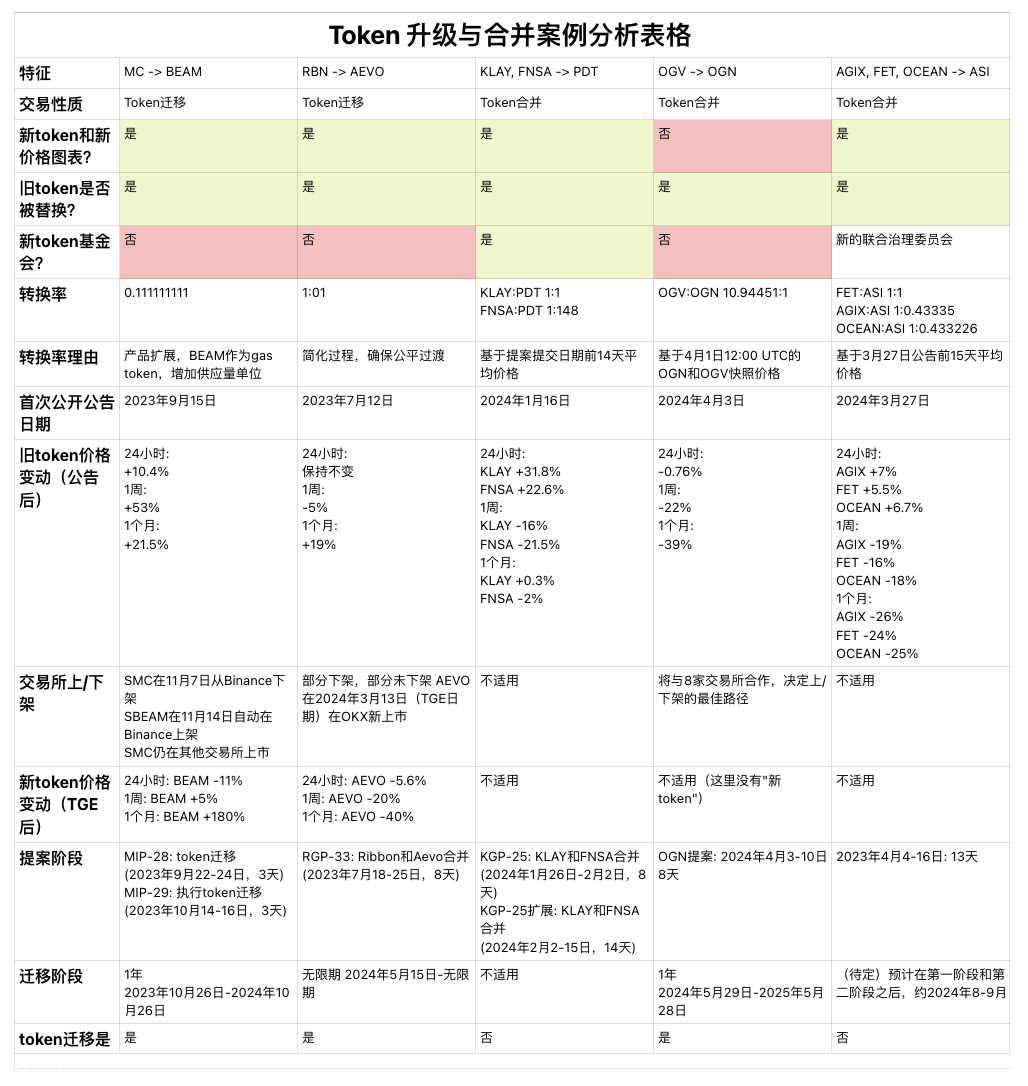
TechFlow Note: This table summarizes detailed characteristics and data from five token upgrade/merger cases, including transaction nature, token replacement, exchange ratio, announcement date, price impact, exchange listings/delisting, proposal and migration phases, specific migration steps, and changes in new token utility.
Now, let’s dive deeper.
-
MC -> BEAM
Merit Circle’s migration to Beam is likely one of the most successful and well-executed token migrations to date. It serves as a strong example of how a project can evolve into a blockchain, with clear, consistent community communication and a transparent proposal process. Detailed timeline:
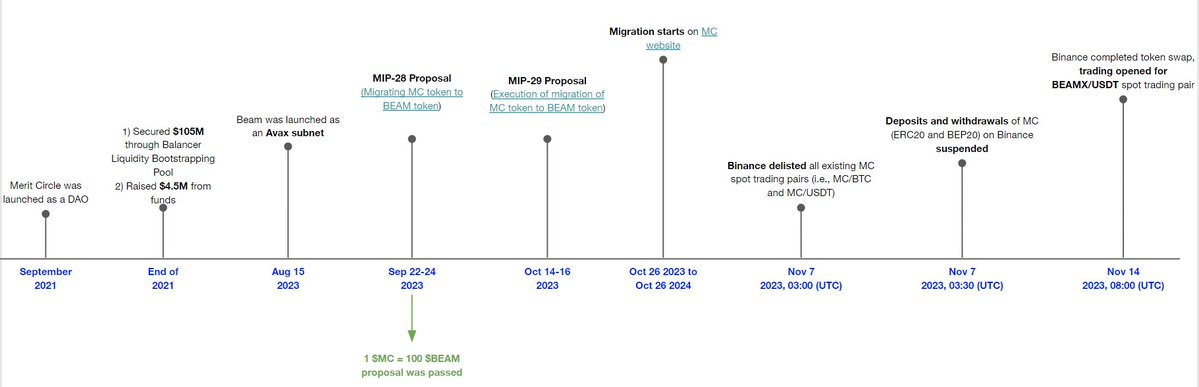
Why upgrade?
-
Better alignment between token brand and underlying network.
-
Enhanced token utility.
-
Market positioning, brand recognition, and brand strength.
Time-efficient – a fast way to align internal and external stakeholders around Beam’s new vision and awareness.
Why not just do an airdrop?
-
BEAM was intended to replace MC, not coexist with it.
-
Fair and accurate airdrops were difficult due to constant trading of MC tokens.
-
High costs involved (including gas fees).
Price impact
-
Within six weeks post-migration, BEAM increased in value by approximately 200%, indicating strong market support.
-
Meanwhile, MC’s price also rose over 3x since the migration opened on October 26, 2023.
-
RBN -> AEVO
In DeFi, Ribbon Finance’s merger with Aevo (an OP-based non-custodial exchange) is an interesting case that incorporated an automatic staking mechanism during the process.
Two distinct products, 1 RBN token → 1 unified product, 1 new AEVO token. Here’s the timeline:
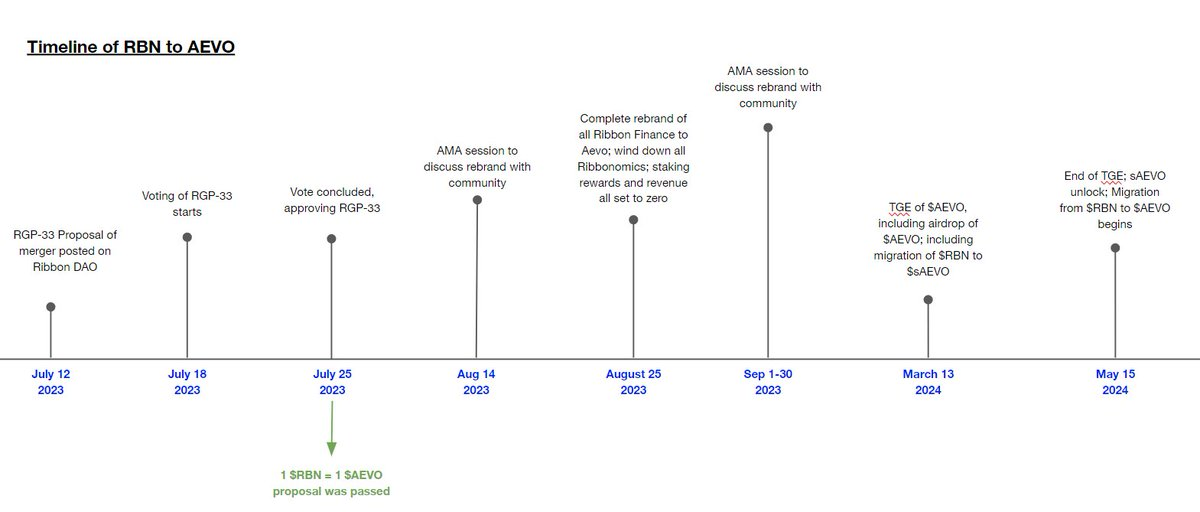
Why merge:
-
To address scalability challenges Ribbon faced in DeFi options.
-
Product synergy.
-
Technical advantages in UI/UX: Aevo L2 rollup aims to offer users zero gas fees, reduced order latency, improved order execution, and active market maker support.
-
Strategic direction and goal: The new AEVO token is built upon a clear, evolved vision—to become a high-performance derivatives trading platform offering more products under one brand.
Staking mechanism:
Post-conversion AEVO tokens must be locked for 2 months. AEVO is converted into sAEVO (staked AEVO), which then becomes locked → preventing immediate sell-offs that could cause price volatility.
-
AGIX, FET, OCEAN -> ASI
One of the hottest merger cases this year involves the combination of three high-FDV AI tokens: Fetch.ai (AI agents), SingularityNET (AI development and integration), and Ocean Protocol (data sharing and monetization). When the news first broke in March, our team held a call with Singularity to understand their motivations and mechanics.
The key takeaway from this case is their exchange rate methodology, and why they chose not to apply any premium or discount based on token valuation.
Why merge:
-
Liquidity consolidation—liquidity is expensive.
-
To create the largest independent player in the AI research and development space.
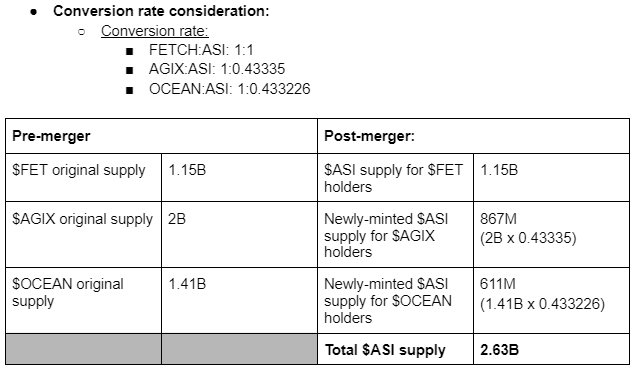
Exchange rate considerations:
-
Exchange ratios were based on the average price over the 15 days prior to the announcement.
-
To reduce friction in valuation negotiations, the team valued each token under identical market conditions, without applying premiums or discounts based on liquidity or trading volume differences.
-
FET was selected as the base token, so the exchange ratio with ASI is 1:1.
-
You can review the current two-phase merger process here: https://fetch.ai/blog/navigating-the-asi-token-merger-a-comprehensive-guide.
-
KLAY, FNSA -> PDT
This year, two of Korea’s most established tokens decided to merge—one backed by Kakao, the other by LINE—both being Korea’s largest messaging apps. Their vision is to become Asia’s leading blockchain, leveraging their combined base of over 250 million wallet users, 240+ DApps, and services.
The key learning from this case study lies in their burn mechanism:
-
~22.9% of the total new PDT token supply will be burned.
-
100% of non-circulating supply will be removed.
-
Purpose: Reduce inflation and control supply.
They published a very comprehensive document explaining the process with clear mathematical guidance. Following their steps is straightforward and makes their rationale easy to understand: https://klaytn.foundation/wp-content/uploads/2024/02/PJD-Supplement-Insights_240208_EN.pdf.
-
OGV -> OGN
Objective: To consolidate all of Origin’s products and their associated appeal into a single governance and yield-bearing token, OGN. Liquidity consolidation.
Key insight from this case: The team realized that OGV’s market pricing appeared unjustifiably low, with a market cap/TVL ratio significantly below competitors.
Final thoughts:
-
Token migration or merger does not guarantee immediate and/or long-term positive price movement. Therefore, ensure you have solid reasoning and justification for “why migrate or merge.” Do it for the right reasons and for the right community.
-
Token migration is not a one-time event. It’s just the beginning. Communication, transparency, and governance proposals shouldn’t stop afterward—that’s why I believe some case studies are more successful than others.
-
Most of these five cases haven’t completed their migration period yet, so there’s still much to monitor, including progress across their overall product and ecosystem, as well as token performance, before judging whether “this was a successful migration or merger.”
Join TechFlow official community to stay tuned
Telegram:https://t.me/TechFlowDaily
X (Twitter):https://x.com/TechFlowPost
X (Twitter) EN:https://x.com/BlockFlow_News
 @cornergirl999


