8 Major Market Hotspots Analysis: How Do They Impact Recent Trading Logic?
TechFlow Selected TechFlow Selected
8 Major Market Hotspots Analysis: How Do They Impact Recent Trading Logic?
In the crypto world, stablecoins are the foundation of DeFi, providing a stable medium of exchange that allows users to buy and sell without having to convert back to fiat currency.
 Navigating Web3 tides with focused insights
Author: WOO
Key Takeaways
1. Market Hot Events
-
Wintermute: Stablecoin market cap rises to $164 billion for the first time since 2022. -7.25
-
JD.com: To issue a public blockchain-based stablecoin pegged 1:1 to the Hong Kong dollar in Hong Kong. -7.24
-
Mt. Gox official documents state that over 17,000 creditors have received compensation in BTC and BCH. -7.24
-
Mt. Gox creditors have received returned BTC, BCH, and ETH assets in their Bitstamp accounts. -7.25
-
Kraken CEO: Kraken has returned Bitcoin and BCH to Mt. Gox creditors. -7.24
-
On the 10th anniversary of Ethereum's ICO, the U.S. SEC officially approves spot Ethereum ETFs for trading. -7.23
-
Binance Labs invests in Catizen.AI’s issuance platform PLUTO Studio. -7.23
-
Biden announces withdrawal from the 2024 U.S. presidential election; Harris declares candidacy for vice president and may be nominated as the Democratic presidential candidate on August 19. -7.22
2. Popular Sector Introduction (Stablecoin Sector)
-
Importance: The current total market cap of stablecoins exceeds $164 billion, returning to the bull market level of 2022; stablecoins are the cornerstone of DeFi and an important vehicle bridging Web2 and Web3 payments; yield-generating stablecoins have become a key narrative in the stablecoin sector in 2024; USDT and USDC together issued an additional $10 billion in stablecoins in March; recent trends in stablecoins are relatively optimistic with increased inflows.
-
Core Points: Definition of stablecoins, related narratives, overall sector data performance, types of decentralized stablecoins, key projects and analysis
-
Promising Projects: Ethena, BitU, Midas, SPOT
1. Market Hot Events
1. Wintermute: Stablecoin market cap rises to $164 billion for the first time since 2022. -7.25
2. JD.com: To issue a public blockchain-based stablecoin pegged 1:1 to the Hong Kong dollar in Hong Kong. -7.24
[Analysis of 1 & 2]
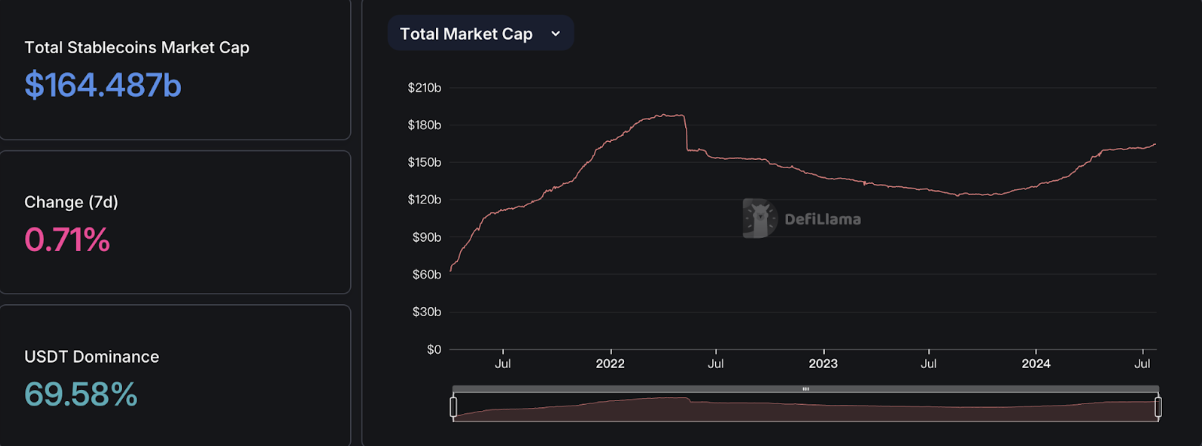
Stablecoin metrics are an important indicator for predicting future trends. According to DefiLlama data, the current total market cap of stablecoins exceeds $164 billion, with USDT accounting for $114.3 billion, or over 69.71%. From December 2021 to May 2022, prior to the Luna collapse, stablecoin market cap steadily grew above $180 billion during the bull market, and it has now returned to that previous bull market level.
From December this year to early January, Tether issued an additional $7 billion in USDT. In March, Tether and Circle together issued $10 billion in stablecoins within 30 days. However, stablecoin inflows slowed after the Bitcoin halving. Recently, market trends have been relatively optimistic, and stablecoin inflows have also increased.
Decentralized stablecoins are considered the most crypto-native and orthodox. After recovering from the UST collapse, they are regaining momentum this year. USDe by Ethena has gained significant traction, backed by figures like Arthur Hayes and other U.S. capital, with APRs briefly exceeding 30%. USD0 by Usual is also entering the space aiming to capture market share.
Since 2022, Hong Kong has been actively focusing on Web3 and clarifying its regulatory direction for stablecoins. In December last year, the Hong Kong Monetary Authority (HKMA) released a consultation paper on the proposed regulatory regime for stablecoin issuers. On July 18 this year, the HKMA announced the list of participants in its stablecoin issuer sandbox, including JD Blockchain Technology (Hong Kong) Co., Ltd.
On July 24, JD.com announced plans to issue a Hong Kong dollar-pegged stablecoin. This move into Web3 sparked widespread discussion. In previous years, due to domestic regulations, major Chinese tech firms quickly retreated from the crypto space, mostly focusing on industrial blockchains and consortium chains—approaches later proven ineffective. Since 2022, while Hong Kong has eased its Web3 policies, traditional tech giants have remained cautious. Tencent’s XR metaverse business and ByteDance’s PICO metaverse unit both underwent layoffs last year, shifting focus toward AI. However, starting in the second half of last year, as bullish market trends emerged, traditional tech firms began re-engaging with Web3. For example, Alibaba Cloud partnered with Aptos to launch Alcove, a developer community in Asia-Pacific; Alibaba’s Ant Chain launched a new Web3 brand ZAN; former Ant employees founded Artela, a parallelized EVM chain; Tencent invested in Wintermute, Immutable X, and Chainbase.
Yet only JD.com chose to enter the stablecoin space, targeting the payment sector. Payment-oriented stablecoins represent a simple yet highly profitable business line that, once compliant, can reach a broader user base. Indeed, Hong Kong’s Web3 regulations are extremely strict—many exchanges applying for compliance licenses were rejected mid-year, and even compliant exchanges showed weak trading performance. The compliance costs for stablecoin issuers are exceptionally high, indicating JD.com is making a bold move to leapfrog competitors among traditional tech firms in the Web3 arena.
3. Mt. Gox official documents state that over 17,000 creditors have received compensation in BTC and BCH.
4. Mt. Gox creditors have received returned BTC, BCH, and ETH assets in their Bitstamp accounts.
5. Kraken CEO: Kraken has returned Bitcoin and BCH to Mt. Gox creditors.
[Analysis of 3, 4, & 5]
Mt. Gox, founded in 2010, was once the world’s largest Bitcoin exchange. In 2014, it suffered a hacker attack resulting in the theft of 850,000 BTC, valued at approximately $480 million at the time, leading to its bankruptcy filing. In 2023, Mt. Gox opened a repayment window and announced a "restitution plan" in May this year, stating it would not immediately sell Bitcoin.
To date, Mt. Gox has recovered 140,000 BTC (worth about $9 billion), creating potential selling pressure that caused some market panic. On June 24, the Mt. Gox trustee announced that BTC and BCH repayments would begin in July, involving crypto assets worth up to $9 billion. As a result, the crypto market plunged, with Bitcoin briefly falling below the $60,000 mark.
Reportedly, Mt. Gox has 127,000 creditors (less than 1% from Japan), needing to repay 142,000 BTC (currently worth ~$8.58 billion) and 143,000 BCH (worth ~$53.31 million).
However, the impact of Mt. Gox’s sales may be overstated, as payouts are not being made all at once. The restitution plan includes base repayment and proportional repayment. Base repayment allows each creditor to claim up to 200,000 JPY in Japanese yen. Proportional repayment offers two flexible options: "early lump-sum repayment" or "mid-term and final repayment." Early lump-sum repayment only provides partial compensation, with amounts over 200,000 JPY allowing creditors to choose a mix of BTC, BCH, and yen or full payment in fiat. Mt. Gox set deadlines of October 31, 2024, for base, early lump-sum, and mid-term repayments, but higher compensation ratios may require waiting five to nine more years. By the end of 2023, several Mt. Gox creditors had already received initial yen-denominated compensation. This upcoming payout marks the first time Mt. Gox will repay in BTC and BCH.
Moreover, payout timelines vary across exchanges. BitGo may take up to 20 days, while Kraken and Bitstamp could take up to 90 days. It’s also uncertain whether individual creditors who bought BTC early will sell their holdings. Overall, Mt. Gox-related selling pressure may be less severe than expected and unlikely to exert significant downward pressure on the market.
6. On the 10th anniversary of Ethereum's ICO, the U.S. SEC approves spot Ethereum ETFs for formal trading. -7.23
VanEck first disclosed plans to apply for a U.S. spot Ethereum ETF in 2021 but later withdrew. Applications for spot Ethereum ETFs resumed in the second half of 2023, including from Grayscale, Invesco Galaxy, BlackRock, Fidelity, Hashdex, VanEck, ARK 21Shares, and others. Due to the SEC’s focus on approving Bitcoin ETFs, decisions on spot Ethereum ETFs were repeatedly delayed until a shift occurred in March.
Between March and April this year, the SEC solicited public comments on spot Ethereum ETFs from various issuers. Grayscale and Coinbase also engaged in discussions with the SEC regarding rule changes for launching spot Ethereum ETFs. Starting in May, issuers including ARK Invest, 21Shares, Fidelity, Grayscale, and Franklin Templeton removed "Ethereum staking" services from their ETF filings, while CoinShares and Valkyrie stated they would not pursue spot Ethereum ETFs, primarily due to the absence of staking. Since then, approval for Ethereum ETFs has proceeded smoothly. As a result, none of the approved Ethereum ETFs offer staking.
According to The Block, the nine spot Ethereum ETFs traded over $1.019 billion on their first day of listing on U.S. exchanges. Grayscale’s Ethereum Trust (ETHE) led with $456 million in volume, nearly half of the total, and recorded a net inflow of $106.6 million on day one. However, it saw net outflows on the following two days—$133 million on the 24th and $152 million on the 25th.
Currently, traditional markets lack the same consensus on Ethereum as they do on Bitcoin. Without staking yields, Ethereum ETFs hold little appeal for crypto insiders, resulting in weaker buying demand compared to Bitcoin. While Grayscale’s Ethereum Trust still faces a management fee premium over 10x, arbitrage opportunities remain. However, the introduction of a lower-fee mini-trust may reduce selling pressure.
7. Binance Labs invests in Catizen.AI’s issuance platform PLUTO Studio. -7.23
There's a rumor that VCs want to invest in the TON ecosystem but can't act. That’s because projects on TON typically have cycles of only two months—if VC rounds lock funds for two years, they naturally can’t participate. Hence, Binance chose to back the game development company behind Catizen. The Pluto team comes from Web2, with over 10 years of experience in Web2 mini-program games.
I consider Catizen a TON mini-game 2.0—a real game that goes beyond simple "tap-to-earn" mechanics. It’s now the No.1 game on TON. On July 24, Telegram CEO Pavel Durov stated that Catizen has over 26 million players and has earned $16 million through in-app purchases—an exceptional user count and revenue capability in today’s Web3 landscape.
8. Biden announces withdrawal from the 2024 U.S. presidential election; Harris declares candidacy for vice president and may be nominated as the Democratic presidential candidate on August 19. -7.22
During the competition between Biden and Trump, Trump—after being shot in the ear and shouting "Fight" under the American flag—won strong public support, even gaining Elon Musk’s endorsement on Twitter. Trump also received praise from the crypto community for launching NFTs, making pro-crypto statements, and proposing crypto-friendly policies. Messari CEO Ryan Selkis even resigned after making overly aggressive remarks supporting Trump.
However, after Biden announced his withdrawal, Harris gained significant support as a potential first Black female U.S. president, with polls showing her lead over Trump. Nevertheless, Harris declined to attend the Bitcoin 2024 conference hosted by Bitcoin Magazine, so prediction market Polymarket still shows Trump with a substantial lead. Notably, driven by the U.S. election, Polymarket’s trading volume exceeded $275 million in July, setting a new record.
Additionally, the U.S. election has significantly boosted political meme coins on Solana.
2. Popular Sector Introduction (Stablecoin Sector)
2. Sector Overview
2.1 What Are Stablecoins?
Stablecoins are a special type of cryptocurrency designed to maintain a stable value over time, unlike other volatile cryptocurrencies. They achieve price stability by pegging their value to another more stable asset, or through purely algorithmic, uncollateralized mechanisms.
Stablecoins are categorized as centralized or decentralized, with both types first emerging in 2014. The first centralized stablecoin was USDT, issued by a core member of Bitfinex through a centralized entity registered in the Cayman Islands. USDT is now the most widely used and highest-market-cap stablecoin. The industry currently includes around 50 centralized stablecoins such as USDT, USDC (Circle), FDUSD (First Digital), PYUSD (PayPal), TUSD (TrueUSD), USDY (Ondo), BUSD (Binance), and GUSD (Gemini).
Decentralized stablecoins are issued and governed in a decentralized manner, pegged 1:1 to the U.S. dollar without reliance on centralized institutions. Often seen as the "holy grail" of financial technology, the first decentralized stablecoin, BitUSD, was launched by bitShares in 2014. However, four years later, BitUSD lost its peg and never recovered. Terra/Luna’s UST was the most famous decentralized stablecoin during the last bull run but collapsed catastrophically, causing massive damage to the industry.
Stablecoin performance varies significantly depending on the type of collateral backing them.
2.2 Narrative
In the crypto world, stablecoins are the foundation of DeFi, providing a stable medium of exchange that allows users to trade without converting back to fiat currency.
The narrative around stablecoins centers on their dual characteristics: “stable” + “coin.” Typically far less volatile than BTC or ETH, stablecoins also embody Satoshi Nakamoto’s vision of “peer-to-peer electronic cash,” with decentralized versions offering censorship resistance—a core tenet of crypto ideology. Algorithmic stablecoins especially align with crypto ideals and decentralization principles.
In recent years, stablecoins have been viewed as a bridge between Web2 and Web3, offering lower costs and faster settlement than traditional cross-border systems like SWIFT. In Africa, USDT and Binance P2P are widely adopted. Given Africa’s vast, fragmented geography and strong international ties, cross-border payments are common, and stablecoins serve as a key settlement currency. For instance, TRON-based USDT dominates emerging markets, holding over 70%, even 80%, market share in regions like South America, Africa, and Turkey. PayPal, with over 430 million users and 40% market share in digital payments, has a major influence in Web2 through its stablecoin PYUSD. JD.com’s focus on a Hong Kong dollar-pegged stablecoin targets the blue-ocean market of compliant stablecoins integrated with payments and cross-border transactions.
Additionally, in developing countries suffering from inflation and currency devaluation due to U.S. monetary policy shifts, stablecoins serve as an excellent hedge—fulfilling Satoshi Nakamoto’s original vision of creating a currency resistant to central bank control.
Regarding decentralized stablecoin narratives, MakerDAO’s DAI leads the way. The name DAI comes from the founder’s knowledge of Chinese, meaning “loan.” Another proposed name was “JIAO,” referencing the world’s first officially issued paper money from the Song Dynasty in China. DAI also pays tribute to Wei Dai, creator of B-money and a pioneer of digital currency.
However, stablecoins are often not truly stable—neither centralized nor decentralized ones. In March 2023, Silicon Valley Bank’s bankruptcy froze part of Circle’s cash reserves, triggering a loss of confidence in USDC, leading to mass redemptions and sell-offs, with USDC dropping to $0.878. This de-pegging also affected decentralized stablecoins like DAI, FRAX, and MIM.
After two years of digesting the LUNA collapse, the market has improved this year, sparking a wave of innovation where decentralized stablecoins are returning to center stage. With upgrades in yield-bearing asset models, interest-generating stablecoins have become a dominant trend, including Ethena’s USDe, Blast’s USDB, Ondo’s USDY, Mountain Protocol’s USDM, and Lybra’s eUSD. These stablecoins derive yield from diverse sources such as U.S. Treasuries, Ethereum staking rewards, and structured strategies.
Regardless, stablecoin performance remains a key indicator of bull markets, reflecting off-chain capital flows and investor sentiment toward the crypto market.
2.3 Overall Data Performance
According to data from DefiLlama and Wintermute, the stablecoin sector (including hundreds of tokens) has surpassed $164 billion in total market cap for the first time since Terra’s collapse in May 2022, returning to the previous bull market level. Wintermute noted this “indicates rising investor optimism, supporting a bullish outlook. Increased stablecoin supply suggests capital is being deposited into the on-chain ecosystem to generate economic activity—whether through direct on-chain purchases that could catalyze price appreciation or through yield-generating strategies that improve market liquidity. Ultimately, this activity drives positive on-chain growth.”
Centralized Stablecoins
Currently, fiat-backed stablecoins have a market cap of $151.99 billion (92.4% of the total stablecoin market), returning to the previous bull market level.
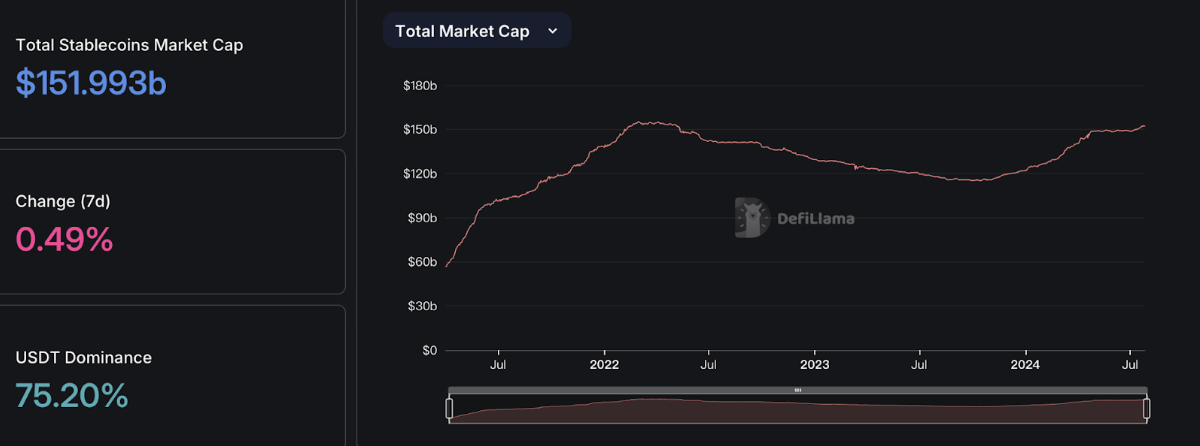
Due to Silicon Valley Bank’s collapse, USDC’s market cap contracted, pushing USDT’s share to 75.2%.
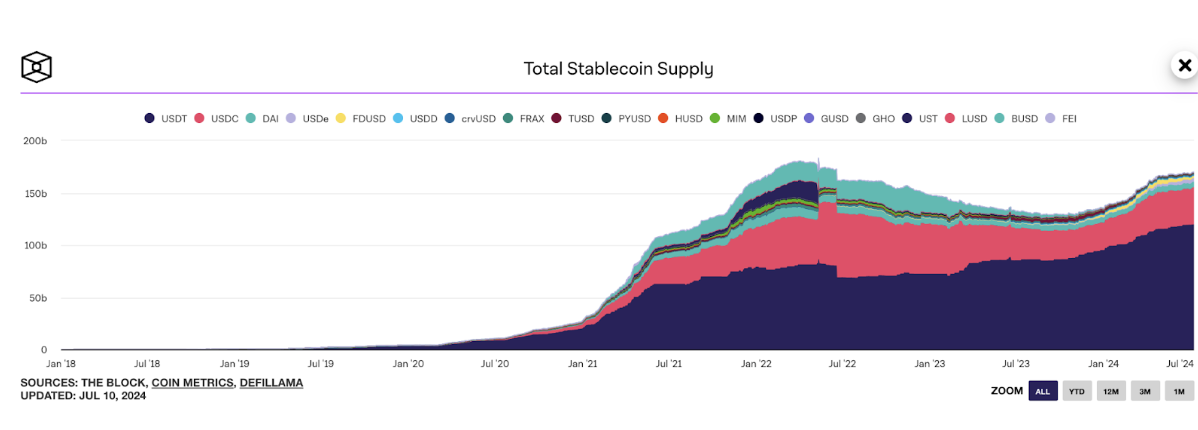
Decentralized Stablecoins
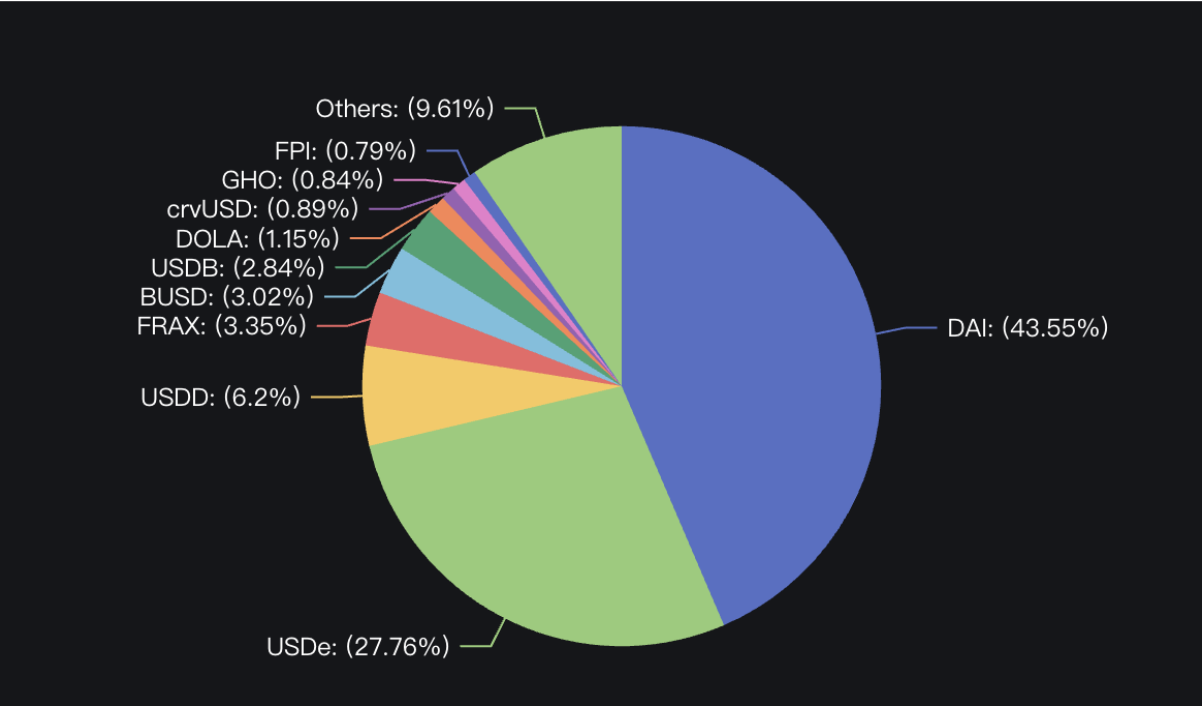
There are now over 100 decentralized stablecoins, with a total market cap of $11.89 billion, still below the previous bull market peak of $30 billion. MakerDAO’s DAI dominates with a 43.55% share and a market cap of $5.181 billion.
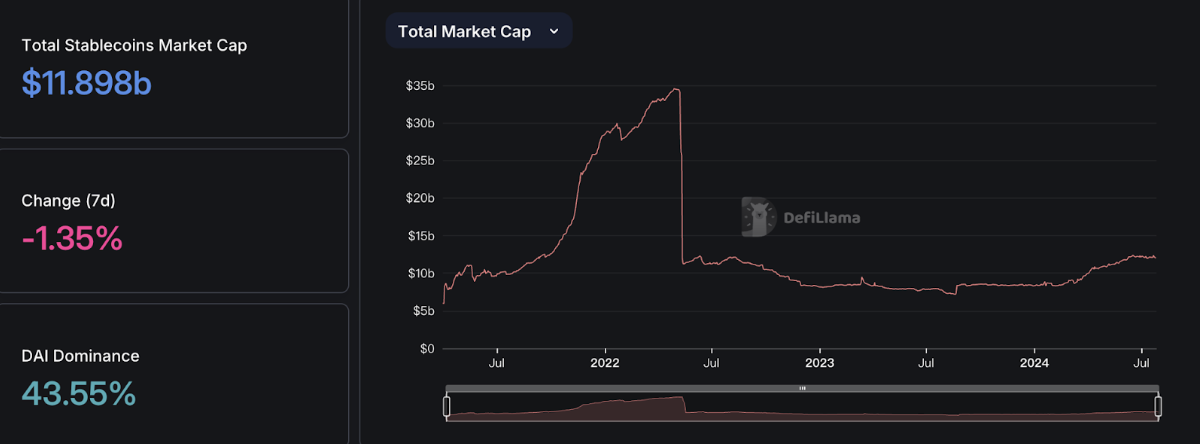
So far this year, Ethena’s USDe has performed best, surpassing $3.3 billion in market cap to become the second-largest decentralized stablecoin, while no other decentralized stablecoin exceeds $1 billion.
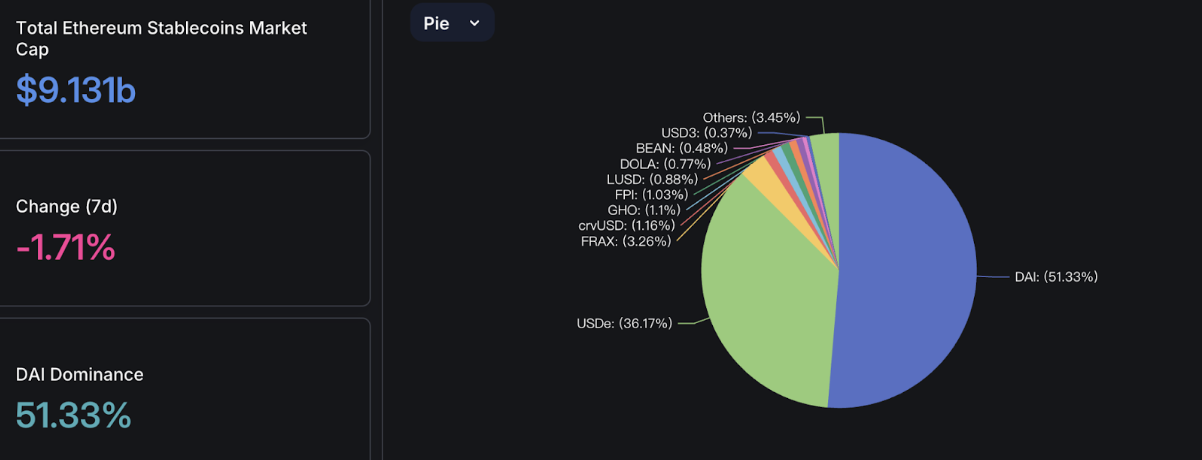
Notably, of the $11.89 billion in decentralized stablecoins, $9.131 billion (76.79%) resides on the Ethereum mainnet, with DAI accounting for 51.33%.
Interestingly, among the top 10 decentralized stablecoins, USDe’s entire $3.3 billion market cap is on Ethereum, while USDY’s $338 million is entirely on Blast. Other leading protocols are primarily multi-chain.
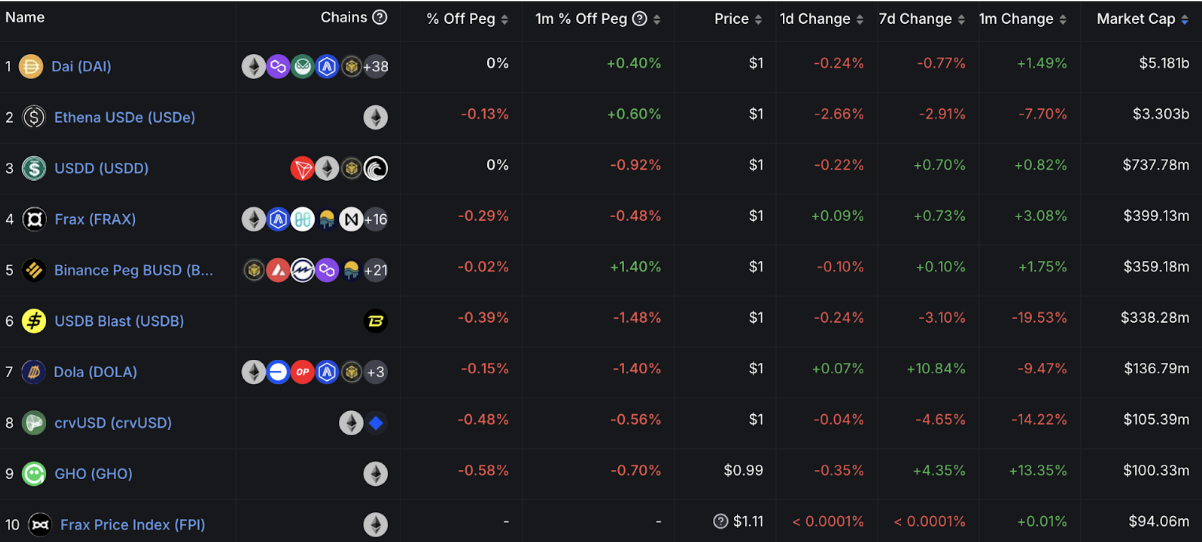
Algorithmic stablecoins have a market cap of $1.47 billion, representing 12.35% of the total decentralized stablecoin market. However, after the Luna crash, algorithmic stablecoins have struggled and continue a downward trend. Notable projects include Sun Yuzhen’s USDD ($737 million market cap) and FRAX, with all others below $100 million.
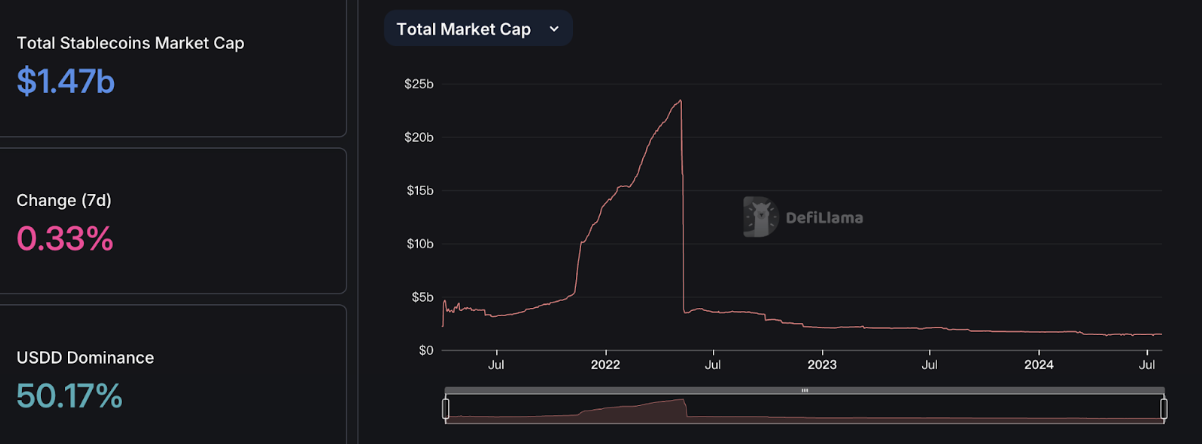
2.4 Types of Decentralized Stablecoins
Decentralized stablecoins are mainly divided into crypto-collateralized and fully algorithmic (uncollateralized) types. Their performance differences largely stem from collateral types. Based on collateral, they can be classified as over-collateralized stablecoins, algorithmic stablecoins, hybrid algorithmic stablecoins, and delta-neutral stablecoins.
Over-Collateralized Stablecoins
Over-collateralized stablecoins are a common decentralized type, backed by crypto assets like BTC and ETH. The flagship example is MakerDAO’s DAI, which locks ETH and other ERC20 tokens in smart contracts at specific collateral ratios to automatically issue DAI—functioning like a “decentralized central bank.” Advantages include relative stability, though excessive collateral reduces capital efficiency. Sharp drops in collateral value may trigger liquidations. MakerDAO is now exploring the use of RWA as collateral.
Algorithmic Stablecoins
Algorithmic stablecoins maintain a fixed price through supply and demand mechanisms without physical collateral, relying instead on mathematical formulas and incentives tied to the dollar. They use algorithms and smart contracts to automatically adjust supply for price stability. There are three types: Rebase (elastic supply), Seigniorage (minting tax), and Fractional Stablecoins. Ampleforth uses Rebase with no supply cap, automatically adjusting supply based on market demand—increasing when price exceeds $1 and decreasing when below.
The seigniorage model uses a dual-token system, typically combining a stablecoin and a governance token. Terra’s UST and LUNA followed this design: UST pegged 1:1 to USD, allowing users to burn $1 worth of LUNA to mint 1 UST and vice versa. If UST trades above $1, users profit by exchanging $1 LUNA for >$1 worth of UST. If below $1, they redeem 1 UST for $1 LUNA. This mechanism incentivizes arbitrage to maintain price stability.
Hybrid Algorithmic Stablecoins (Fractional Stablecoins)
The third type, fractional stablecoins, combines partial algorithmic and partial collateral mechanisms, typically with collateral ratios ≤100%. This improves capital efficiency by requiring less underlying value to back the stablecoin. If the price exceeds $1, the algorithm mints more tokens until it returns to $1; if it falls below, the stablecoin becomes over-collateralized, and excess tokens are burned. Frax is the leading example.
Delta-Neutral Stablecoins
Delta-neutral stablecoins use a portfolio risk management strategy, achieving neutrality by going long equivalent spot positions and shorting equivalent futures contracts, profiting from funding rates. Ethena is a prime example.
3. Sector Ecosystem
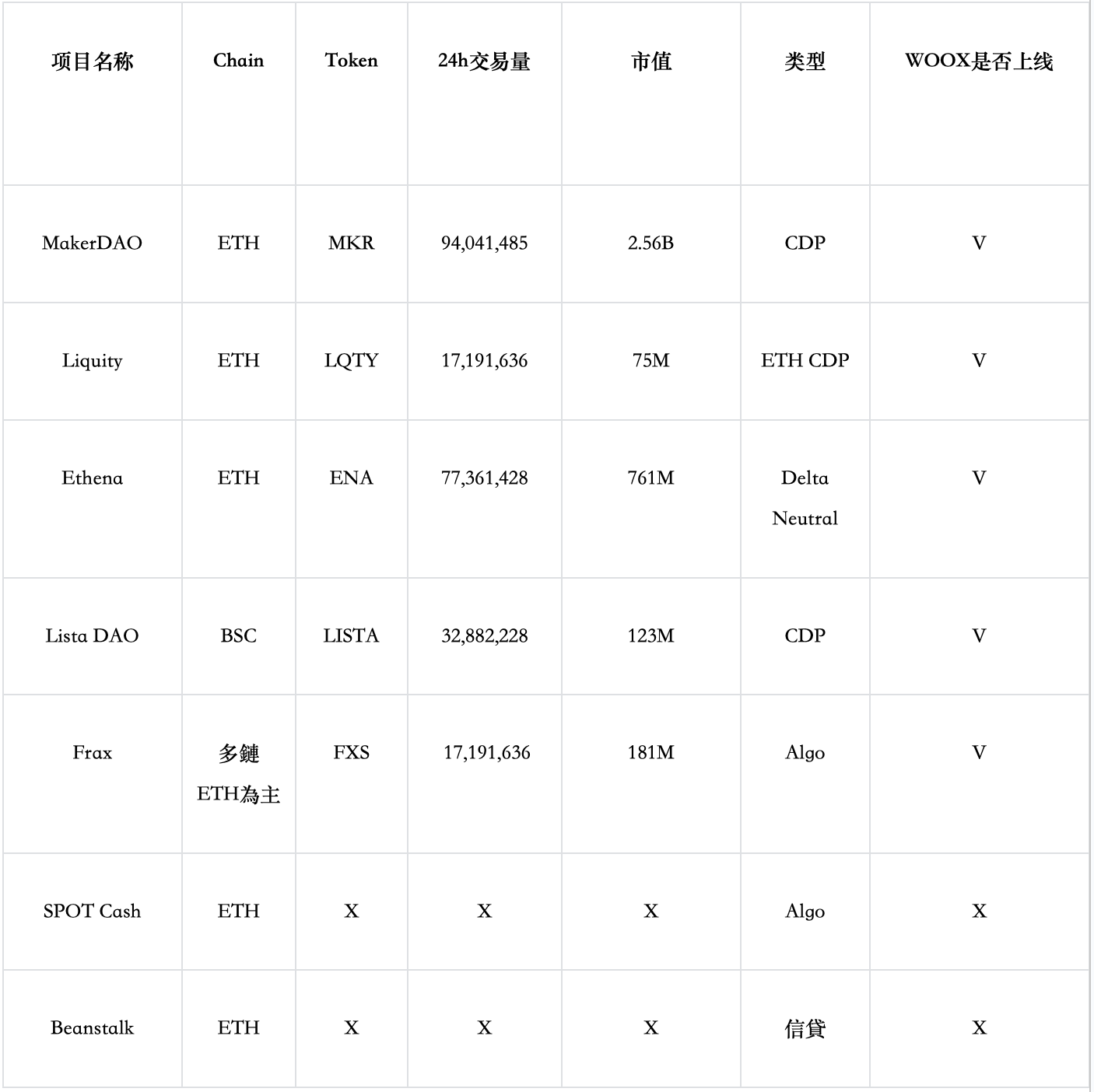
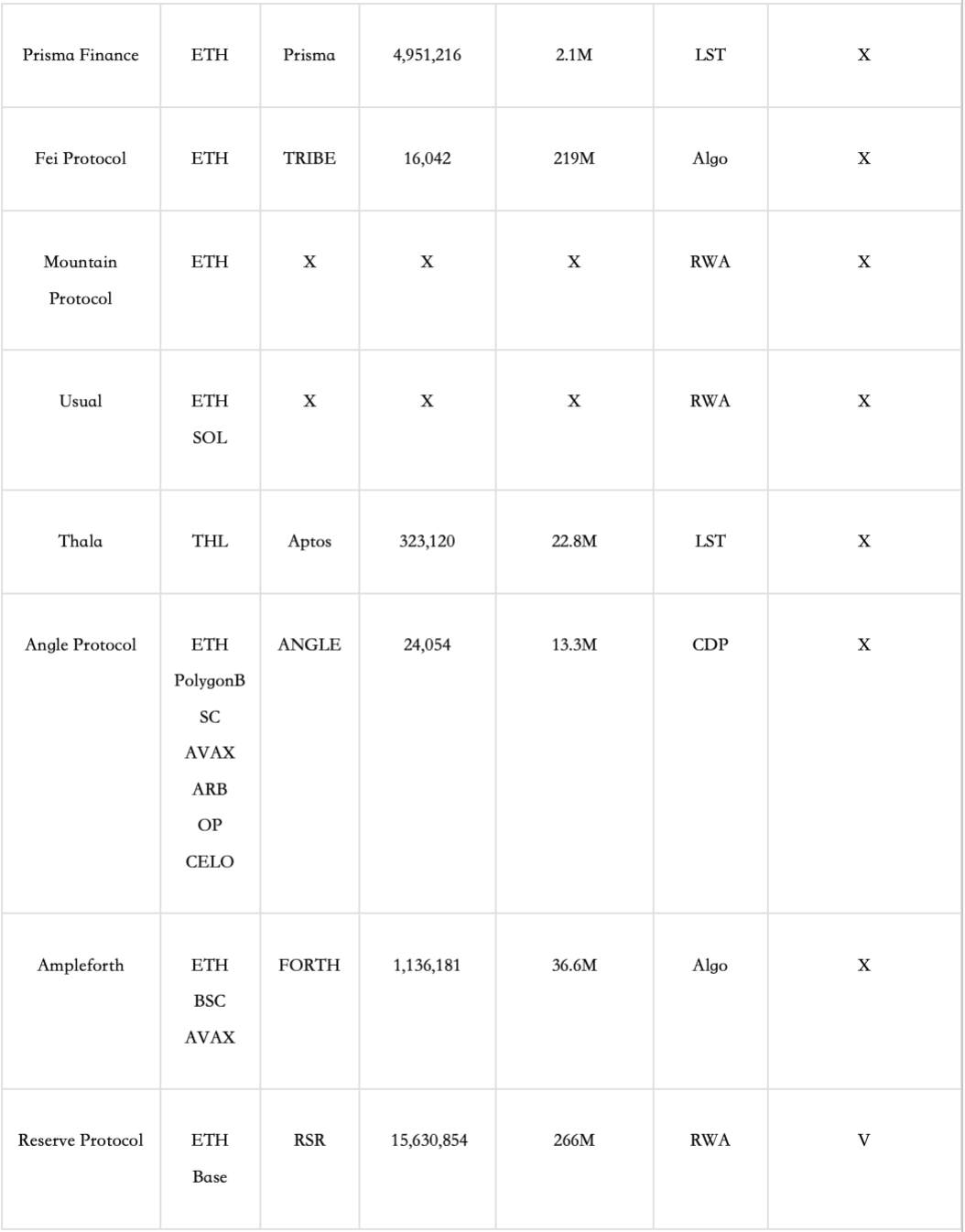
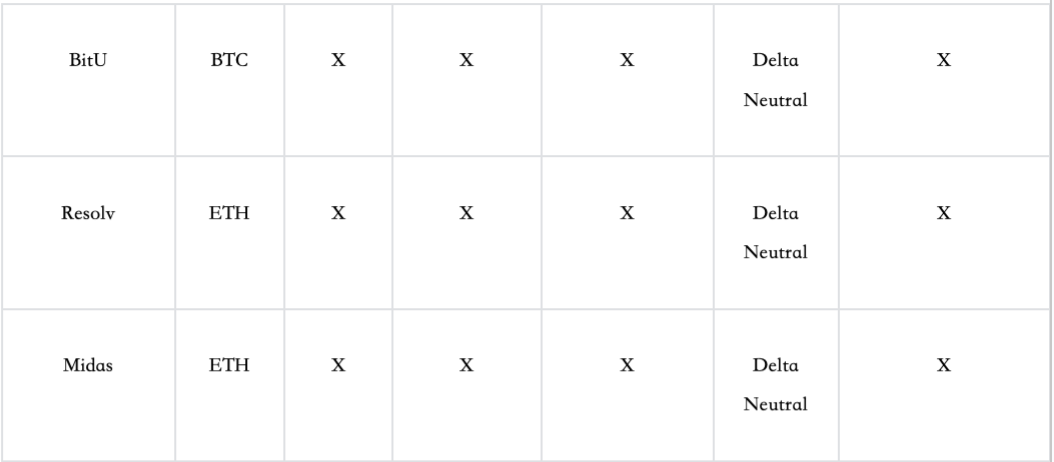
4. Key Project Analysis
1) Project Name: Ethena
Website: https://ethena.fi/
Twitter: https://x.com/ethena_labs
Overview: Ethena is a synthetic dollar stablecoin protocol built on Ethereum, offering a "synthetic dollar" called USDe via a delta-neutral strategy.
Ethena’s synthetic dollar stablecoin USDe provides a crypto-native, scalable monetary solution by triangular hedging against Ethereum and Bitcoin collateral. USDe is fully collateralized (though risks remain that could impair coverage) and composable within decentralized finance (DeFi). Users can stake USDe to receive sUSDe and earn a share of protocol revenues.
Features:
-
Yield from collateral such as LST staking rewards (1x long, beta +1)
-
Opening short positions in futures and perpetual contracts to arbitrage basis and funding rates (1x short, beta -1)
-
USDe yield primarily derived from futures-spot arbitrage
-
Ethena introduced an insurance fund to subsidize yields during negative funding rate periods
Recent Updates:
-
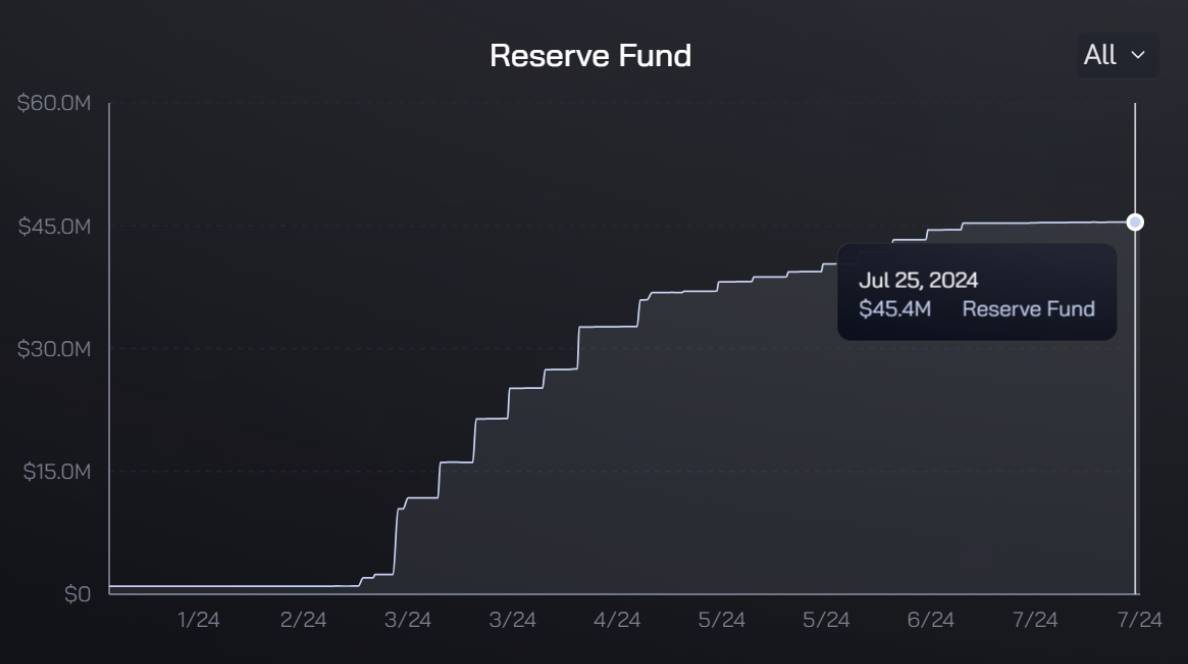
Treasury is at ATH, with total assets reaching $45 million
-
July 24: Announced plans to allocate part of its $235 million USDT stablecoin collateral and $45 million reserve fund to yield-generating RWA products. Securitize, issuer of BlackRock’s BUIDL, and Steakhouse Financial have applied to Ethena’s governance committee for reserve fund allocations.
-
Securitize stated BUIDL enables Ethena’s reserve fund to invest in U.S. Treasury-backed products, recommending allocation of $34 million from the $45 million reserve.
-
July 23: Scroll announced integration with Ethena, bringing USDe to Scroll
-
July 9: Options protocol Lyra announced collaboration with Ethena Labs to launch the sUSDeBULL strategy, using automated bull call spreads to earn principal-protected returns in sUSDe, with a pool cap of 10 million sUSDe
3) Project Name: BitU
Website: https://www.bitu.io/
Twitter: https://x.com/bitu_protocol
Overview: BitU is a crypto-native collateralized stablecoin protocol leveraging off-chain liquidity and efficiency to deliver higher yields (ALMM). Currently, only whitelisted users can stake BTC to mint the stablecoin $BITU, with a minimum collateral ratio of 200% and a liquidation threshold of 110%.
Features:
-
Can be seen as a Bitcoin version of Ethena
-
Revenue comes from lending plus delta-neutral strategy. The protocol maps users’ staked assets to centralized exchanges and lends funds to market makers and hedge funds. It uses Ceffu’s OTC settlement solution MirrorX in its delta-neutral strategy to generate income
-
Stake $BITU to get $sBITU and passively earn ALMM-generated rewards, distributed monthly
-
Selected for Binance Labs’ Season 7 MVB program
Recent Updates:
-
July 1: Announced listing on Math Wallet dApp Store
-
June 27: TVL displayed on DefiLlama, currently at $21.35 million
-
June 14: Announced partnership with CeffuGlobal to use their engine for OTC settlement, enhancing user security
-
April 9: Announced joining Binance Labs MVB Season 7; through ALMM managing protocol funds, staked assets are mapped to exchanges, and ALMM’s yield module generates returns shared with users
Join TechFlow official community to stay tuned
Telegram:https://t.me/TechFlowDaily
X (Twitter):https://x.com/TechFlowPost
X (Twitter) EN:https://x.com/BlockFlow_News