








🐻 The Rise of the Ball: A Multi-Perspective Analysis of Berachain's Success Factors
TechFlow Selected TechFlow Selected
🐻 The Rise of the Ball: A Multi-Perspective Analysis of Berachain's Success Factors
Why is Bear Chain the most anticipated public blockchain in the second half of 2024?
 Navigating Web3 tides with focused insights
Author: Yond, Xiao Xiong Zhi Jia

🐻⛓️ Introduction
Bera morning!
Although Berachain has been in development for over two years, there is still a lack of comprehensive analysis about it in the Chinese-speaking community. Outside niche circles of degens and airdrop farmers, most users' perception of Berachain remains limited to inaccurate or even entirely wrong ideas such as "memechain," "expensive NFTs," "Ponzi scheme," or "the next LUNA."
Why do I believe Berachain is the most promising public blockchain for the second half of 2024—and potentially capable of establishing an independent narrative within the crypto market? In this article, I will help Chinese-speaking audiences rebuild their understanding of Berachain by exploring its history, market demand, economic model design, and community culture.
The Dilemma Facing Emerging Blockchains: Liquidity and Token Distribution
Since early 2023, new blockchains and Layer 2 solutions have emerged like mushrooms after rain. Amid a macroeconomic downturn and insufficient liquidity inflow into the crypto market, competition among chains has increasingly become a battle over existing market liquidity. To bootstrap and attract capital, nearly every new chain and L2 has launched centralized points programs—leveraging future airdrop or token issuance expectations to lure user deposits, generating temporary and uncommitted TVL (Total Value Locked) metrics.
As we pass the midpoint of 2024, let’s review some recently launched chains and L2s that have completed their points programs and issued tokens 👇🏻
Merlin Chain – Peak TVL: $534.4M, Current TVL: $214.07M, Drop: 60%
Blast – Peak TVL: $2.3B, Current TVL: $1.33B, Drop: 44.2%
Mode – Peak TVL: $587.12M, Current TVL: $456.22M, Drop: 22.3%
Data source:
Once these various points systems complete their roles, can new chains and L2s retain the TVL attracted solely by short-term incentives? Can they escape the fate of becoming ghost towns? Since points programs have proven unsustainable—and often damaging to long-term user enthusiasm—can blockchain builders explore healthier models for token distribution that enable organic, lasting liquidity?
Born from DeFi, Beyond DeFi
Berachain's story began at the tail end of the DeFi 2.0 boom in late 2021. Protocols like Olympus DAO introduced complex Ponzi-style game mechanics that generated ultra-high APYs, reigniting interest in on-chain DeFi projects during a bear market. Suddenly, discussions around (3,3) flooded crypto social media. *(The term (3,3) originates from game theory's Nash equilibrium, representing the optimal outcome in mutual cooperation; conversely, (-3,-3) represents the worst-case scenario.)*
Berachain wasn't originally a blockchain—it started as a series of NFT projects centered around a humorous "stoner bear" character. Its mechanism borrowed from OHM’s rebase system: holding the first-gen Bong Bears entitled holders to airdrops of subsequent collections, incentivizing long-term holding. There were five follow-up series: Bond Bears, Boo Bears, Baby Bears, Band Bears, and Bit Bears.
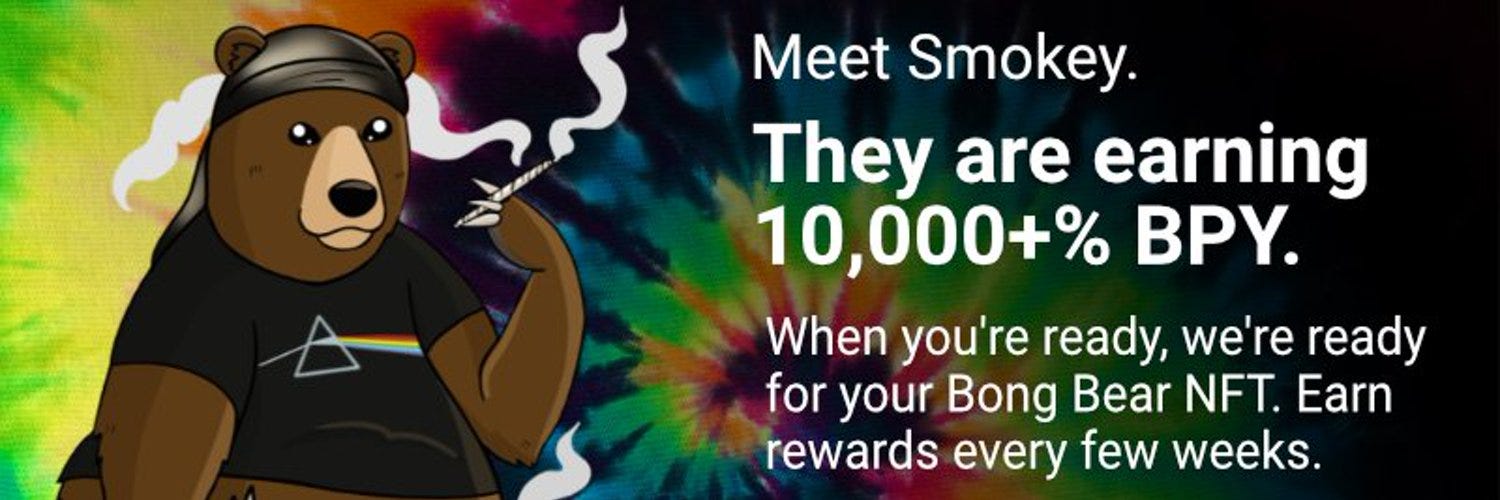
After Berachain announced its transition into a public blockchain, the value of these previously released NFTs surged. The cheapest collection, Bit Bears, now has a floor price as high as 3.8 ETH.
Proof of Liquidity: Coexistence Through Game Theory
Blockchain is one of the closest industries to asset issuance, with strong financial characteristics. Most innovation in blockchain serves to create more efficient methods of asset issuance—in layman's terms, “building better ponzi schemes.” So, could the game theory and Ponzi-like models used in DeFi to boost capital efficiency also serve other sectors—or even form the foundational design of a blockchain itself?
Berachain’s Proof of Liquidity (PoL) answers with a resounding yes.
The widespread belief that Berachain is just a "Ponzi" largely stems from its unique Proof of Liquidity mechanism.
Various consensus mechanisms exist in blockchain: Bitcoin uses Proof of Work (PoW), Ethereum uses Proof of Stake (PoS). Validators follow these rules to verify blocks, secure the network, and earn rewards.
Berachain has three core monetary units:
$BGT: Berachain Governance Token, non-transferable and non-tradable, convertible 1:1 into BERA
$BERA: Native chain token, used for gas fees and secondary market trading
$HONEY: Over-collateralized stablecoin minted using blue-chip assets as collateral
For a basic introduction to Proof of Liquidity, see this earlier article: 🐻📝 Bear Class 01: What is Proof of Liquidity?
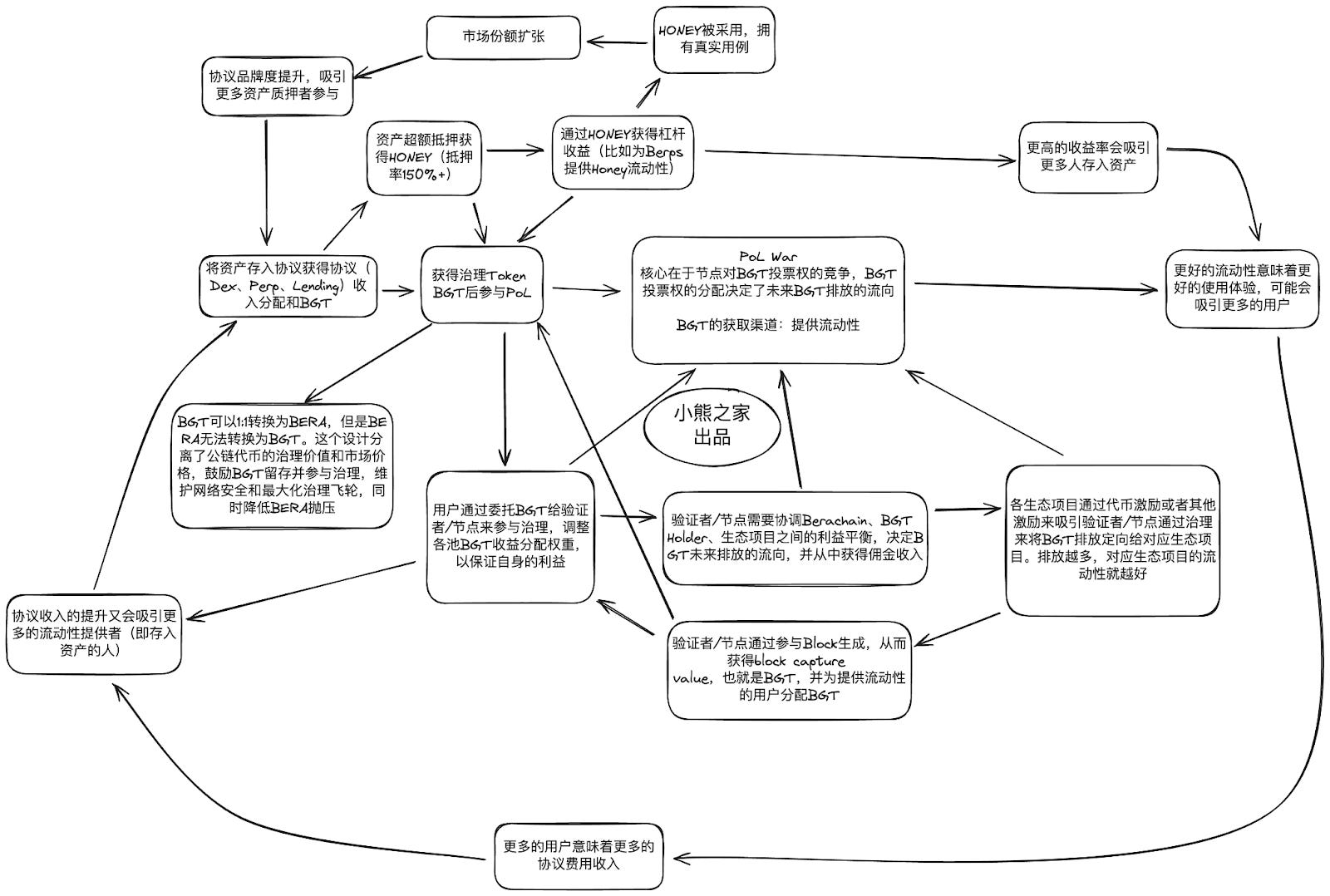
Through Proof of Liquidity, Berachain injects liquidity directly into the base layer of the chain. Using a BGT flywheel mechanism, it encourages users and ecosystem protocols to participate in governance and unlock long-term benefits. This approach avoids single-point failure risks where a single dApp dominates most of the chain’s liquidity—a common issue on so-called "ghost chains"—while stimulating broader ecosystem participation in governance and encouraging TVL retention.
The one-way conversion between BGT and BERA (note: BGT converts 1:1 to BERA, but not vice versa) decouples governance value from market price. This encourages BGT to remain within the ecosystem to fulfill its governance function, offering long-term returns ($BGT value capture per block, governance rewards, bribes for delegated voting power), while reducing sell pressure on BERA.
Under the Proof of Liquidity model, all three parties in the chain’s ecosystem—validators, ecosystem projects, and users—cooperate symbiotically, creating a positive feedback loop:
➡️Validators: Have governance rights and influence how BGT emissions are directed. They’re incentivized to attract BGT delegation from retail users and projects, keeping BGT on-chain and engaged in governance to earn extra income—rather than simply mining and dumping BERA.
➡️Ecosystem Projects: Can convert revenue into chain liquidity without disrupting their business model, earning additional BGT rewards in return.
➡️Users: Benefit from deeper liquidity, lower trading slippage, more yield opportunities, and maximized economic returns by delegating their BGT to validators.
Compared to blunt, short-term points programs that drain a chain’s long-term potential, the (3,3,3) flywheel is far more organic. It promotes long-termism and TVL retention, distributing token ownership through governance-based competition—achieving maximum fairness among stakeholders under shared game rules.
Community Culture and Cohesion
Much of Berachain’s popularity on crypto social media can be attributed to its quirky, meme-driven community culture—the so-called “Power of the Bears”
If you’ve interacted with Berachain or its ecosystem before, beyond seeing the 🐻⛓️ emoji suffix on Twitter handles, you’ve likely encountered its slang: Henlo, BM, Ooga Booga
Henlo: A cuter version of “Hello,” akin to the Chinese internet slang “ni hao”
BM: Bera Morning – equivalent to GM (Good Morning)
Ooga Booga: Mimicking bear sounds, it's a greeting “password” used across the Berachain ecosystem
The word “community” (or its English counterpart) appears frequently in crypto discourse, yet many users hold a narrow understanding—often equating it only to group chats, Telegram groups, or Discord servers.
Due to linguistic and cultural barriers, many users find Berachain’s slang confusing or alienating, sometimes associating it with similarly themed memecoins and mistakenly labeling Berachain a mere “memechain.”
A true “community” forms around shared beliefs among individuals. When people resonate with a common cultural symbol, they can coalesce into tightly-knit tribal networks with real influence. Community is collectivism built upon individualism.
We shouldn’t demonize Berachain’s abstract culture. Western internet memes involving weed, politics, and dark humor (“42069” culture) are fundamentally no different from abstract expressions in Chinese online spaces (e.g., gaming memes, anime references, Sun Forum jokes)—all belong to branches of contemporary internet subcultures.
The absurdist culture thriving in Berachain resonates with the online entertainment values of young Westerners—who also make up the core crypto demographic—strengthening their sense of belonging. On customer acquisition paths overlooked by many new chains and L2s, Berachain has carved out a symbolic advantage through its hyper-memetic identity.
🐻⛓️ Conclusion: Hype or Real Substance?
We still don’t know when Berachain’s mainnet will launch. Inside the community, there’s even an ongoing joke: “Berachain will never go live.” Yet despite being stuck on testnet, Berachain has already amassed a massive audience and potential user base. Memes and deep technical discussions about Berachain circulate widely on crypto Twitter—positive indicators of strong brand awareness and market attention.
With Binance Labs recently announcing support for Berachain ecosystem projects like Shogun and Infrared, the mainnet launch may finally be near.
That said, Berachain has faced criticism in the Chinese community regarding testnet interactions and potential airdrops. Some crypto KOLs have accused Berachain of indefinitely delaying mainnet launch, emotionally manipulating users (“PUA”), and delivering poor UX due to occasional network congestion.
While highlighting Berachain’s strengths, we must also rationally acknowledge the criticisms present in the market.
Join TechFlow official community to stay tuned
Telegram:https://t.me/TechFlowDaily
X (Twitter):https://x.com/TechFlowPost
X (Twitter) EN:https://x.com/BlockFlow_News
 @0xBeraHome






