

Ending “Subsidies-for-Growth”: The Extreme Capital Efficiency Logic Behind Berachain’s “Fiscal” Reform
TechFlow Selected TechFlow Selected
Ending “Subsidies-for-Growth”: The Extreme Capital Efficiency Logic Behind Berachain’s “Fiscal” Reform
Evolution is the only way forward.
 Navigating Web3 tides with focused insights
Author: Black Mario
Recently, Berachain’s Proof-of-Liquidity (PoL) mechanism underwent a major reform: its $BGT annual inflation rate was reduced from 8% to 5%—a proactive cut of approximately 46% in emissions—while simultaneously cleaning up a series of “ghost treasuries” and updating treasury access criteria. The community has dubbed this move a “sovereign fiscal reform.”
This appears to signal Berachain’s formal exit from the subsidy-driven cold-start era, shifting instead toward building a mature economy anchored in extreme “capital efficiency” and a “self-sustaining business loop,” with significantly higher ROI certainty.

The Logical Evolution: From Cold-Start Strategy Toward Sovereign Value
In traditional Proof-of-Stake (PoS) systems, security scales directly with staked token volume, and “locking tokens equals participating in governance” is the core principle. By contrast, PoL itself represents a highly sophisticated financial engineering design. It centers liquidity as the foundational element, binding network security, governance rights, and ecosystem liquidity together—attempting to redefine power distribution and incentive flows within a public chain.
PoL operates via three functionally distinct, mutually balanced tokens:
- $BERA (Fuel Base): The system’s operational fuel, fulfilling basic security functions and serving as Berachain’s foundational asset base.
- $HONEY (Value Unit): An over-collateralized native stablecoin acting as the ecosystem’s on-chain financial settlement medium, ensuring stability for economic activity.
- $BGT (Governance Core): A non-transferable soulbound token and the very soul of the PoL system. $BGT deeply ties governance rights to “genuine ecosystem contributions.” Holding and delegating $BGT grants control over the allocation of network incentives.
Validators influence which Reward Vaults receive incentives by accumulating delegated $BGT—a symbolic exercise of power, but more importantly, the central value lever of Berachain’s sovereign economic system.
At mainnet launch, Berachain adopted a high-inflation model of roughly 8%–10%. As a classic cold-start strategy, it successfully achieved initial liquidity accumulation and validated PoL’s real-world resilience.
However, as the ecosystem matures, certain latent issues have emerged:
- The early high-yield environment attracted highly sensitive capital. While such capital fulfilled short-term fundraising objectives during cold start, its long-term retention and contribution to commercial co-construction remain suboptimal.
- Some treasuries operated inefficiently, even exhibiting self-reinforcing distribution loops. This diluted scarce $BGT budget allocation, failing to fully translate into long-term ecosystem stickiness.
- Sustained high emission rates eroded the marginal value of $BGT as a sovereign asset. For long-term builders, optimizing the inflation structure is essential to safeguarding their long-term interests and enhancing network resilience.
If the PoL incentive mechanism ultimately devolves into a mere operational cost, then regardless of how impressive short-term metrics appear, the ecosystem’s long-term value remains fundamentally constrained. Incentives should not be subsidies—and certainly not indiscriminate airdrops—but rather productive capital capable of generating ROI. Every unit of $BGT emitted should yield sustainable transactions, user retention, and tangible cash-flow potential. This, perhaps, is the true essence behind the slogan “Bera Builds Businesses.”
Under this shared consensus, the reform aimed at “separating truth from falsehood” and reconstructing sovereign fiscal efficiency officially commenced at the start of 2026.
Berachain’s “Fiscal” Reform
Optimizing $BGT Emissions: Anchoring Long-Term Ecosystem Value
In any mature economy, monetary policy adjustments often herald a qualitative shift in growth logic. By reducing $BGT’s annual inflation rate from ~8% to 5%, Berachain has taken a pivotal step toward “value sovereignty.”
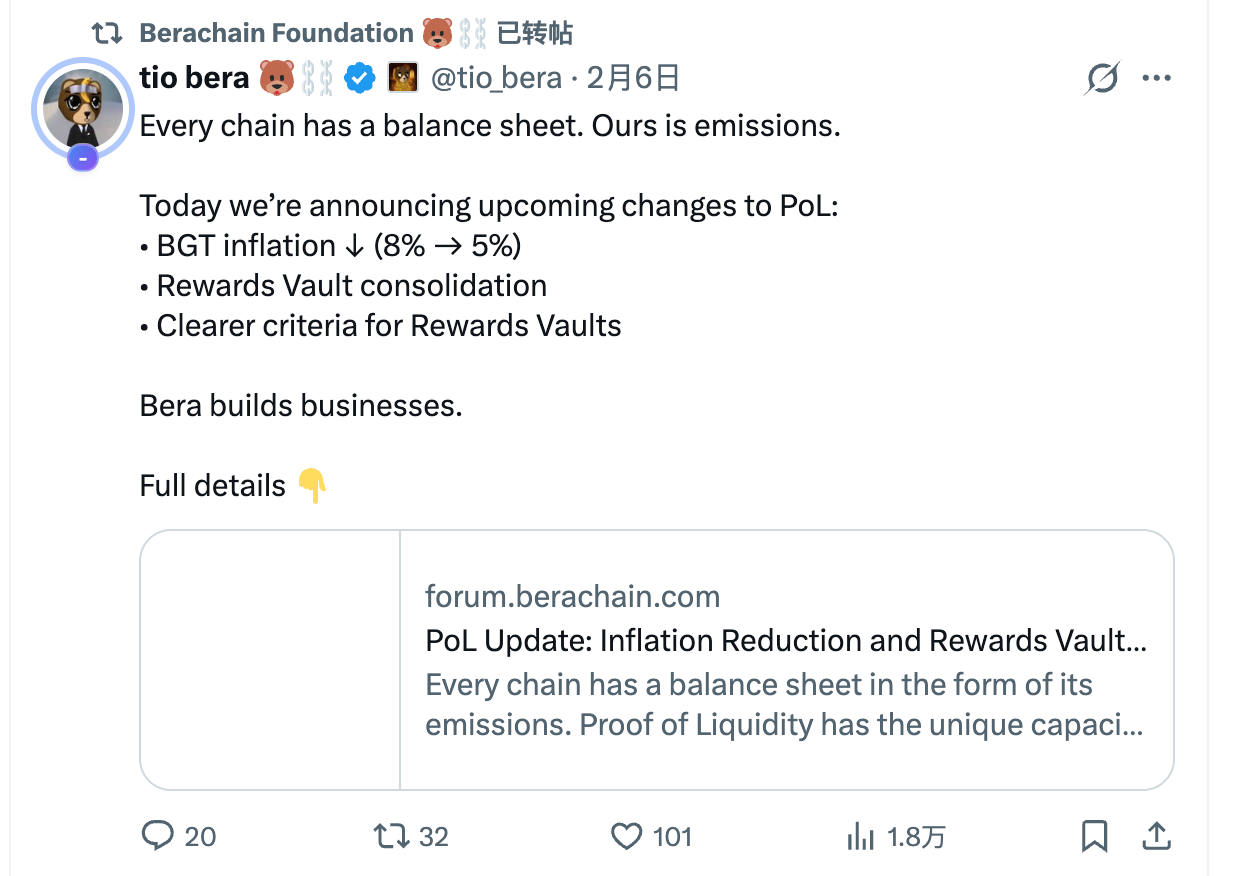
Indeed, the earlier 8% inflation rate functioned more like “expansionary credit” tailored for the ecosystem’s startup phase—successfully achieving initial liquidity accumulation in the short term. Today’s ~46% reduction in PoL-related emissions (reward rate dropping from 1.2 to 0.65) reflects not only precise calibration of current ecosystem capacity and incentive efficiency, but also a refinement in liquidity management: maintaining baseline network security while moderately tightening new emissions ensures every newly injected $BGT unit achieves stronger value anchoring.
For $BGT—a soulbound governance asset—scarcity forms the bedrock of its routing authority. Slowing the emission rate significantly reduces marginal dilution pressure on holders and delegates. This “proactive balance-sheet contraction” directly reinforces $BGT’s hard-currency attributes as the core governance asset, further rebalancing value capture.
Naturally, observing Ethereum and other top-tier L1s reveals that a steady decline in inflation rate often serves as an entry ticket into the “golden maturity phase.” Berachain’s pivot now sends a clear signal: the ecosystem has attained stability driven by endogenous growth—not reliant on scale expansion alone.
When total incentives become scarcer, protocols across the ecosystem will spontaneously launch an efficiency race.
This “tightened” incentive budget effectively creates premium space for high-quality protocols. Under the new economic model, $BGT emission rights will flow increasingly toward “high-productivity protocols” delivering authentic user interaction and possessing deep, engaged user bases.
Reward Vault Consolidation: Shifting Ecosystem Value Capture from “Scale Expansion” to “Quality Depth”
If inflation reduction constitutes macro-level “balance-sheet contraction,” then consolidating reward vaults represents micro-level precision irrigation for ecosystem efficiency.
In its latest tweet, the Berachain Foundation announced plans to remove approximately 200 underperforming reward vaults. Importantly, this initiative isn’t a blanket dismissal of early projects—it reflects resource rebalancing expected at this specific stage of ecosystem evolution.
During cold start, broad vault distribution helped probe diverse market needs. Yet once the ecosystem matures, reallocating incentives away from chronically idle or functionally overlapping pools—and redirecting them toward core protocols demonstrating genuine transactional vitality—is inevitable for boosting overall network competitiveness.
Simultaneously, Berachain immediately implemented stricter, dynamic treasury access criteria. Henceforth, incentive allocation will no longer follow first-come-first-served inertia; instead, it will rely on a multidimensional KPI evaluation framework. Potential criteria may include:
- Enduring Demand: Assessing whether protocols generate authentic transaction volume and user engagement—not merely passive capital parking.
- External Incentive Coordination: Encouraging protocol teams to synergize their own resources and external funding with $BGT emissions to jointly energize the ecosystem.
- Verifiable Contribution: Each unit of incentive emission must translate into observable network effects—for instance, $HONEY liquidity depth or fee revenue recirculation.
By eliminating self-reinforcing or low-efficiency incentive pathways, Berachain is actively carving out growth room for teams with real product strength. This “pruning for excellence” aims to end survival models dependent solely on system subsidies—and instead nurture commercially viable entities capable of autonomous profitability.
This, perhaps, is the concrete realization of the “Bera Builds Businesses” vision: incentives are no longer an indiscriminate incubator, but a precision capital accelerator. Projects selected through this mechanism will possess stronger resilience and commercial value—delivering more certain value support to $BGT and $BERA holders amid fierce L1 competition.
Evolution Is the Only Way Forward
Berachain’s landmark PoL reform marks its definitive paradigm shift toward becoming a “mature L1 with real output.” By optimizing emission efficiency, the ecosystem is fully transforming $BGT emissions into productive capital with demonstrable ROI certainty—pushing the network into the highest tier of capital efficiency while anchoring firmer value signals for $BGT and $BERA holders.
Under the new pilot mechanism, incentives gain precise routing properties: each unit of injected liquidity triggers outsized, verifiable protocol-layer returns—such as real fee revenue, interest income, or ecosystem premiums—establishing a virtuous value loop where “incentive cost < protocol revenue.”
This “1 > 1 capital alchemy” represents a blockchain-level active asset management system—converting every unit of inflation into KPIs that drive commercial prosperity, fundamentally locking in Berachain’s long-term sovereign value recovery. Amid a highly homogenized L1 landscape, it establishes Berachain as the benchmark for authentic economic growth and closed-loop business viability.
Thus, “Bera Builds Businesses” is evolving from grand narrative into a finely tuned financial engine.
Join TechFlow official community to stay tuned
Telegram:https://t.me/TechFlowDaily
X (Twitter):https://x.com/TechFlowPost
X (Twitter) EN:https://x.com/BlockFlow_News















