Thanefield Research Report: The Rise of Chain Abstraction – A Rapid Overview of Technology and Ecosystem
TechFlow Selected TechFlow Selected
Thanefield Research Report: The Rise of Chain Abstraction – A Rapid Overview of Technology and Ecosystem
Removing existing user experience frictions and simplifying interactions between end users, developers, and on-chain applications will bring a new wave of growth to cryptocurrency.
 Navigating Web3 tides with focused insights
Author: Thanefield Research
Compiled by: TechFlow
Introduction
In the context of Ethereum’s rollup-centric roadmap, the number of blockchains is exploding. The surge in rollups and app chains validates the multi-chain theory. While multi-chain scaling offers advantages, it also brings about fragmentation, leading to liquidity and users being scattered across multiple environments. This makes it more difficult for both users and developers to interact with blockchains.
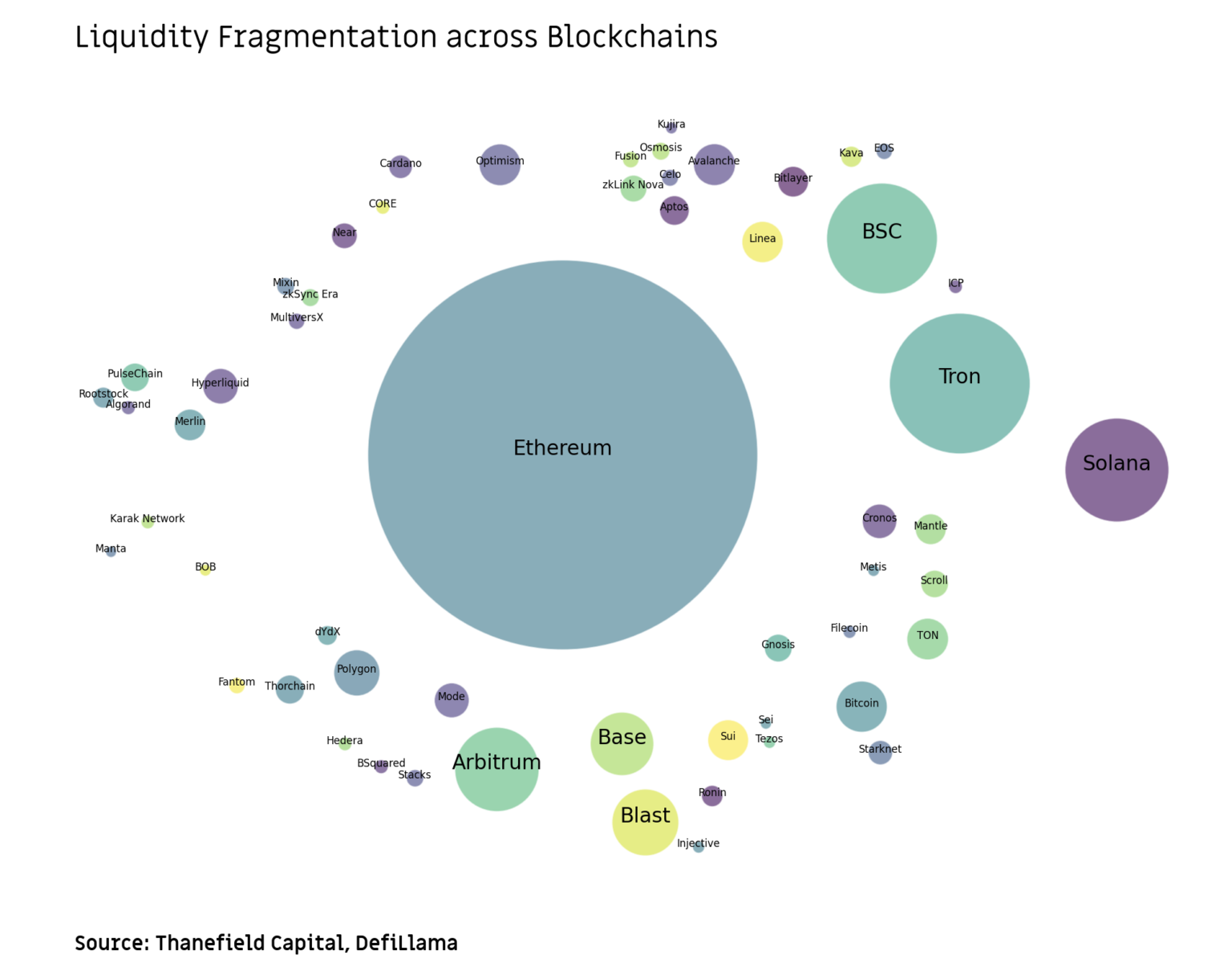
For example, a typical user operating across three blockchains faces several challenges. First, they need to find a secure, cost-effective, and fast bridge to transfer assets. If the bridge is poorly designed, users may pay excessive fees or have their assets locked up for long periods during transfers.
Additionally, users must hold sufficient native tokens to cover transaction fees on each blockchain. Using non-native assets (such as stablecoins) adds further complications. They also need to separately store and manage each mnemonic phrase, increasing friction and security risks.
Similarly, developers face increased complexity when ensuring cross-chain interoperability, managing cross-chain liquidity efficiently, and integrating various infrastructure layers—significantly extending development time.
Without solutions like chain abstraction that significantly improve user experience, these complexities will only worsen as the number of blockchains and rollups increases.
We believe chain abstraction is key to solving these challenges. By simplifying the experience for users and developers, it can unify fragmented environments, making blockchains more accessible and efficient for billions globally. Based on this vision, this article explores various projects in the abstraction space that are helping realize this future.
High-Level Concept of Chain Abstraction
Conceptually, chain abstraction aims to simplify the complexities involved in interacting with on-chain finance, hiding them from end users and developers.
From a developer’s perspective, chain abstraction enables rapid, secure development of chain-agnostic applications that run seamlessly across all rollups without worrying about underlying execution complexities.
From a user’s perspective, the vision is to allow interaction with decentralized applications without understanding the underlying cryptographic concepts. The goal is to eliminate all technical complexity and deliver an intuitive user experience.
A common analogy is how we interact with computer applications today. Although the internet is ubiquitous in daily life, most users don’t understand technical details like HTTP or TCP/IP. Similarly, when building web applications, most developers don’t need deep knowledge of communication protocols—the browser environment abstracts away most of the underlying work.
However, in today’s crypto landscape, funds on one chain cannot access applications on another without explicit bridging. Likewise, the choice of which blockchain to deploy on still matters significantly for developers.
Thus, current crypto resembles early consumer computing. Chain abstraction will be the driving force to elevate it to the seamless user experience of the modern internet.
Eliminating existing UX friction and simplifying interactions between end users, developers, and on-chain applications will unleash a new wave of growth for cryptocurrency. This will drive mass adoption and expand the user base beyond today’s isolated Web3-native communities to billions worldwide.
Early signs of this vision are evident in Telegram, which has 900 million users who can easily join crypto through a familiar interface. Similarly, Base users can set up smart wallets using passkeys, avoiding the need to securely store 12-word mnemonics or pay gas fees, as transactions can be sponsored by Coinbase.
While both ecosystems are still in early stages, their progress shows this vision is closer to reality than it appears—and entirely achievable.
Components of Chain Abstraction
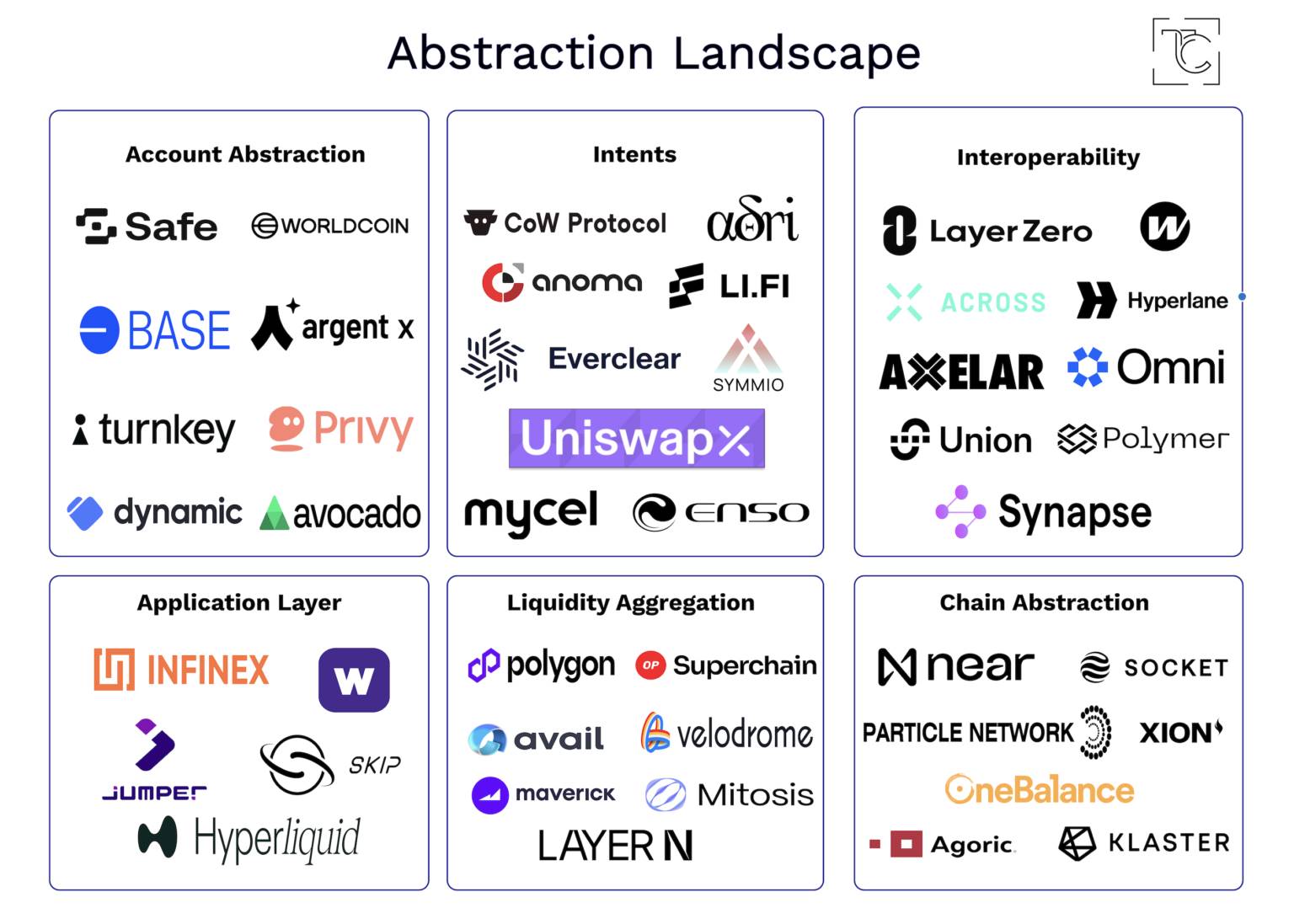
Achieving such a high level of abstraction requires breakthroughs across multiple infrastructure layers. Below, we first break down the building blocks of the abstraction stack, then dive deeper into each category, highlighting key projects and their design choices.
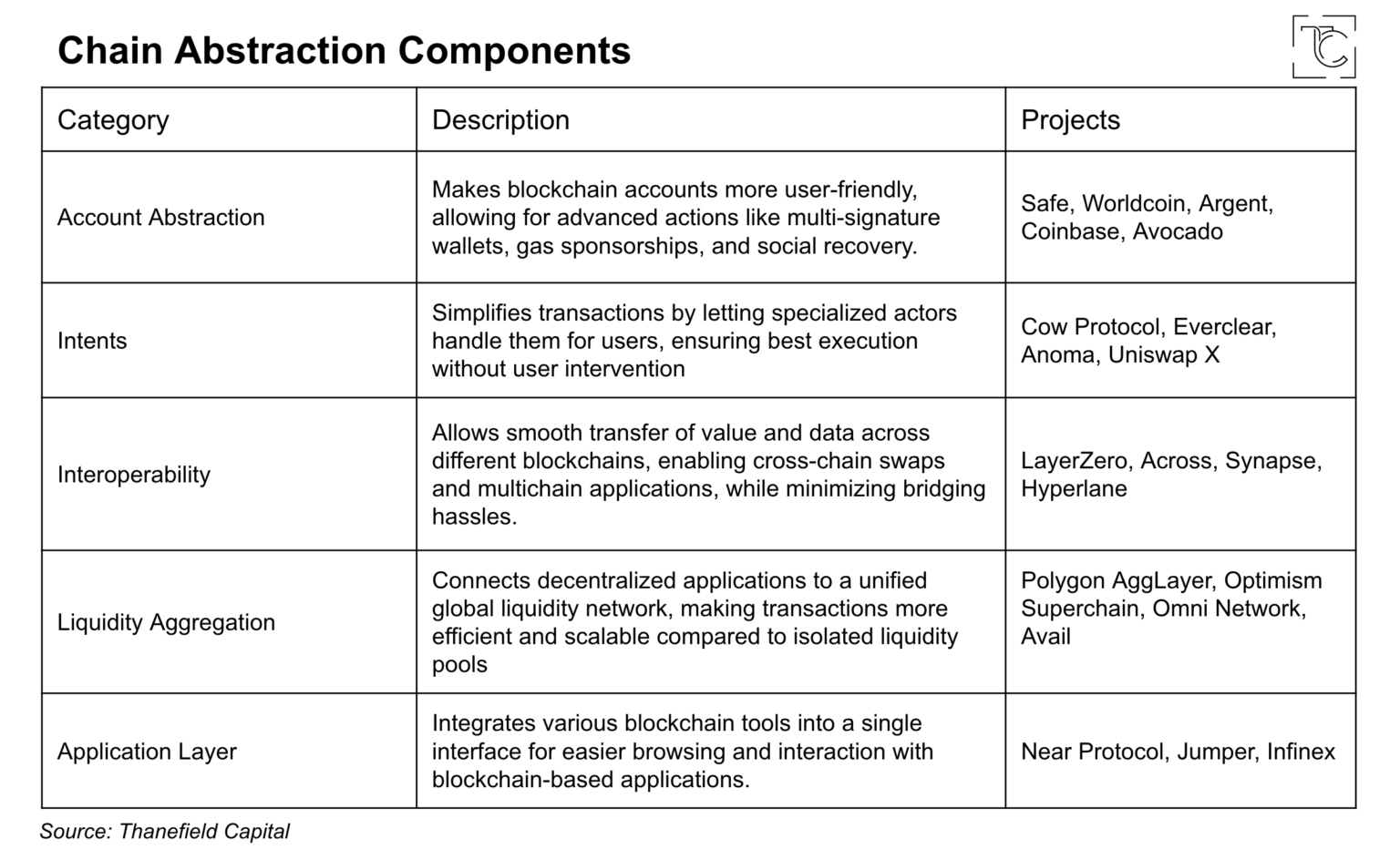
Account Abstraction
Account Abstraction (AA) introduces the concept of smart contract wallets to enhance blockchain user experience. It aims to simplify the complexity of using blockchain wallets—for instance, eliminating the need to manage public/private key pairs. The idea of AA emerged in the Ethereum community as early as 2016, driven by core developers’ dissatisfaction with limitations of existing wallets. Today, AA is part of Ethereum’s roadmap, with the ultimate goal of fully native AA. Although implementations may vary across blockchains, our focus will primarily be on account abstraction within Ethereum and EVM-compatible environments.
On most EVM-compatible chains, there are two types of accounts: externally owned accounts (EOAs) and smart contract accounts. EOAs are traditional wallets—like those accessed via MetaMask—controlled by private keys used to sign messages and interact with the blockchain. EOAs have several limitations that can significantly impact ordinary users’ Web3 experience, including private key management, the need for native tokens to pay gas fees, and inability to perform atomic transactions.
Smart contract wallets are fully programmable and address these UX issues by introducing Web2 design principles such as social login and account recovery. The method of implementing smart wallet functionality depends on the blockchain’s design and available infrastructure. On Ethereum and most EVM chains, the network currently does not support native account abstraction, meaning only EOAs can sign messages.
Currently, two smart wallet standards have been widely adopted, with millions of accounts deployed: Safe, the pioneer in this space, and ERC-4337, a relatively newer standard relying on intents and additional off-chain infrastructure. The upcoming Pectra upgrade will also include EIP-7702, advancing the existing account abstraction framework toward its final stage, where EOAs can transition into smart contract accounts.
Safe
As a pioneer and the most widely used provider in the account abstraction space, Safe (formerly Gnosis Safe) started as a multisig wallet. It has since evolved into a comprehensive smart wallet solution and become a critical component of Ethereum and EVM infrastructure. Safe has deployed nearly 10 million wallets and secures approximately $90 billion in assets across various EVM chains and rollups.
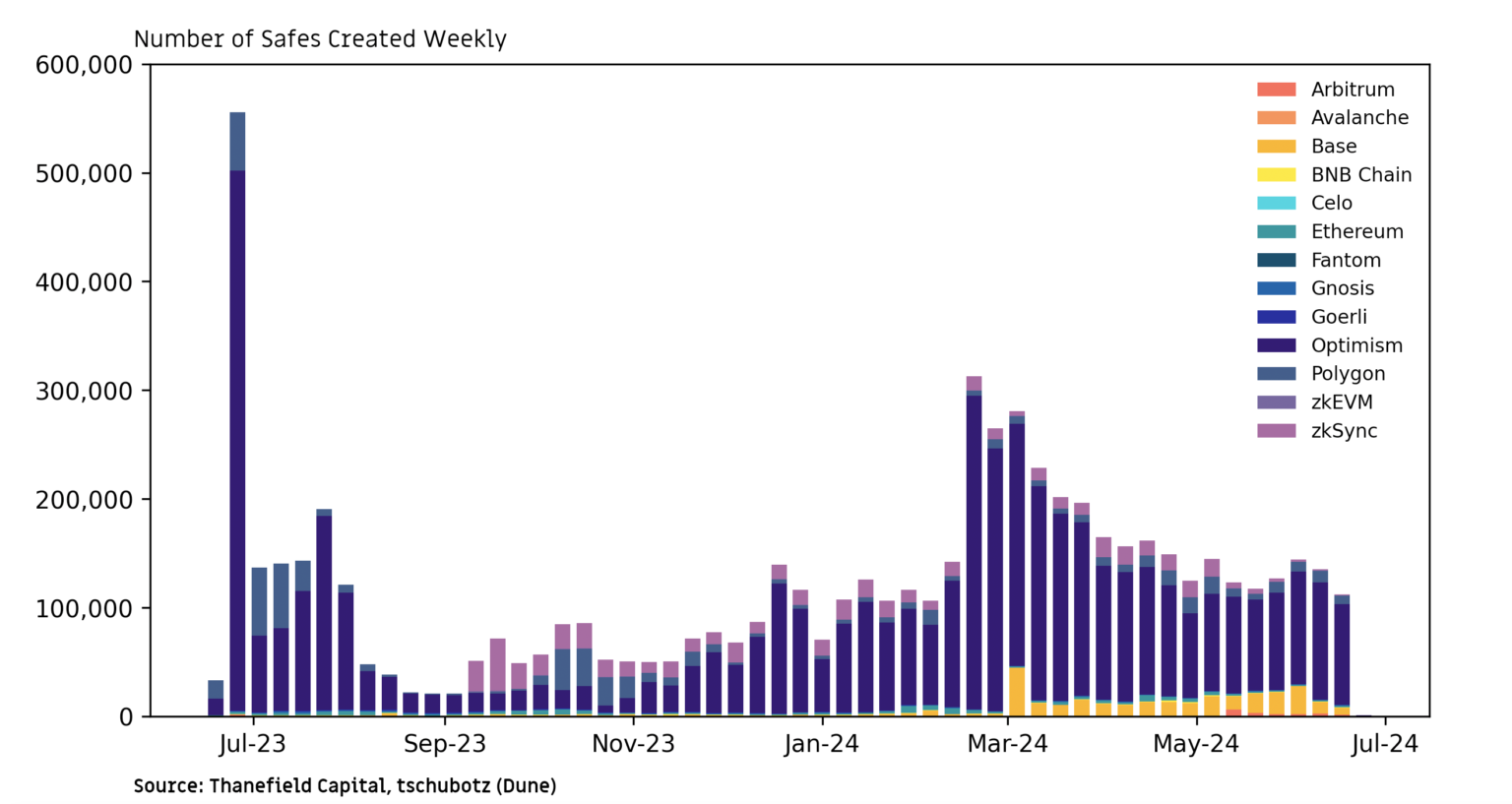
Safe adopts a modular architecture. Core components are integrated into the battle-tested Safe{Core} stack, while Safe Modules introduce custom functionalities that enhance overall capabilities. This modular approach is similar to hooks used in Uniswap v4—Safe Modules ensure strong security at the core layer and simplify customization and integration for developers. Developers can create modules tailored to specific needs or integrate existing ones. For example, users can add or remove modules enabling passkey authentication or spending limits. Additionally, Safe includes an ERC-4337 module, making it compatible with this newer account abstraction standard and its associated infrastructure.
ERC-4337
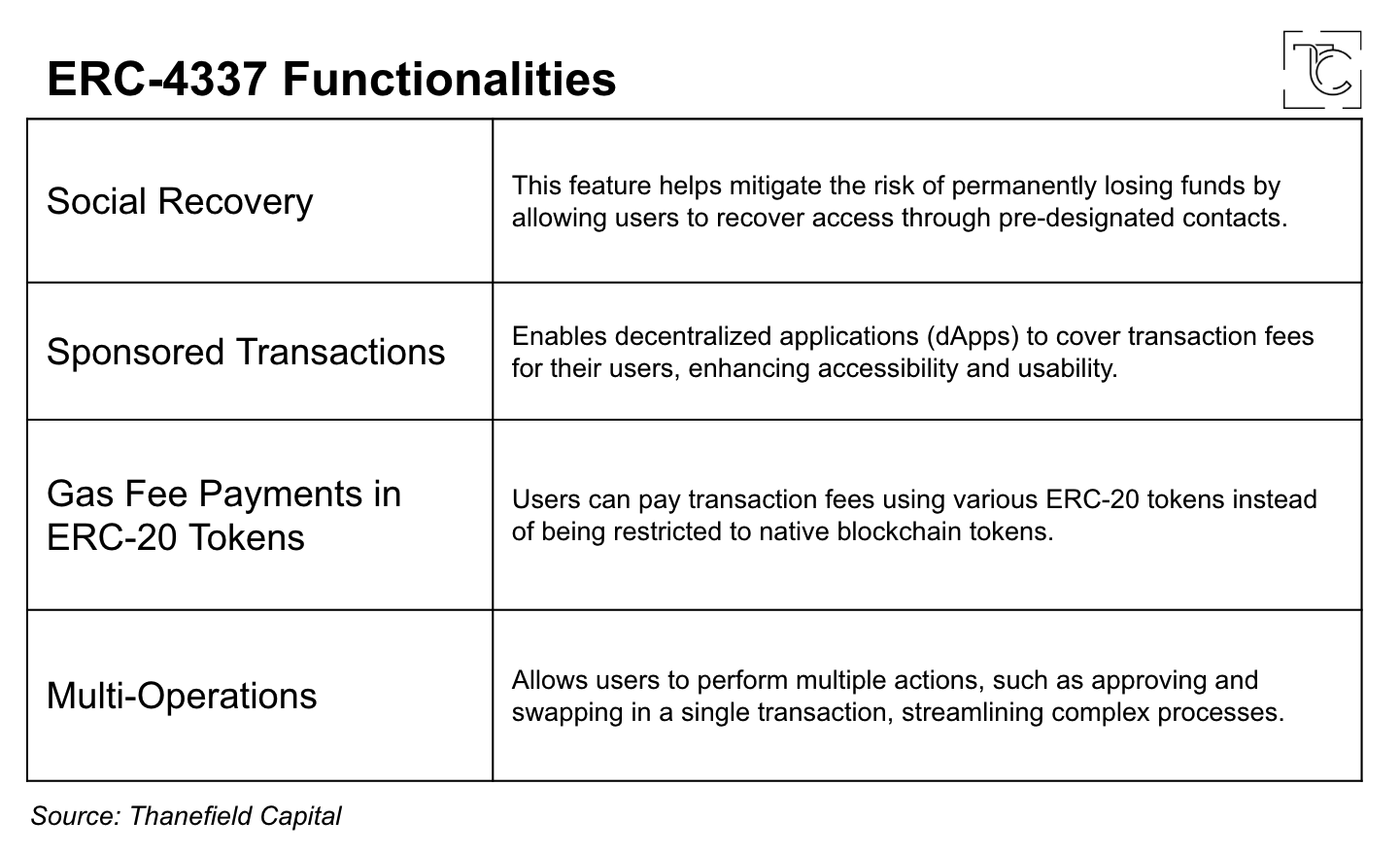
ERC-4337 is the current standard used on Ethereum and most EVM chains, implemented on the Ethereum mainnet in March 2023. It serves as an intermediate step in account abstraction development, enabling AA without requiring changes to the consensus layer protocol. Instead, it leverages a concept called pseudo-transactions (UserOps), which are intent-based and combine on-chain and off-chain infrastructure to facilitate and execute operations.
ERC-4337 brings significant improvements to user experience:
ERC-4337 Transaction Flow
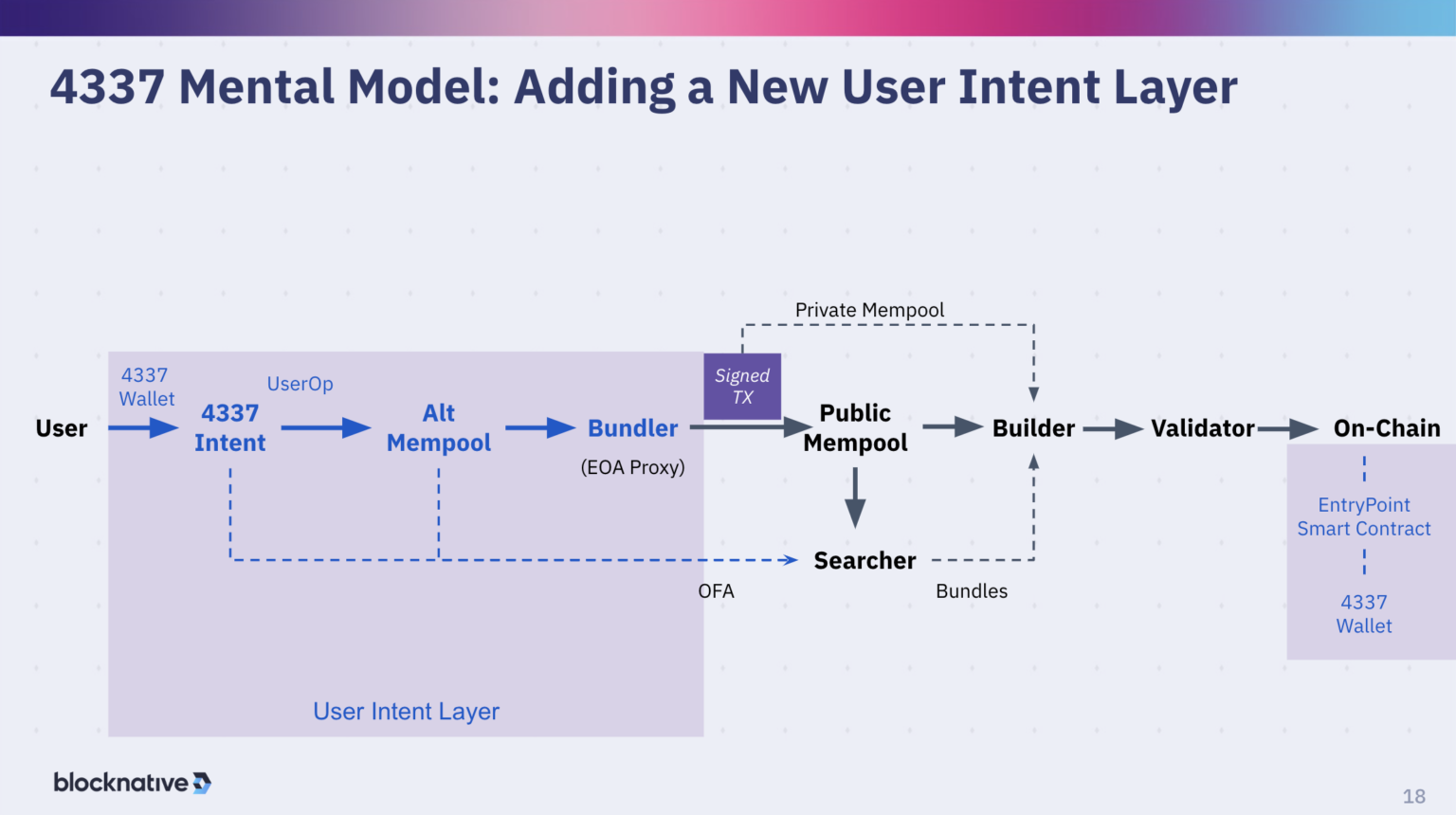
ERC-4337 introduces a new transaction flow without modifying the consensus layer. This approach integrates several infrastructure components, differing from the traditional EOA transaction cycle. The key difference lies in the steps before transaction signing; afterward, the process remains unchanged. Key elements include UserOps, Paymasters, Alternative Mempools (alt mempools), Bundlers, and the EntryPoint contract.
In the ERC-4337 transaction cycle, users express their intent to perform a specific on-chain action via a UserOp instead of directly signing a transaction. UserOps are managed in an alternative mempool (alt mempool), a dedicated pool separate from the public mempool. Bundlers, similar to block builders, monitor the alt mempool and select UserOps based on priority fees to bundle together. These bundles are signed by the bundler and submitted to the EntryPoint contract—a global contract on Ethereum dedicated to handling all ERC-4337 operations—for execution. If needed, Paymasters can sponsor transactions or pay gas fees using ERC-20 tokens. Afterward, transactions proceed normally and are executed on-chain.
For a visual representation of this process, this diagram provided by Blocknative is very helpful:
ERC-4337 Adoption
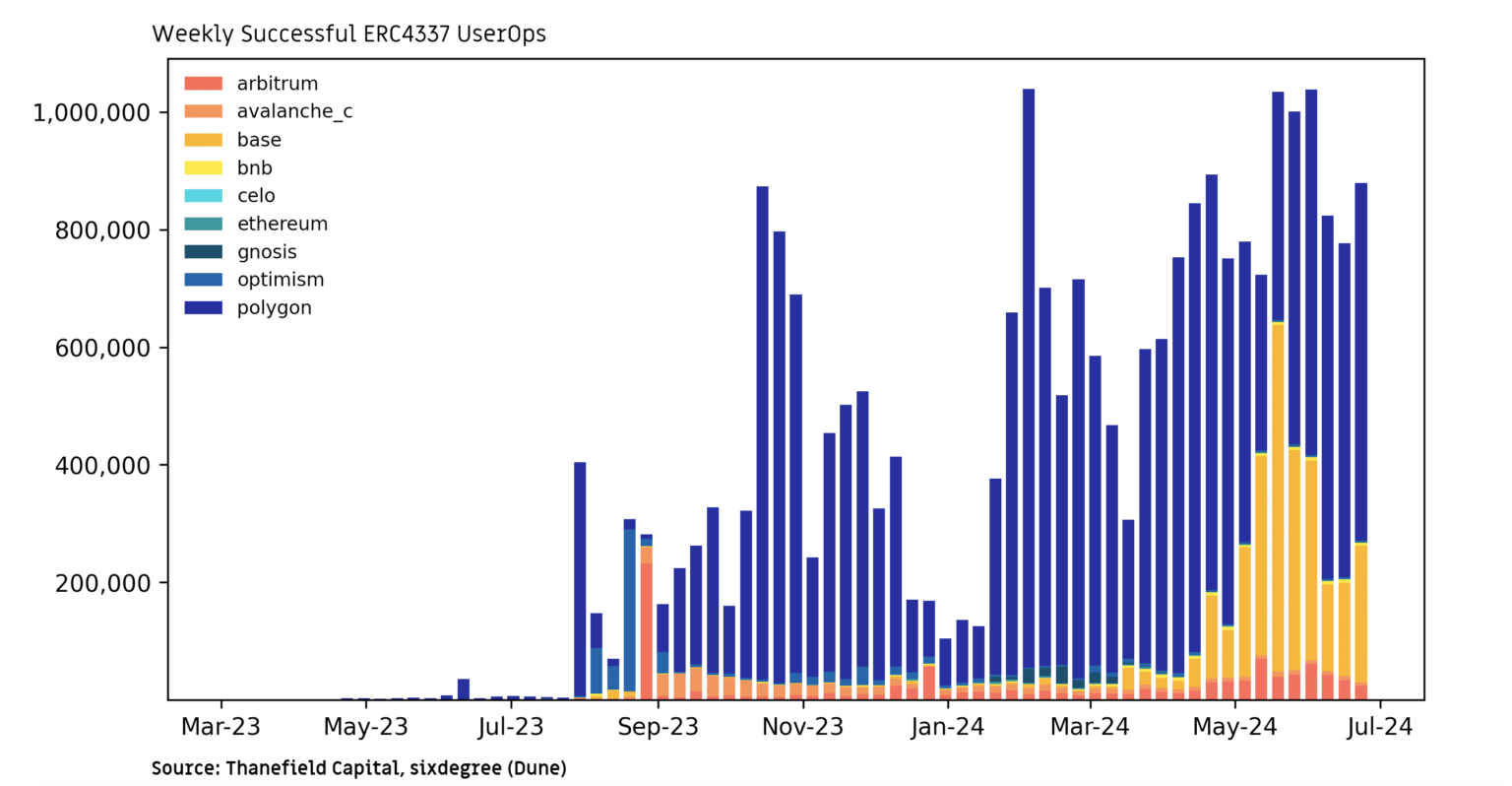
Since its deployment in 2023, ERC-4337 has seen widespread adoption on Layer 2 solutions and sidechains, particularly on Base and Polygon. To date, over 5.5 million ERC-4337 wallets have been created, with an average of around 800,000 successful UserOps per week.
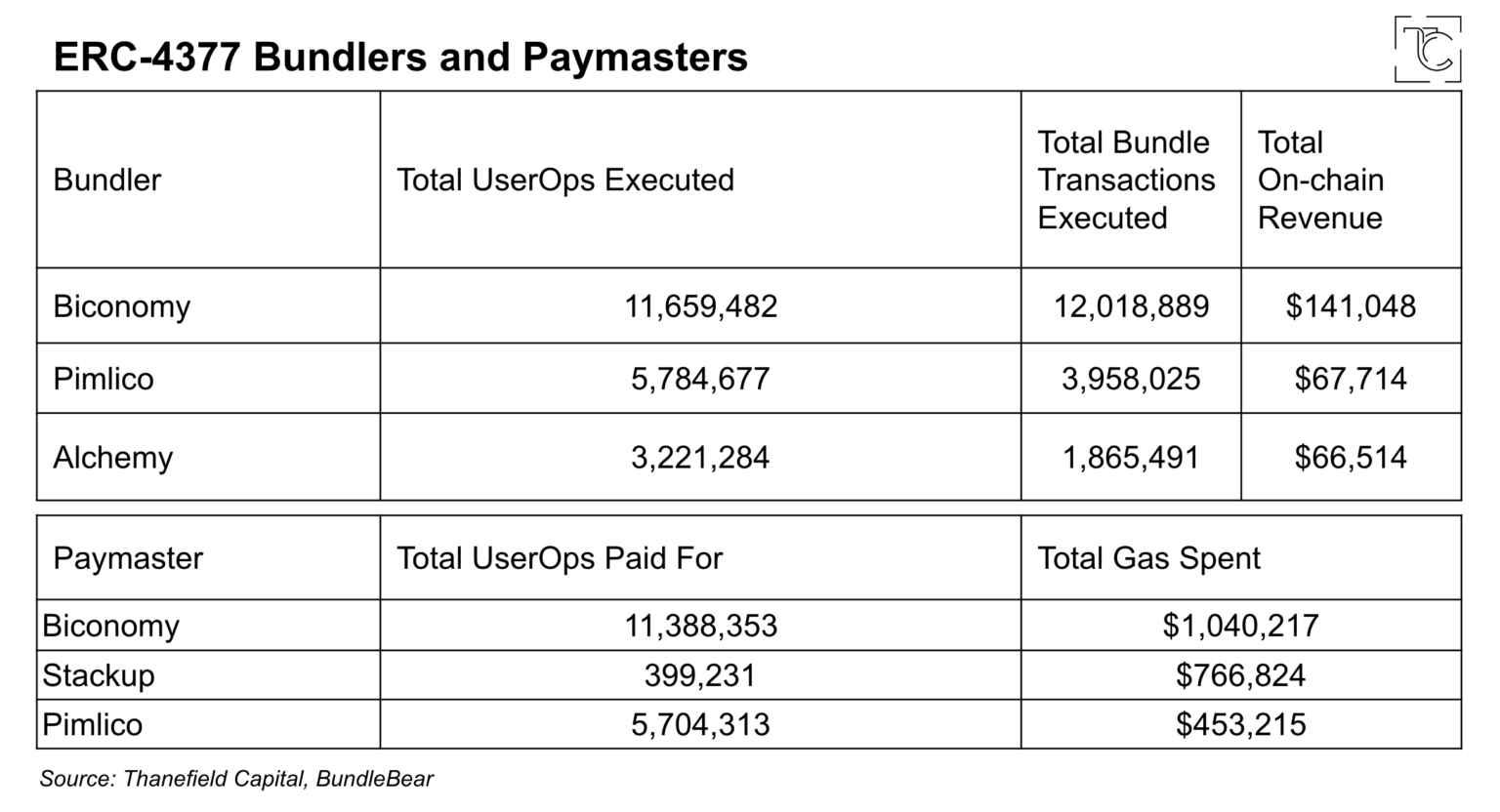
Coinbase is at the forefront of driving smart wallet development and adoption. On June 5, Coinbase launched the Coinbase Smart Wallet, a new product built on the ERC-4337 standard. This smart wallet offers several notable features, including passkey authentication, transaction sponsorship for selected dApps on Base, and multi-account ownership. As Coinbase focuses strategically on bringing new users to the Base platform, smart wallets are likely to soon become the dominant wallet type on Base. Biconomy, Pimlico, and Alchemy are also emerging as key providers of critical ERC-4337 infrastructure components, especially in bundling and paymaster services. The table below shows dominance in terms of executed and paid UserOps.
Despite these encouraging figures, ERC-4337 wallets have not yet achieved widespread adoption on the Ethereum mainnet, with only two to three hundred active wallets per week. Safe wallets remain the dominant smart wallet standard on Ethereum. One major limitation of the ERC-4337 design is that it does not allow existing EOA wallets to be converted into smart wallets. Additionally, relatively high gas fees on the Ethereum mainnet make certain features (like transaction sponsorship) economically unfeasible.
EIP-7702
Following ERC-4337, EIP-7702 represents a significant step toward fully native account abstraction. This proposal, drafted by Vitalik Buterin, quickly emerged as a response to the controversial EIP-3074, which faced compatibility issues with future Ethereum AA roadmap proposals. Unlike ERC-4337, which operates at the infrastructure level, EIP-7702 proposes direct changes at the protocol level. The proposal is expected to be included in the upcoming Pectra upgrade, scheduled for Q4 2024 to Q1 2025.
EIP-7702 is considered one of the most important user experience improvement proposals in Ethereum’s history. It enhances the ERC-4337 framework by introducing key features such as transaction batching, gas sponsorship, and temporary permissions for EOAs. Specifically, it introduces a new transaction type allowing EOAs to temporarily adopt smart contract code during a transaction and revert to their original state afterward. The proposal ensures forward compatibility with existing ERC-4337 implementations and aligns with the long-term goals of Ethereum’s AA roadmap.
Case Study: Worldcoin
Worldcoin is developing a protocol called "human identity verification" aimed at enabling applications to verify that users are real humans rather than AI-driven bots. This verification is achieved through World ID, a digital passport issued after users scan their iris using Orbs—specialized devices. Once obtained, World ID can serve as a universal verification tool across various applications and services. In addition to verification, users receive biweekly WLD grants distributed on-chain.
Worldcoin has successfully issued over 4.5 million World IDs, enabling users to verify their identity without any prior blockchain knowledge. During registration, the World App automatically generates a Safe smart wallet for each user on the Optimism network in the background. This process completely abstracts the blockchain layer, delivering a user experience akin to Web2 features such as facial authentication, social recovery, and detailed account management.
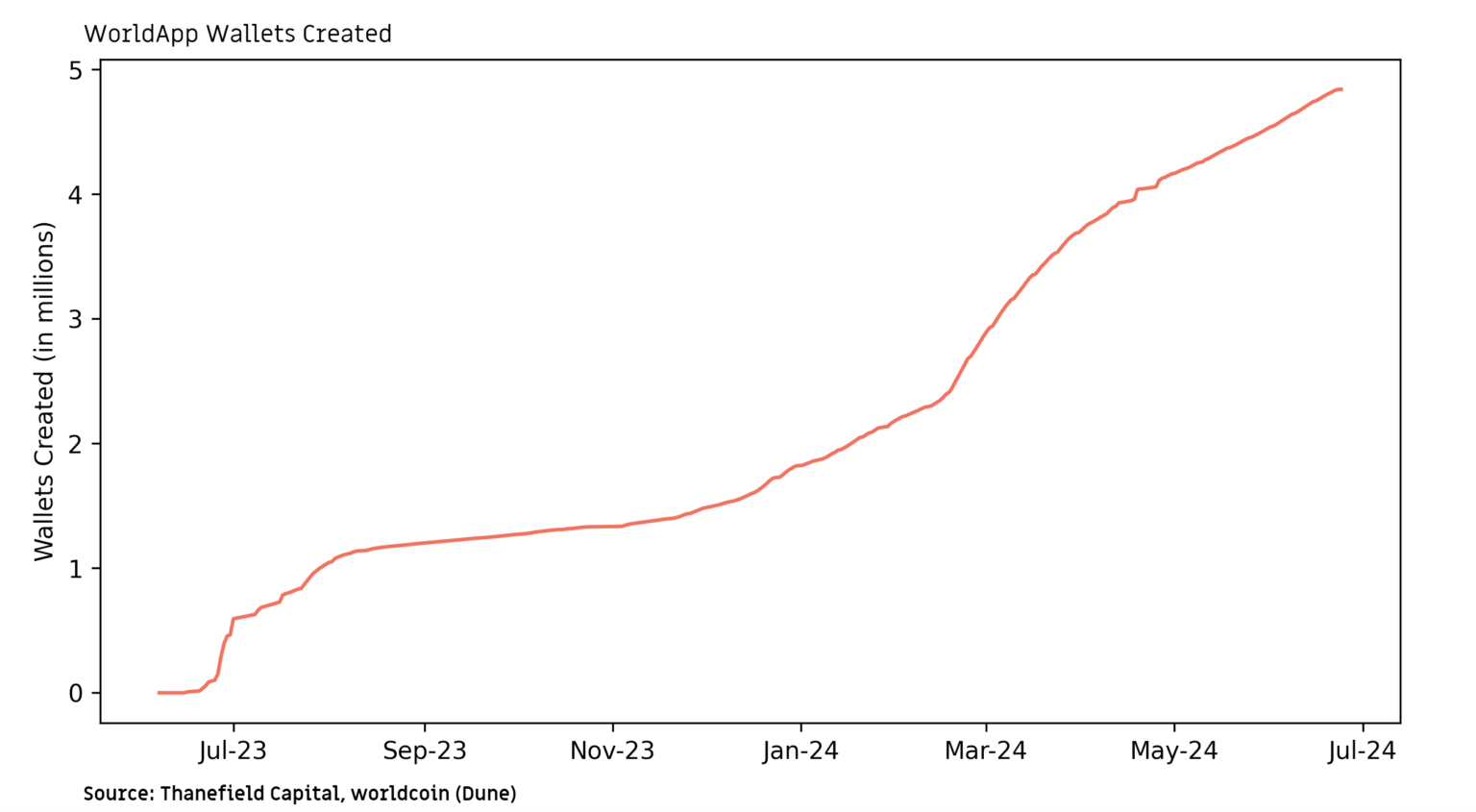
Both WLD grants and World ID are stored in a self-custodial manner, ensuring users retain control over their digital assets. In Worldcoin’s case, Safe-powered smart accounts enable users to enjoy the benefits of self-custody and economic incentives offered by crypto while experiencing a Web2-like UX. As a result, Web3 adoption has been impressive, with a large number of first-time Web3 users joining the ecosystem.
Interoperability, Liquidity Aggregation, and Intents
With Ethereum’s rollup-centric roadmap and the rise of application-specific chains, the number of distinct blockchain platforms will rapidly increase. This expansion underscores the necessity for robust cross-chain communication.
Some ecosystems have developed native interoperability solutions, offering standardized security models and achieving a degree of chain abstraction within their domains. Notable examples include Polkadot’s shared security architecture and Cosmos’ IBC protocol. In the context of rollups, synchronous cross-chain message passing and atomic cross-chain interactions can be achieved using shared sequencers responsible for processing, ordering transactions, and managing state. For instance, Optimism has adopted this approach for its Superchain vision.
Despite these advances, cross-chain communication—especially beyond these established ecosystems—remains a major challenge due to lack of native interoperability and broad standardization. In this section, we explore various architectural designs for interoperability in the context of chain abstraction. We also highlight leading projects in each vertical, showcasing how they advance blockchain connectivity.
Message Passing Systems
The classic approach to blockchain interoperability involves using general-purpose message passing systems, typically relying on a set of external validators. In this design, users specify desired outcomes, and off-chain entities construct precise execution paths across multiple chains. These paths are executed by a coordinated set of smart contracts and relayers. However, because each chain continuously produces blocks and changes state, achieving atomic execution across multiple chains is inherently challenging. Even with a robust data availability layer maintaining the state of all integrated chains, navigating routes across multiple chains involves significant complexity.
Message passing systems vary greatly in design and architecture. They can be modular or monolithic, permissioned or permissionless, support different chains, and operate based on mint-and-burn mechanisms or liquidity pools. Developers face numerous trade-offs when selecting a message passing system to integrate into a chain abstraction stack, as each offers different levels of security guarantees and user experience. This diversity in design and functionality may hinder the adoption of universal standards, leading to further fragmentation in the field.
Currently, cross-chain aggregators like Li.Fi and Socket use simple message passing systems. These platforms integrate with numerous bridges and DEXs, simulating suggested routes for users. Once a route is selected, it executes in strict sequence.
Intent-Based Designs
In intent-based interoperability designs, users simply express their desired outcome, rather than specifying exact execution paths as in traditional blockchain transactions. These intents are auctioned to Solvers (off-chain entities), who bid for the right to execute them. The specific resolution method is irrelevant—they can be partially or fully matched or filled from the Solver’s own inventory. In this system, users define the outcome, and experts compete to deliver optimal execution.
A key advantage of this approach, especially in cross-chain asset transfers, is that it handles native tokens directly instead of IOUs, providing native security guarantees and enhancing overall safety. Currently, intent-based applications exist primarily in bridges (such as Across and Synapse) and decentralized exchanges (such as Cow Swap, Uniswap X, and 1inch Fusion).
Recently, Across and Uniswap collaborated to propose the cross-chain intent standard ERC-7683, marking the first attempt to create a unified framework for standardizing cross-chain operations in intent-based systems. Other notable developments include Socket’s recent release focusing on modular cross-chain order flow, and Everclear (formerly Connext) announcing intent-based primitives leveraging a solver network and an EigenLayer-based optimistic rollup to manage liquidity across blockchains.
However, implementing intent-based solutions faces significant challenges. First, users need access to a cross-chain account—an intelligent account that manages keys in the background and enables cross-chain transactions. Additionally, standardization is a major hurdle—currently, every intent-based application must independently develop its infrastructure, including intent aggregation, matching, and auction models. This lack of standardization leads to fragmentation and inefficiency across the ecosystem.
Chain abstraction is a concept without technical specifications, so it can be approached from many angles. In our view, some of the most interesting attempts include Anoma’s intent-centric architecture, Polygon’s Aggregation Layer, and NEAR’s full-stack chain abstraction solution. We’ll now explore these initiatives in depth.
Case Study: Anoma
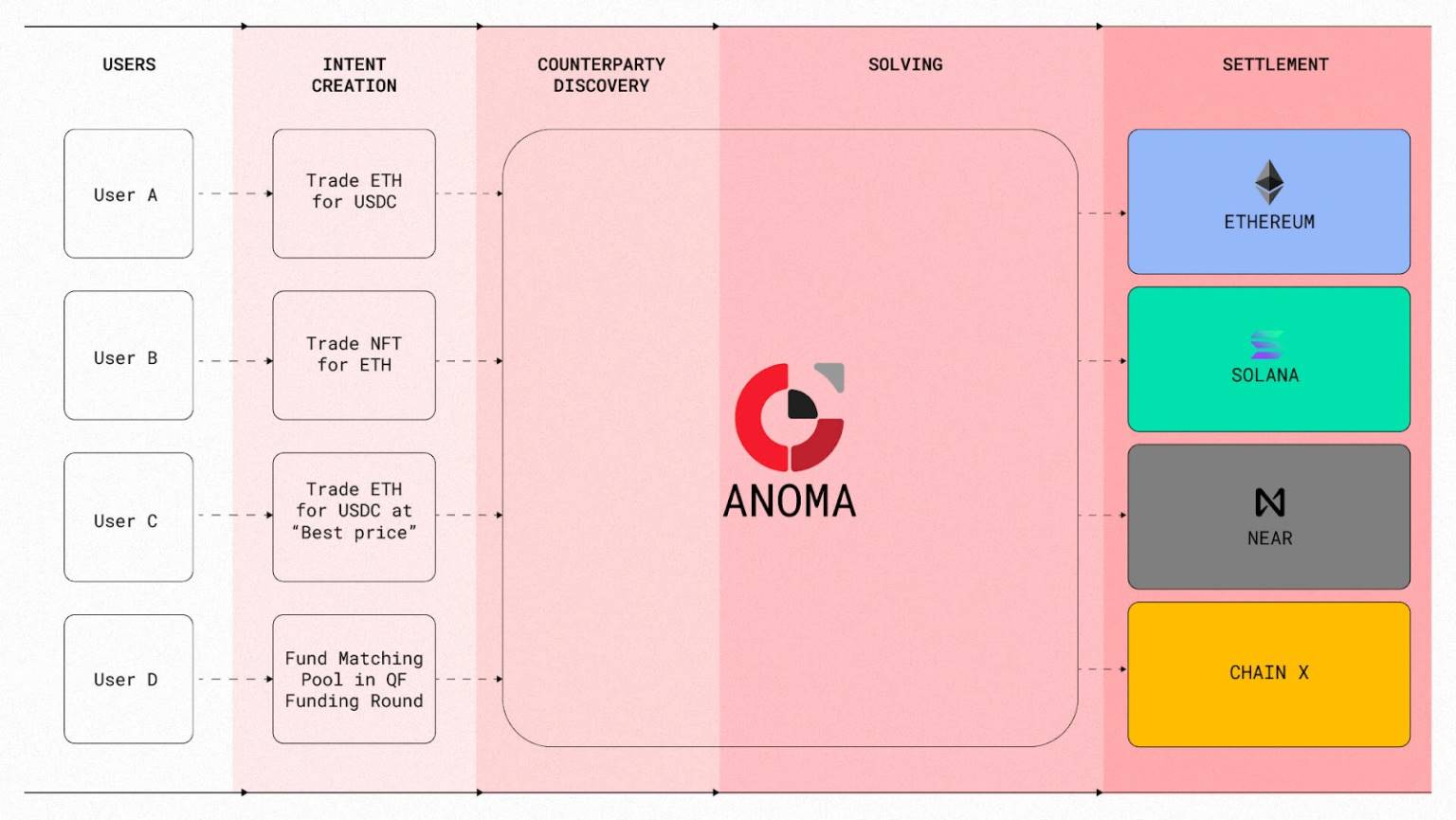
Anoma is a privacy-focused, intent-centric protocol designed to enable decentralized counterparty discovery, settlement, and atomic multi-chain settlement. The platform has a unique architecture: unlike traditional blockchain systems requiring users to specify execution flows, Anoma only requires users to define acceptable final states, expressed through programmable commitments called intents. Anoma’s uniqueness lies in the composability of these intents, which can be collectively resolved regardless of origin.
Anoma’s transaction architecture consists of the following steps:
-
Generalized intents: Anoma’s architecture can handle arbitrary intents, not limited to specific applications or special cases. This flexibility allows for a wide range of applications and interactions.
-
Counterparty discovery: A decentralized process where individual intents propagate across the network, becoming accessible to potential solvers.
-
Solving: At this stage, solvers collaborate to combine and compute intents, finding a valid solution—a transaction that can be executed and settled across chains.
-
Settlement: The solution is verified and finalized on-chain. Anoma’s intent-centric architecture supports settlement on its own sovereign L1, other L1s, or any rollup settling on an L1.
Case Study: Polygon AggLayer
Polygon’s AggLayer is a zero-knowledge (ZK)-based system designed to solve interoperability and fragmentation issues among different rollups and Layer 1s (L1s). By aggregating ZK proofs from all participating chains, this approach delivers unified cryptographic security and atomic composability.
AggLayer brings connected environments to Ethereum via a unified bridging contract. Each connected chain maintains a copy of this unified bridge root, enabling seamless cross-chain transactions. Additionally, AggLayer features a message protocol bridge that establishes message queues for each chain, allowing them to maintain local outbound message queues protected by ZK proofs. This eliminates the need to lock tokens on one chain to interact with another. By publishing ZK proofs of events across multiple chains on Ethereum, AggLayer achieves a seamless user experience akin to a single ecosystem.
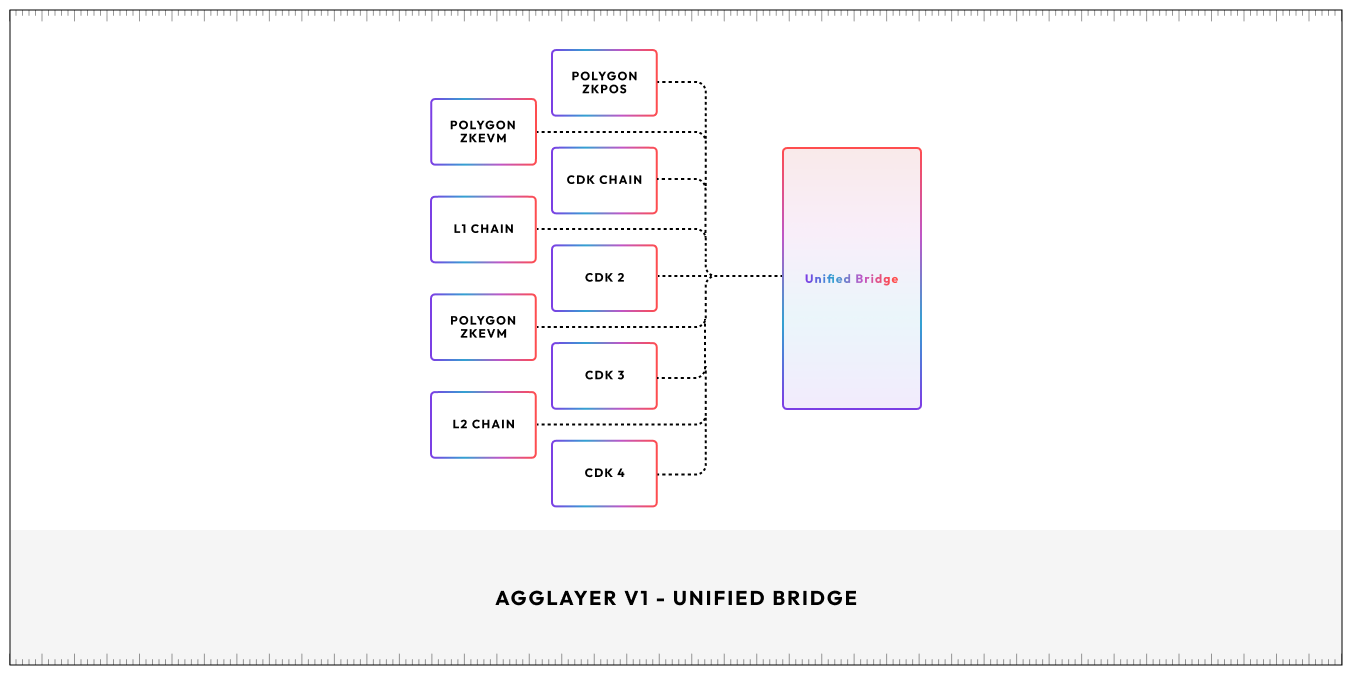
Polygon CDK allows projects to launch ZK-based interconnected L2s or connect existing L1s to AggLayer, preserving liquidity, users, and state. The first component of AggLayer went live in February 2024, marking a significant step for Polygon in creating a network of sovereign chains.
Case Study: NEAR Chain Abstraction Stack
NEAR is developing a comprehensive chain abstraction stack for its blockchain and surrounding ecosystem. The stack includes the following components:
-
Security Aggregation Stack: Includes NEAR DA (data availability), which collects state supporting chains. It also integrates zkWASM developed in collaboration with Polygon and leverages EigenLayer for fast finality to accelerate transaction processing.
-
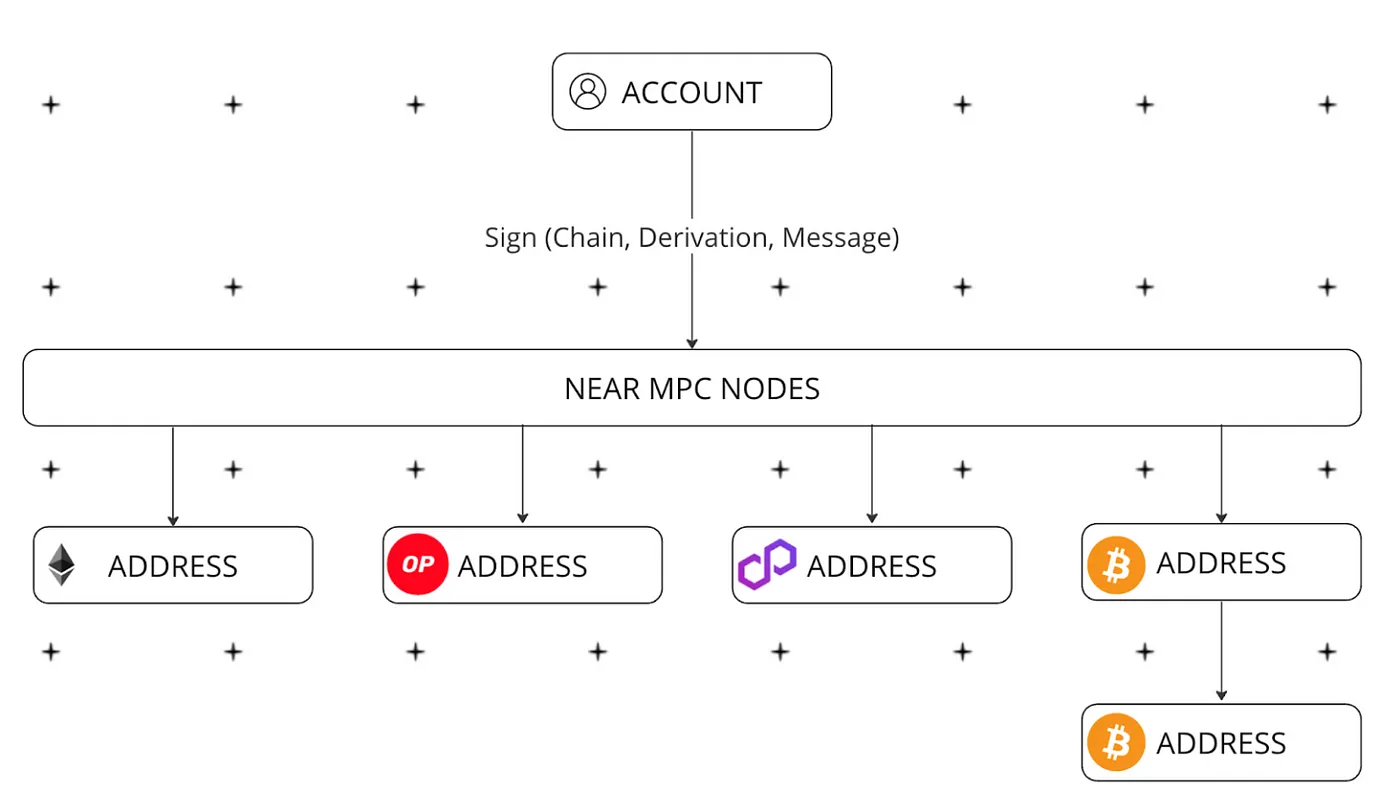
Account Aggregation: Based on Multi-Party Computation (MPC), this component enables NEAR accounts to authenticate interactions with external blockchains via signature requests. Private keys for these external chain accounts are managed by NEAR network validators as a decentralized signing service. This setup effectively binds accounts from different networks to a central NEAR “master account,” securely managing all linked accounts.
-
Intent Layer: Contains relayers that execute complex cross-chain intents, enabling more sophisticated transactions and interactions across blockchain networks.
-
Application Layer: Integrates various Web3 services into a user-friendly application, simplifying access to and interaction with decentralized technologies.
Below is a visual representation of NEAR’s account aggregation architecture:
Application Layer
Viewing the stack from the bottom up, the application layer is the final stage of chain abstraction, where infrastructure is integrated and consistently presented to developers and users.
Ideally, developers should be able to easily build protocols independent of specific blockchains without integrating various modular layers—reducing significant workload. This means developers wouldn’t need to consider blockchain selection, cross-chain liquidity management, or data availability solutions.
From a user’s perspective, the ideal state is interacting with blockchain applications as smoothly as using other digital services, without dealing with crypto-related hassles like gas fees and seed phrases. This requires simplified UIs, optimized onboarding, and removing the need for users to understand underlying technology—major barriers today. Eliminating these barriers would dramatically improve user experience and drive mass adoption.
Before realizing this vision, tools must be developed to integrate diverse infrastructures into a unified interface. Therefore, we believe chain abstraction is crucial for excellent user experience.
Whoever controls the front end has the most direct relationship with users and captures maximum value from their order flow. While most attention and investment today focus on infrastructure, we believe the future will shift toward higher layers of the stack.
Conclusion
There are currently nearly 300 chains with significant liquidity and on-chain expressiveness—from Layer 1s to Layer 3 solutions. This number continues to grow with no signs of slowing down.
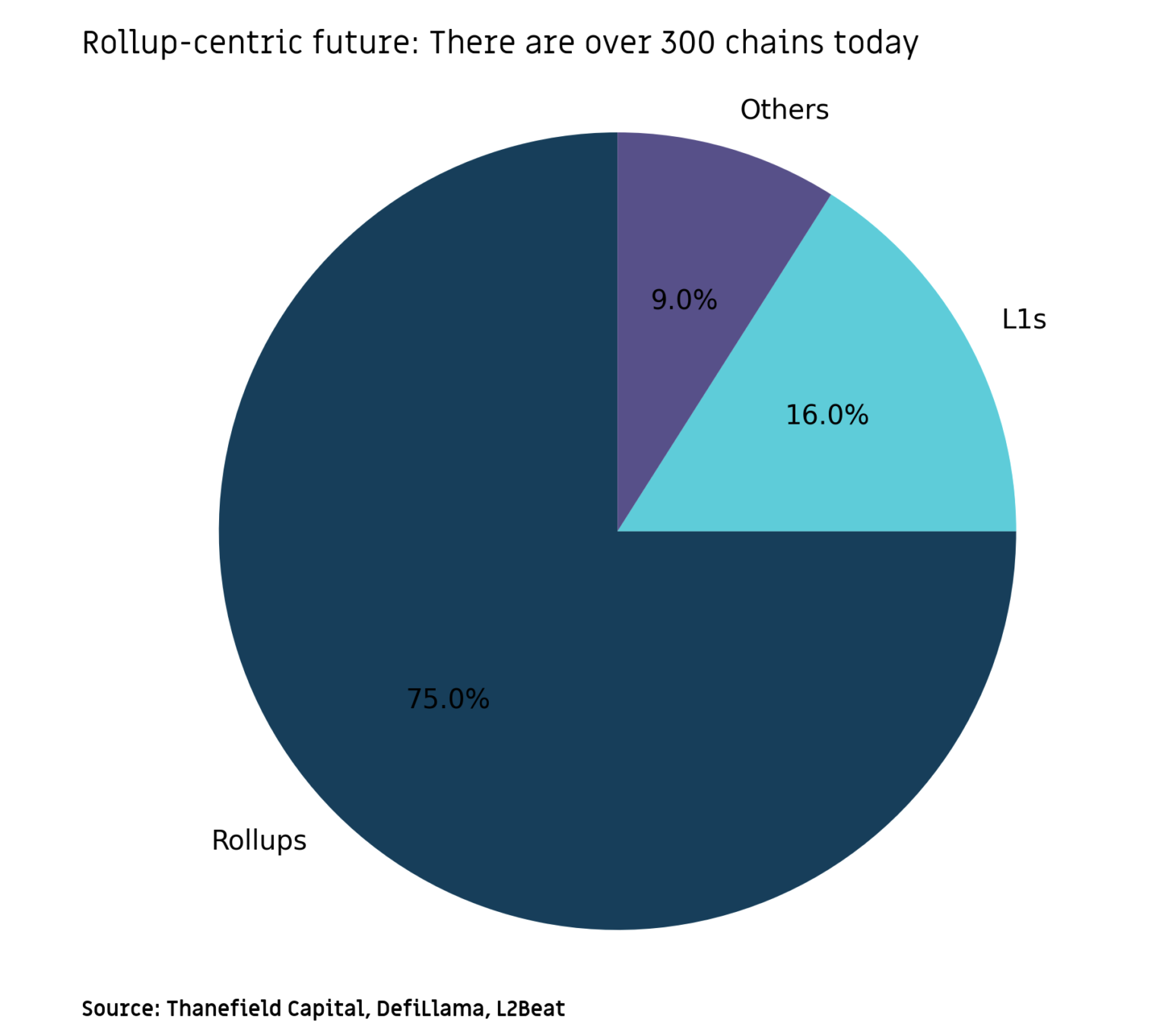
One of the main drivers behind this growth is applications’ demand for scalability and sovereignty, achievable through owning their own execution stack and economic model. For example, recently ENS, Aave, and dYdX launched their own rollups. Open-source technologies like OP Stack have made building, deploying, and operating rollups cheaper and easier, and Rollup-as-a-Service providers like Conduit and Caldera further reduce operational and technical overhead. Ironically, deploying a rollup today is often cheaper than transacting on Ethereum during the 2021 cycle.
For today’s users, managing crypto is often confusing and tedious—protecting seed phrases, signing multiple transactions for simple tasks, handling assets across different chains, bridging them, and finding the best prices across various DEXs. While rollups offer potential to scale without sacrificing security and decentralization, their proliferation increases complexity from user and developer perspectives. Simple implementation would only worsen user experience.
Modern chain abstraction tools solve this problem, making crypto simpler and more viable for a broader audience. Due to their proximity to users, winners in this space will capture substantial value. As on-chain applications generate increasing revenue, the market will recognize the importance of owning the front end.
Join TechFlow official community to stay tuned
Telegram:https://t.me/TechFlowDaily
X (Twitter):https://x.com/TechFlowPost
X (Twitter) EN:https://x.com/BlockFlow_News
 @ThanefieldRes