Particle Network: Understanding the Similarities and Differences Between Interoperability and Chain Abstraction
TechFlow Selected TechFlow Selected
Particle Network: Understanding the Similarities and Differences Between Interoperability and Chain Abstraction
As chain abstraction solidifies as the next evolutionary step for Web3, interoperability solutions will find new and creative ways to contribute to it, creating a positive flywheel effect.
 Navigating Web3 tides with focused insights
Author: Carlos Maximiliano Cano
Translation: TechFlow
Since the emergence of the first smart contract networks, the field of blockchain interoperability has evolved with the clear goal of enabling users to freely navigate multi-chain environments regardless of differing blockchain standards, architectures, and economic structures.
At the same time, the race to build better blockchains and scale existing ones has not stopped, leading to the following situation:
-
Blockchains are faster and cheaper than ever before, continuously launching and evolving.
-
Modular scalability through L2s/L3s has become fully integrated into the overall Web3 roadmap and culture, but comes with the side effect of fragmentation.
-
Interoperability and cross-chain technologies aim to connect blockchains, but have failed to independently solve broader Web3 user experience issues.
-
Chain abstraction (ChA) emerges as the ultimate solution to transform modular ecosystems into borderless ones, abstracting away the complexity of interacting with multiple chains.
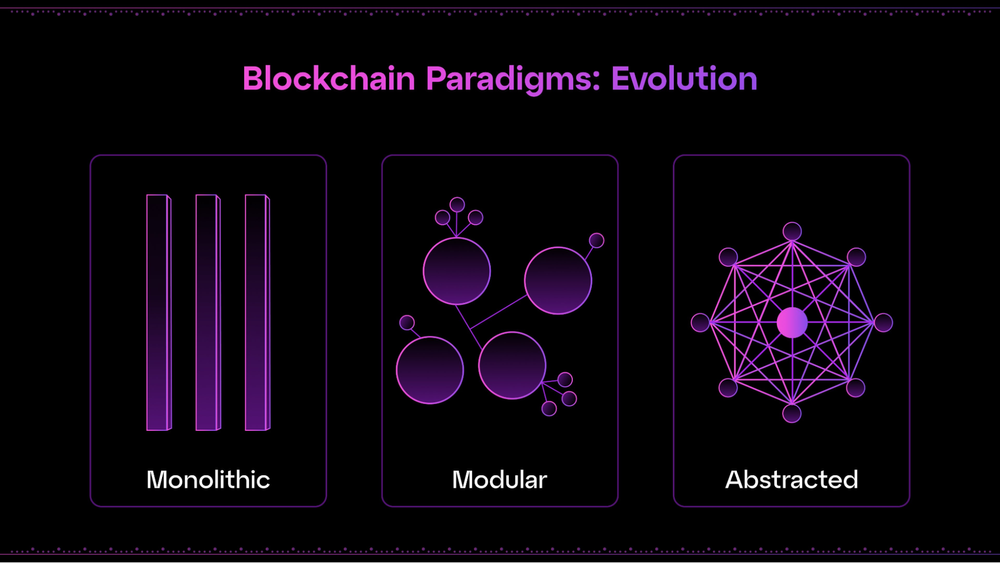
The evolution of blockchains. In today's rapidly expanding modular paradigm, some ecosystems inevitably become isolated.
With this paradigm shift in Web3 experiences, it's worth asking: If chain abstraction solutions aim to create a borderless, unified ecosystem where users can easily (often unconsciously)move across chains, how do they differ frominteroperabilityand cross-chain solutions?
This article aims to answer that question while providing a comprehensive overview of the deep relationship between these two concepts and their evolution over time.
Demystifying Blockchain Interoperability and Chain Abstraction
Since the terms "blockchain interoperability" and chain abstraction are often confused, it is important to clearly and narrowly define both:
Interoperability
The term "interoperability" is widely used in Web3 and, as mentioned in the introduction, often means different things. To provide a definition broad enough to encompass all solutions categorized under this term while clearly delineating its boundaries, we can use the following:
-
Interoperability solutions: Refers to various components and technologies that facilitate interaction between one chain and one or more other chains. These solutions can be user-facing or developer-oriented, enabling cross-chain usage within dApps or as standalone products.
Therefore, blockchain interoperability solutions can range from simple communication primitives to relatively complex products, some of which have become integral parts of the current Web3 paradigm (e.g., bridges). An incomplete list includes:
-
Cross-chain bridges that enable asset transfers between chains.
-
Atomic swap protocols allowing users to exchange assets on one chain for assets on another.
-
Arbitrary Message Bridges (AMBs) that allow message exchange between blockchains. Developers leverage AMBs to enable interoperability among dApps and other products or infrastructure.
DEX-based specialized interoperability protocols (e.g., ThorChain).
Chain Abstraction
As a quick recap from our previous articles, chain abstraction (ChA) is the ecosystem’s organic response to the ongoing issue of Web3 fragmentation. It is defined as “user experience unaffected by manual processes required to interact with multiple chains,” and to be fully realized, requires multiple technical layers across different levels of the tech stack. This is illustrated below:
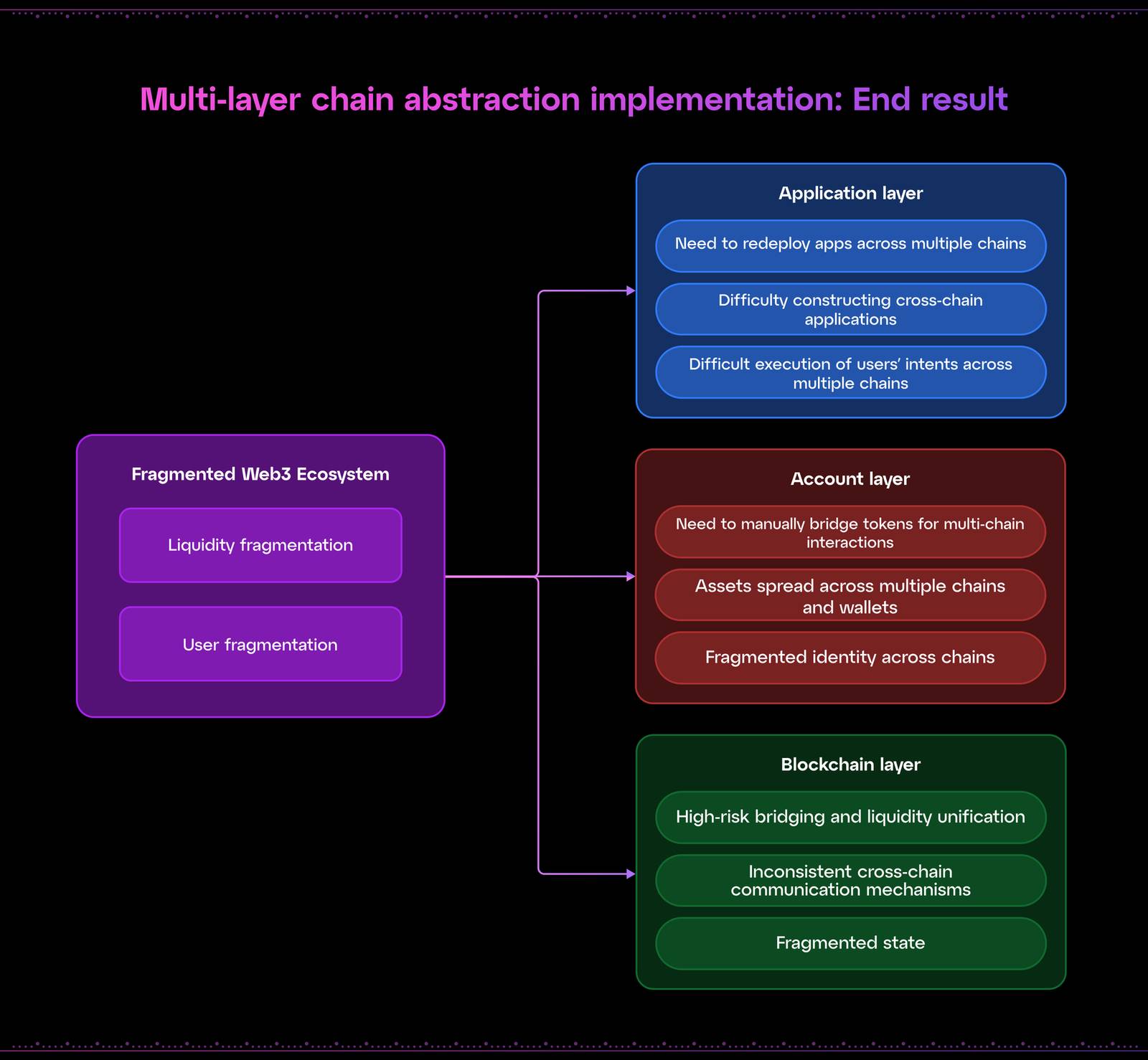
The three layers of chain abstraction and the problems each layer addresses.
The Relationship Between Interoperability and Chain Abstraction Solutions
We have already discussed in detail how interoperability technologies serve as foundational elements for achieving chain abstraction experiences.
Interoperability solutions largely form the bedrock upon which chain abstraction (ChA) is built. Without the foundation laid by bridges, messaging protocols, and other solutions, simplified multi-chain workflows would be unimaginable. Therefore, we can say that the field known today as "chain abstraction" is, to some extent, the result of leveraging interoperability solutions to improve multi-chain experiences.
This is also why we view blockchain interoperability—alongside account abstraction and intents—as one of the three fundamental technologies for improving Web3 user experience and a major driving force behind ChA innovation:
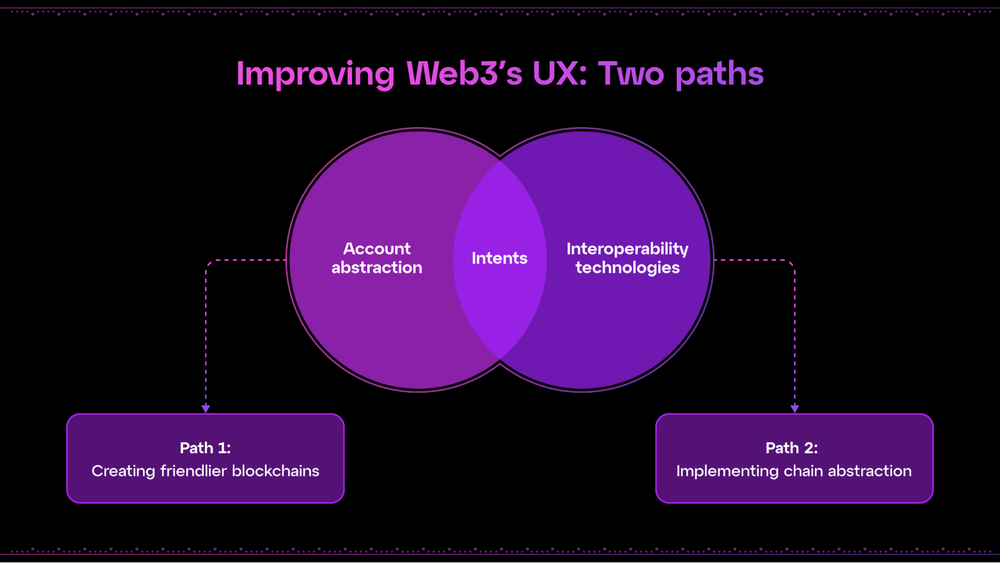
Together with account abstraction and intents, interoperability solutions aim to abstract away the complexities of Web3, pushing toward a frictionless future.
Leveraging Blockchain Interoperability Solutions for Chain Abstraction
Here, it's worth exploring how interoperability is used to build chain abstraction solutions. For this, we can revisit our integration depth framework.
The framework is based on the idea that any component that in some way achieves “eliminating manual processes required for multi-chain interactions” can be considered a chain abstraction solution. Thus, interoperability technologies such as cross-chain messaging solutions remain part of the ChA stack but are primarily implemented at “deeper-level” integrations that leverage them to achieve chain abstraction across multiple areas of user experience.
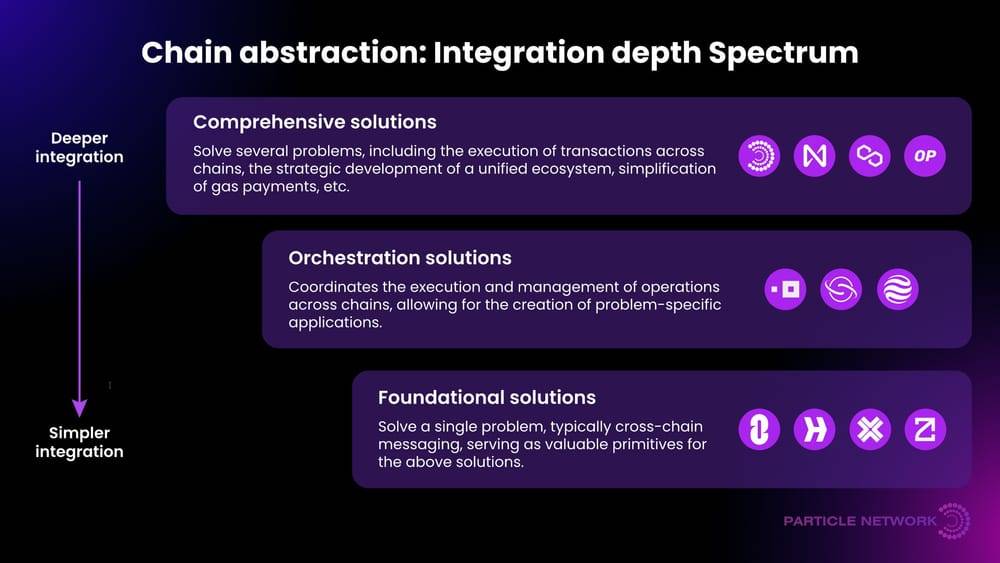
Interoperability solutions exist at the base of the ChA stack, enabling the creation of deeper-level implementations.
Blockchain Interoperability: Evolving Toward Chain Abstraction Implementation
To arrive at the main conclusion of this article, let us now consider two key points:
-
As previously stated, chain abstraction leverages interoperability solutions to enhance multi-chain experiences.
-
As interoperability solutions become increasingly mature and widespread in the industry, we observe their providers attempting to offer composable, sophisticated solutions for developers and end-users—in other words, seeking to deliver deeper-level ChA solutions.
The latter can be seen in the case of Stargate, a product from LayerZero. LayerZero’s first live product was a low-level communication primitive for building cross-chain dApps. After launching the protocol, the team behind LZ decided to put these primitives into practice by creating a fully composable cross-chain bridging solution, unprecedented in its category. Due to its full composability, this bridge can be viewed as an intermediate point between foundational and coordinated solutions, addressing increasingly complex challenges required for a ChA experience.
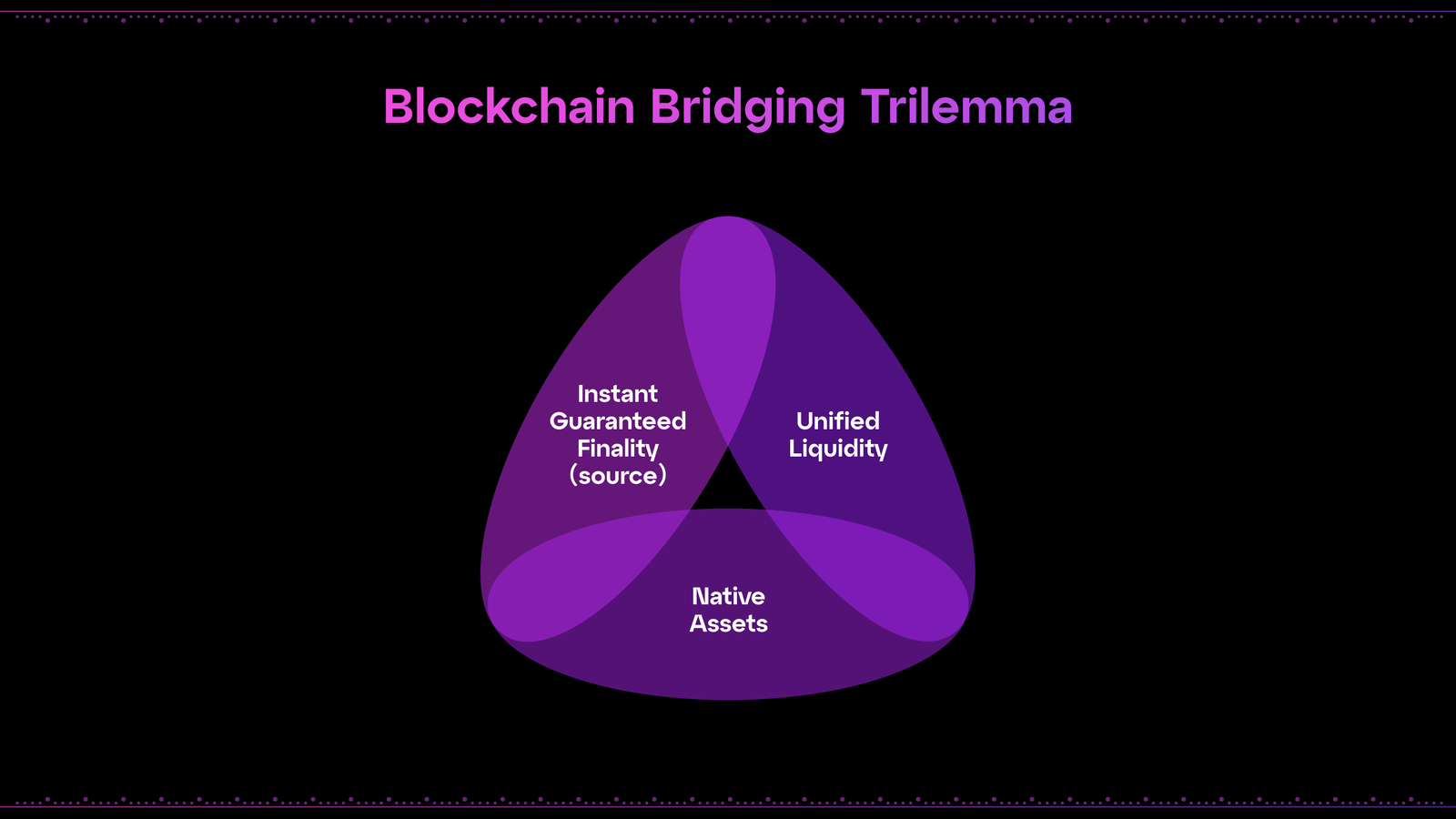
The Stargate Bridge solves the blockchain bridging trilemma by leveraging interoperability solutions to implement deeper ChA features.
Another example is Socket. Originally a cross-chain liquidity layer (SocketLL) and data layer (SocketDL) for blockchain interoperability and bridging, Socket eventually consolidated its offerings into Bungee. Bungee is essentially a bridge aggregator that selects the cheapest, fastest, and most liquid bridge based on user preferences. Later, realizing that chain abstraction is indispensable for solving fragmentation and advancing Web3 user experience, they began building Socket 2.0, a modular and scalable coordination chain abstraction protocol for developers to build chain-agnostic applications.
A Shifting Tide
The examples above illustrate our expectation of a growing trend in Web3: interoperability solutions gradually becoming central to the multi-chain experience, while creative applications emerge aimed at implementing chain abstraction (ChA) in specific domains.
This also aligns with the inherent goals of interoperability solutions themselves, as once their core use cases are established, they have two expansion paths:
-
Capturing a larger share of the ecosystem (e.g., by integrating more chains/protocols).
-
Achieving deeper levels of chain abstraction integration.
Therefore, as chain abstraction accelerates and interoperability solutions become more prevalent in the Web3 experience, we can only expect the latter to continue evolving, actively seeking to build ChA infrastructure.
Conclusion
While interoperability and chain abstraction solutions are not the same, these two concepts are closely linked. Viewed broadly, we see them representing different stages in the evolution of multi-chain interaction, moving forward in tandem with the industry's continuous development and growth.
As chain abstraction solidifies as the next evolutionary step for Web3, interoperability solutions will find new and creative ways to contribute, forming a positive flywheel effect.
Ultimately, this can only lead to a truly borderless, frictionless Web3 ecosystem.
Join TechFlow official community to stay tuned
Telegram:https://t.me/TechFlowDaily
X (Twitter):https://x.com/TechFlowPost
X (Twitter) EN:https://x.com/BlockFlow_News
 @ParticleNtwrk