Cobo: How to Unlock the Trillion-Dollar Market Cap of BTCFi?
TechFlow Selected TechFlow Selected
Cobo: How to Unlock the Trillion-Dollar Market Cap of BTCFi?
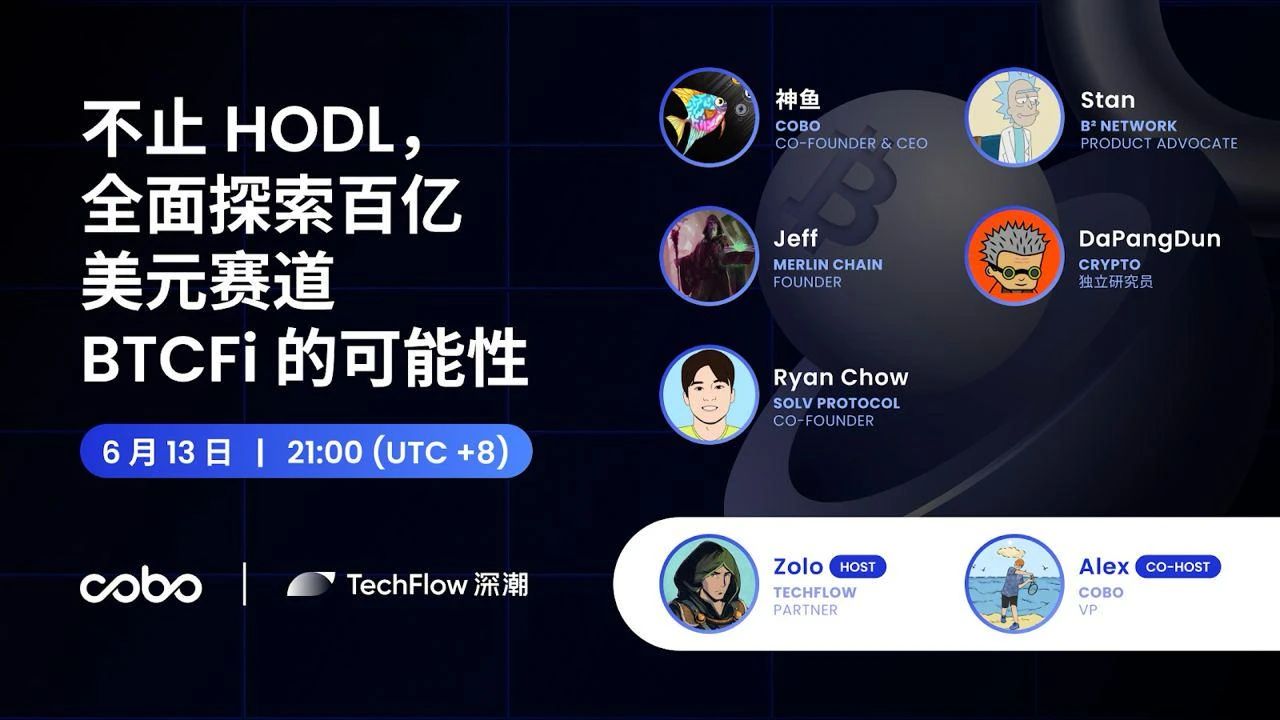
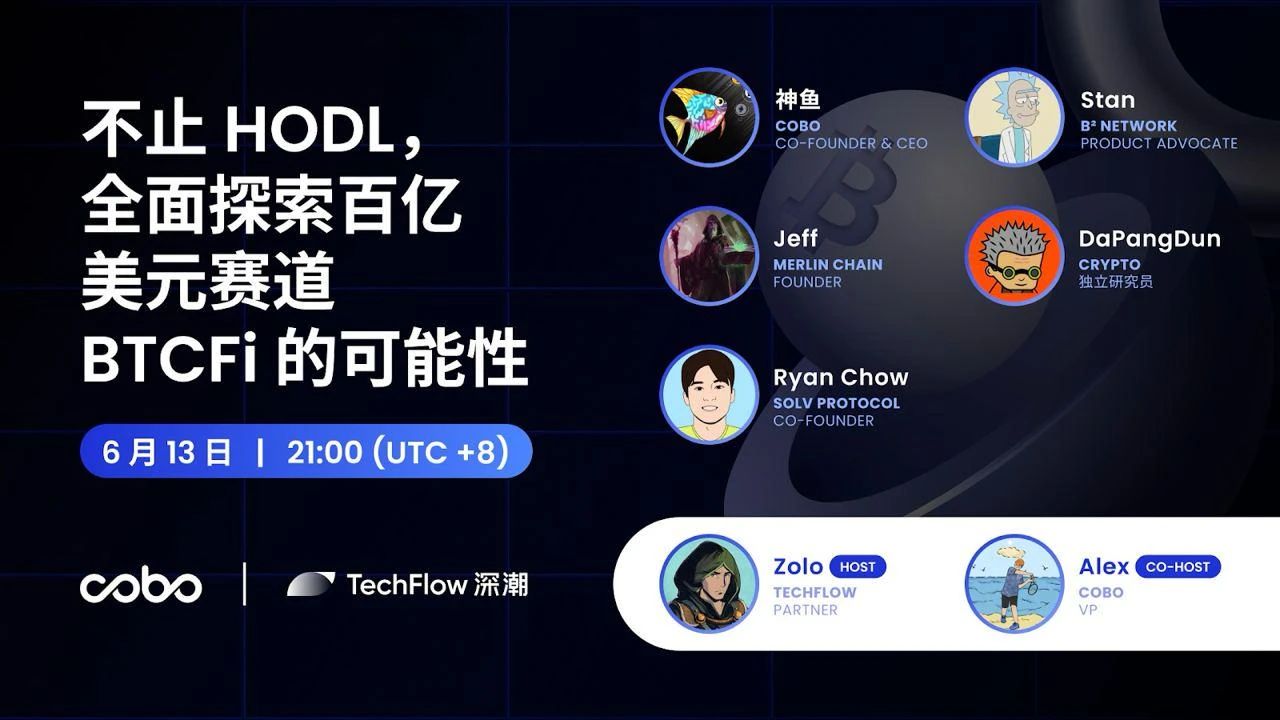
AMA recap: "Beyond HODL: Exploring the Possibilities of the Billion-dollar BTCFi Sector," co-hosted by Cobo and TechFlow.
 Navigating Web3 tides with focused insights
On the evening of June 13, Cobo, together with TechFlow, hosted a Space on X featuring Cobo co-founder and CEO Shen Yu, Merlin Chain founder Jeff, Solv Protocol co-founder Ryan Chow, B² Network product advocate Stan, and independent crypto researcher DaPangDun. The discussion was centered around the theme “Beyond HODL: Fully Exploring the Possibilities of the Billion-Dollar BTCFi Sector,” diving deep into this evolving landscape.
Cobo has compiled key insights from the guests to share with our users and readers.
As a global leading digital asset custody solution provider, Cobo now offers an easy-to-integrate Babylon Staking API, enabling fast access to the Babylon ecosystem and opportunities for BTC yield generation. We welcome entrepreneurs building within the BTC staking ecosystem to reach out—Cobo provides strong ecosystem fund support and multiple convenient infrastructure tools.
Over the past two years, the crypto industry has undergone dramatic changes, particularly in the Bitcoin ecosystem, which is now exhibiting entirely new ecological characteristics. This includes the emergence of BTC Layer 2 networks that carry TVL (total value locked), enabling Bitcoin to participate in on-chain DeFi activities such as lending, stablecoins, and innovative models like Solv Protocol and CeDeFi. A growing base of on-chain players seeking passive income and a new cohort of active users have emerged, gradually forming a supporting ecosystem and infrastructure around them.
With these new demands come fresh opportunities across emerging sectors. Bitcoin’s asset scale far exceeds that of Ethereum and stablecoins; thus, any growth in Bitcoin’s total value locked (TVL) or participation in specific products will bring staggering volume. Shen Yu believes the BTCFi sector holds immense potential that remains largely untapped, with a highly significant market size. In the short term, BTCFi's total market cap could reach tens of billions of dollars—even surpassing Ethereum’s all-time high ecosystem valuation. Long-term, it may exceed one trillion dollars.
This episode of Cobo X Space brought together diverse participants across the Bitcoin landscape to explore the topic “Beyond HODL: Unlocking the Full Potential of the Billion-Dollar BTCFi Ecosystem.” The blossoming Bitcoin ecosystem is showing new signs of diversity, user segmentation, and distinct user personas.
Jeff, founder of Merlin Chain, believes there are currently several hundred thousand to about one million active on-chain Bitcoin users. Unlike Ethereum users, the BTCFi ecosystem has cultivated a new type of Bitcoin-native user. These users are indifferent to gas fees, more focused on discovering promising assets—especially inscriptions, runes, and meme coins—and deeply passionate about Bitcoin culture and fair issuance principles. They seek equal profit opportunities, show high engagement and loyalty, prefer high-risk/high-reward strategies, and are more familiar with Bitcoin wallets—many even find Ethereum wallets like MetaMask harder to use. The Bitcoin ecosystem may surpass Ethereum in attracting large holders and high-net-worth individuals, both in terms of potential market size and per-user value, possibly achieving higher total value locked. The rise of this user group could inject new vitality into the Bitcoin ecosystem.
In addition to this new wave of active on-chain users, another core segment within BTCFi consists of institutions and large holders who own substantial amounts of Bitcoin and wish to generate stable returns passively. However, the market currently lacks suitable增值 pathways, leaving most Bitcoin assets idle in cold wallets.
How can we tap into this unmet demand? Unlocking the potential of hundreds of billions of dollars worth of dormant BTC assets held in cold storage by institutions, whales, and some individual users will be a critical focus for BTCFi’s future development.
Large Bitcoin holders and institutional users are inherently risk-averse. To meet their needs, Shen Yu, co-founder and CEO of Cobo, suggests considering the following:
-
In the long run, as user demand grows, Bitcoin script language development and technical upgrades will gradually mature over the next 3–5 years, eventually enabling fully decentralized and permissionless solutions. Until then, during this transitional phase, we will see a surge of multi-party computation (MPC)-based co-custody solutions emerge.
-
These interim solutions can activate institutions, large holders, and select individual users, allowing them to better leverage Bitcoin’s underlying infrastructure. By using multi-party custody to ensure asset security and reduce single points of failure, such systems can offer yield opportunities while aligning well with the lower risk tolerance of whales and institutions.
-
Bitcoin’s biggest weakness lies in its inability to build smart contracts directly on the mainchain, making asset ownership a key bottleneck for industry development and introducing vulnerabilities and moral hazard risks.
Ryan Chow, co-founder of Solv Protocol, noted that hybrid models combining centralized custody with decentralized technologies—such as Cobo’s MPC-based approach—ensure transparent fund flows and clear ownership rights. This resolves the issue in traditional opaque CeFi models where funds disappear into black boxes, leaving users unaware of where their assets go or how they’re controlled. By separating asset management from custody, specialized secure custodians like Cobo can collaborate with innovation-focused projects such as Solv, Merlin, and B² Network that drive value creation and ecosystem expansion. This division of responsibilities between custody and management offers transparent and secure Bitcoin asset management and yield generation. This new model has the potential to address the pain points of traditional CeFi and open up safe, transparent paths for yield growth.
The BTCFi space is vast enough to accommodate numerous startups and experimental innovations. This cycle has attracted new traffic from AI, BTCFi, and crypto payments, injecting fresh momentum. Unlike Ethereum, which has a unified foundation, Bitcoin lacks absolute orthodoxy. Its diverse cross-chain approaches create massive opportunities for consolidating consensus and liquidity—offering particular advantages to Asian entrepreneurs. The future of BTCFi looks promising.
Key takeaways summarized below:
How big is the BTCFi market? When will this market truly thrive without relying on existing subsidies or points programs?
Shen Yu: First, I believe the BTCFi sector has a very substantial market size. Over the past two years, a large amount of traditional capital has entered the crypto market through ETFs, and so far only Bitcoin and Ethereum have gained recognition. Given Bitcoin’s advantage as hard money, it dominates the industry in terms of asset share—but historically lacks efficient utilization mechanisms comparable to those on Ethereum.
Demand for Bitcoin asset management is strong, yet reliable, secure, and stable增值 methods remain scarce. Currently, the primary way to extract value is to use Bitcoin as collateral to borrow other cryptocurrencies for investment. If the Bitcoin ecosystem develops rapidly, it can provide many more earning channels for this major asset class. Personally, I estimate BTCFi’s short-term market cap could reach tens of billions of dollars—possibly even exceeding Ethereum’s historical peak. In the long run, BTCFi could surpass one trillion dollars, fluctuating with market cycles.
This is already a broad space capable of hosting many startups and innovations, especially when compared to Bitcoin’s early mining era, which had an annual value of just hundreds of millions. Today, BTCFi’s main users are institutions and large holders who hold significant Bitcoin and want passive, stable yields. Yet the market still lacks appropriate增值 mechanisms, leaving most Bitcoin assets idle in cold wallets.
Long term, as demand increases, Bitcoin scripting capabilities and technical upgrades will gradually improve over the next 3–5 years, ultimately enabling fully decentralized and permissionless solutions.
However, as a peer-to-peer cash system, Bitcoin’s foundational infrastructure evolves slowly. It may take years before full decentralization enables permissionless solutions at scale.
During this transition, we’ll see a wave of MPC-based multi-party custody solutions serving as intermediaries. These will activate institutional, whale, and some retail users, helping them better utilize Bitcoin’s foundational infrastructure. Multi-party custody ensures asset safety, reduces single points of failure, and enables yield generation on top.
As founders building in the Bitcoin public chain space, what do you see as the market size? Who are your target customers? Do you prefer institutional clients or other types of users?
Jeff: The market size for this sector is enormous. Bitcoin currently has a market cap of over $1 trillion, but the potential scale of actively used on-chain Bitcoin assets could reach hundreds of billions. Merlin primarily focuses on two ways to empower Bitcoin users:
-
-
Enabling participation in on-chain DeFi, such as lending and stablecoins, giving Bitcoin yield-generating capabilities;
-
Cross-chain bridging of Bitcoin to EVM-compatible chains for participation in other DeFi protocols.
-
A current industry challenge—and one we aim to solve—is retail-level wrapping and unwrapping capability, i.e., bridge functionality. Cobo has helped resolve this—over the past 45–60 days, $13–15 billion worth of Bitcoin passed through our wallet for cross-chain bridging.
Another long-term challenge is generating real yield for Bitcoin—not reliant on project points or token speculation, which are highly cyclical. Solv is exploring quantitative investment strategies to generate USD-denominated returns from Bitcoin.
Beyond native BTC, Merlin is fully committed to new Bitcoin-native assets like BRC-20 and Ordinals. Their users are highly active, and return potential exceeds fixed annual yields. Merlin provides liquidity for these assets, enabling trading and market-making. As long as investments are in a bull market, returns can be substantial—similar to the surge in inscriptions and runes at the end of last year.
Encouraging first-layer users to release liquidity to second layers, where better trading, lending, and contract operations occur, is a long and challenging process. Merlin’s DEX has generated over $1 billion in trading volume over recent months, averaging $20–30 million daily. This gradual buildup could bring higher yields and more users to the chain itself.
Overall, the industry is still very early, and different chains pursue different strategies. For Merlin, the focus is on sustainably bringing new business to the Bitcoin ecosystem over the long term, rather than chasing short-term volume spikes.
Stan: The value of BTCFi lies in transforming Bitcoin from a passive asset into an active one, mainly in three ways:
-
-
Leveraging Bitcoin’s security to protect broader networks, such as with Stacks;
-
Enhancing liquidity and utility of Bitcoin and related assets—including via Layer 2 networks—to lay the groundwork for native Bitcoin DeFi;
-
Providing cross-chain functionality to bring Bitcoin capital into other DeFi ecosystems, improving capital efficiency.
-
Therefore, BTCFi’s target customers fall into three main categories:
-
-
Existing Bitcoin users: miners, long-term holders, etc., who seek yield-generating opportunities;
-
Users and projects from other blockchains: such as EVM or Solana ecosystems, where BTC L2s enable interoperability;
-
Newcomers outside crypto: as a core audience for blockchain adoption, BTCFi can lower their entry barrier.
-
BTCFi can only sustain long-term growth if the downstream Layer 2 networks exhibit sufficient vitality, user engagement, and innovation.
Jeff, can you estimate the number of active DEX-native traders on Layer 2 networks—including rune and inscription traders—as well as their average asset holdings? How would you describe this user group?
Jeff: In terms of user scale, active on-chain Bitcoin users number in the hundreds of thousands to roughly one million, observable through top assets and NFT data. Most are new on-chain users who previously may have only traded coins casually. They are more comfortable with Bitcoin wallets and often find MetaMask difficult to use.
These users tend to have relatively high net worth. Due to Bitcoin’s high transaction fees—tens to hundreds of dollars per transaction—users unable to afford these costs are naturally filtered out. Thus, Bitcoin on-chain users care less about fee levels and more about identifying promising assets. For example, in Merlin’s early days, hundreds of millions of dollars worth of BRC20 assets and Ordinals NFTs were quickly staked, demonstrating both high activity and strong financial capacity.
Typical user profile: Enthusiastic about Bitcoin culture, believers in fair issuance, and strongly motivated by equal earning opportunities such as airdrops. As a new cohort of active Bitcoin-native users, their future development is promising, and Bitcoin’s programmability potential remains underexploited.
Overall, this is a new breed of financially strong, culturally aligned, and highly engaged on-chain users whose rise could inject new energy into the Bitcoin ecosystem.
Ryan, given your extensive entrepreneurial experience in the Ethereum community, how does providing BTC financial services in the Bitcoin community differ from Ethereum? Solv has been pursuing compliance and attracting large regulated investors—do you see a path to bringing these investors into the Bitcoin ecosystem?
Ryan: The user base, ethos, and infrastructure of the Bitcoin ecosystem differ significantly from Ethereum. Providing BTC financial services in the Bitcoin community presents several key differences and challenges compared to Ethereum:
-
-
Bitcoin’s infrastructure lags behind, with higher base-layer decentralization, making infrastructure development and UX improvement much harder than on Ethereum;
-
High gas fees make retail-focused services significantly more difficult to operate on Bitcoin.
-
Yet, the Bitcoin ecosystem also offers unique advantages:
-
-
It has a vast high-net-worth user market and huge TVL potential. Bitcoin’s asset scale far exceeds Ethereum and stablecoins, so growth in Bitcoin TVL or capital participation brings massive volume. Moreover, Bitcoin whales (those holding over 1,000 BTC) likely have higher average holdings than Ethereum whales, suggesting higher per-user value and ticket size.
-
The Bitcoin user base is relatively conservative—distinct from Ethereum users—creating opportunities to innovate in new areas.
-
Two additional key differences between Bitcoin and Ethereum ecosystems:
1) Bitcoin lacked innovation opportunities in the past, but this cycle has drawn significant new traffic from AI, BTCFi, and crypto payments, revitalizing the space.
2) Unlike Ethereum, which has a unified foundation, Bitcoin lacks a central authority. Its variety of cross-chain solutions creates massive opportunities for consolidating consensus and liquidity, offering greater room for Asian entrepreneurs.
Bitcoin’s high decentralization makes it somewhat easier for compliant institutions to participate.
Solv operates BTCFi-related services across multiple public chains. Regarding your BTCFi ecosystem, are you concerned that partners or BTCFi projects might become centralized finance (CeFi) problem entities in this cycle? How do you view this risk?
Ryan: Bitcoin’s most apparent weakness is its inability to support smart contracts on Layer 1. The Bitcoin mainnet lacks this environment, making smart contract deployment extremely difficult at this stage. Consequently, asset ownership becomes a fundamental constraint on industry development.
Because Bitcoin cannot support smart contracts on Layer 1, asset ownership issues remain a key bottleneck, creating vulnerabilities and moral hazards.
This has led to hybrid models from companies like Cobo and Antalpha that combine centralized custody with decentralized technology, ensuring fund locations and movements are transparent and traceable. While some criticize their centralized aspects, these models differ from traditional CeFi by guaranteeing transparency in fund flows and clear ownership. The core flaw of CeFi is that once funds enter a black box, users lose visibility and control, leading to opaque profit structures. By separating asset management from custody, trusted custodians like Cobo can collaborate with innovation-driven projects like Solv, Merlin, and B² Network to deliver transparent and secure Bitcoin asset management and yield solutions. This new division of labor between custody and management could resolve traditional CeFi pain points and open secure, transparent paths to yield growth.
Can you share any exciting new projects or trends you’ve recently noticed?
DaPangDun: On BTCFi, I analyze from several angles:
Security is paramount—wallet security, asset ownership protection, and systemic risk prevention (e.g., volatility from DeFi "matryoshka" schemes).
BTCFi requires foundational elements: (1) attachable assets (including BTC itself); (2) diverse Fi forms (lending, staking, etc.); (3) implementation paths (sidechains, OP_Codes, etc.).
After the previous DeFi Summer, market tolerance for security risks has decreased, guiding BTCFi toward safer, more reliable development.
Stablecoins play a crucial role in BTCFi—users interested in Fi activities tend to prefer stablecoin-denominated positions.
The market will test various implementation paths through competition to determine which prevails.
The ultimate goal of Fi is yield—projects will achieve this through various means (staking, lending, etc.).
Overall, BTCFi must prioritize security, diversify asset types, explore multiple implementation paths, and incorporate stablecoins—all aimed at delivering sustainable user returns.
Does Merlin Chain plan to partner with Tether or Circle to introduce native stablecoins? What are the main challenges?
Jeff: Currently, because BTC Layer 2 solutions (mainly sidechains) cannot offer absolute security guarantees, introducing compliant stablecoins remains difficult. While bridging USDT and USDC is possible, user trust in bridge security is critical.
Moreover, BTC users don’t have strong immediate demand for stablecoins—they often prefer BTC-denominated trading. Therefore, due to trust issues with current Layer 2s, fully trusting platforms to host stablecoins from Tether or Circle remains a mid-to-long-term goal. For now, the focus may shift toward developing native BTC-denominated projects—including over-collateralized stablecoins—while moderately integrating USDT and USDC, rather than large-scale adoption of compliant stablecoins.
What are the main challenges and obstacles facing BTCFi ecosystem development? What barriers would traditional asset managers or ETH-based asset management projects face entering this space?
Shen Yu: The biggest obstacle for BTCFi is that ecosystem development lags far behind the pace of application innovation—due to Bitcoin’s slow foundational upgrades. Bitcoin’s decentralized nature requires broad community consensus for upgrades, a complex and lengthy process that contrasts sharply with entrepreneurs’ desire for rapid iteration. As a result, the BTCFi ecosystem will remain fragmented and diverse for the foreseeable future, with continuous waves of experimentation.
Bitcoin lacks official backing or unity like Ethereum, leading to a more fragmented and diverse BTCFi landscape. This poses greater challenges for projects managing balance sheets. However, this also brings unique advantages. For example, Bitcoin’s use of multisig and MPC mechanisms allows finer-grained permission separation and asset monitoring for large holders and institutions, reducing risk and increasing appeal.
Ryan: From a regulatory perspective, Ethereum has defined “red lines” and “green lines” for BTCFi development, offering guidance. So far, Bitcoin L2s, sidechains, and the Lightning Network haven’t triggered major regulatory concerns.
On asset custody, whether Bitcoin or Ethereum, certain compliance requirements apply due to asset ownership transfer.
In yield-generating applications, Bitcoin holds an edge. Since Bitcoin is clearly classified as a commodity, related yield and management regulations are theoretically looser. In contrast, whether Ethereum staking qualifies as a security remains debated, creating gray areas. Currently, Ethereum staking doesn’t require KYC or AML measures, though some exchanges offering such products have received SEC warnings—highlighting uncertainty. While some Bitcoin yield products haven’t fully addressed compliance, they haven’t triggered major regulatory actions, suggesting the space remains in a gray zone. Still, due to asset classification, compliant operation is often necessary. For example, some Solv products require KYC to mitigate regulatory risk, while others allow non-KYC retail participation via DeFi and decentralized exchanges.
The last Bitcoin rally was driven by L2-led user education and scalability. The next phase—yield generation—may become the new growth engine. Throughout this evolution, regulatory considerations must remain a priority.
Join TechFlow official community to stay tuned
Telegram:https://t.me/TechFlowDaily
X (Twitter):https://x.com/TechFlowPost
X (Twitter) EN:https://x.com/BlockFlow_News
 Cobo
Cobo