It has been two years since the bull market for inscriptions. Will BTCFi spark another explosive bull run?
TechFlow Selected TechFlow Selected
It has been two years since the bull market for inscriptions. Will BTCFi spark another explosive bull run?
BTCFi will become an inevitable trend through improved capital efficiency, drivers of institutional adoption, and the development of technological infrastructure.
 Navigating Web3 tides with focused insights
Author: Tiger Research
Translation: AididiaoJP, Foresight News
Summary
The funding base of Bitcoin is vast but underutilized; BTCFi will change this:
Currently, over 14 million BTC sits idle, and Bitcoin lacks the capital efficiency seen in Ethereum's DeFi ecosystem. BTCFi unlocks liquidity by transforming BTC into yield-bearing assets, enabling its use in lending, staking, insurance, and other decentralized financial applications built upon Bitcoin’s security.
Institutional demand for native BTC yield is growing, and the infrastructure is ready: from compliant custody solutions to real-world yield protocols, the BTCFi ecosystem now includes ETFs, permissioned lending, insurance models, and staking protocols that meet institutional standards.
Technological breakthroughs and Layer-2 innovations have made BTCFi scalable and programmable. Upgrades like Taproot and emerging Layer-2 platforms now support smart contracts, token issuance, and composable DeFi applications on Bitcoin.
Liquidity Bottleneck: The Purpose of BTCFi
Source: Glassnode
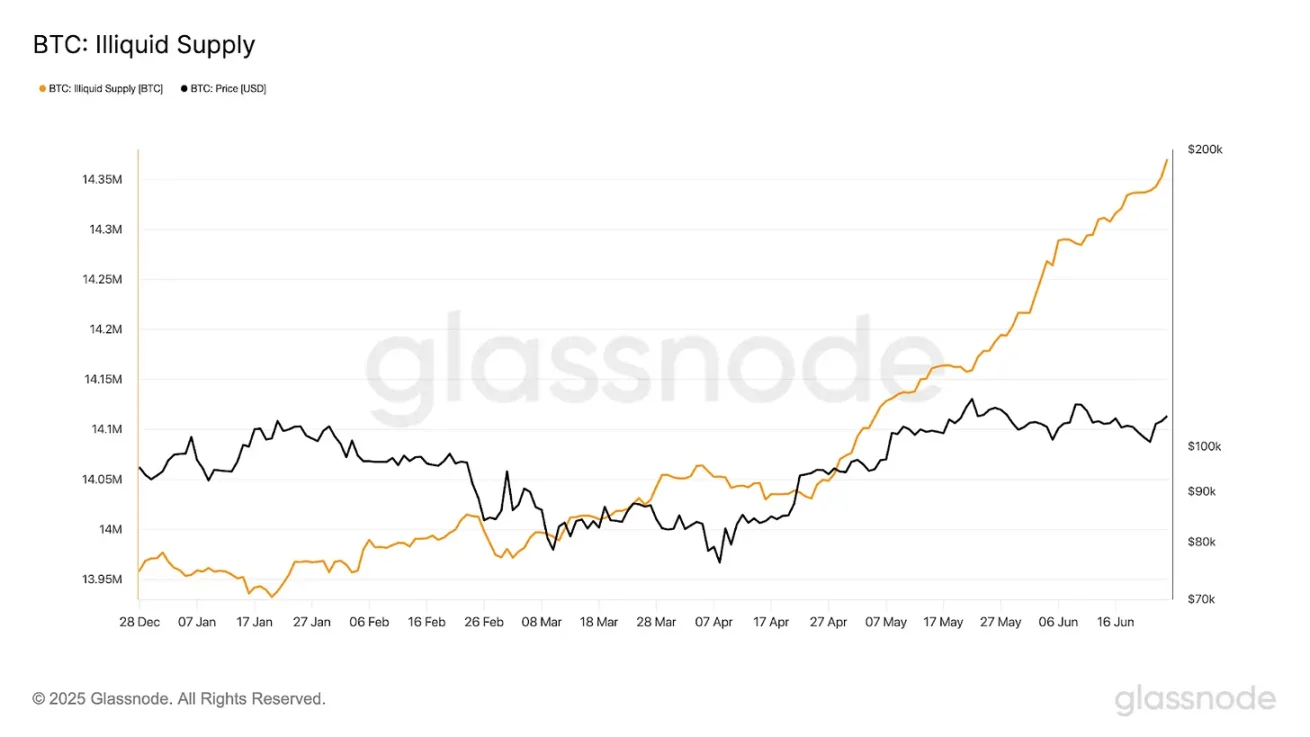
Bitcoin today represents an asset base exceeding $1 trillion, yet most of these assets remain idle. Analysts estimate that 99% of BTC’s market cap is “idle,” meaning nearly all Bitcoin is stored in wallets or cold storage without generating any on-chain yield. On-chain data confirms this: over 14 million BTC has remained long-term inactive.
Source: DefiLlama
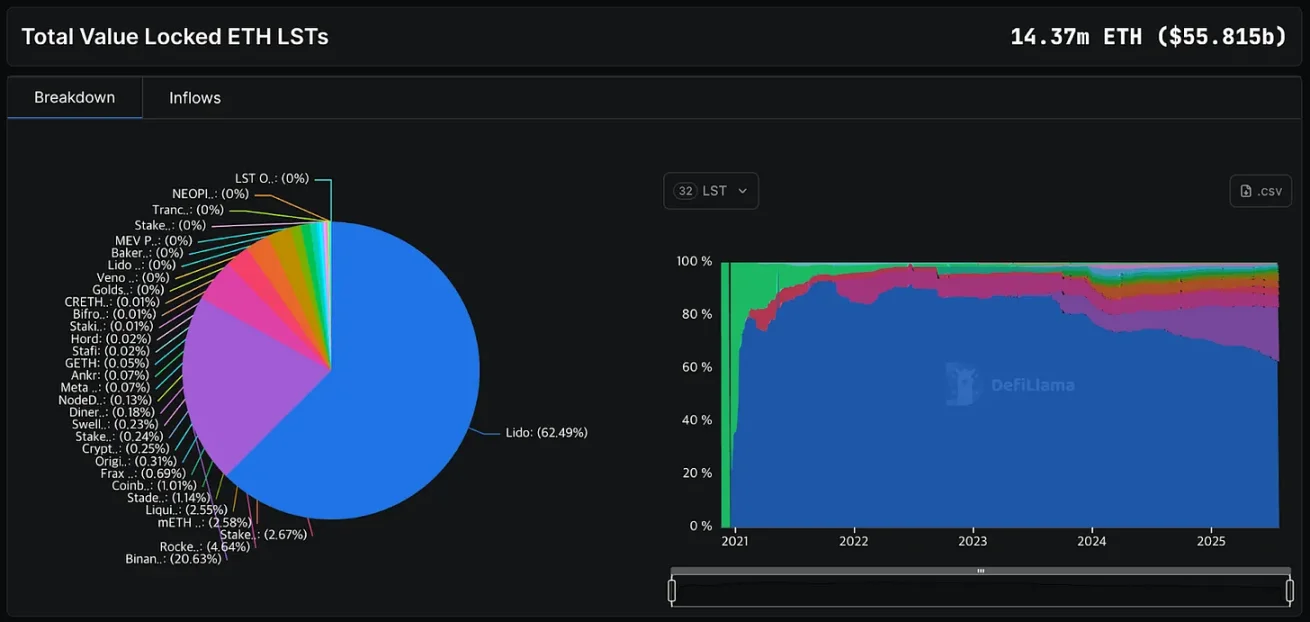
This stands in stark contrast to Ethereum, where large amounts of ETH are actively deployed in DeFi and staking. For example, liquid staking protocols on Ethereum have locked more than 14.37 million ETH (approximately $56 billion), turning ETH into yield-generating assets and fueling a vibrant on-chain economy.
Ethereum’s DeFi “summer” demonstrated how capital efficiency—through staking rewards, lending interest, and liquidity provision—can unlock immense value for smart contract platforms. In comparison, Bitcoin has remained largely underutilized; its vast liquidity yields zero returns and cannot be further composed into financial products at the base layer.
BTCFi (Bitcoin DeFi) aims to unlock this dormant capital. As CoinGecko’s beginner guide notes, Bitcoin DeFi “transforms Bitcoin from a passive asset into a productive asset,” allowing holders to earn yield on BTC or deploy it within DeFi applications.
At its core, BTCFi seeks to bring to Bitcoin the same transformation DeFi brought to Ethereum: turning static assets into revenue streams and establishing them as foundational building blocks for further innovation.
Rising Institutional Demand for Yield
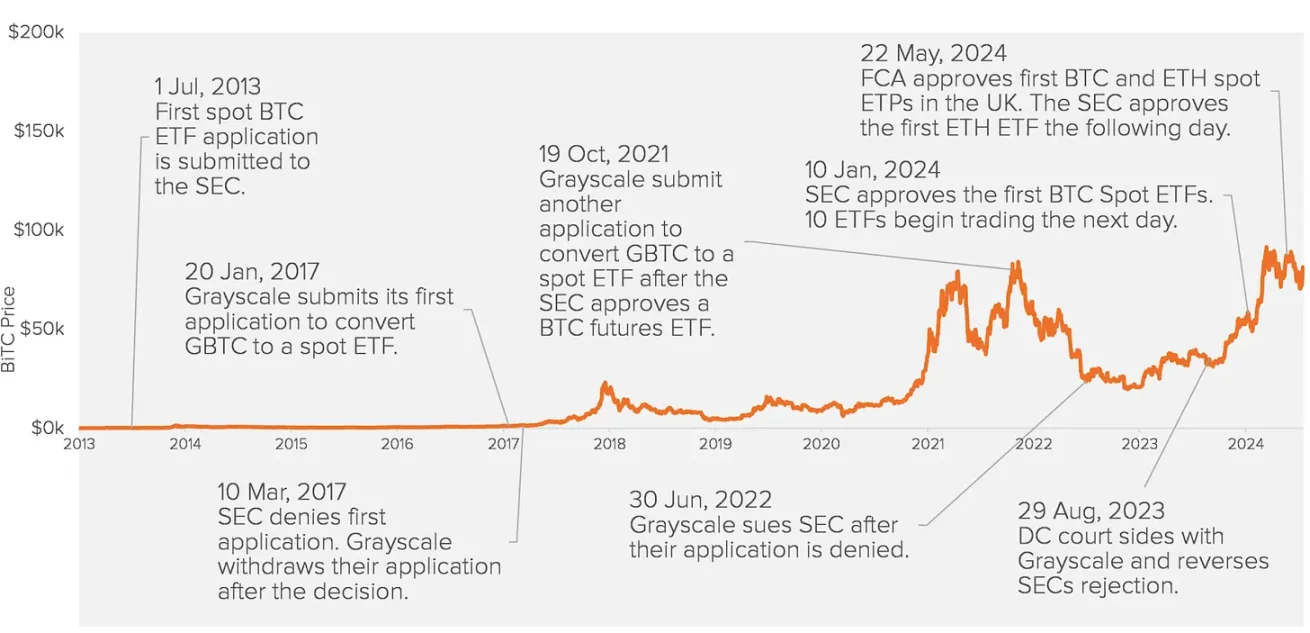
Historical development of Bitcoin ETFs. Source: Fioderers
Institutional demand may be the strongest catalyst driving BTCFi growth, and this trend is already visible. From late 2023 to 2024, several major asset management firms applied for and received approval to launch spot Bitcoin ETFs, ultimately bringing BTC into mainstream investment portfolios.
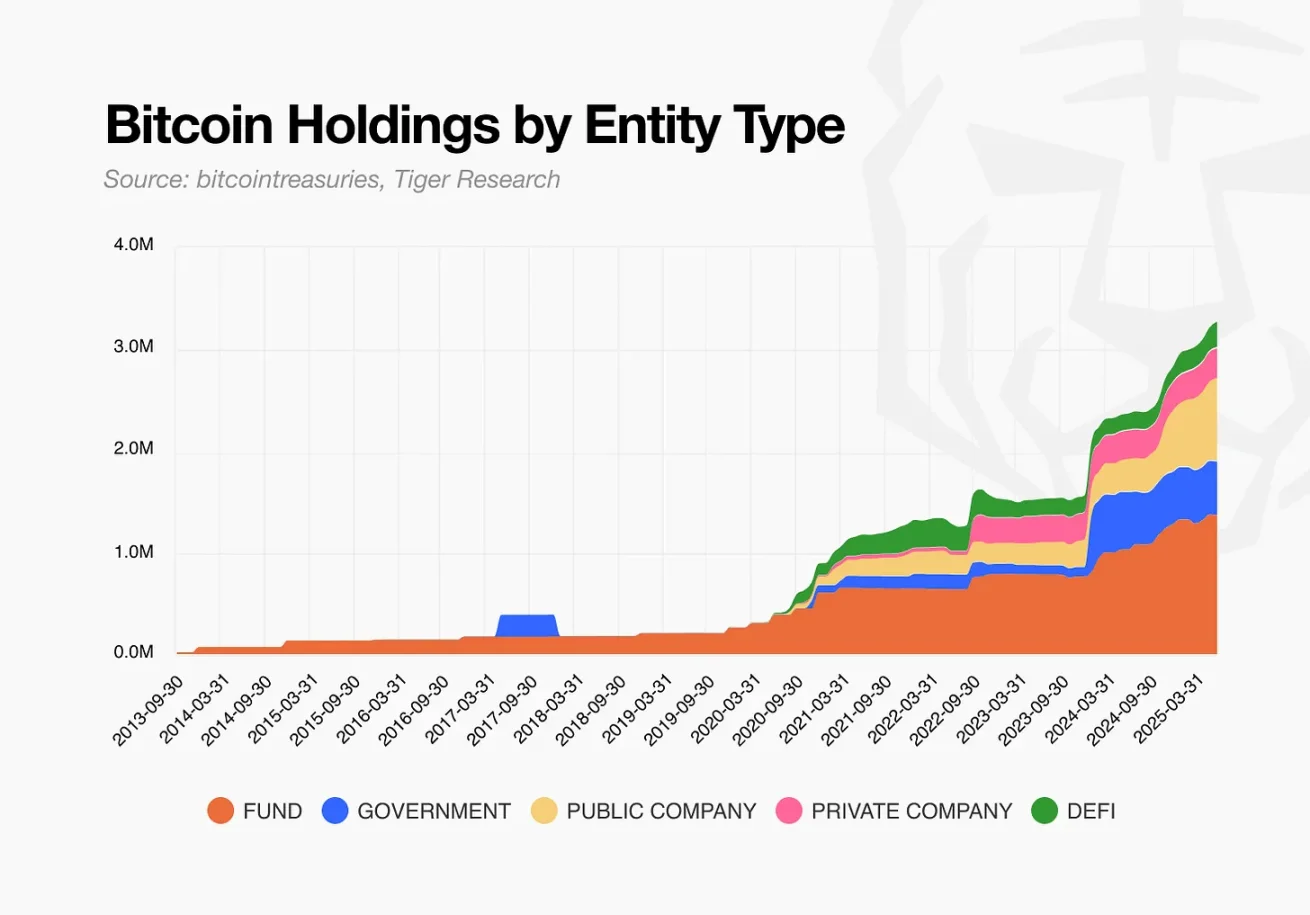
Institutions now view Bitcoin as a strategic reserve asset, but they are also yield-sensitive. In traditional finance, capital is never idle—bonds pay interest, stocks pay dividends, and even cash is placed in money market funds. Until recently, Bitcoin generated no yield at all.
BTCFi is changing this. Institutions are now asking a logical question: What can we do with our held BTC? More and more institutions are exploring ways to lend, stake, or use Bitcoin as collateral to unlock yield, mirroring traditional financial models.
As these options emerge, institutional interest in BTCFi is surging. An annual return of 3%-5% on BTC might seem modest, but when managing billions of dollars, such incremental gains become highly valuable.
As BTCFi matures, BTC holders can now access 10%-20% annualized yields through decentralized protocols, making the opportunity even more attractive. If BTC can offer stable, low-risk returns while retaining upside potential, it could become not just a reserve asset, but a monetary anchor for DeFi.
As more institutions and individuals adopt BTC as a long-term reserve asset, the need to generate yield on idle holdings becomes increasingly clear. Yield generation is evolving from a niche strategy into a fundamental component of asset management.
Just as U.S. Treasuries underpin traditional capital markets, Bitcoin could become the foundational yield asset in crypto finance, setting benchmarks for everything from lending rates to DeFi protocol valuations.
Infrastructure Is in Place
The BTCFi ecosystem is rapidly advancing, launching new products and frameworks designed specifically for institutional adoption:
Compliant Custody and Liquidity Wrapping
Companies like Fidelity Digital Assets, Coinbase Custody, and BitGo now support DeFi participation under strict custodial compliance. Emerging solutions such as Liquidity Custody Tokens (LCTs)—like BBTC from BounceBit—allow institutions to hold BTC under compliant custody while deploying it on-chain to earn yield. Institutions can thus benefit from DeFi’s yield potential while maintaining regulatory compliance.
ETFs and Yield-Integrated Products

Europe’s first yield-bearing Bitcoin ETP. Source: CoreDAO
Yield-bearing Bitcoin ETPs are already live in Europe. Valour’s BTCD ETP stakes BTC into Bitcoin Layer-2s, offering an annualized yield of approximately 5.6% as of end-2024. Meanwhile, institutions are beginning to explore structured notes linked to BTC, dual-yield products, and basis trading strategies that combine traditional financial instruments with crypto-native yield engines.

BounceBit aims to help institutions earn yield on BTC. Source: BounceBit
For instance, BounceBit Prime combines tokenized U.S. Treasuries with BTC yield strategies in a single product, delivering dual returns familiar to traditional investors such as family offices and hedge funds—a Bitcoin yield product designed for Wall Street.
Another example is SatLayer, which launched a decentralized insurance tool backed by yield-bearing BTC. Often referred to as the “Berkshire Hathaway of Bitcoin,” SatLayer allows any BTC holder to re-stake their assets into on-chain insurance pools and earn a share of premium income. SatLayer is collaborating with both crypto-native and traditional underwriters like Nexus Mutual and Relm to build a new class of decentralized BTC insurance products.
Protocol Maturity and Institutional Trust
BTCFi protocols like Babylon and Lombard have achieved multi-billion dollar total value locked (TVL), passed security audits, and are progressing toward SOC2 compliance. Many protocols have also hired Wall Street veterans as advisors and prioritized risk management in their design. These efforts are building credibility among global institutional capital allocators.
All of this points to a future where BTC yield becomes a cornerstone of institutional portfolios, much like U.S. Treasuries in traditional markets. This shift will also create ripple effects: institutional capital flowing into BTCFi benefits not only BTC holders but also enhances cross-chain liquidity, drives more DeFi standards, and provides the entire crypto economy with a trusted, productive capital base layer.
In short, BTCFi offers institutions the best of both worlds: the reliability of Bitcoin as a high-quality asset, combined with the opportunity to earn yield.
Why Now? The Tech Stack Driving BTCFi Explosion
BTCFi is no longer just a theoretical concept—it is becoming reality, thanks to breakthroughs in three areas: technological upgrades within the Bitcoin ecosystem, growing market demand fueled by improved infrastructure, and rising institutional interest driven by regulatory clarity.
From Taproot to BitVM
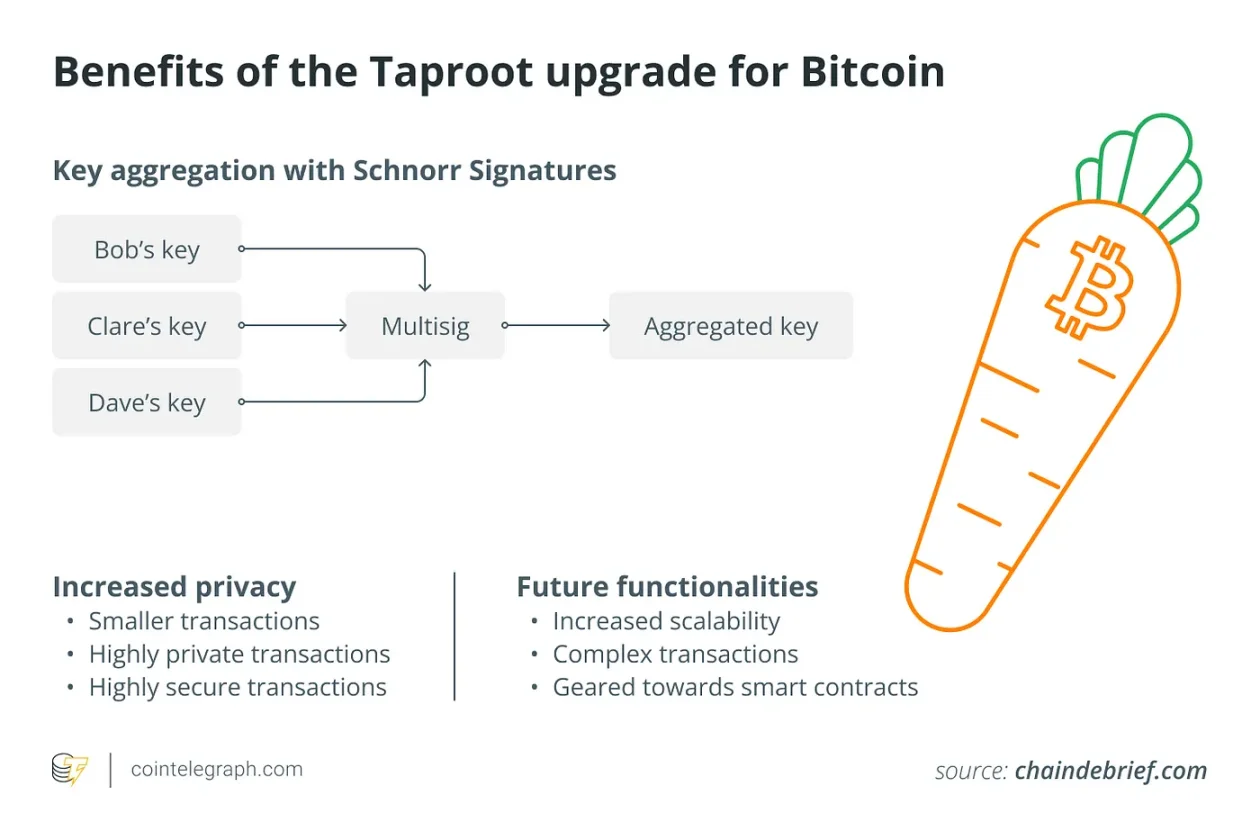
The Taproot upgrade enhances Bitcoin privacy and efficiency. Source: chaindebrief
Recent upgrades to the Bitcoin protocol and ecosystem are laying the foundation for more complex financial applications. For example, the 2021 Taproot upgrade improved Bitcoin’s privacy, scalability, and programmability, even "encouraging the use of smart contracts on Bitcoin" through enhanced efficiency. Taproot also supports new protocols like Taro (now Taproot Assets) for issuing tokens and stablecoins on the Bitcoin ledger.
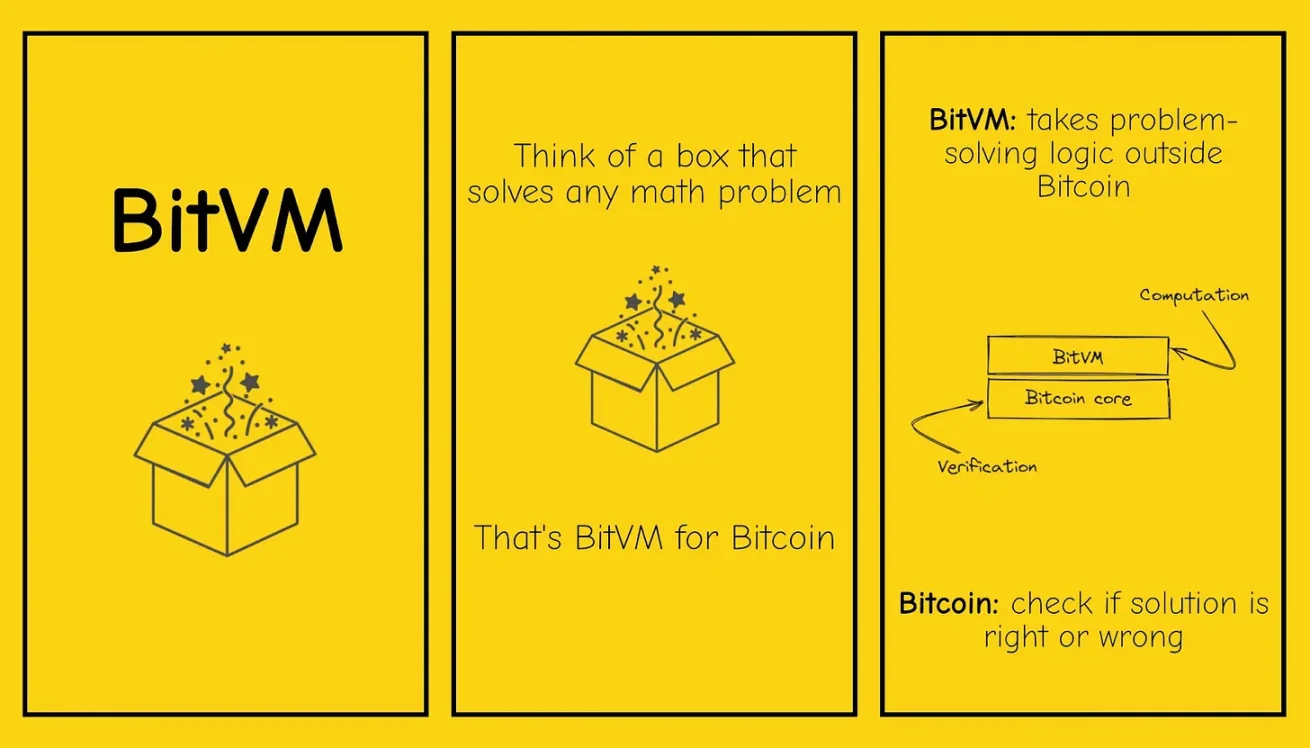
BitVM. Source: Bitcoin Illustrated
Likewise, concepts like BitVM—a proposed Bitcoin “virtual machine”—promise Ethereum-like smart contracts on Bitcoin, with its testnet scheduled for launch in 2025. Equally important, a wave of Bitcoin-native Layer-2 networks and sidechains has emerged.
Platforms such as Stacks, Rootstock (RSK), Merlin Chain, and the new BOB Rollup are introducing smart contract capabilities to the Bitcoin ecosystem.
Stacks enables smart contracts secured by Bitcoin’s hash power, cross-chain tokenization via sBTC, and native BTC yield through Proof-of-Transfer (PoX) staking, making Bitcoin more programmable and productive for developers and institutions alike.
BOB (Build on Bitcoin) is an EVM-compatible Layer-2 using Bitcoin as its finality anchor. It even plans to leverage BitVM for Turing-complete contracts secured by Bitcoin.
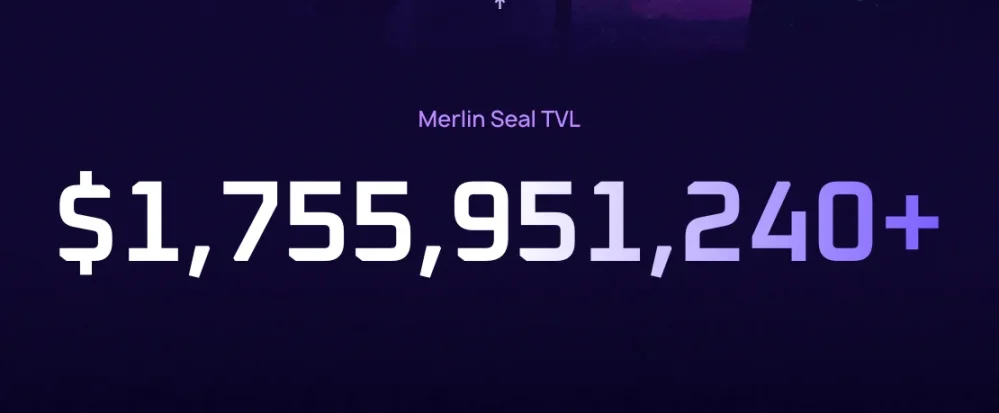
Merlin’s TVL currently exceeds many ETH Layer-2s such as ZkSync, Linea, and Scroll. Source: Merlin
In the meantime, the Babylon protocol has introduced Bitcoin staking to secure other chains and has attracted tens of thousands of BTC. By end-2024, Babylon had staked over 57,000 BTC (approximately $6 billion), making it one of the highest TVL-ranked DeFi protocols. Merlin, once the top Bitcoin Layer-2 by TVL, reached around $3.9 billion in TVL within 50 days of launch, significantly expanding the BTCFi landscape.
Together, these upgrades and new layers overcome many early barriers, allowing Bitcoin to now support tokens, smart contracts, and cross-chain interactions in a modular fashion.
From Ordinals to BRC-20
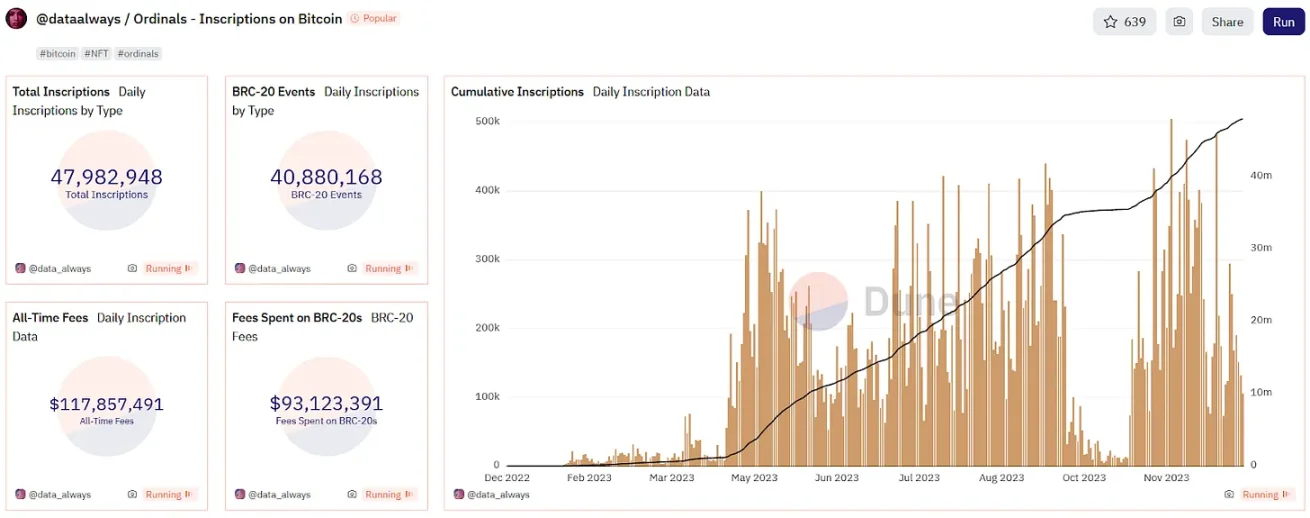
2023 was the breakout year for Ordinals and BRC-20 tokens. Source: Dune @dataalways
Demand for more expressive uses of Bitcoin has clearly grown over the past two years. A prime example is the 2023 explosion of Ordinals and BRC-20 tokens. Users began inscribing assets and NFTs onto sats, driving a surge in on-chain activity.
By end-2023, over 52.8 million Ordinal inscriptions had been created, rising to about 69.7 million by end-2024. Meanwhile, miners collected hundreds of millions in fees—over 6900 BTC (around $405 million) by Q3 2024.
This boom proved users are willing to do more with Bitcoin block space than just holding or sending payments—the market demand for Bitcoin NFTs, tokens, and DeFi applications is evident.
The emergence of the Ordinals protocol fundamentally enabled Bitcoin to carry these new asset types, while the BRC-20 standard provided a framework for tokenization. Though technically different from Ethereum’s ERC-20, its role in expanding Bitcoin’s utility is similar.
All these advancements constitute a technology stack that didn’t exist just a few years ago. The Bitcoin ecosystem is now ready to build full DeFi infrastructure around its core asset.
In summary, these catalysts acting together have matured BTCFi, and this trend is likely to accelerate in the coming years.
5. BTCFi Ecosystem Scenarios
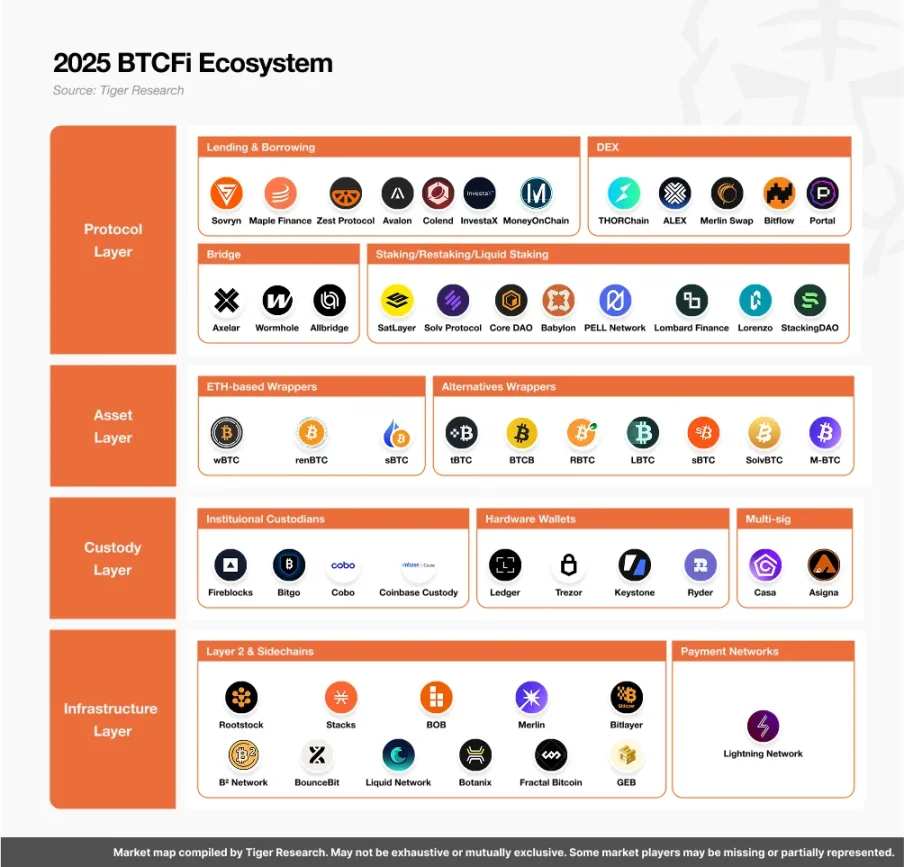
BTCFi aims to transform Bitcoin from a passive store of value into an actively deployed financial asset within decentralized finance.
Bringing Bitcoin into DeFi
The BTCFi lifecycle typically begins when BTC holders transfer their assets to a bridge or custodian. The original BTC is locked, and a 1:1 tokenized version is issued. This wrapped BTC enters the asset layer of the ecosystem, enabling integration with smart contracts and DeFi protocols.
Exploring the BTCFi Tech Stack
Once tokenized, BTC flows through structured layers within the BTCFi tech stack. At the asset level, Solv Protocol enables BTC to function as cross-chain yield-bearing collateral via SolvBTC and its Staking Abstraction Layer (SAL), supporting structured products and capital-efficient use cases.
Institutional adoption is supported by products like lstBTC, launched by Maple Finance in collaboration with CoreDAO, leveraging Core’s dual staking mechanism. BitLayer provides a trust-minimized, Bitcoin-native Layer-2 environment where Peg-BTC can support smart contract activity.
On the compliance front, IXS delivers real-world yield on BTC through compliant financial structures. Meanwhile, infrastructure projects like Botanix expand Bitcoin’s programmability by introducing EVM compatibility, enabling BTC to serve as gas for smart contracts.
Using BTC as Collateral and Staking Asset
With infrastructure in place, BTC can be used as collateral. For example, on bitSmiley, BTC can be used to mint stablecoins, enabling yield generation or stablecoin strategies. Emerging staking models are also expanding BTC’s utility: protocols like Babylon allow native BTC to participate in securing proof-of-stake (PoS) networks and earn rewards in return.
Risk Management and Position Exit
Throughout this process, BTC holders retain economic exposure to Bitcoin price movements while earning yield from DeFi protocols. These positions are reversible: users can exit at any time by closing positions, redeeming wrapped BTC, and reclaiming their original Bitcoin (minus fees or plus earnings).
Protocol Incentives and Revenue Models
Underpinning these flows are diverse monetization models. Lending platforms earn revenue through origination and usage fees, capturing the spread between borrowers and lenders. DEXs charge liquidity fees on each trade, typically shared with liquidity providers and protocol treasuries. Staking and bridging services take commissions from earned rewards, incentivizing uptime and network security.
Some protocols use native tokens to subsidize usage, bootstrap activity, or manage treasuries. Custodial products usually follow traditional asset management models, charging annual fees (e.g., 0.4%-0.5%) on assets under custody or management.
Additionally, spread capture offers a less visible but significant revenue stream: protocols can profit from interest rate differentials and basis trades through cross-chain arbitrage or structured yield strategies.
Together, these models demonstrate how BTCFi protocols activate idle Bitcoin while building sustainable revenue foundations. As more BTC enters this layered system, it doesn’t just circulate—it compounds, generates yield, and supports a parallel economy centered on Bitcoin.
Join TechFlow official community to stay tuned
Telegram:https://t.me/TechFlowDaily
X (Twitter):https://x.com/TechFlowPost
X (Twitter) EN:https://x.com/BlockFlow_News
 @tiger_research