The Final Chapter of BTCFi: Observing the Decline of the Ecosystem from BitLayer's Crash
TechFlow Selected TechFlow Selected
The Final Chapter of BTCFi: Observing the Decline of the Ecosystem from BitLayer's Crash
Looking back at the rise and fall of BTCFi, we may need to reexamine BTC's position within the crypto ecosystem.
 Navigating Web3 tides with focused insights
Author: San
On August 27, BitLayer, a BTC ecosystem project, launched on Binance Alpha. This once highly anticipated star project in the BTCFi space delivered a sharp plunge instead, marking a telling moment for the entire sector.
According to CMC data, BTR opened at $0.1511 and plummeted to $0.077 within hours, a single-day drop of 48.6%. As of today, August 28, the token remains 44.3% below its all-time high, with a 24-hour trading volume of $60.3 million. The trading volume-to-market-cap ratio reached an extreme speculative level of 274%, revealing the stark reality of a lack of long-term holders.
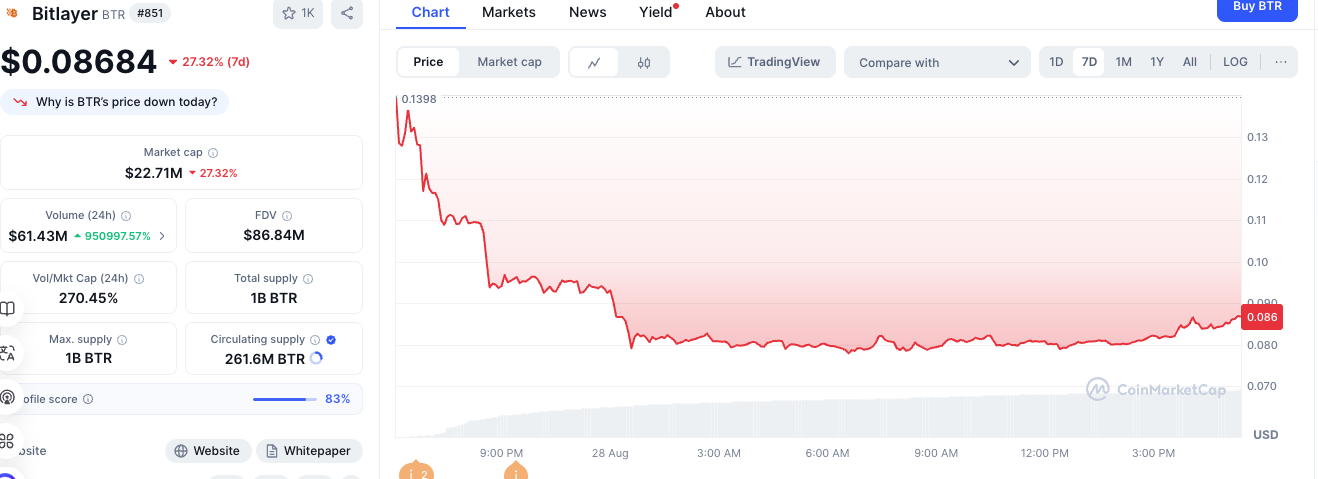
More thought-provoking is that despite the on-chain TVL still holding relatively high at $429 million, the token's cliff-like collapse clearly reflects market skepticism toward BTCFi’s ability to capture ecosystem value.
The steep decline of BitLayer at launch represents far more than just another "launch-at-peak" incident—it symbolizes the broader narrative shift of BTCFi from frenzy to decline.
Collective Decline of Mainstream Projects
The BTC ecosystem has indeed spawned several sensational projects, yet their inherent flaws and narrative contradictions remain undeniable.
Merlin Chain: TVL Drops from $3.8B to Just $50M
Once the leading BTCFi project, Merlin Chain’s data trajectory has been nothing short of dramatic.
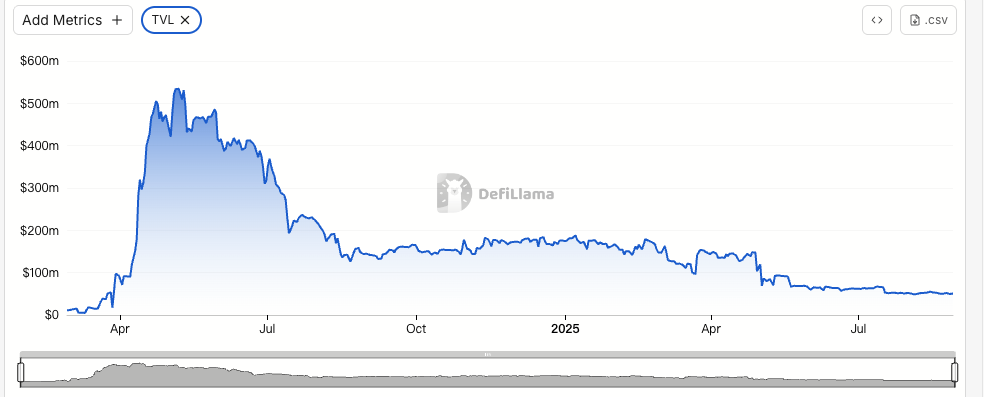
Within 50 days of launch, it attracted up to $3.8 billion in BTC staking, peaking at a TVL of $530 million, briefly becoming the top BTC Layer2 in both TVL and user count.
Yet the reality is brutally harsh: according to DeFillama, Merlin Chain’s current TVL stands at only $50 million—over a 90% drop from its peak. Its token MERL hovers around $0.115, up 45.1% year-to-date but still down 90% from its all-time high. More disheartening is its 24-hour on-chain inflow of merely $1,946.
From undisputed leader to widely ridiculed outcast, Merlin Chain made this fall in just six months. Today, people still occasionally mention Merlin—but almost exclusively as a punchline.
Ordinals & BTC NFTs: From Celebration to Self-Mockery
The once-hyped Ordinals inscriptions and BRC-20 tokens on Bitcoin have also lost their luster.
Recall that winter when inscriptions exploded—every chain rushed to launch inscription products, fueling a nationwide craze for minting. BTC, as the origin of all things crypto, gave rise to popular projects like Sats and Ordi. The slogan “Buy Ordi today, drive an Audi tomorrow” still echoes faintly in our ears.
Nowadays, “Ordinals are dead” has shifted from mockery to an inside joke even official inscription accounts use for self-deprecation.

BTC NFT markets now see fewer than 2,000 active users daily—just 1.7% of total chain activity—far behind ETH or Solana ecosystems.
The practical utility of inscriptions and NFTs remains controversial, but one thing is clear: users have been leaving one by one. Loss of user confidence signals that this narrative is being gradually forgotten amid the fast pace of the crypto market.
Beyond Merlin Chain, BTC inscriptions, and NFTs, other BTCFi projects are increasingly exposing their own limitations and structural flaws.
Babylon has set a new TVL record of $6.3 billion, yet its token price has fallen 77% from its peak, highlighting the lack of innovation in its single-staking model. Core, another popular BTC ecosystem project, now has a TVL of just $386 million—down over 70% since the beginning of the year.
The truth behind the numbers is even grimmer: apart from Babylon, most BTCFi projects generate less than $50,000 in daily fee revenue—dwarfed by traditional DeFi projects that routinely pull in millions. The unsustainability of this business model is now being ruthlessly exposed.
Narrative Fatigue and Inherent Contradictions
The fundamental challenge of BTCFi stems from Bitcoin’s own technical limitations.
Designed as “digital gold,” BTC lacks native smart contract programmability, forcing all BTCFi applications to rely on compromised solutions like sidechains, L2s, or cross-chain bridges.
According to DeFillama, bridged assets account for 80%-100% of TVL among major BTCFi projects: 80% for Merlin Chain, 94% for Core, and nearly 100% for BitLayer via cross-chain BTC.
This heavy reliance on cross-chain infrastructure not only increases security risks but also contradicts Bitcoin’s core principles of decentralization and self-sovereignty.
On social media, discussions around BTCFi have shifted from early excitement to a skeptical “prove-your-worth” phase. An increasing number of KOLs now label the BTC ecosystem as a doomed sector.

Retail sentiment speaks even louder—the enthusiasm for the BTC ecosystem continues to be diluted by fresh narratives emerging on ETH and SOL. Recent whale movements selling BTC to rotate into ETH have only poured cold water on these smoldering ashes.

Image source @Ai Auntie
On another front, the bleak state of the BTC ecosystem exposes the internal contradictions in most BTCFi economic models.
To attract liquidity, projects must offer high yield incentives, which often depend on token inflation—thereby diluting long-term value.
BitLayer’s extreme turnover rate and Merlin Chain’s user exodus both demonstrate the unsustainability of this “mine-and-dump” model.
BTC: Returning to a Spiritual Totem
Reflecting on the rise and fall of BTCFi, we may need to reassess BTC’s role in the crypto ecosystem.
Unlike ETH, designed from the start as a “world computer,” BTC functions more like a cryptographic totem—one meant to consolidate consensus and faith, not to enable functional expansion.
ETH can support a DeFi ecosystem because its architecture is optimized for programmability. BTC’s value proposition was never about “what it can do,” but “what it represents.” Perhaps the moment we tried to make BTC carry complex financial applications, we violated its very essence.
Compared to BitLayer or Merlin, Babylon stands out as relatively successful—and precisely because as a pure BTC staking protocol, it doesn’t attempt to change BTC. Instead, it leverages BTC’s security to serve other chains. This “specialize in your strength” approach may well be the correct way for BTC to participate in DeFi.
The decline of BTCFi isn’t a failure of BTC itself—as evidenced by BTC repeatedly hitting new highs this year. Rather, BTCFi’s downfall reflects the market’s rational correction against excessive financialization.
BTC remains the most important value storage tool in crypto, but it will never—and should never—become the next ETH.
Recognizing this may be the true mark of the industry’s maturity.
Join TechFlow official community to stay tuned
Telegram:https://t.me/TechFlowDaily
X (Twitter):https://x.com/TechFlowPost
X (Twitter) EN:https://x.com/BlockFlow_News
 深潮TechFlow