FHE赛道一览,Web3隐私数据终局何时到来?
TechFlow Selected TechFlow Selected
FHE赛道一览,Web3隐私数据终局何时到来?
FHE targets any private data within the entire internet ecosystem.
 Navigating Web3 tides with focused insights
Author: Peng Sun, Foresight News
The market is full of contradictions—privacy-focused projects have largely disappointed, yet the ideological notion of data privacy remains deeply inspiring. Privacy is an enduring dream in the world of crypto.
Cryptography is a primitive of blockchain. When we first learned about homomorphic encryption (HE), we were still debating whether zero-knowledge proofs (ZK) could ever be applied to blockchains. Now, we’re at the stage of asking how well ZK works and when we should use HE.
For many, cryptographic technologies remain distant and inaccessible due to high technical barriers, making it difficult for retail investors to participate. Last December, with the explosion of AI + Crypto, I noticed that some Western VCs began paying attention to the FHE space. This trend culminated on May 5 this year when Vitalik Buterin reshared his 2020 article "Exploring Fully Homomorphic Encryption" and commented that "many people are interested in FHE lately." Around the same time, new podcasts focused on FHE and FHE competition platforms have also emerged.
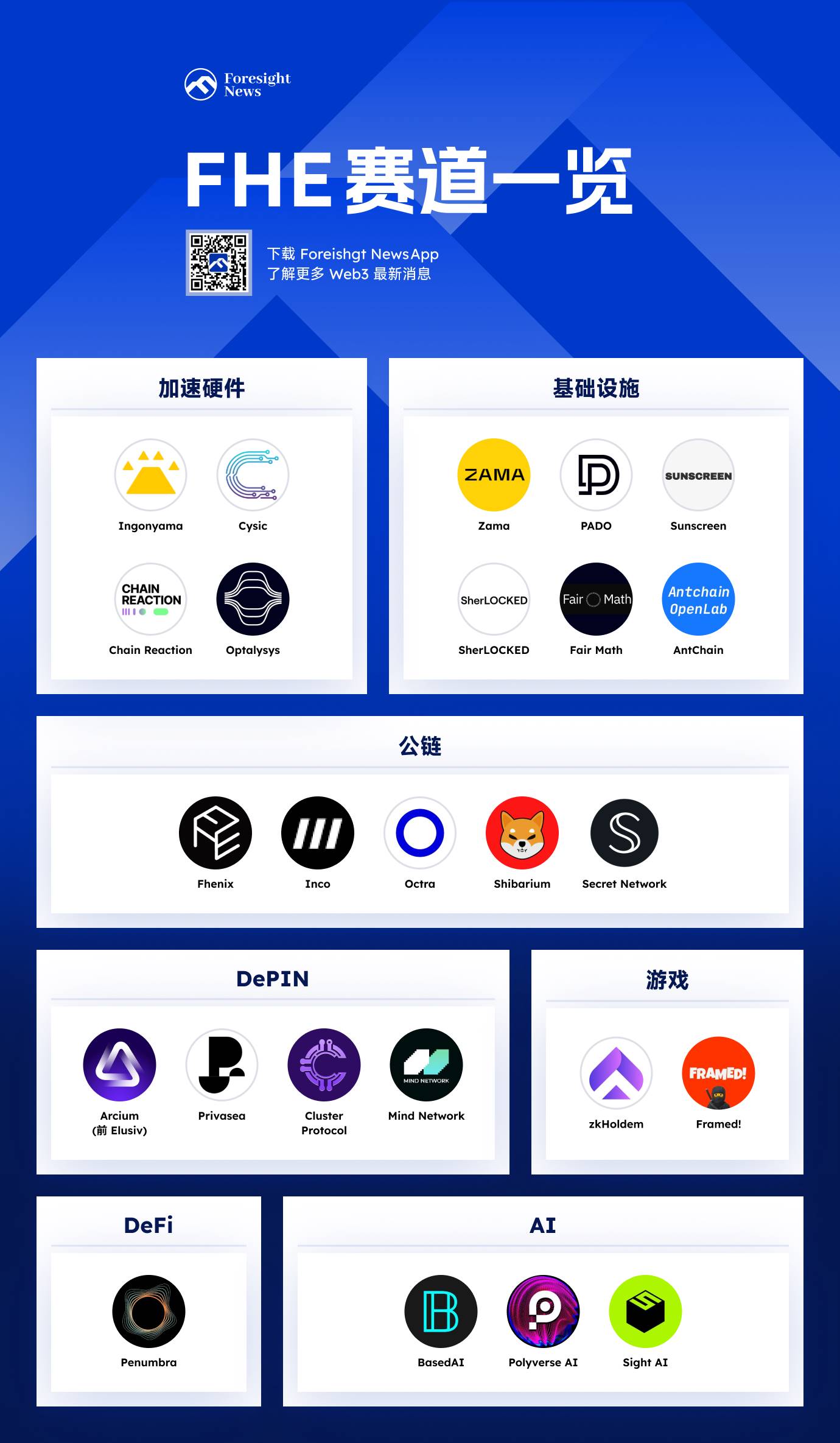
So, what exactly is FHE hidden in the ivory tower? What are its application scenarios? And why is it attracting so much capital? Today, Foresight News reviews 25 projects in the FHE space spanning infrastructure, public chains, DePIN networks, AI, gaming, and DeFi.
What is FHE (Fully Homomorphic Encryption)?
Homomorphic Encryption (HE) was first proposed in 1978, aiming to solve the problem of processing data without accessing it directly. However, progress remained slow until 2009, when only Partially Homomorphic Encryption (PHE)—supporting either addition or multiplication operations—existed. In 2009, Craig Gentry published a groundbreaking 200-page thesis titled A Fully Homomorphic Encryption Scheme, introducing the first scheme capable of arbitrary sequences of additions and multiplications on encrypted data—what we now call Fully Homomorphic Encryption (FHE)—marking a major leap forward in the field.
We often refer to ZKP as the holy grail of cryptography, but FHE is equally significant—and even more ambitious in vision. The key difference between ZKP and FHE lies in their functions: ZKP allows one party to prove the truthfulness and reliability of data without revealing the data itself, playing a crucial role in Layer 2 solutions by significantly reducing computation costs.
FHE aims for "computable but invisible." Traditional cryptographic algorithms require decryption before any computation can be performed on ciphertext; they cannot operate directly on encrypted data. FHE changes this—it enables direct computations on encrypted data (ciphertext), producing results identical to those obtained from plaintext computations. To illustrate: imagine placing data A into a black box (encryption). When sending this box to a recipient, there’s no need to open it—the recipient can compute directly on the sealed box, with zero leakage of A’s content during the process. This achieves true privacy-preserving computation.
FHE has broad applications beyond Web3 and blockchain—it applies to any privacy-sensitive data across the internet ecosystem, including advertising, personalized recommendations, AI, gaming, on-chain transactions, MEV protection, blockspace auctions, on-chain voting, anti-Sybil attacks, machine learning, healthcare, finance, and natural language processing. That said, FHE hasn’t seen widespread adoption yet due to its immense computational demands. Currently, FHE computations are 4 to 5 orders of magnitude slower than plaintext (10,000x to 100,000x).
Moreover, while FHE protects data privacy, it does not guarantee computational integrity—this is where integration with ZKP becomes valuable. In past years, integrating ZKP and FHE was technically challenging, compounded by FHE's extreme computational requirements, which limited its application in blockchain. However, recent advancements in FHE technology have opened the door for combining ZK and FHE. With hardware acceleration already benefiting ZKP, and the rise of DePIN offering decentralized compute networks, the combined potential of FHE and ZKP appears increasingly promising.
Hardware Acceleration
Due to the large number of polynomials involved in FHE computations, CPUs are inefficient at handling them. Ultimately, GPU, FPGA, and ASIC-based hardware acceleration will be required. Lattica AI has tested GPU acceleration and CUDA implementations for FHE schemes. If GPUs can effectively accelerate FHE, it could lead to fully decentralized FHE computing. Nevertheless, FPGA and ASIC remain the ultimate choices for optimal performance.
Ingonyama
When discussing ZKP, FHE, and hardware acceleration, one cannot overlook Ingonyama, arguably the strongest player in this space. Founded in 2022 by Shlomovits—a graduate of Israel Defense Forces’ elite Unit 8200 and serial entrepreneur—the company is a semiconductor firm developing a programmable parallel processor similar to a GPU, specifically designed to accelerate advanced cryptography, particularly zero-knowledge proofs (ZKP) and fully homomorphic encryption (FHE). While currently focused on ZKP, many underlying computations overlap with FHE, making future expansion into FHE acceleration a natural progression.
Recently, ZKP hardware acceleration company Accseal (Zhixinhua Xi) announced a strategic partnership with Ingonyama, integrating their products Leo and ICICLE v3. Accseal previously developed a ZK ASIC chip, and this collaboration is expected to drastically reduce computational costs and improve performance for end users.
In November 2023, Ingonyama raised $20 million in seed funding led by Walden Catalyst, with participation from Geometry, BlueYard Capital, Samsung Next, Sentinel Global, and StarkWare. In January 2024, the company secured another $21 million in seed funding, co-led by IOSG Ventures, Geometry, and Walden Catalyst Ventures.
Cysic
Cysic is a hardware acceleration company positioned as a real-time ZK proof generation and verification layer, offering ZK Compute-as-a-Service (ZK-CaaS) powered by proprietary ASIC, FPGA, and GPU chips. Cysic has already developed FPGA hardware and plans to launch ZK DePIN chips/devices—ZK Air and ZK Pro—to build a DePIN network called Prover Network.
According to Cysic co-founder Leo Fan, ZK and FHE share many common modules, meaning much of Cysic’s current work can be reused in FHE. Additionally, Leo contributed to Taiko and HashKey Capital’s FHE research and published an academic paper on FHE, suggesting Cysic may become a key player in FHE hardware acceleration in the future.
In February 2023, Cysic raised $6 million in seed funding, led by Polychain Capital, with participation from HashKey, SNZ Holding, ABCDE, A&T Capital, and Web3.com Foundation.
Chain Reaction
Chain Reaction is a blockchain chip startup that began mass production of its Electrum blockchain chip in Q1 this year. The chip is optimized for fast and efficient execution of blockchain hashing operations and can also be used for cryptocurrency mining such as Bitcoin. The company plans to release an FHE chip by the end of 2024, enabling data processing while maintaining encryption.
In February 2023, Chain Reaction raised $70 million in funding led by Morgan Creek Digital, bringing total funding to $115 million. The funds will be used to expand its engineering team.
Optalysys
Optalysys is a dedicated hardware acceleration platform for FHE, building scalable FHE hardware using optical computing. It has launched an accelerator program encompassing simulators, software, and hardware. Optalysys targets the intensive computations common across all FHE schemes, providing acceleration for confidential computing solutions. Its current product is the hybrid photonic chip Optalysys Etile, combining digital interfaces with silicon photonics, integrated with traditional digital electronics in multi-chip modules, centered around photonic circuits.
Infrastructure
Zama
Zama is an open-source cryptography company building FHE solutions for blockchain and AI. Co-founded in early 2020 by Hindi and Pascal Paillier—renowned cryptographer and one of the inventors of Fully Homomorphic Encryption (FHE)—Zama provides FHE solutions for Web3 projects, including the TFHE-re library, TFHE compiler Concrete, privacy-preserving machine learning framework Concrete ML, and confidential smart contract environment fhEVM.
Zama focuses on TFHE (Threshold Homomorphic Encryption). Its TFHE-re is a pure Rust implementation enabling Boolean and integer operations on encrypted data, giving developers and researchers fine-grained control for advanced functionality. fhEVM integrates TFHE-re into the EVM, exposing homomorphic operations as precompiled contracts, allowing developers to use encrypted data within smart contracts without modifying compilation tools.
On March 7, 2024, Zama completed a $73 million Series A round led by Multicoin Capital and Protocol Labs, with participation from Metaplanet, Blockchange Ventures, Vsquared Ventures, Stake Capital, Filecoin founder Juan Benet, Solana co-founder Anatoly Yakovenko, and Ethereum co-founder and Polkadot co-founder Gavin Wood. Funds will support continued R&D of its FHE tooling.
PADO
PADO is a decentralized computing network based on zkFHE, aiming to develop versatile zkFHE algorithms capable of supporting machine learning (ML) applications and broader virtual machine functionalities. Any computational resource can eventually join the network as a node. Currently, PADO Labs is developing core components such as the PADO extension, developer toolkit, and node SDK. The PADO extension serves as a one-stop portal where users can generate proofs across various platforms.
Technically, PADO’s most significant innovation is combining zk-SNARKs with FHE to ensure both privacy and verifiability of data computation. It further integrates MPC, IZK (Interactive Zero-Knowledge), and zkFHE. According to its roadmap, PADO’s near-term focus is enhancing specific (F)HE capabilities and launching customized products for zkFHE-enabled applications. Current efforts prioritize optimizing FHE algorithms and integrating ZK components for verifiability. PADO’s early HE scheme supports linear operations, reducing ZK proof time for ciphertext and additive homomorphic operations to around 0.7 seconds—with potential to drop below 0.1 seconds. Compared to Zama’s approach, PADO halves computation time for homomorphic comparisons. It also extends support for larger plaintext spaces (e.g., u8/u16/u32), achieving at least double the performance of Zama. General zkFHE performance improves 3–5x when leveraging Zama’s libraries. PADO supports popular programming languages like Python and Rust.
At the application level, PADO currently focuses on data-sharing scenarios within the AO and Arweave ecosystems. In April, PADO partnered with AO to launch Verifiable Confidential Computing (VCC), built on top of AO. PADO will gradually establish decentralized computing units based on AO and use the Arweave blockchain as a secure storage layer for private data. Users encrypt their data via PADO’s zkFHE technology and store it securely on Arweave. Any computation request from within the AO ecosystem is routed through AO’s scheduler to PADO’s computing nodes, which then dispatch tasks to zkFHE nodes. These nodes retrieve encrypted user data from Arweave and perform corresponding fully homomorphic computations along with proof of computational integrity.
In 2023, PADO raised $3 million in seed funding.
Sunscreen
Sunscreen is a privacy-focused startup aiming to empower engineers to easily build and deploy private applications using cryptographic techniques like FHE. Sunscreen has open-sourced its FHE compiler—a Web3-native tool that converts standard Rust functions into privacy-preserving FHE equivalents—delivering strong performance for arithmetic operations (e.g., DeFi) without requiring hardware acceleration. The compiler supports the BFV FHE scheme. Sunscreen is also developing a ZKP compiler compatible with its FHE compiler to ensure computational integrity, although proving homomorphic operations remains relatively slow. Additionally, the team is exploring decentralized storage systems for FHE ciphertexts.
In terms of roadmap, Sunscreen will first enable private transactions on testnet, followed by predefined private programs, and ultimately allow developers to write arbitrary private programs using its FHE and ZKP compilers.
In July 2022, Sunscreen raised $4.65 million in seed funding led by Polychain Capital, with participation from Northzone, Coinbase Ventures, dao5, and individual investors including Naval Ravikant and Tux Pacific, founder of Entropy. Founded by Ravital Solomon and MacLane Wilkison, co-founder of privacy network NuCypher, Sunscreen aims to simplify FHE-based application development. Prior to this, Sunscreen had secured $570,000 in pre-seed funding.
SherLOCKED
SherLOCKED is an FHE-powered infrastructure enabling privacy on EVM blockchains. Developers can use it to write custom smart contracts that operate on encrypted blockchain data. Simply put, it encrypts public transaction data on-chain so that no one can view it—because all on-chain data exists in encrypted form.
It follows a formula: ZK + MPC + FHE = SherLOCKED, consisting of three main parts—SherLOCKED SDK, a node network, and zkVM computing infrastructure. When a user sends a transaction to a smart contract, the node network first uses MPC to encrypt the data and passes it to the SDK. Then, the SDK invokes the smart contract function with the encrypted data as input, and the contract performs operations on the ciphertext. Since these computations consume substantial gas, SherLOCKED outsources them to RISC Zero’s zkVM-based proof computer (Bonsai), which performs the computation and generates a ZK proof. Finally, this proof is verified by on-chain relays and validators. SherLOCKED can be deployed on any EVM-compatible network.
SherLOCKED was built by Nitanshu, co-founder of Rize Labs, during ETHGlobal’s ETHOnline hackathon in October 2023, where it advanced to the finals and won recognition. As of now, SherLOCKED’s GitHub repository has not been updated in seven months.
Fair Math
Fair Math is a research-driven organization adopting an open-source, community-oriented approach focused on developing FHE-based privacy-preserving technologies. In April 2024, Fair Math released the “Collaborative FHE-(E)VM Manifesto,” proposing a modular design for FHE-(E)VM that allows multiple versions to coexist, using a standardized reference implementation to support FHE application development.
The manifesto also introduces FHERMA, a competition platform developed in collaboration with OpenFHE, aimed at advancing FHE through uniquely structured challenges. According to plans, over 25 FHE challenges will be launched on the platform in 2024. Poly Circuit is an application-layer FHE component library built via FHERMA challenges—once challenge winners are identified, their solutions are added to the repository via PR. OpenFHE-rs is a joint project between Fair Math and OpenFHE, serving as the most comprehensive FHE Rust library available to developers.
In February 2024, Fair Math raised $1.4 million in pre-seed funding led by gumi Cryptos Capital, Inception Capital, and Polymorphic Capital to promote FHE adoption.
AntChain
AntChain TrustBase is an open-source technical framework based on AntChain, incorporating wide-area consensus algorithms, zero-knowledge proofs, and fully homomorphic encryption.
Public Chains
Fhenix
Fhenix is an Ethereum L2 powered by FHE Rollups and FHE Coprocessors, fully EVM-compatible with full Solidity support, enabling smart contracts with on-chain confidential computation using FHE. Fhenix does not use zkFHE; instead, it employs Optimistic Rollup rather than ZK Rollup, leveraging Zama’s FHE implementation via fhEVM to provide on-chain confidentiality, focusing specifically on TFHE (Threshold FHE).
On April 2, 2024, Fhenix announced a collaboration with EigenLayer to develop an FHE coprocessor, aiming to bring FHE to smart contracts. The “FHE coprocessor” specializes in computing on encrypted data without prior decryption, offloading FHE computations from Ethereum, L2, or L3 to designated processors. These coprocessors are secured by Fhenix’s FHE Rollup and EigenLayer’s staking mechanism. According to the roadmap, Fhenix plans to launch its mainnet in January 2025.
In September 2023, Fhenix raised $7 million in seed funding led by Sora Ventures, Multicoin Capital, and Collider Ventures, with participation from Node Capital, Bankless, HackVC, TaneLabs, and Metaplanet. Fhenix will launch a public testnet in early 2024, supporting ecosystem application development.
Inco
Inco Network is a universal privacy layer for Web3 and a modular confidential computing L1 blockchain, providing privacy protection for on-chain applications. It combines Ethereum’s EVM with FHE and leverages EigenLayer for security, allowing programs to operate and compute on encrypted data without decryption, eliminating the need for TEEs, circuits, off-chain storage, or coprocessors—all executed natively on-chain with on-chain randomness. Inco has launched the Gentry testnet to tackle Web3 privacy challenges. It supports applications in gaming, DeFi (including dark pools, private lending, blind auctions), and enterprise solutions (private stablecoins, private RWAs, private voting).
In April 2024, Inco partnered with Ethos, EigenLayer’s validation service, enabling shared economic security and allowing Ethereum DApps to utilize Inco’s confidential computing. Inco also collaborated with modular interoperability protocol Hyperlane to extend privacy data storage and computation into modular blockchain ecosystems.
Inco has established a strategic partnership with Zama for protocol development, adopting Zama’s TFHE solution in its fhEVM. Inco’s fhEVM is compatible with Ethereum tooling (Remix, Hardhat, MetaMask) and Solidity. Advisors include Polygon co-founder Sandeep Nailwal and Anand Iyer, investment partner at Canonical GP and Lightspeed Ventures.
In February 2024, Inco Network raised $4.5 million in seed funding led by 1kx, with participation from Circle Ventures, Robot Ventures, Portal VC, Alliance DAO, Big Brain Holdings, Symbolic, GSR, Polygon Ventures, Daedalus, Matter Labs, and Fenbushi.
Octra
Octra is an FHE blockchain network supporting isolated execution environments. It proposes a novel form of FHE bootstrapping on Hypergraphs, referred to as HFHE. According to official documentation, HFHE is compatible with any project and can run independently. Most of Octra’s codebase is written in OCaml, AST, ReasonML (for interacting with the Octra blockchain), and C++. This approach is relatively new, with limited academic discussion. Its security remains unverified and requires further validation.
Octra introduces a machine learning-based consensus mechanism using participant nodes and support vector machines for load management, selecting confirmation paths based on historical experience, verifying outcomes, and ensuring tamper-proof processes.
Octra’s lightweight client allows nodes to run on Raspberry Pi, PCs, servers, cloud instances, or mobile devices. Currently, Octra Network’s validation process is in testing and debugging phase, and the testnet has not yet launched.
Shibarium
Shibarium is Shiba Inu’s Layer 2 solution, currently using fully homomorphic encryption technology from cryptography firm Zama to develop a new Layer 3 blockchain (name not yet disclosed). TREAT token will serve as the utility and governance token for this privacy-focused L3, built atop Shibarium, designed for blockchain and AI applications, supporting confidential computing in smart contracts and machine learning.
TREAT will be the final non-stablecoin in the Shiba Inu ecosystem, which will introduce a new token called Shi later this year. Existing ecosystem tokens include meme coin SHIB, BONE (governance token for Shibarium), and LEASH (fixed-supply token held by loyal Shiba Inu users, rewarding them with BONE).
In April 2024, Shiba Inu raised $12 million by selling its unreleased TREAT token to non-U.S. venture investors, with participation from Polygon Ventures, Foresight Ventures, Mechanism Capital, Big Brain Holdings, Shima Capital, Animoca Brands, Morningstar Ventures, Woodstock Fund, DWF Ventures, Stake Capital, and Comma 3 Ventures.
Secret Network
Secret Network is a privacy-focused public chain and Web3 privacy computing layer. Under its Secret 2.0 plan, the team is developing a TFHE Layer 1 network based on Fhenix, alongside privacy-preserving rollups as complementary layers.
DePIN
Arcium (formerly Elusiv)
Arcium is a DePIN network on Solana for parallel confidential computing. Founded by Yannik Schrade, Julian Deschler, Nicolas Schapeler, and Lukas Steiner, it was formerly Elusiv—a compliance-focused privacy protocol based on zero-knowledge proofs—rebranded as Arcium on May 8, 2024.
Arcium initially supports Solana, enabling developers and applications in DeFi, DePIN, and AI to access trustless, verifiable, and high-performance confidential computing. Arcium is not a standalone blockchain—it relies on underlying blockchains for data availability and consensus—but allows developers to deploy confidential smart contracts across different chains. It also empowers non-blockchain users to configure trust models according to their needs.
The Arcium network consists of two primary components: the Arx network and the Multi-party Execution Environment (MXE). MXE combines MPC, FHE, and ZKP to enable secure computation on encrypted data. The Arx network is a decentralized node network (each node called an Arx), where anyone can contribute by running a node. Arcium has launched an incentivized private testnet, inviting 100 individual developers or teams to participate by operating MPC or middleware nodes or building on-chain applications using MXE.
In November 2022, Elusiv raised $3.5 million in seed funding led by LongHash Ventures and State Stripities Ventures, with participation from Jump Crypto, NGC Ventures, Big Brain Holdings, Anagram, Cogitent Ventures, Equilibrium, Marin Ventures, Token Ventures, Moonrock Capital, Monke Ventures, and Solanafm.
In May 2024, Arcium raised $5.5 million in strategic funding led by Greenfield Capital, with participation from Coinbase Ventures, Heartcore Capital, Longhash VC, L2 Iterative Ventures, Stake Facilities, Smape Capital, Everstake, Solana co-founder Anatoly Yakovenko, and Monad co-founder Keone Han. Total funding now stands at $9 million, allocated toward building a trust-minimized, configurable encrypted computing framework for developers and blockchain apps.
Privasea
Privasea is a DePIN+AI project integrating Fully Homomorphic Encryption Machine Learning (FHEML) into a distributed computing network. It has launched an FHE-powered dApp called “ImHuman,” ensuring secure execution of “Proof of Humanity” (PoH). Specifically, after creating an ImHuman account, if a user forgets their password, recovery is impossible. ImHuman scans facial vectors using the front camera, encrypts them directly on-device—never transmitting raw data to any server—and Privasea cannot access it. The encrypted facial vector is sent to Privasea’s server and minted into a personalized NFT, completing PoH. Users who complete PoH receive exclusive airdrops. Currently, ImHuman is available only on Google Play, with App Store launch imminent.
Privasea has also built the AI DePIN infrastructure Privasea AI Network, whose testnet is live. By establishing a decentralized computing network, the testnet provides scalable distributed resources for FHE AI tasks, reducing risks associated with centralized data processing. Privasea’s FHE solution is powered by Zama’s machine learning tools.
In March 2024, Privasea raised $5 million in seed funding, with participation from Binance Labs, Gate Labs, MH Ventures, K300, QB Ventures, and CryptoTimes. In April, it completed another strategic round with OKX Ventures, Laser Digital (backed by Nomura Group), and Tanelabs (incubator backed by SoftBank) among others.
Cluster Protocol
Cluster Protocol is a DePIN proof-of-computation protocol aiming to become the “GitHub for decentralized AI models,” using FHE to provide secure and consistent rewards for GPU providers, empowering individuals and SMEs globally.
In March 2024, Cluster Protocol completed its seed round with participation from Pivot Ventures and Genesis Capital. Funding amount was not disclosed. Cluster Protocol will also join Pivot’s incubation accelerator program.
Mind Network
Mind Network is an FHE restaking layer for DePIN and AI, powered by Zama, aiming to realize “HTTPZ”—a vision of end-to-end encrypted internet. Its products include MindLayer (an FHE restaking solution for AI and DePIN networks), MindSAP (an FHE-empowered stealth address protocol), and MindLake (an FHE DataLake built on FHE validator networks via MindLayer). Within MindLayer, users can restake BTC and ETH LST tokens into Mind Network, introducing FHE-enhanced validators to ensure end-to-end encryption for validation and computation in AI and DePIN networks. It also features a Proof-of-Intelligence (PoI) consensus mechanism tailored for AI machine learning tasks, ensuring fair and secure distribution among FHE validators. FHE computations can be accelerated via hardware. MindLake is a data storage rollup designed to compute on encrypted on-chain data.
Additionally, Mind Network is launching a rollup chain in collaboration with AltLayer, EigenDA, and Arbitrum Orbit. The Mind Network testnet is live.
In June 2023, Mind Network raised $2.5 million in seed funding with participation from Binance Labs, Comma3 Ventures, SevenX Ventures, HashKey Capital, Big Brain Holdings, Arweave SCP Ventures, and Mandala Capital. That same month, it was selected for Binance Labs’ fifth incubation season, joined Chainlink BUILD, and received an Ethereum Foundation Fellowship Grant.
Gaming
zkHoldem
zkHoldem is an on-chain Texas Hold’em game powered by ZKP and FHE, currently live on Manta Network and soon to launch on Arbitrum.
Framed!
Framed! is a fully on-chain “Mafia” (killer) game powered by Inco Network and fhEVM. It reached the finals of ETHGlobal New York in September 2023. The Framed! Twitter account has not been updated since December last year, suggesting possible discontinuation.
DeFi
Penumbra
Penumbra is a fully private cross-chain PoS network and DEX in the Cosmos ecosystem, founded in 2021. Penumbra operates a shielded pool enabling private transfers, staking, and swaps, using Threshold Homomorphic Encryption (TFHE) to execute shielded point-to-pool swaps processed as batch transactions. Penumbra aims to consolidate all asset trading within the Cosmos ecosystem into a single shielded pool.
In November 2021, Penumbra raised $4.75 million in seed funding led by Dragonfly Capital, with participation from Interchain Foundation, Lemniscap, Robot Ventures, Volt Capital, Figment, Strangelove Ventures, Informal Systems, and ZKValidator.
AI
BasedAI
BasedAI is a decentralized AI project leveraging ZK-LLM, similar to Bittensor, capable of integrating FHE with any LLM connected to its network. The BaseAI Cerberus Squeezing method uses deep compression principles to enhance LLM efficiency, reduce computational load, and maintain data encryption throughout processing and transmission. The BasedAI Prometheus testnet is nearly complete, with Cyan set to begin soon.
BaseAI has issued its token but explicitly stated it will not conduct airdrops.
Polyverse AI
Polyverse AI is a global AI data engine powered by privacy, Web3, and FHE, aiming to become a “decentralized Google.” It addresses AI data privacy using FHE and ZKP, with its AI data layer supporting generative AI, DeAI, DeFi, DePIN, metaverse, and LLM applications.
Sight AI
Sight AI is a decentralized AI inference network using FHE, providing a secure, private, and collaborative infrastructure for future DeAI inference. It introduces vFHEML (verifiable FHE machine learning) and leverages ring-based SNARGs to accelerate proof generation. Given the difficulty of integrating FHE with ZK-SNARKs, Sight AI avoids ZK-SNARKs for data verifiability, instead combining SNARGs with FHE to create vFHE, reducing computational demands and speeding up proof generation.
Join TechFlow official community to stay tuned
Telegram:https://t.me/TechFlowDaily
X (Twitter):https://x.com/TechFlowPost
X (Twitter) EN:https://x.com/BlockFlow_News
 Foresight News