A Comprehensive Analysis of Sei: The Leading Player in the Parallel EVM Narrative
TechFlow Selected TechFlow Selected
A Comprehensive Analysis of Sei: The Leading Player in the Parallel EVM Narrative
The upcoming Sei V2 upgrade will introduce several technical enhancements.
 Navigating Web3 tides with focused insights
Author: Patryk Krasnicki, Messari
Translation: 1912212.eth, Foresight News
Key Takeaways
-
Sei positions itself as a high-speed L1 network compatible with CosmWasm and Cosmos's IBC protocol.
-
The Twin-Turbo consensus mechanism reduces transaction latency and accelerates transaction execution and network consensus through intelligent block propagation and optimistic block processing.
-
Parallelization increases throughput because transactions are executed independently and in parallel.
-
The upcoming Sei V2 upgrade will introduce several technical enhancements, including full backward compatibility for EVM smart contracts and tokens, optimistic transaction parallelization, and a re-architected network storage interface.
-
As of April 9, 2024, based on a 7-day moving average, Sei has an average of 8,300 daily active addresses and 394,000 daily transactions, with its DeFi TVL reaching $38.7 million.
Introduction
The previous bull market exposed blockchain limitations, with networks experiencing high gas fees and slow transaction speeds. However, during the recent bear market, new L1s have emerged with technological innovations aiming to overcome these constraints. Sei Labs is building an L1 designed to become the fastest network for exchanging digital assets. Built-in technologies such as Twin-Turbo consensus and transaction parallelization reduce transaction latency and increase throughput. Sei competes with alternative Layer-1 networks, including emerging non-EVM L1s (like Sui and Aptos), established networks (such as Solana), and upcoming parallelized EVM chains like Monad. As the network matures, Sei Labs plans to roll out the Sei V2 upgrade followed by further technical improvements via a parallel stack, positioning Sei for differentiation and growth.
Background
Sei was announced in May 2022, founded by Jayendra Jog and Jeff Feng, who previously worked as software engineers at Robinhood and as venture investors at Coatue Management. Sei Labs raised $35 million across two funding rounds and launched two incentivized testnets. The Seinami incentivized testnet (also known as Atlantic-1) went live in July 2022, followed by the upgraded Atlantic-2 testnet in March 2023.
Sei launched its Pacific-1 mainnet and native token SEI in August 2023, distributing SEI via an airdrop to eligible users. Since mainnet launch, network activity has steadily grown, with the on-chain ecosystem expanding under support from the Sei Foundation. Sei Labs is now working on major technical upgrades to its public Devnet ahead of the planned rollout of Sei V2 in the first half of 2024.
Technology
Sei is an integrated general-purpose first-layer network. As a monolithic blockchain, Sei combines execution, settlement, consensus, and data availability into a single network. The blockchain is compatible with Cosmos’s Inter-Blockchain Communication (IBC) protocol and is built using modified forks of the Cosmos SDK and Tendermint Core. Sei’s application layer supports CosmWasm smart contracts written in Rust. Although built using Cosmos technology, Sei maintains sovereignty in architecture and governance.
Built-in network features enhance transaction efficiency and throughput to support Sei’s goal of becoming the fastest digital asset exchange network. These include the Twin-Turbo consensus mechanism to reduce transaction latency and transaction parallelization to boost throughput. Additionally, an on-chain Central Limit Order Book (CLOB) supports liquidity across the network, though it has since been deprecated. Sei’s initial set of technical capabilities will be expanded in the upcoming Sei V2 upgrade.
Consensus
Sei relies on a Proof-of-Stake (PoS) protocol based on Tendermint Core, a Byzantine Fault Tolerant (BFT) algorithm used to achieve consensus. Sei validators process transactions and resolve state changes (account balances, smart contracts, etc.). Validators are selected to produce blocks based on their total stake (self-staked plus delegated SEI tokens). Anyone meeting hardware requirements can operate a validator node to secure the network.
Currently, only the top 39 validators by total stake can participate in consensus and earn network transaction fees and staking rewards. If active validators act maliciously, their stake may be slashed or burned. SEI token holders can delegate their SEI to existing validators, enabling delegators to help secure the network. Delegators also share in the validator’s SEI rewards, minus the commission rate set by the validator. Both validators and delegators must wait a 21-day unbonding period before fully unlocking staked SEI. Notably, non-vested tokens can be staked to secure the network.
Sei also leverages its novel Twin-Turbo consensus mechanism, which reduces transaction latency through two key components:
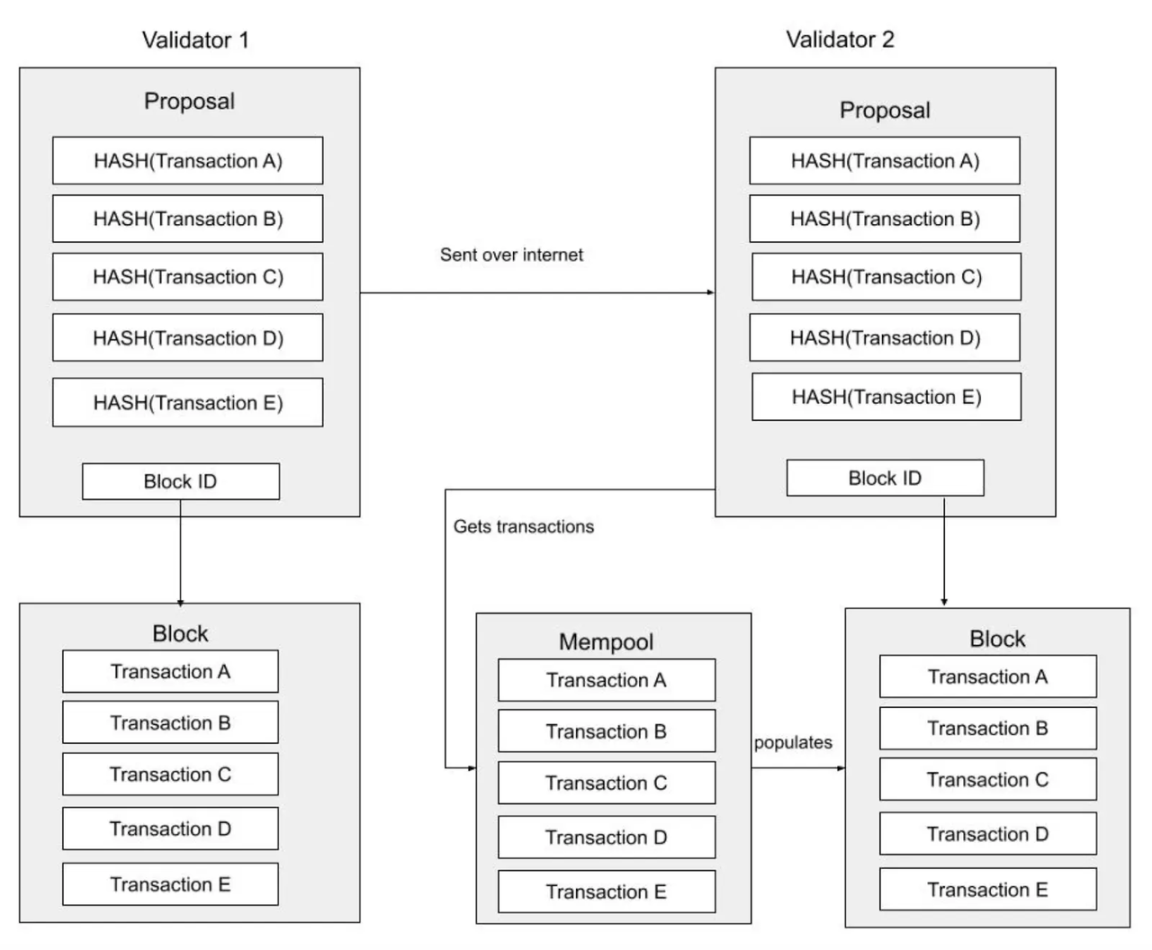
Intelligent Block Propagation: Block proposers create transaction blocks distributed among the validator set. These blocks are compressed to include only the hash of each transaction. Normally, validators must wait for the full content of a proposed block before reaching consensus. However, Sei’s design allows validators to receive individual transactions and leverage those already present in their mempool. If all required transactions are available locally, validators can reconstruct the proposed block without waiting for its complete transmission, reducing reconstruction time and lowering transaction latency.
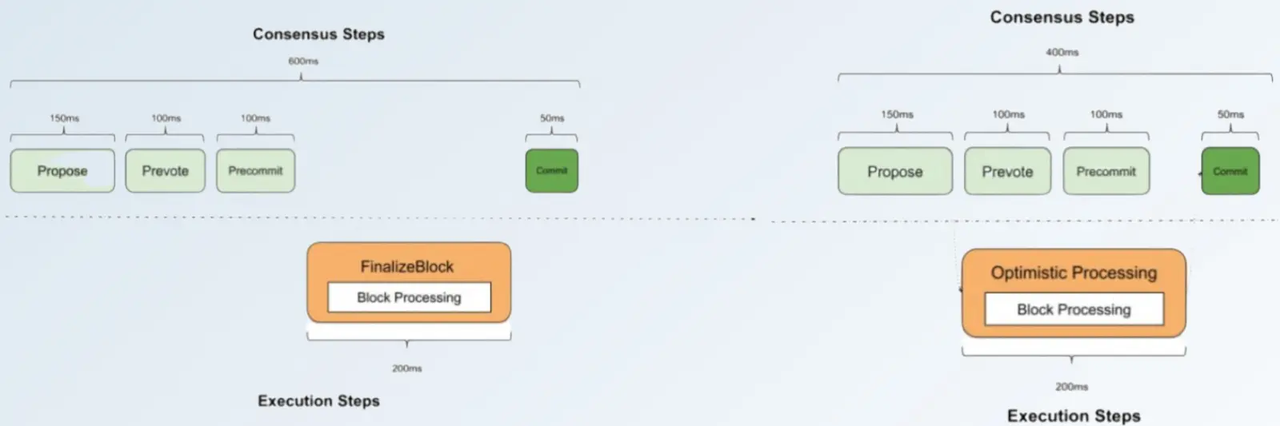
Optimistic Block Processing: Typically, validators go through pre-vote and pre-commit steps before finalizing a proposed block. On Sei, once a validator reconstructs the block content, it optimistically assumes validity. This processing occurs simultaneously with pre-voting and pre-committing. Validators immediately begin processing the first block proposal they receive—even before consensus confirmation—helping to reduce transaction latency.
If the validator set fails to reach consensus on the optimistically accepted block content, the network rejects the block, and future rounds at that block height will not use optimistic block processing. It’s worth noting that intelligent block propagation and optimistic block processing come with a trade-off of quadratic communication complexity. In other words, the number of messages exchanged between validators grows exponentially, making it difficult to scale the maximum validator set size due to increased bandwidth and processing demands.
Execution
Many chains use sequential transaction engines where transactions are ordered and executed one after another. To accelerate execution, Sei enables parallel transaction execution, allowing smart contracts to run independently without interference. This reduces network congestion and increases throughput. Currently, parallelization on Sei is optional and pessimistic. To utilize parallelization, developers must define the state (account balances, smart contracts, etc.) accessed by their smart contracts. If undefined, transactions are processed sequentially. When dependency mappings are defined, the network tracks which transactions can run in parallel and which cannot due to interdependencies. These mappings are created using Directed Acyclic Graphs (DAGs). If transactions depend on the same state location (read/write), they are processed sequentially, synchronizing execution on Sei.
Roadmap
In November 2023, Sei announced plans for Sei V2, involving three major network upgrades. In February 2024, Sei launched a public Devnet to test Sei V2 features. The upgrade is expected to deploy to mainnet in the first half of 2024. After Sei V2 launches, the team plans to introduce Sei’s Parallel Stack, enabling Layer-2 scaling on Sei.
EVM Integration
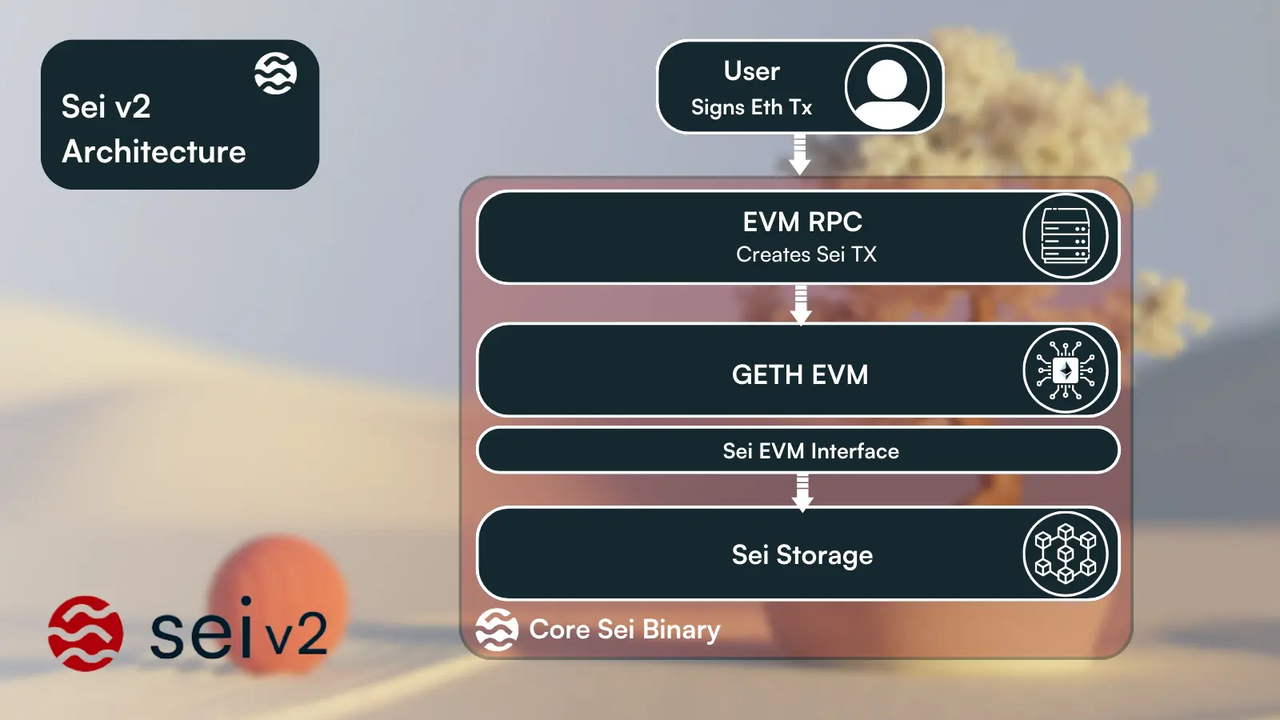
Sei V2 plans to introduce compatibility with EVM smart contracts written in Solidity, including ERC-20 and ERC-721 token standards. EVM smart contracts will also be backward compatible, meaning Ethereum and its Layer-2 contracts can be seamlessly redeployed onto Sei.
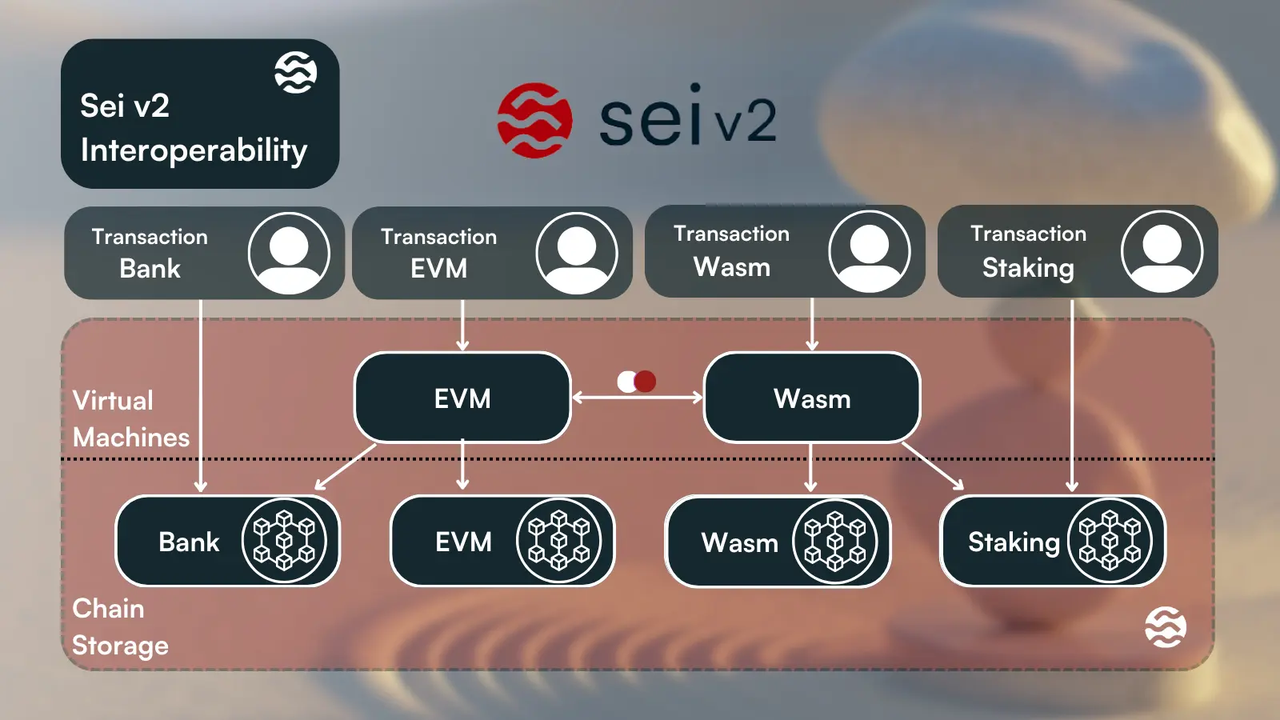
Sei will support both execution environments simultaneously. Moreover, each user’s EVM and Wasm addresses will be linked and share the same underlying account. Using pointer contracts and precompiles, EVM smart contracts and tokens will interoperate with existing CosmWasm contracts and vice versa.
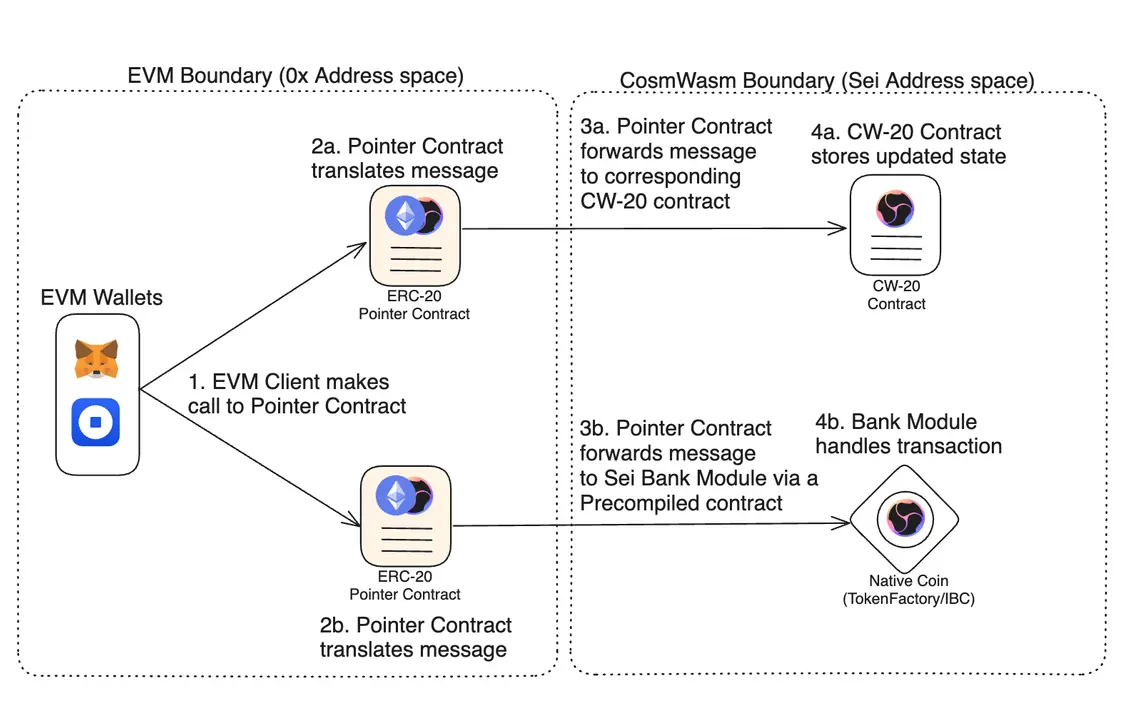
These contracts will allow tokens to be accessible in both environments without requiring wrapped versions. Essentially, pointer contracts act as bridges between the two execution environments, allowing users to specify which messages they want to send in either environment. With EVM compatibility, Sei will become a suitable hub for deploying cross-chain EVM protocols.
Many leading protocols on Ethereum also exist on other EVM-compatible networks. This upgrade could lead to EVM infrastructure and DeFi protocols deploying on Sei, bootstrapping a strong EVM ecosystem. It will also enable EVM developers to build directly on the network.
According to Electric Capital’s 2023 Developer Report, 87% of multi-chain developers work on at least one EVM chain. This previously inaccessible developer ecosystem will now be able to leverage Sei’s enhanced transaction efficiency and throughput to build novel EVM-native applications on Sei. Evidence of this is already visible through EVM applications being built on Sei’s public Devnet.
Optimistic Parallelization
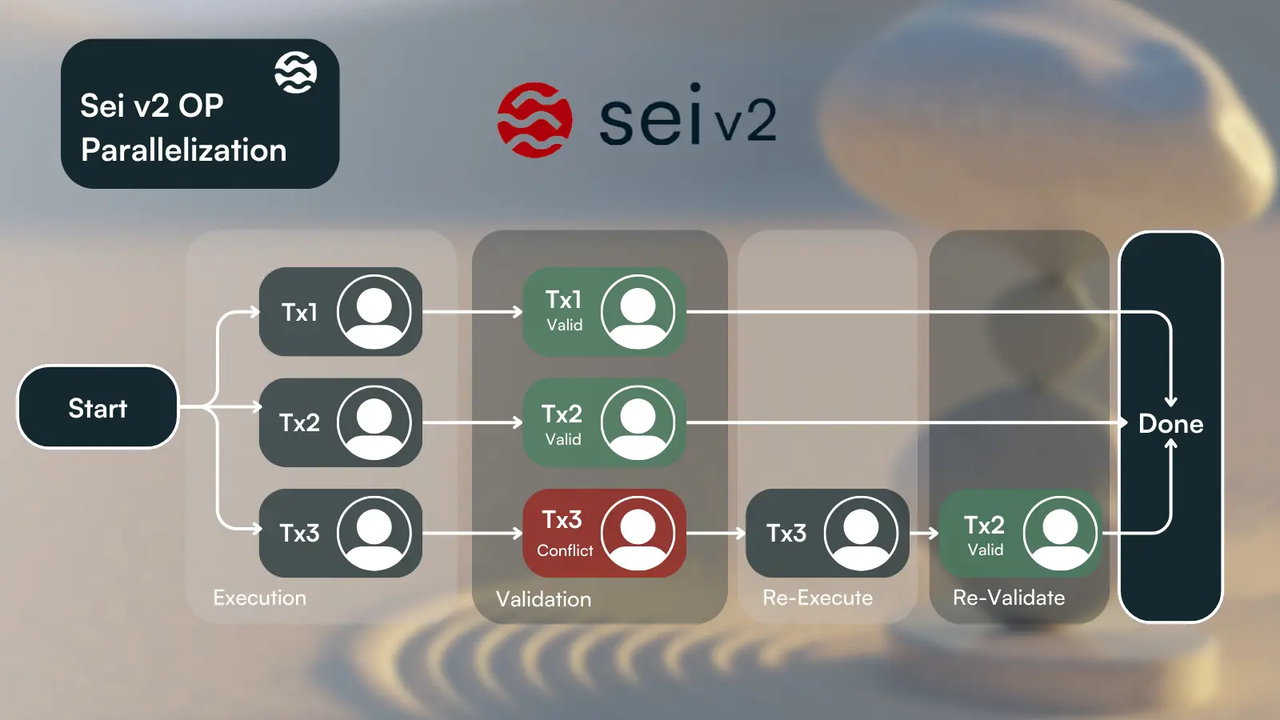
Currently, parallelization on Sei is optional. To use it, smart contract developers must explicitly define the state accessed by their contracts. Sei V2 plans to shift from pessimistic to optimistic parallelization, where all transactions are assumed to meet parallel execution conditions by default. Similar to optimistic block processing fallbacks, if transactions interact with the same part of Sei’s state (i.e., dependencies exist), they will be reprocessed sequentially. This change eliminates the need for developers to define dependency mappings, significantly improving developer experience.
SeiDB
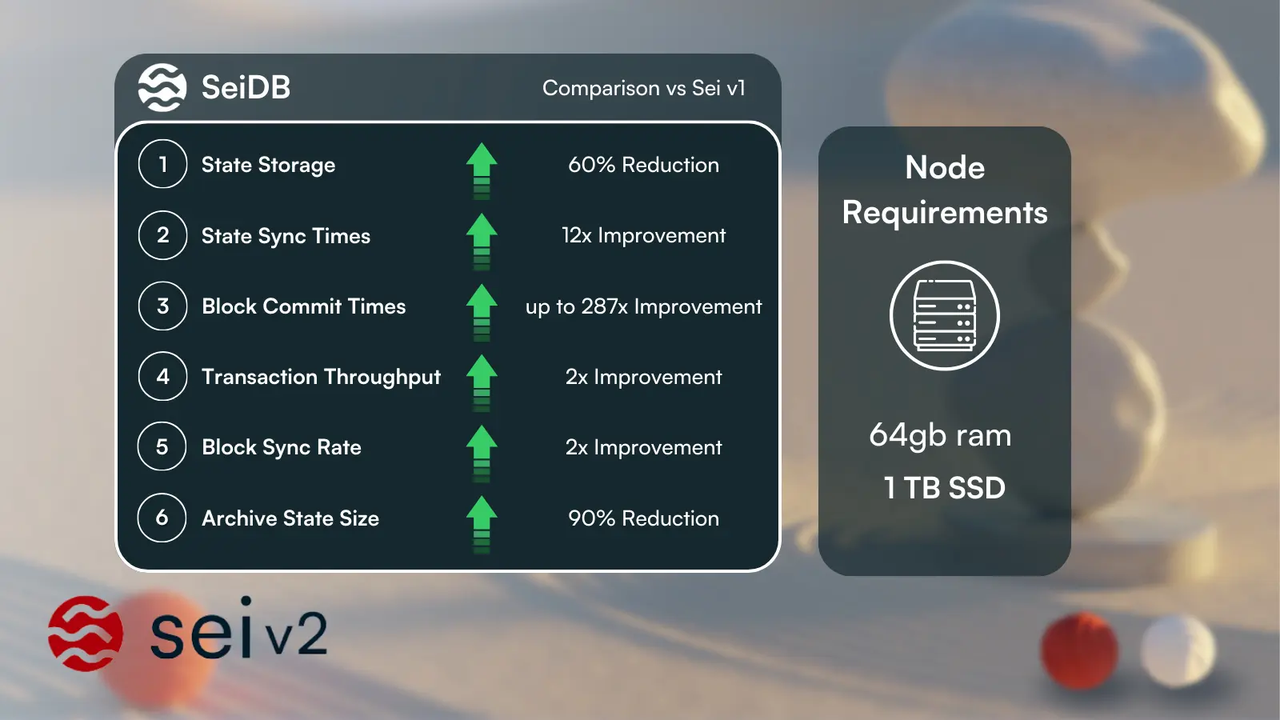
Sei V2 plans to re-architect the network’s storage interface. SeiDB will introduce a new storage layer on Sei, decoupling the State Commitment (SC) layer from the State Storage (SS) layer. This is expected to:
Improve state read/write performance, reducing state sync time and commit time, thus achieving faster finality.
Reduce state bloat by minimizing metadata storage requirements.
Lower hardware requirements for node operators.
Parallel Stack
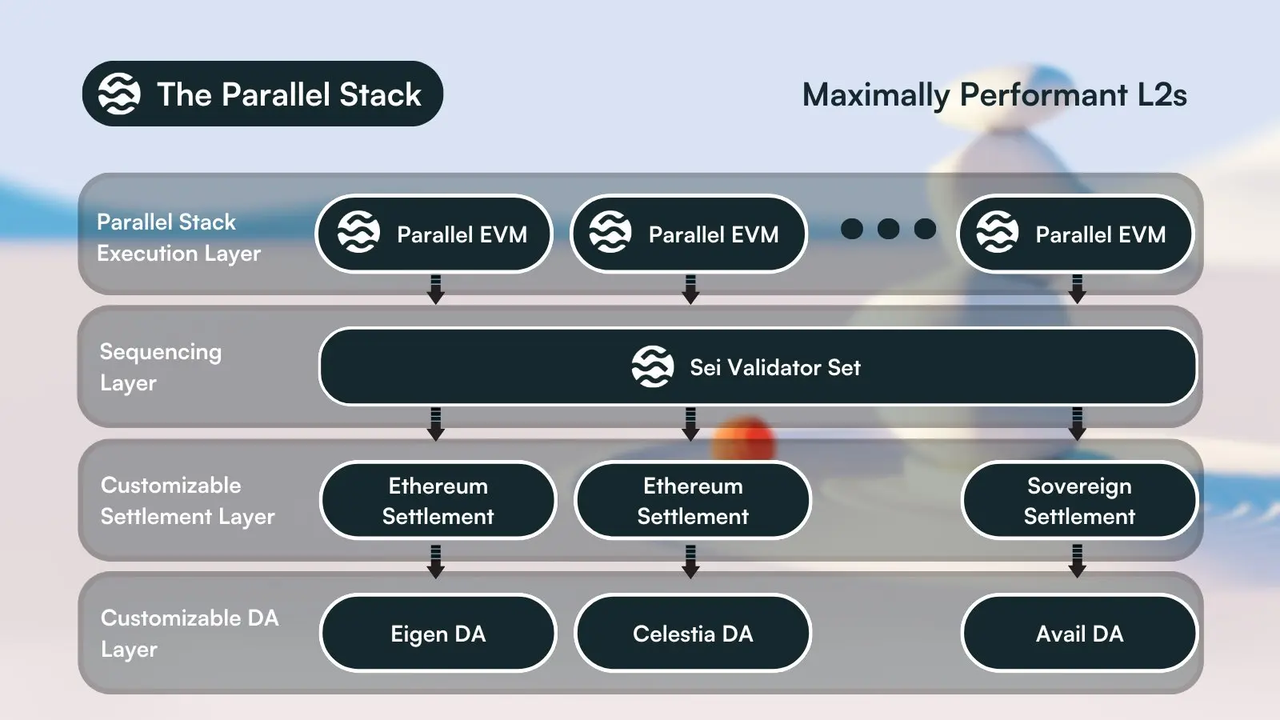
Modular blockchains separate one or more functions—execution, settlement, consensus, and data availability. Modular blockchains gained traction in 2022 with the rise of Ethereum Layer-2s acting as dedicated execution layers. In 2023, networks specializing as DA layers began launching. Sei plans to enter the modular blockchain space after Sei V2 goes live and EVM compatibility is achieved. Specifically, Sei’s upcoming open-source Parallel Stack aims to empower developers to launch modular Layer-2 blockchains as parallelized EVM execution layers. These L2s can use Sei’s validator set for sequencing services while customizing their own settlement and DA layers.
SEI Token
SEI is Sei’s native token, launched on August 16, 2023, with the Pacific-1 mainnet. The maximum supply of SEI is capped at 10 billion tokens. As of April 9, 2024, approximately 8.7 billion SEI tokens are in circulation, with about 65.18% staked (~5.67 billion) and 31.72% circulating (~2.76 billion). The remaining ~1.3 billion SEI will be minted over ten years as inflationary rewards for active validators. The SEI token serves multiple functions within the Sei network:
-
Settling network transaction fees;
-
Staking by validators and delegators;
-
Rewarding validators;
-
Participating in governance.
Tokenomics
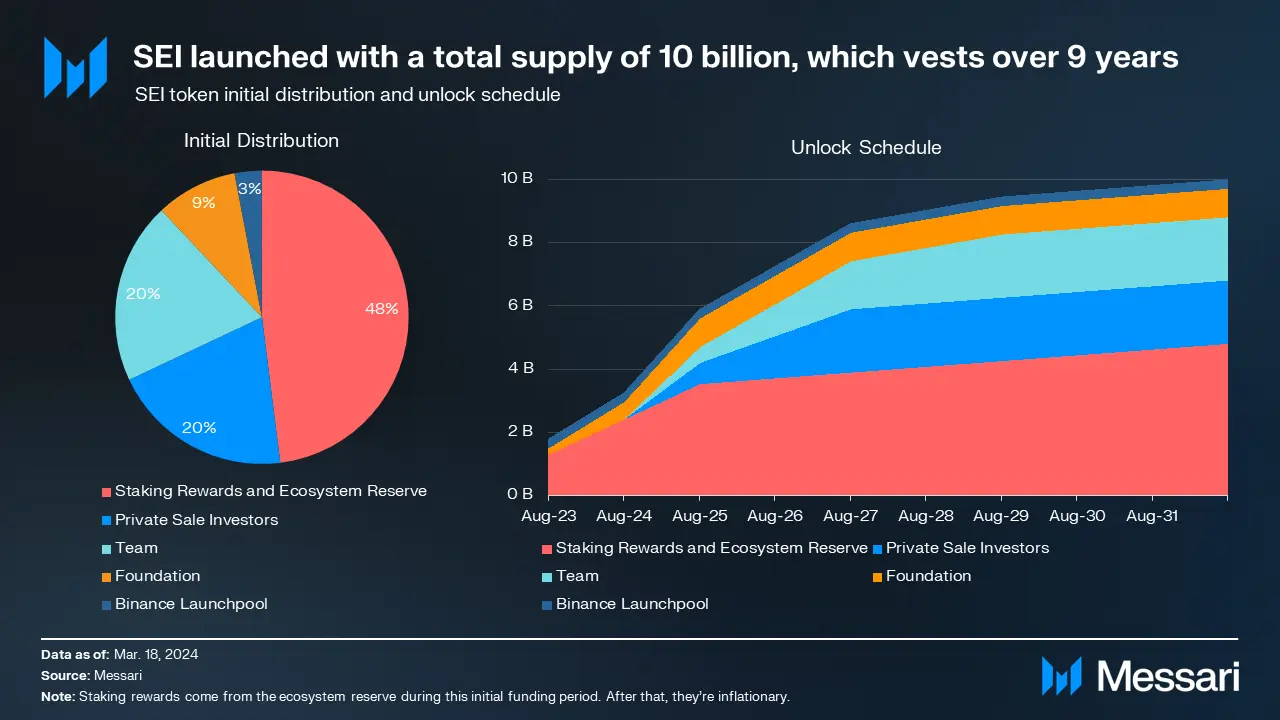
SEI token allocation across five categories:
Ecosystem Reserve (48% of total supply): 4.8 billion tokens allocated to the Sei Foundation-controlled Ecosystem Reserve. This reserve funds staking rewards, ecosystem programs, airdrops, and incentives. Of this, 27% is available at TGE, while the remaining 73% vests over nine years with variable unlock schedules.
-
300 million SEI (3% of total supply) from the Ecosystem Reserve were allocated to airdrops. Eligible users included participants in Sei’s incentivized Atlantic testnets. While exact criteria were not disclosed, official testnet tasks involved Dawn NFT, Dusk NFT, and Sunken Treasure NFT. Additionally, active users bridging assets to Sei from Solana, Ethereum, Arbitrum, Polygon, Binance Smart Chain, and Osmosis qualified.
-
1.5 billion SEI (15% of total supply) will be minted over ten years as inflationary rewards for active Sei validators.
-
The Sei Foundation has not yet disclosed how the remaining 3 billion SEI (30% of total supply) will be allocated across specific ecosystem initiatives.
Private Investors (20% of total supply): 2 billion tokens allocated to private investors, subject to a one-year lock-up followed by a three-year linear vesting schedule. Sei Labs raised $35 million across two funding rounds.
-
$5 million raised in August 2022 during a seed round led by Multicoin Capital, with participation from Coinbase Ventures, Hudson River Trading, and others.
-
$30 million raised in April 2023 through two strategic funding rounds involving Jump Crypto, Distributed Global, Flow Traders, and others.
-
Circle Ventures completed a strategic investment in Sei in November 2023.
The project team did not disclose whether equity and/or tokens were sold in these rounds.
-
Team (20% of total supply): 2 billion tokens allocated to the team, subject to a one-year lock-up followed by a five-year variable vesting schedule. Specifically, 76% of tokens vest linearly over the first three years, while the remaining 24% vest linearly over the subsequent two years.
-
Foundation (9% of total supply): 900 million tokens allocated to the Foundation. Of these, 22% are available at TGE, with the remaining 78% linearly unlocked over two years.
-
Binance Launchpool (3% of total supply): 300 million tokens allocated to Binance’s Launchpool. Users could stake BNB, TUSD, and FDUSD over 30 days to earn a portion of SEI tokens.
Notably, non-vested tokens (e.g., those allocated to the team, foundation, and private investors) can be staked. These staked tokens earn liquid SEI rewards and retain governance rights and the ability to secure the network.
Governance
Sei uses an on-chain governance process where proposals can influence network parameters, such as SEI minting schedules or increasing the maximum number of active validators. Sei does not have an official voting frontend, but governance can be accessed via supported wallets like Fin Wallet and Compass Wallet. The governance process works as follows:
-
Proposal Creation: A proposal initiates a two-day deposit period during which SEI can be deposited to support pending proposals. Once the minimum deposit threshold of 3,500 SEI (approximately $2,400 as of April 9, 2024) is met, the proposal enters on-chain voting. Using the is-expedited flag can accelerate this process, halving the deposit period to one day but doubling the minimum deposit to 7,000 SEI (approximately $4,800).
-
Deposit Period: SEI can be deposited to support pending proposals. If the minimum threshold is met, the proposal proceeds to voting. If not, the proposal is canceled and all deposits are burned.
-
Voting on Proposals: Users who stake SEI can vote on active proposals—their voting power proportional to their staked tokens. The voting period lasts five days, with a quorum of 33% of staked supply required. A simple majority of at least 50% of voting power must approve the proposal. If more than 33% of total voting power selects "no_with_veto," the proposal fails regardless of other votes.
Since mainnet launch, 48 out of 53 active proposals had passed as of April 9, 2024. These include minor increases in the maximum number of active validators, adjustments to governance deposit parameters, updates to minimum network transaction fees, and network software upgrades. Notably, non-vested tokens can participate in governance through staking.
Current State of the SEI Ecosystem
Since launching its mainnet in August 2023, various vertical protocols have launched and driven ecosystem growth:
-
DeFi: As of April 9, 2024, Sei’s TVL stands at approximately $38.7 million, lagging behind Solana, Sui, and Aptos. Astroport, Sei’s decentralized exchange, holds the largest TVL at around $38.3 million. Traders can use Levana Finance, a decentralized perpetuals exchange (with cumulative volume of ~$36.6 million), while lending protocols like Hoyu and Kawa Finance are operating on Sei’s public Devnet.
-
Liquid Staking: Protocols like Silo and Kryptonite allow users to liquid-stake SEI tokens via their respective iSEI and stSEI tokens. As of April 9, 2024, Silo and Kryptonite had staked approximately $11.6 million and $4.4 million worth of SEI tokens, respectively.
-
Wallets: As of April 9, 2024, Sei averages around 8,300 daily active addresses and 394,000 daily transactions. Wallet offerings include native Sei wallets in Fin Wallet and Compass Wallet. SPACE ID provides .sei naming services, with over 20,300 human-readable NFT names representing Sei addresses already minted.
-
NFTs: The NFT ecosystem on Sei is one of the most active parts of the network, with historical trading volume exceeding $20 million. Native NFT marketplaces include Pallet Exchange, MRKT, Quik, and Dagora. Notable NFT projects include (1) Seiyans, building MRKT; (2) The Colony, building AntSwap; and (3) WeBump, offering a toolkit called Lighthouse used to mint over 500,000 NFTs.
-
Gaming: A partnership with Pixel Realm aims to bring their venture fund, game marketplace, and game studio to Sei.
-
DePIN: Nimble Network launched first on Sei, aiming to decentralize AI model training.
Other formally announced partnerships or integrations include Seijin (LaunchPad project), Kado (crypto on/off-ramps), Tenderly (EVM dev tools), and Space and Time (data indexing). Following the Sei V2 upgrade and EVM compatibility, various EVM applications—including protocols like Algebra DEX—are expected to launch. Additionally, ecosystem growth is continuously stimulated through several initiatives:
-
Ecosystem Fund: In September 2022, Sei announced an Ecosystem and Liquidity Fund to help early founders and teams acquire users and scale. Backed by Multicoin Capital, Flow Traders, Hudson River Trading, and others, the fund launched with $50 million. In January 2023, MEXC Global received $20 million in funding. In April 2023, Foresight Ventures secured $50 million.
-
Creator Fund: In April 2024, Sei announced a Creator Fund focused on new and existing NFT and social projects. Partnering with Gitcoin, a well-known leader in community funding across multiple ecosystems.
-
Sei Launchpad Program: Managed by the Sei Foundation, this program supports founders building on Sei through mentorship and investment. Interested applicants can apply here.
-
Ecosystem Reserve: Part of Sei’s Ecosystem Reserve is designated for funding ecosystem programs, airdrops, and incentives. While no additional programs, airdrops, or incentives have launched since the SEI token genesis, the Sei Foundation retains control of these tokens and may use them to stimulate future network and ecosystem growth.
Sei is a Layer-1 blockchain designed to become the fastest network for exchanging digital assets. It incorporates novel built-in technical features—Twin-Turbo consensus and transaction parallelization—to enhance transaction efficiency and throughput. Since launching its mainnet in August 2023, Sei has seen the emergence of a native project ecosystem and a growing community.
To maintain momentum, Sei must successfully deploy the planned features of the Sei V2 upgrade. EVM compatibility could unlock new opportunities by expanding Sei’s developer ecosystem and supporting the deployment of established EVM protocols on Sei. Optimistic transaction parallelization will improve developer experience, while SeiDB will comprehensively enhance network performance.
Beyond V2, Sei aims to launch its Parallel Stack. As developers seek improved UX and novel design spaces, the stack could drive further growth in the Sei ecosystem and validator adoption through Layer-2 EVM rollups.
Join TechFlow official community to stay tuned
Telegram:https://t.me/TechFlowDaily
X (Twitter):https://x.com/TechFlowPost
X (Twitter) EN:https://x.com/BlockFlow_News
 Messari