What Is the Potential of Parallel EVM? An Overview of Artela Developers' Creative BUIDLs
TechFlow Selected TechFlow Selected
What Is the Potential of Parallel EVM? An Overview of Artela Developers' Creative BUIDLs
This article explores the potential applications demonstrated by Artela's EVM++ technology, through an analysis of the highly popular Artela ecosystem in the recent developer landscape.
 Navigating Web3 tides with focused insights
Author: Mikkke Pignard, Xiao Zhu Web3
TL;DR
-
Parallel EVM is gaining momentum, with more and more projects adopting related technologies for upgrades.
-
The potential transformation brought by parallel infrastructure lacks concrete application examples and remains a work in progress.
-
By examining Artela—a platform with a vibrant recent developer ecosystem—this article explores the potential applications enabled by its EVM++ technology.
-
Parallelization is a means, not an end, aiming to provide dApps with a runtime environment capable of large-scale operations.
-
DeFi under EVM++: Accelerating DeFi runtime security and RWA applications.
-
Reviewing innovations in omnichain gaming, AI coprocessors, and other new applications within the EVM++ framework.
What Updates Can Parallel Execution Bring to Infrastructure?
Parallel execution (parallel EVM) has become a key technological focus in infrastructure development. Many projects aim to enhance performance through parallelization to unlock new crypto applications, including Monad, Artela, MegaETH, and Sei. Recently, Starknet also announced support for parallel execution. However, the transformative potential of parallel infrastructure lacks tangible application demonstrations and is still on the path to realization.
This article analyzes the highly active Artela ecosystem to explore the potential use cases demonstrated by its EVM++ technology. Developer-driven innovation is Artela’s primary approach to advancing technical progress. Currently, over 800 active developers are contributing to Artela's BUIDL efforts, delivering more than 300 Aspect-native extension use cases and over 130 ecosystem projects. They have also developed supporting tools for EVM++, such as the Aspect Browser, Aspect IDE, and Aspect Hardhat plugin—all independently built and maintained by community developers.
Parallelization Is a Means, Not an End
As Reforge Research noted in their analysis of parallel EVMs: parallelization is a means, not an end.
The architectural philosophy behind parallel execution aims to create a runtime environment where dApps can scale massively. Parallel EVM represents improved execution efficiency over traditional EVM. Projects like Monad and MegaETH primarily focus on this aspect. Another school of thought advocates not only EVM compatibility but also breaking beyond pure EVM limitations via dual-VM architectures—adopted by Artela, Arbitrum Stylus, and Sei V2.
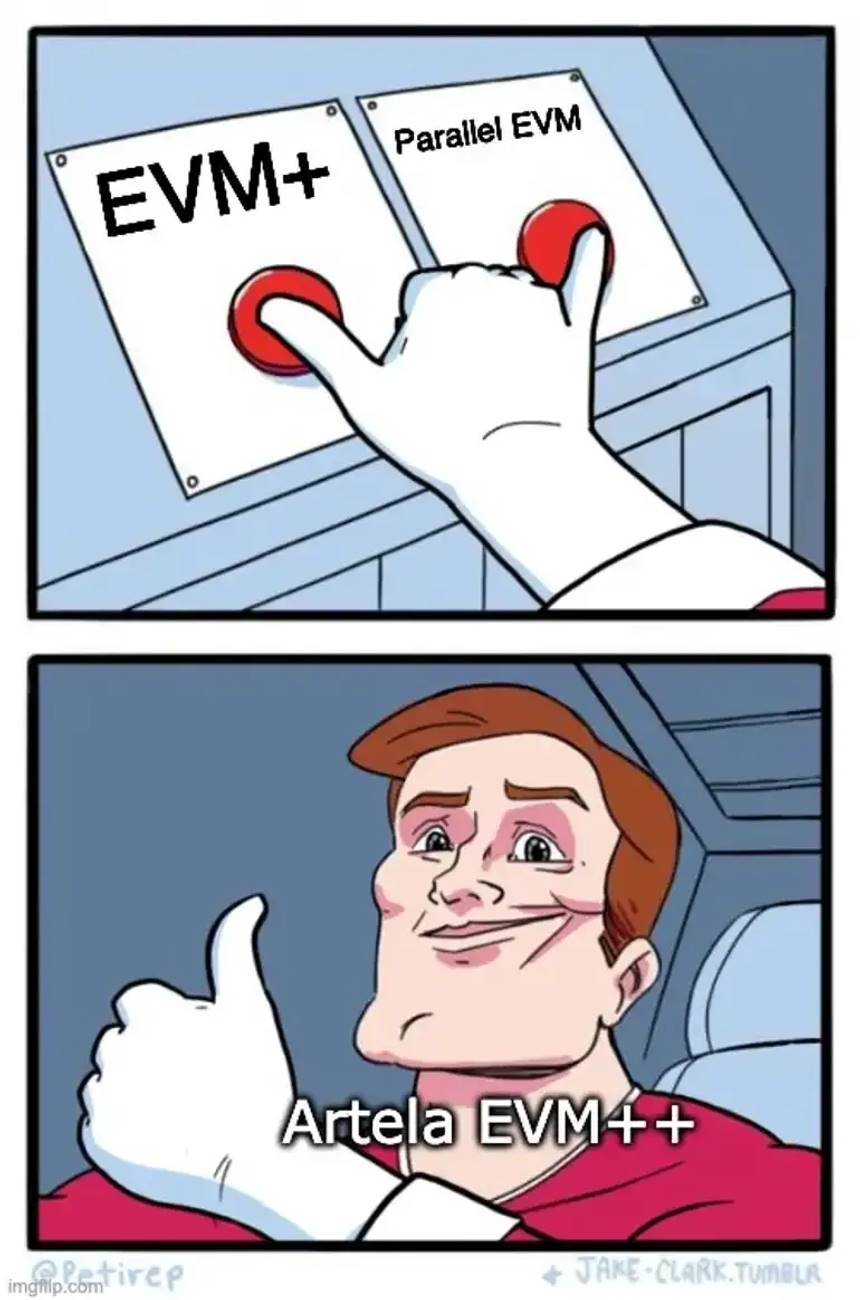
Artela combines a parallel EVM with WASM-based extensions in a dual virtual machine architecture, aiming to deliver high performance and scalability for dApps. This dual-pronged approach is known as EVM++. Through its developer community, Artela conveys a technological vision of creating a new decentralized application runtime environment that accelerates integration of innovative domains such as Secure DeFi, AI, and AW/FOCG (autonomous worlds / fully on-chain games) into the crypto world.
DeFi Under EVM++: Accelerating Runtime Security and RWA
DeFi remains the most active application category in crypto. With advancements in BTC ETFs and mainstream banks’ involvement in RWA, DeFi is gradually approaching traditional finance. However, user experience and security issues remain pressing concerns. Over the past year, major protocols like Curve and KyberSwap suffered repeated attacks, exposing the vulnerabilities of “naked” DeFi protocols. How does EVM++ address these challenges?
Key partners building DeFi solutions on EVM++ include GoPlus, a Web3 user security provider, and ZAN, a Web3 security firm with traditional fintech expertise. Together, they are exploring on-chain security, runtime risk control, user protection, deep protocol integration, and collaborating on user education, security ecosystems, and product integrations.
The anti-rug feature co-designed with GoPlus for AMM protocols automatically identifies malicious liquidity pool attacks, protecting traders and liquidity providers. Their joint testnet security education campaign attracted over 300,000 participants.
ZAN’s KYT Aspect, built on EVM++, delivers a fintech-grade on-chain DeFi security solution. The KYT (Know Your Transaction) Aspect provides real-time transaction security analysis for dApps, enabling on-chain detection of flash loan attacks, arbitrage, and money laundering activities. By integrating this Aspect, DeFi protocols can customize risk control policies similar to traditional fintech services, enhancing fund security and compliance.
Developed by ZAN team members from Ant Digital Technologies, this project seamlessly integrates fintech-level security into the Artela network, clearly demonstrating the feasibility of advanced on-chain security via Aspects and highlighting EVM++’s effectiveness in addressing DeFi security challenges.
ArtexSwap, the first AMM protocol built on EVM++, achieves high transaction security and liquidity protection. Its Anti-Rug Pull Aspect, Blacklist Aspect, and Slippage Guard Aspect offer robust technical safeguards for token supply monitoring, transaction activity blocking, and real-time liquidity pool surveillance.
Innovation in Omnichain Gaming Enabled by EVM++
Omnichain gaming and Crypto AI have been top directions attracting developer interest over the past year. As the "rising stars" of crypto, they naturally demand higher performance and scalability from blockchain execution environments.
Artela continues to explore the potential of EVM++ in gaming together with pioneers Blade Games and Cellula. EVM++ contributes value as an on-chain “coprocessor” (analogous to GPUs in traditional computing), offering a high-performance execution environment and flexible interoperability.
-
Unlocking Omnichain NPCs: Artela and Blade Games collaborated to build a version of Royale game featuring “on-chain NPCs”. Using EVM++, players can register their accounts as automated NPC characters that algorithmically engage in battles against real players!
-
Enabling “AI in Games”: Cellula has an interesting BUIDL on EVM++, leveraging it as an on-chain coprocessor to implement an on-chain version of Pac-Man. It runs AI-agent algorithms directly on EVM++, enabling automatic battles between players and ghosts entirely on-chain. The AI agent combat module, originally implemented off-chain in Java, was ported to Aspect while maintaining high playability—one on-chain transaction can execute over 1,000 rounds of AI pathfinding decisions. This enables on-chain operation of AI agents and asynchronous PvP gameplay!
EVM++ and AI Coprocessors
Artela announced a strategic partnership with Phala to build a native extension layer supporting AI on EVM++, making intelligent on-chain dApps possible.
Phala is exploring the construction of a trustless AI coprocessor layer on Artela, combining on-chain AI algorithms via EVM++ with off-chain TEE-based AI coprocessing. This approach brings popular large language models (LLMs) and Web3 data layers into blockchain protocols, enabling dApps built on EVM++ to achieve more dynamic and intelligent interactions.
Developer Innovation Continues
In the past quarter, Artela successfully onboarded over 2,100 Web2 developers into Web3 through its Web3 Developer Learning Program. These participants contributed 2,818 code commits and 1,319 pull requests across course projects. Not only did they quickly master Aspect-native extensions, but they also created over 100 innovative use cases during advanced EVM++ training. These span applications from DeFi security to omnichain gaming, showcasing Artela’s potential in lowering EVM development barriers and unleashing developer creativity.
On Artela’s Aspect Hub, all innovative Aspect use cases are community-contributed, with some particularly groundbreaking ones standing out. For example, Throttle Aspect demonstrates how rate-limiting techniques from traditional transaction systems can be applied to smart contracts, helping decentralized protocols resist Sybil attacks and unfair behavior. KYT Aspect offers real-time on-chain transaction security analysis, effectively defending against flash loan attacks, arbitrage, and money laundering—highlighting EVM++'s powerful capabilities in DeFi security. LinkLearner leverages off-chain model training combined with on-chain weight aggregation via Aspect, creating a decentralized AI model training platform with automatically adjustable parameters on-chain.
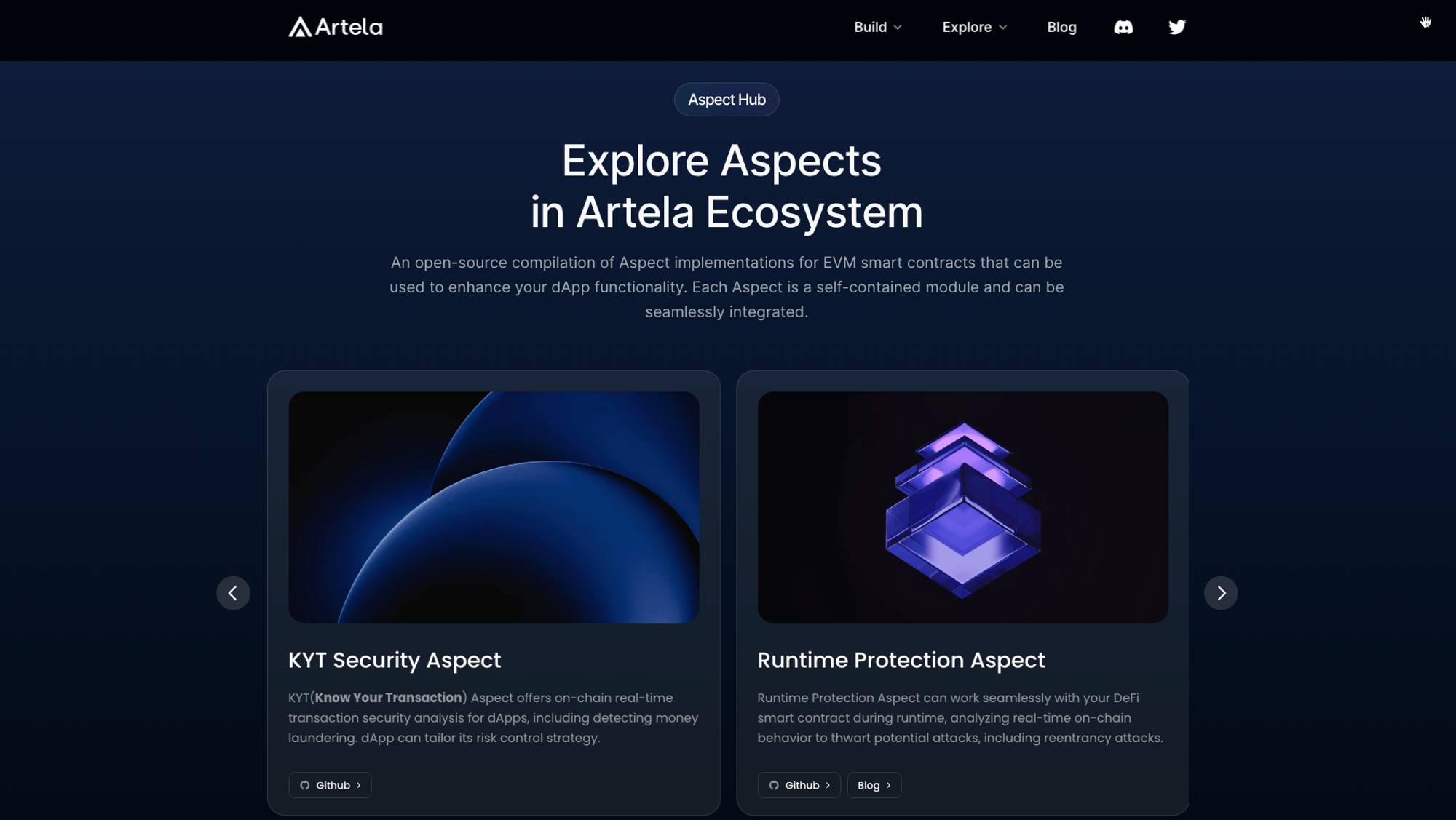
To further empower developer innovation, multiple open-source communities—including LXDAO and BuidlerDAO—have contributed rich EVM++ tooling. Tools include Artela Scan, a block explorer with dedicated Aspect support for intuitive on-chain data visualization; the Artela Aspect Hardhat plugin, which greatly simplifies Aspect development; and Solide Aspect IDE, providing a one-stop development platform to accelerate Aspect innovation and sharing. Additionally, the Aspect Marketplace offers developers a decentralized platform to freely manage, rent, buy, and sell Aspects.
Conclusion
The Web3 industry is undergoing a transitional phase. While next-generation infrastructures like parallel EVM continue evolving, active developer communities exemplified by Artela’s BUIDL movement persist in pushing technological frontiers. Will this combination of strong ecosystems, high-performance, scalable infrastructure, and creative developers usher in the next era of crypto? The future is worth watching.
Join TechFlow official community to stay tuned
Telegram:https://t.me/TechFlowDaily
X (Twitter):https://x.com/TechFlowPost
X (Twitter) EN:https://x.com/BlockFlow_News