








How Mask Network Defines the New Cycle of SocialFi with Vitalik's Open Support
TechFlow Selected TechFlow Selected
How Mask Network Defines the New Cycle of SocialFi with Vitalik's Open Support
Mask Network is no longer just a product; it has evolved into a Web3 social group.
 Navigating Web3 tides with focused insights
The recent surge in DEGEN's price within the Base ecosystem has once again drawn market attention to the wealth effect of decentralized social protocols like Farcaster. On March 28, Vitalik posted on Firefly, a social aggregation app under Mask Network, stating that users can simultaneously publish posts on both Farcaster and Lens, adding, "Having client choices matters—we should support them!" Following this endorsement, the MASK token price broke through $5 and continued rising to $6.4.
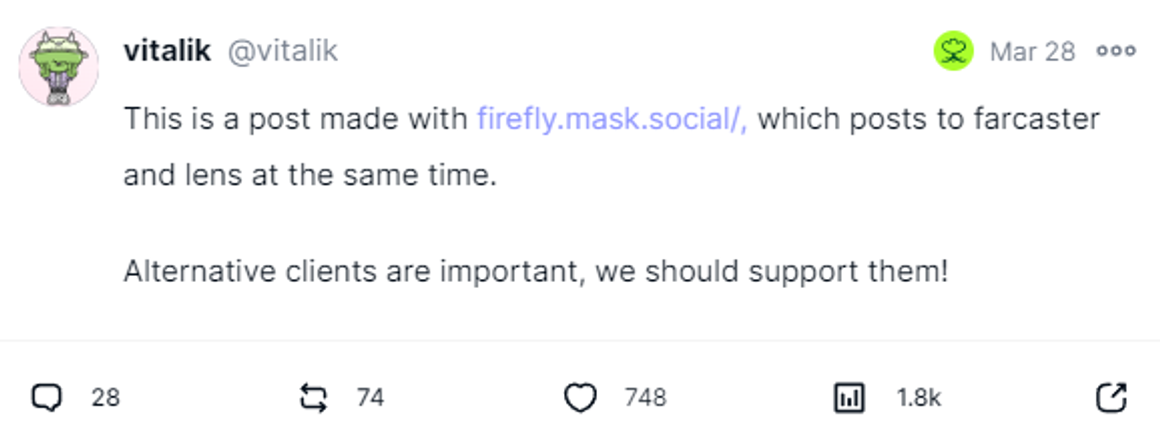
Vitalik has long maintained a positive stance toward decentralized social applications and frequently shares opinions or hosts AMAs on Warpcast, a front-end application built on the Farcaster protocol. His explicit support for Firefly this time suggests that the app is poised to achieve broader mainstream breakthroughs in the near future.
Cross-posting Made Easy: What Is the Social Aggregator Firefly?
Firefly is a Web3 social aggregation application incubated by Mask Network. It enables users to access content from X (formerly Twitter), Mastodon, Lens, Farcaster, Mirror articles, Gitcoin, and Snapshot—all within one interface. Users simply log in using their respective social protocol accounts.
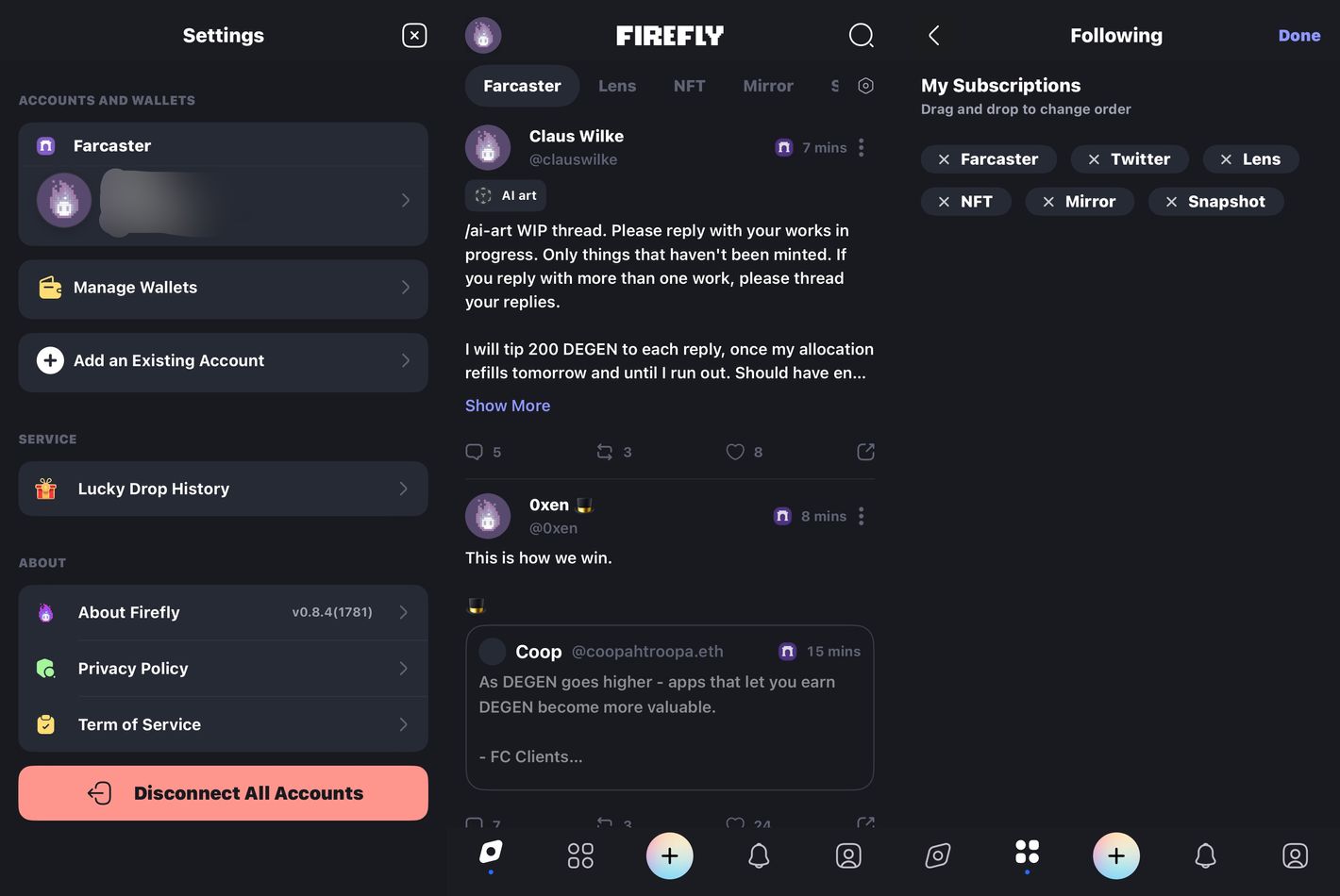
Additionally, users can leverage decentralized identities powered by NextID, a closely affiliated project of Mask Network.
Another standout feature of Firefly is its红包 (red envelope) functionality. Recently, Suji Yan, founder of Mask Network, has been frequently distributing红包 on Firefly—making it worth downloading the app to personally experience the unique charm of a Web3 social application.
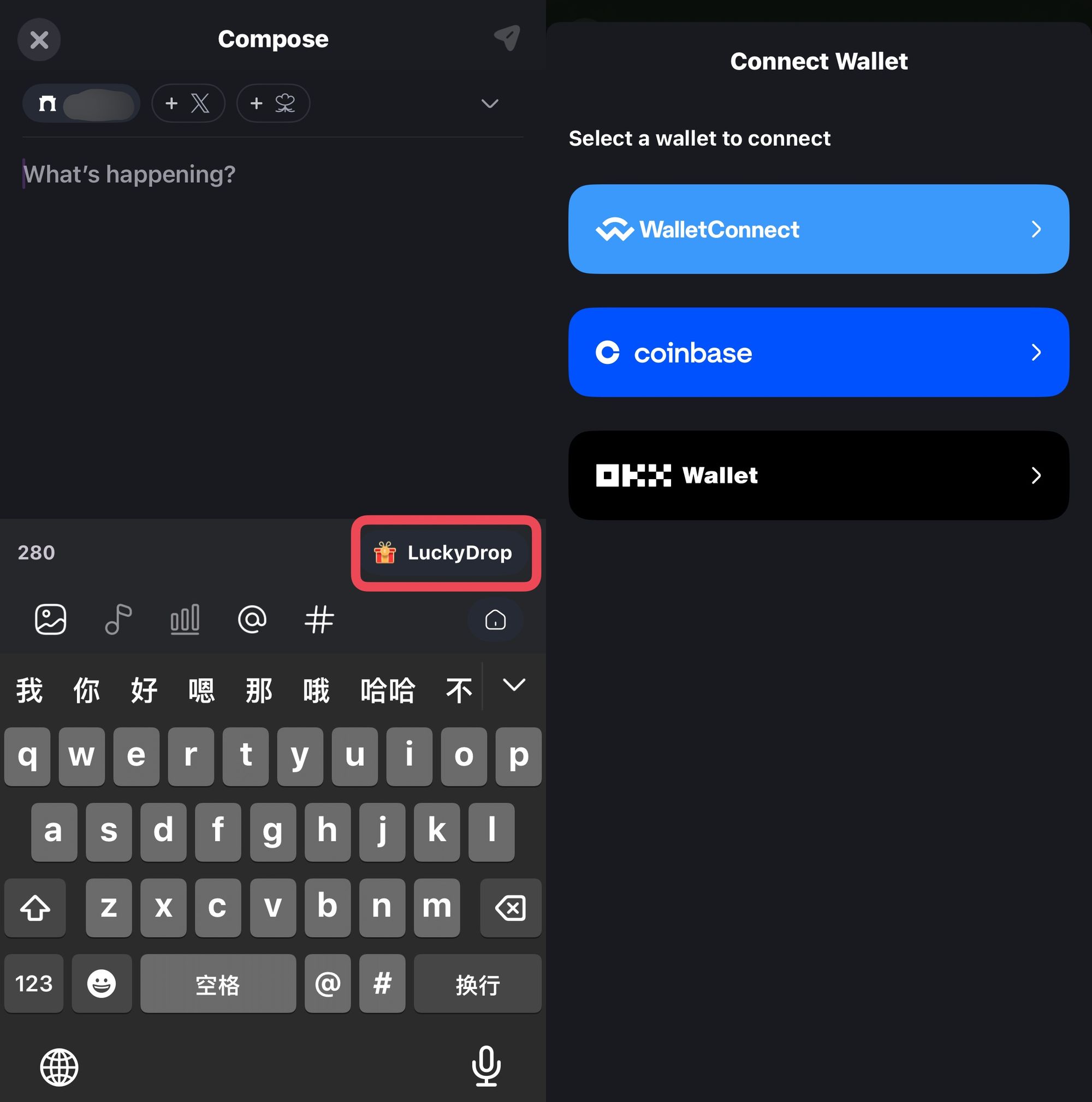
Vitalik is a long-time user of Mask. As early as Lunar New Year 2020, he sent his first ETH红包 using Mask Network. His recent public backing of Firefly—a project incubated by Mask—suggests that the platform will likely become a fertile ground for memes, much like Warpcast.
However, if you've used Warpcast, you may have noticed its instability. On March 31, its founder even had to publicly clarify that they were investigating ongoing outages. In contrast, Firefly, as an aggregator across multiple protocols, does not face such single-point-of-failure risks. Notably, Vitalik’s own post on Warpcast was actually published via Firefly. Last night, rumors circulated that Warpcast was valued at $1 billion—highlighting just how much growth potential remains for both Mask and Firely.
How Mask Network Is Redefining the New Cycle of SocialFi
After the approval of Bitcoin spot ETFs ushered the crypto market into a bull run, liquidity has rotated across various sectors. Now, the social sector is gaining momentum, fueled by the popularity of Warpcast. But why would a niche Web3 social tool earn Vitalik’s endorsement?
Vitalik gave the answer: “choice.” Users choose Firefly not just for the app itself, but because it aggregates content from established platforms and well-known social products. In the crypto space, information is power. A protocol that allows users to access diverse content without being locked into a single channel creates the strongest product moat—one that stands as Firefly’s—and Mask Network’s—core competitive advantage in the SocialFi arena.
So which stage of SocialFi are we currently in? The year 2017 marked the pure speculation phase, heavily influenced by ICOs. Projects like Steem, Huoxin, and ONO emerged amid rampant hype, but limited user participation led most of them to fade away. In 2020, inspired by the DeFi wave, experiments in social monetization began entering the spotlight, with projects like Mask Network, CyberConnect, and Deso gaining visibility. The explosive bull market of 2021 could be seen as the birth year of SocialFi.
From 2022 to 2023, well-funded protocols like Farcaster and the Web3 social infrastructure layer Lens Protocol launched, yet failed to gain significant traction due to a lack of rich social soil. Later, Paradigm directly developed Friend.Tech, which briefly sparked discussions around the social track. However, due to operational issues on the team’s part, it failed to achieve true mainstream breakout.
Historically, while SocialFi has evolved as an independent sector, its development has largely depended on external forces. This overreliance has led many to claim that there isn’t yet a usable Web3 social protocol, with both usability and economic models still having significant room for improvement.
The core obstacles to growth lie in openness and singularity. In their early stages, both Farcaster and Lens Protocol lacked openness, requiring invitation codes for access. Although now open to registration, they still present barriers such as setup costs. This top-down operational model, combined with slow development, caused users to lose patience.
Singularity refers to the fact that a healthy social system requires extensive supporting infrastructure and integrated ecosystems to function smoothly. For example, WeChat integrates payments, shopping, video, gaming, and more. Friend.Tech took an ultra-minimalist approach—while initially feeling very “Web3”—it lacked sufficient ecosystem tools, making long-term user retention difficult.
Therefore, the next generation of social apps must improve upon these two aspects. As a veteran player that has weathered multiple market cycles, Mask Network already possesses deep expertise in this area. Firefly now offers free registration, is building aggregative influence within its ecosystem, integrates widely used social platforms, and benefits from celebrity endorsements—positioning it perfectly to capture the upcoming surge in social activity.
The Future of Mask Network
As a pioneer in the SocialFi space, Mask Network has taken a bold new step forward. It is no longer merely a single product—it has evolved into a full-fledged Web3 social conglomerate. Beyond offering social platforms, Mask Network actively invests in and builds decentralized social applications, developer tools, protocols, and creative content, opening doors to Web3 for more users. This aligns with Suji Yan’s previously endorsed strategy of “surrounding the city from the countryside.” When every social product becomes interconnected with Mask Network, it will naturally become the King of SocialFi.
Currently, the long-term value of decentralized social networks remains underestimated—precisely the opportunity Mask Network aims to seize. By consolidating social needs and attracting more users into the Web3 world, Mask is following a trajectory similar to Tencent’s evolution: leveraging social interaction as a pivot point to expand into other domains.
Since the beginning of 2024, Mask Network has invested in eight notable projects, including AltLayer, 0xScope, and Orbiter Finance. This indicates that Mask is becoming a gateway for traffic, laying the foundation for expansion into other areas—much like how Tencent leveraged WeChat and QQ to create familiar social gaming experiences with titles such as Honor of Kings.
In the SocialFi race, everyone awaits the arrival of the inflection point. For now, Mask Network appears to be the most competitive protocol, actively shaping the future of decentralized social interaction.
Join TechFlow official community to stay tuned
Telegram:https://t.me/TechFlowDaily
X (Twitter):https://x.com/TechFlowPost
X (Twitter) EN:https://x.com/BlockFlow_News






