








A Deep Dive into Mode Network, a Popular OP Superchain Project
TechFlow Selected TechFlow Selected
A Deep Dive into Mode Network, a Popular OP Superchain Project
Mode Network is an L2 based on the OP Stack, with an airdrop planned for April.
 Navigating Web3 tides with focused insights
Author: Linke, Core Contributor of Biteye
Editors: Viee, Crush, Core Contributors of Biteye
01 Introduction
Mode Network is a modular Layer2 focused on the DeFi sector built using the OP Stack. It adopts Optimism's Bedrock upgrade and offers over 95% lower fees compared to the Ethereum mainnet.
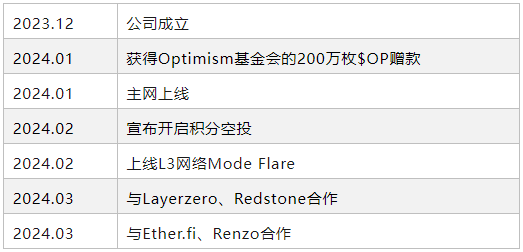
In January 2024, the project received a $5.3 million grant from the Optimism Foundation (distributed in OP tokens). Mode will also donate a portion of its sequencer revenue to the Optimism Collective. The strong relationship between Mode and the Optimism Foundation supports the project’s development.
02 Current Development Status
Steady Growth with High TVL Ranking
Mode launched its mainnet on January 31, 2024, and began its points-based airdrop campaign in February.
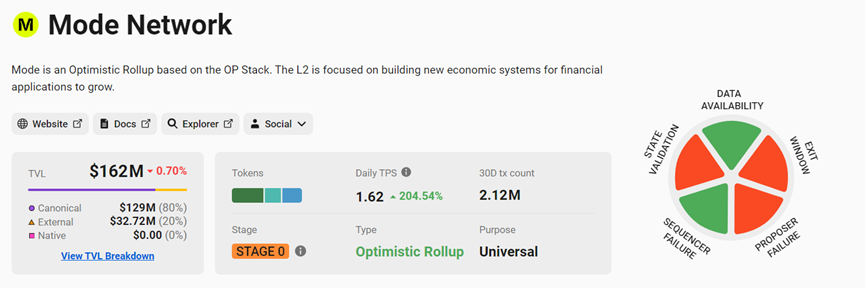
Since mainnet launch, Total Value Locked (TVL) has grown steadily. As of March 19, 2024, Mode ranked 13th among all Layer2 networks with a TVL of $162 million. Its average daily TPS is 1.62, median gas price is 0.001 Gwei (less than $0.01 per transaction), and it has processed 2.12 million transactions over the past 30 days.
Airdrop Ongoing: How to Participate
Mode has a total token supply of 10 billion, with 5.5% allocated for airdrops. The full tokenomics have not yet been released.
Mode started its points-based airdrop in February and plans to launch its token in April. Users accumulate points to qualify for the token airdrop. Participation now could yield returns in under a month.
There are currently three ways to earn points:
-
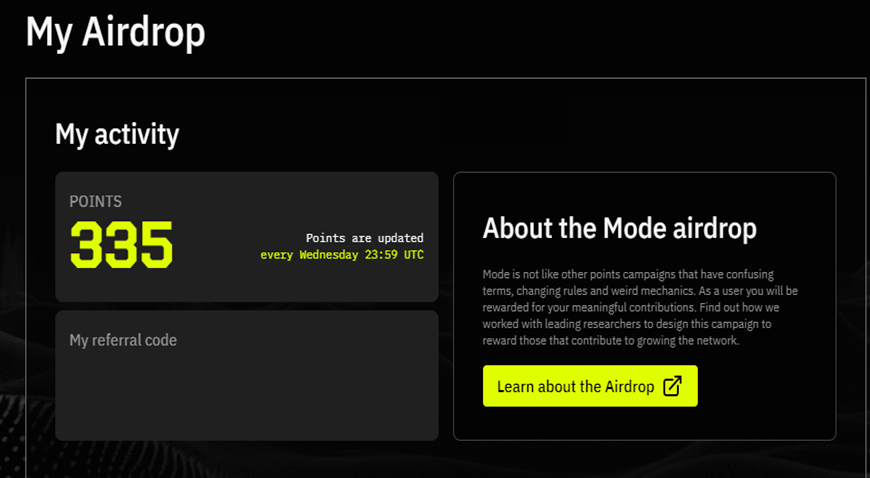
Legacy User Reward: Web3 veterans receive initial points based on their blockchain interaction history when connecting their wallets. These points can be activated by bridging any amount of assets;
-
Referral Bonus: After activating points, users receive a unique referral code. The referrer earns 16% of the referred user’s points;
-
Ecosystem Interaction Rewards: Users earn additional points by interacting with Mode’s ecosystem applications, with different projects offering varying point rewards.
For developers, Mode offers:
-
Sequencer Revenue Sharing
-
Developer Airdrop Incentives
-
Optimism RPG Funding Grants
The developer airdrop allocation totals 500 million tokens (5% of total supply). Since this portion does not directly affect most users, we will not elaborate further.
General user participation steps are as follows:
1. Visit the airdrop activity page (https://ref.mode.network/MDCKN9) to check your initial points. If you see "INELIGIBLE TO CLAIM," your IP address may be restricted—please switch your network.
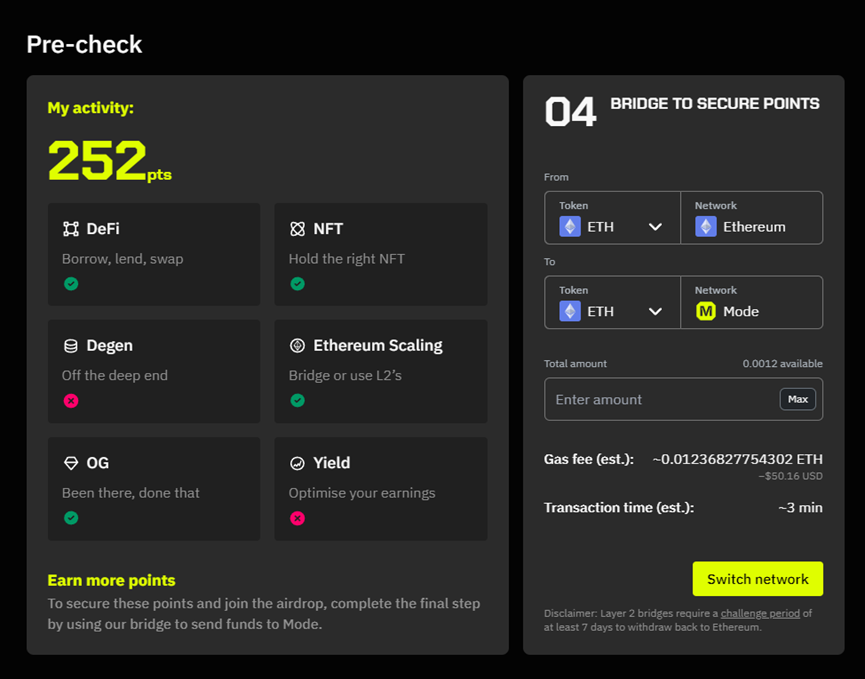
2. Bridge assets: Users must bridge assets from other networks to activate points and use ETH as gas for the airdrop activities. You can use either the official bridge or third-party bridges. Using the official bridge incurs higher gas fees and requires a seven-day withdrawal waiting period. Alternatively, third-party bridges like MiniBridge (https://minibridge.chaineye.tools/) allow bridging from other Layer2s at lower costs.
Community admins note that users should use the official bridge at least once. It is recommended to use the official bridge first before switching to third-party options.
3. Interact with applications: Engage with dApps on Mode to earn more points. Different apps offer varying point rewards. Additionally, Mode has partnered with LRT projects ether.fi and Renzo, both of which have high TVL and ample capital, helping boost Mode’s overall TVL.
We recommend the “double-dip” strategy: Bridge weETH and ezETH tokens to Mode to simultaneously earn staking yields, EigenLayer points, LRT protocol points, and Mode points—maximizing capital efficiency.
03 Project Analysis Across Dimensions
Team Background
James Ross, Founder of Mode Network

Graduated from the University of Sussex, UK, majoring in Economics and Philosophy. He invested early in EigenLayer and Ethena and previously served as an advisor at Hashflow.
Federico Sarquis, Technical Lead of Mode Network

Previously organized events for Ethereum Argentina.
The Mode team has 15 employees listed on LinkedIn, though core members are relatively few. Based on their locations, the team likely operates remotely. Founder James Ross’ early investments in EigenLayer and Ethena suggest strong industry connections.
Technical Overview
Mode is a modular Layer2 built on the OP Stack. It has already launched Mode Flare, a Layer3 network supported by Optimism and Celestia, ideal for developing on-chain games and trading platforms. Technically, beyond the concept of “modularity,” key components include OP Stack and Mode Flare.
1. Modular Blockchains
Modular blockchains focus on handling a limited set of functions while outsourcing others to separate layers.
The goal of modularity is to address the blockchain trilemma—security, decentralization, and scalability—a concept introduced by Ethereum founder Vitalik Buterin and widely used to evaluate public chain projects.
Among leading public chains—Bitcoin, Ethereum, and Solana—we observe different trade-offs within the trilemma. Bitcoin excels in security and decentralization but lacks scalability. Solana sacrifices some security and decentralization for superior scalability.
Modular blockchains decompose functions such as consensus, execution, and data availability across different chains. For example, settlement occurs on Ethereum, data availability is handled by Celestia, and execution takes place via SVM on Solana. This layered approach minimizes the impact of the blockchain trilemma by matching specific needs to optimized chains.
Other modular Layer2 projects include Mantle, Eclipse, and Boba Network. While these lag behind top-tier Layer2s, they gain new opportunities through modularity.
Indeed, modularity is one of the key narratives of the current bull market.
2. OP Stacks
Introduced by leading Layer2 project Optimism, OP Stack has been adopted by several notable projects including Coinbase’s Base, DeBank’s DeBank Chain, and Farcaster’s Farcaster Stack. Its broad adoption aligns with the original vision of the OP Superchain.
The OP Superchain refers to a decentralized network of Layer2 chains sharing security, communication layers, and open-source technology stacks. Chains within this network must meet certain standards to enhance interoperability. Projects using OP Stack are generally considered part of the OP Superchain.
According to L2beat data as of March 10, 2024, the top five Layer2s by TVL were Arbitrum, OP Mainnet, Blast, Manta Pacific, and Starknet. However, Optimism ranks 29th by market cap while Arbitrum ranks 47th—highlighting how OP Stack’s widespread adoption contributes significant narrative value despite differences in market capitalization. Therefore, joining the OP Superchain appears beneficial for project growth.
3. Mode Flare
A Layer3 network powered by Optimism and Celestia, designed for developers to deploy app-specific chains. It features high throughput, rapid deployment, EVM compatibility, flexible tech stack, and transaction fees under $0.005. Three projects are preparing to launch on Mode Flare:
1) DEDPRZ: A cryptocurrency casino using $USA tokens and DEDPRZ NFTs
2) Liq Market: A decentralized derivatives exchange
3) Macaw: A prediction market for political events and current affairs
Other Layer2s, such as Arbitrum with Xai, have also launched Layer3s primarily targeting gaming with cheaper gas and higher throughput. Though their application value currently lags behind Layer2s, their long-term potential remains significant.
Mode Ecosystem
Let’s review some of the key projects currently live on Mode.
-
Ether.fi is a leading liquidity restaking protocol in the EigenLayer ecosystem built on Ethereum. It allows users to restake ETH or liquid restaking tokens (LRTs) to mint eETH at a 1:1 ratio.
-
Ether.fi leads the LRT sector with $2.67 billion TVL and has raised $32.3 million across two funding rounds from investors including CoinFund, North Island Ventures, and OKX Ventures.
-
Renzo is another Ethereum-based LRT protocol in the EigenLayer ecosystem. Users deposit ETH or other LRTs to receive ezETH at a 1:1 ratio. Renzo ranks third in the LRT space after Ether.fi and Puffer Finance, with $990 million TVL. It raised $3.2 million in seed funding from Binance Labs, OKX Ventures, IOSG Ventures, and Robot Ventures.
-
Kim Exchange is Mode’s native decentralized exchange, community-driven and customizable. It leverages Mode’s sequencer fee-sharing mechanism to offer enhanced incentives, with $6.45 million TVL.
-
IONIC is a lending protocol on Mode backed by Metacartel Ventures, Ohm, and Mode. Designed to offer optimal interest rates and balanced economic models, it has $61 million TVL. Founded by Henri Mahal and funded by MetaCartel Ventures.
-
Mode Name Service, provided by Space ID, uses the .MODE domain format. As of March 10, 2024, 75.7k domains have been registered across 70.3k holders.
-
LogX is a perpetual futures exchange enabling trading with Bitcoin and Ethereum. Designed as a large-scale aggregator, it pools liquidity from multiple chains. Users don’t need to manage gas tokens or execute multiple transactions per action. TVL stands at $11.21 million.
-
Poolshark is a decentralized protocol for concentrated liquidity, deployed on Mode, Arbitrum, and Scroll. Liquidity providers can create targeted liquidity positions. It enables limit-order trading for professional traders on DEXs, with $595k TVL.
-
Layerbank is a cross-chain lending protocol operating across LSD, RWA, and LRT sectors. Deployed on Manta, Bsquared, Mode, Linea, and Scroll, it holds $414 million TVL overall, with $10.11 million on Mode.
Overall, Mode’s ecosystem is DeFi-centric and offers meaningful user engagement. Mode is actively partnering with LRT projects, creating mutual benefits—Mode gains users and capital, while LRT tokens gain new utility.
04 Competitive Landscape Among Modular Layer2s
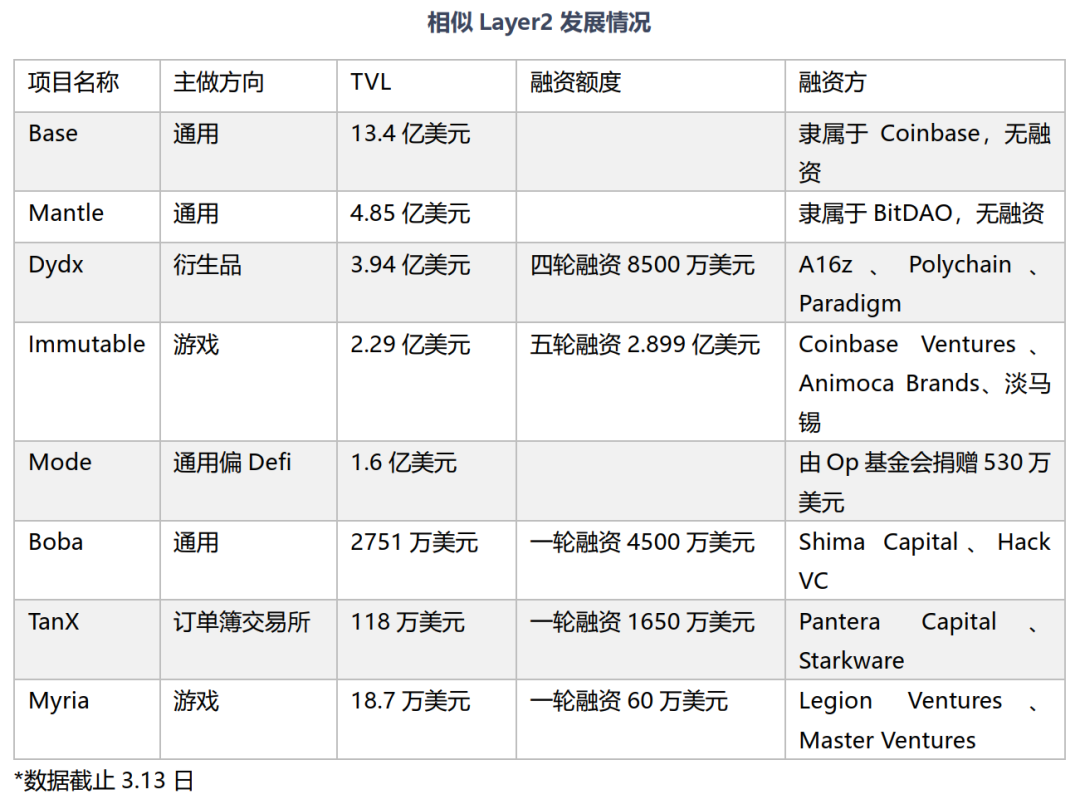
As a modular Layer2 using OP Stack, Mode is compared here with other Stack-based or modular Layer2 projects.
05 Conclusion
Mode is a modular Layer2 focused on DeFi and built on the OP Stack. The OP Superchain, enabled by OP Stack, already hosts many well-known projects, fostering user growth and ecosystem expansion. Moreover, modularity remains a defining narrative of the current bull market. Improving blockchain performance cannot rely solely on monolithic chains; modularity allows leveraging strengths across different chains, with leading modular projects already demonstrating strong performance.
Overall, Mode aligns well with the current evolution path of Layer2s, and its achievements are promising. In terms of competitive positioning, Mode stands out among peers, aiming to become the DeFi Hub of the OP Superchain. Its future development warrants close attention.
Join TechFlow official community to stay tuned
Telegram:https://t.me/TechFlowDaily
X (Twitter):https://x.com/TechFlowPost
X (Twitter) EN:https://x.com/BlockFlow_News
 @BiteyeCN






