








2024 Bitcoin Halving: The Ultimate Guide
TechFlow Selected TechFlow Selected
2024 Bitcoin Halving: The Ultimate Guide
Bitcoin price is expected to reach $60,000 before the halving in 2024, fluctuating between $32,000 and $85,000 throughout the year.
 Navigating Web3 tides with focused insights
Author: EarnBIT
Translation: Baihua Blockchain
In April 2024, Bitcoin will undergo another halving—an event that occurs every four years, cutting miners' rewards. Evolving market structures support the widely anticipated price surge. This halving cycle is fundamentally different from previous ones, and our guide summarizes common price predictions and unique driving factors.
1. Bitcoin's Halving Cycle
The halving reduces the number of newly mined bitcoins proportionally. This happens every 210,000 blocks, forming a four-year price cycle. Previous halvings occurred in 2012, 2016, and 2020.
"The total issuance will be 21,000,000 coins. They will be distributed as network nodes generate blocks, halving every four years. First four years: 10,500,000 coins. Next four years: 5,250,000 coins. Then next four years: 2,625,000 coins. Then next four years: 1,312,500 coins. And so on…" — Satoshi Nakamoto, Cryptography Mailing List, January 8, 2009
This event will reduce miners’ profitability, as miners use specialized hardware (application-specific integrated circuits, ASICs) to process transactions. According to CoinDesk, mining a block profitably cost at least $10,000 to $15,000 in 2023. After the halving, this could soar to $40,000 per coin.
2. When Is the Bitcoin 2024 Halving?
Rewards will decrease from 50 bitcoins per block to 6.25, and further reduce to 3.125 bitcoins per block on April 19, 2024. You can watch the countdown using the Bitcoin halving countdown table here.
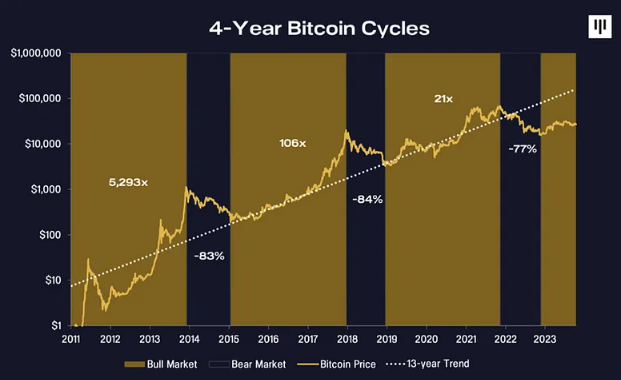
Bitcoin’s four-year price cycle. Source: Pantera
3. Price Impact: Context Around the Bitcoin Halving
Although the narrative of scarcity is important, other factors beyond supply contraction are at play. In theory, declining inflation should boost demand, but the actual price impact may be limited.
Slower coin production lowers the inflation rate while ensuring Bitcoin’s supply remains capped (at 21 million). This non-inflationary nature attracts crypto enthusiasts: unlike fiat currencies and gold, Bitcoin is not subject to central authorities or natural reserves.
Lower rewards promote network health and sustainability. According to Digiconomist, annualized energy consumption stands at 141.46 TWh—equivalent to Ukraine’s entire energy usage—with a carbon footprint similar to Oman (78.90 Mt CO2).
Bitcoin is also influenced by factors beyond the pace of supply expansion—drivers both within and outside the blockchain industry: regulation, Federal Reserve monetary policy, geopolitics, etc.
According to the Efficient Market Hypothesis (EMH), if all traders know about the halving, its effect must already be reflected in the price. However, as Warren Buffett said over thirty years ago: “Investing in a market believed to be efficient is like playing bridge with someone who tells you it doesn’t help to look at the cards.”
As Grayscale points out, changes in supply structure are the only certainty. The halving brings Bitcoin closer to its maximum supply, posing challenges for all miners.
That said, Bitcoin’s scarcity is also programmable and thus known in advance. Models directly linking this to rising prices may be flawed. Otherwise, Litecoin (another cryptocurrency undergoing halving) would have consistently risen after each halving, which has not been the case.
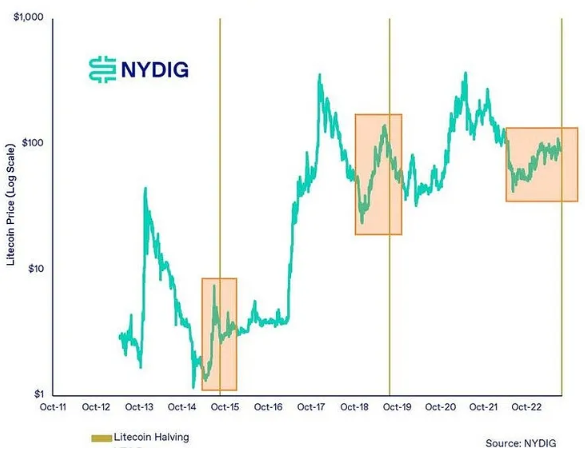
Litecoin’s halving cycles. Source: NYDIG
4. Historical Perspective: Macroeconomic Context
Previous halvings were accompanied by narratives emphasizing Bitcoin’s fundamentals as an alternative store of value, or benefited indirectly from external catalysts.
In 2012, the EU was suffering a deep debt crisis. By November 2013, Bitcoin surged from $12 to $1,100.
In 2016, initial coin offerings (ICOs) boomed, with over $5.6 billion flowing into other cryptocurrencies. By December 2017, Bitcoin rose from $650 to $20,000.
In 2020, amid the coronavirus pandemic, inflation concerns soared. By November 2021, Bitcoin surged from $8,600 to $68,000, reaching an all-time high of $69,044.77 on November 10. Its perception as a safe-haven asset played a key role.
Bitcoin 2024 Halving: Clues from Past Performance
Past performance does not guarantee future results, and as shown, influencing factors extend beyond crypto. Nevertheless, previous halvings offer clues about possible scenarios.
Timing of Highs and Lows
Theoretically, Bitcoin rebounds from lows well before the halving, typically 12–16 months prior, according to CoinDesk. Analysts at Pantera estimate bottoms usually occur around 477 days before the halving.
The upward trend persists both before and after the halving. Post-halving rallies last on average 480 days (ending at the subsequent bull market peak).
This time, the low appeared earlier than expected (December 30, 2022). It reached $15,742.44 on November 10.
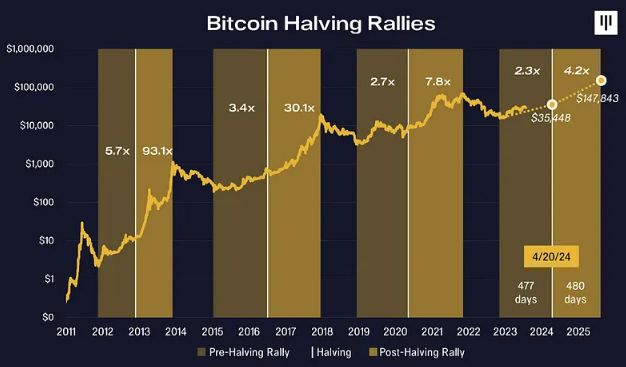
Bitcoin’s rebound during halving cycles. Source: Pantera
If history repeats, according to Pantera’s newsletter, the rally will end by late 2025.
Bitcoin 2024 Halving Predictions: Back to $69,000 Soon?
In the past three halving cycles, Bitcoin gained over 30% in the first eight weeks. As Markus Thielen, founder of 10x Research, noted, Bitcoin averaged a 32% gain during that period.
Given the current price of $52,456.77, if the same trend repeats, prices could return to the all-time high of $69,000. Thielen added that this likelihood increases "the closer we get to the Bitcoin halving."
Daily RSI
On February 19, 10xResearch reported that the daily RSI (Relative Strength Index) had broken above 80. This momentum indicator measures the speed and change of price movements, with readings above 70 indicating strong upward momentum.
Historically, when RSI exceeds 80, it signals gains exceeding 50% over the following 60 days. Bitcoin’s 14-day RSI last reached such levels in December 2023. As of February 22, it stood at 70.88%.
5. Bitcoin 2024 Halving and Spot ETFs
This year, Bitcoin’s rally has been supported by the adoption of spot Bitcoin ETFs. To date, these exchange-traded funds, which allow investors exposure to Bitcoin returns without direct ownership, have attracted over $5 billion in net inflows.
This capital inflow not only supports bullish investor sentiment but also offsets selling pressure from block rewards (i.e., the potential sale of all newly mined Bitcoin).
According to Grayscale, at the current block reward of 6.25 BTC, annual sell-side pressure amounts to $14 billion (based on a $43,000 price). After the 2024 halving, this will drop to $7 billion, requiring less buying pressure to counteract selling pressure.
Spot Bitcoin ETFs have already absorbed “almost three months’ worth of potential post-halving sell pressure”—in just 15 trading days.
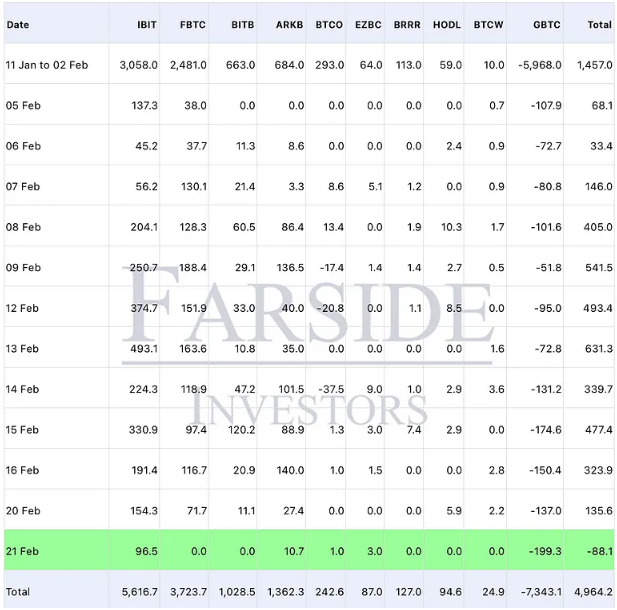
Cumulative inflows into Bitcoin ETFs. Source: Farside Investors
6. 2025 Forecast: Bitcoin Price Reaching $150,000–$200,000 Post-Halving
Markets typically rise in the period leading up to Bitcoin halvings due to anticipation. As of February 22, 2024, experts and research firms are broadly optimistic, forecasting an average Bitcoin price range of $150,000 to $200,000 by mid-2025.
Order book liquidity for Bitcoin has reached its highest level since October 2023, though still below pre-FTX collapse levels. Unless demand declines (contrary to current trends), reduced new Bitcoin supply will inevitably boost its price. Some analysts say a new all-time high has already begun.
Bernstein notes that pre-halving behavior reflects upcoming supply tightening and growing demand for spot ETFs. The firm expects prices to “hit new highs in 2024” and peak at $150,000 by mid-2025.
Anthony Scaramucci, founder of Skybridge Capital, forecasts Bitcoin will reach $170,000 or higher by July 2025. In a January interview with Reuters, he stated:
“Whatever the price is on halving day in April, multiply it by four—it will reach that price within the next 18 months.”
Scaramucci used a conservative starting point of $35,000 (halving price) to calculate $170,000. Based on the current price of $52,000, this scenario would push Bitcoin above $200,000.
Meanwhile, based on his long-term estimate, the market cap of this pioneering cryptocurrency should reach half that of gold. This would require growth from today’s ~$1 trillion to ~$6.5 trillion—over sixfold increase.
Skeptics: More Drivers Needed to Reach All-Time Highs
Rachel Lin, co-founder and CEO of SynFutures, says the halving “is unlikely to trigger a full-blown bull market” unless crypto adoption grows significantly. “This alone is insufficient for Bitcoin to return to near $69,000, let alone surpass it.”
However, due to U.S. elections, regulators may reduce “headline-chasing” actions at this critical moment. Thus, crypto may face fewer negative headlines that could dampen investor enthusiasm. This could pave the way for the next bull trend.
Short- and Medium-Term Factors to Watch
The halving is a medium-term positive. Peter Henn of CCN summarized potential bullish and bearish factors for Bitcoin in the coming weeks and months.
Growing institutional adoption is a major bullish factor, along with price rebounds and positive technical indicators. However, adverse regulatory shifts and macroeconomic developments, such as rising inflation, could affect market sentiment.
Medium-term warning signs include regulatory policies and competing cryptos, including central bank digital currencies (CBDCs). Hacks and other security breaches could damage market confidence.
Over the next 1–2 years, Bitcoin could also benefit from Lightning Network improvements and strengthening as a store of value.
Bitcoin 2024 Halving and Miners
Miners will continue securing the blockchain as long as economic incentives remain sufficient. Therefore, Bitcoin’s price must be high enough to offset costs during and after the halving.
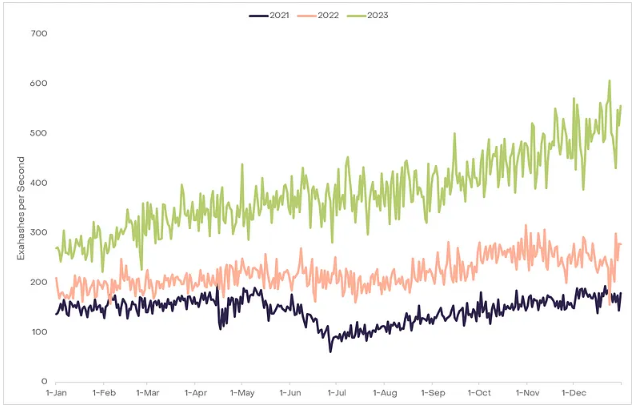
Hash rate hit an all-time high in 2023. Source: Glassnode.
Large miners are actively stockpiling Bitcoin. According to Taras Kulyk, founder of SunnySide Digital, “the halving has already been factored in by most companies,” as “they’ve been anticipating and incorporating halving prices into their forecasts for years.”
Meanwhile, miners with higher electricity costs and less efficient equipment may ultimately have to shut down operations, given their hardware investments and daily expenses. Improving operational efficiency is crucial to staying in business and profiting post-halving.
Efficiency improvements include purchasing more advanced equipment, selling holdings on-chain, and equity issuances. For example, Canada-based Hut8 is improving mining farm efficiency through custom software and hopes to acquire more power plants. After its recent merger with USBTC, its hash rate nearly tripled to 7.3 exahashes per second (EH/s).
Marathon Digital, the top publicly listed miner by real hash rate, launched a $750 million mixed equity offering. Core Scientific recently completed an oversubscribed $55 million equity financing round to restore solvency. The company also focuses on keeping its hardware online and maximizing available capacity.
However, CEO Adam Sullivan believes the Bitcoin network has a “self-healing property” and will continue incentivizing miners. As more miners go offline and hash rate declines, proof-of-work difficulty also drops. This can compensate for increasing speeds and fluctuating node operation interest.
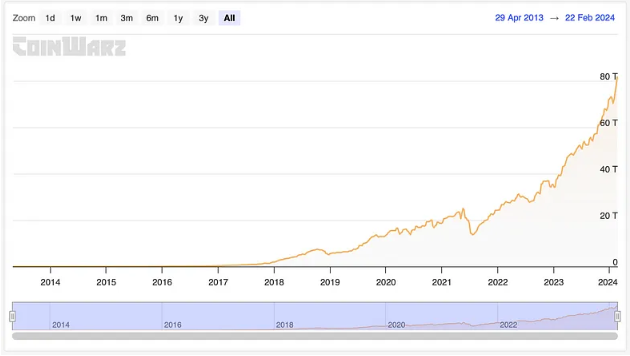
Bitcoin mining difficulty chart. Source: CoinWarz.
Mining difficulty is a moving average of block generation rates; when blocks are generated too quickly, difficulty increases. Thus, the network automatically adjusts—those leaving free up larger block shares, rewarding those who stay. For remaining participants, mining becomes more profitable.
7. Rising Transaction Fees and Miner Revenue
The 2024 halving follows the launch of Bitcoin Ordinals. This protocol, enabling Bitcoin NFTs (“inscriptions”), introduced new use cases, driving increased transaction fees and developer activity. These effects provide additional optimism regarding mining profitability and network sustainability.
In November 2023, the Ordinals boom pushed Bitcoin transaction fees to a two-year high (over $37), surpassing Ethereum’s gas fees. Since then, inscription fees have accounted for over 20% of miner revenue.
As of February 22, 2024, Bitcoin ranks among the top three blockchains by NFT trading volume. In December 2023, it became the leader. Thus, Ordinals activity represents a novel mechanism to incentivize miners via higher transaction fees and maintain network security.
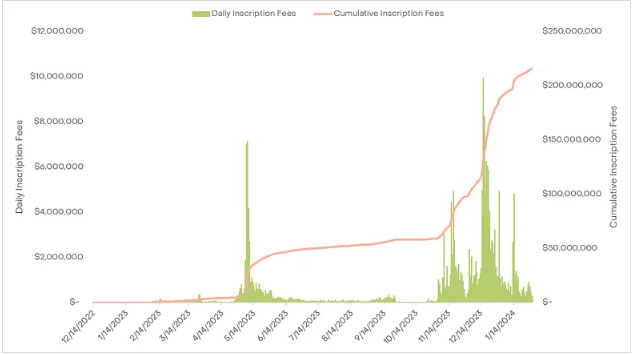
Growth in Bitcoin inscription fees. Source: Glassnode.
High transaction fees led to soaring stock prices for publicly traded mining firms. At the end of 2023, these companies earned massive profits, with miner revenues nearly quadruple the two-year average.
Since then, fees have dropped to slightly above $4. However, mining stocks like Marathon Digital (MARA) and Cleanspark (CLSK) have outperformed Bitcoin over the past three months, rising 116.57% and 231.28%, respectively. They may also respond positively to stable stock market performance.
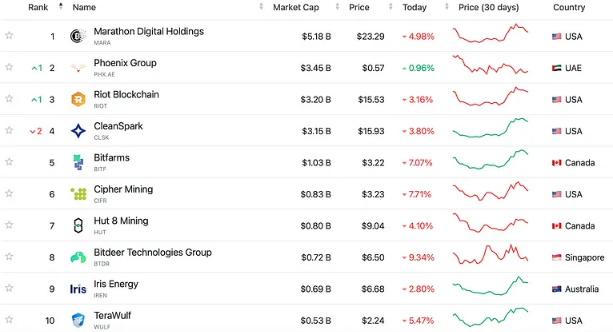
Market capitalization of the top ten Bitcoin mining stocks. Source: companiesmarketcap.com
Top Mining Locations
According to World Population Review, measured by cumulative hash rate, the U.S. led in 2023 with 35.4%, followed by Kazakhstan (18.1%), Russia (11.23%), Canada (9.55%), and Ireland (4.68%). China was once the second-largest mining hub but banned Bitcoin mining in 2021, prompting miners to relocate to Kazakhstan.
Environmental Sustainability Concerns
Bitcoin mining remains highly unsustainable—in 2023, Bitcoin mining consumed energy equivalent to all of Australia, or seven times Google’s annual energy use (91 TWh).
In the U.S., Bitcoin mining accounts for 0.6% to 2.3% of electricity demand—equivalent to an entire state’s consumption, such as Utah. Earlier this year, the U.S. Energy Information Administration required all U.S. miners to report detailed energy usage. The agency’s report noted:
“Concerns raised with the EIA include strain on the electric grid during peak demand periods, potential electricity price increases, and impacts on energy-related carbon dioxide (CO2) emissions.”
Major media outlets like The New York Times have highlighted the “public harm” caused by large-scale mining operations. The Biden administration has been critical of crypto, and the EIA emphasizes that price spikes incentivize more mining, increasing power consumption.
Meanwhile, New York State implemented a two-year moratorium on new mining facilities unless they rely entirely on renewable energy. In Texas, miners are paid to curtail operations during peak energy demand as part of a “demand response” program.
8. On-Chain Indicators: Long-Term Bullish Signs
Finally, let’s examine two technical indicators providing broader insights into Bitcoin’s overall outlook and potential price trajectory.
MVRV Z-Score
MVRV is an oscillator comparing Bitcoin’s market value to its realized value—or spot price to realized price. This chart visualizes market cycles and profitability, helping identify periods when the coin is undervalued or overvalued.
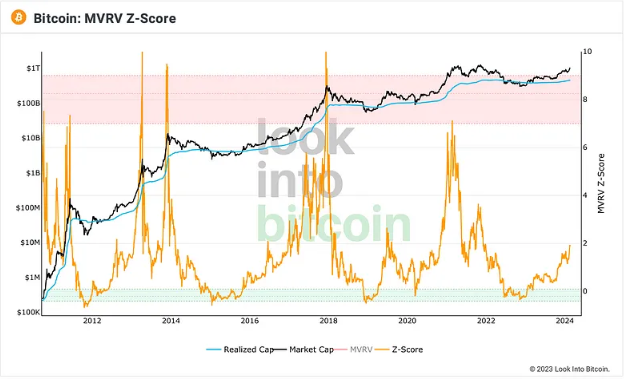
Bitcoin MVRV Z-Score chart. Source: lookintobitcoin.com
As markets mature, Bitcoin’s peaks, volatility, and returns become less extreme. Amid growing adoption of this pioneering digital currency, its realized price grows slower than in past cycles. Hence, gradual appreciation rather than explosive surges is more likely, with better long-term growth potential.
Meanwhile, a significant portion of Bitcoin has been accumulated by holders. Long-term holder supply reached an all-time high by the end of 2023, and whales continue to show confidence in the asset this month.
9. Power Law Channel
The Power Law Channel shifts focus from current price to whether Bitcoin is overbought or oversold. This charting tool creates a channel defined by upper and lower parallel lines representing price range boundaries.
Exceeding the midline indicates overbought conditions, while falling below suggests oversold conditions. Breaking above the lower bound signals further upside potential, with Bitcoin typically reaching the midline within 1–2 months.
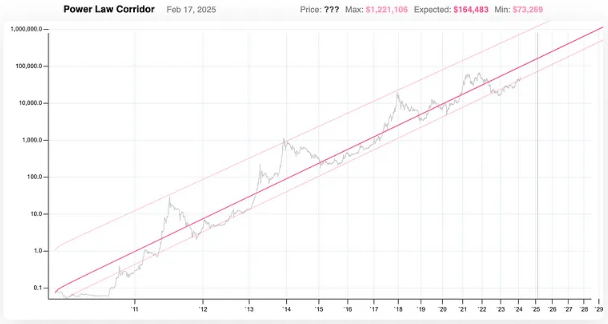
Bitcoin 2024 halving price projection: Power Law Channel forecast as of February 17, 2025. Source: bitcoin.craighammell.com
According to James Bull, overbought conditions typically last about 1.5 years (strong bull market), while prolonged bear markets extend for 2.5 years. However, the model has critics. As its creator Harold Christopher Burger stated:
“Acknowledging Bitcoin follows a power law is provisional. Moreover, besides time, other factors should influence Bitcoin’s price, such as its scarcity.” However, “power law fits improve on log-log plots, suggesting the model might hold.”
10. Conclusion
Before and after each halving, Bitcoin’s price is driven by multiple factors beyond scarcity. The 2024 halving occurs against a backdrop of massive Bitcoin ETF inflows, rising on-chain activity, strong momentum, and overall market maturity.
With improving macro conditions—including anticipated Fed rate cuts—Bitcoin appears poised to break out within the Power Law Channel. It has endured its longest bear market, and major miners have prepared for reduced block rewards.
Our Bitcoin 2024 Halving Price Prediction
EarnBIT’s analysis team expects Bitcoin to rise to $55,000–$60,000 before the halving, with a full-year range of $32,000–$85,000. Past performance does not predict future outcomes, and new black swan events are always possible—but so far, the overall environment appears favorable for growth.
Join TechFlow official community to stay tuned
Telegram:https://t.me/TechFlowDaily
X (Twitter):https://x.com/TechFlowPost
X (Twitter) EN:https://x.com/BlockFlow_News
 @coinmonks


