The New Narrative of EigenDA Driven by Billions of Dollars in Restaking
TechFlow Selected TechFlow Selected
The New Narrative of EigenDA Driven by Billions of Dollars in Restaking
This article delves into how blockchain technology could address the GPU shortage faced by AI startups, and the aggregation of GPU clusters may occur in the future.
 Navigating Web3 tides with focused insights
Author: Sreeram Kannan, EigenLayer; IOSG Ventures
The 11th edition of IOSG Ventures' "Friends Reunion" event, the Restaking Summit, recently concluded successfully in Denver. Covering hot topics such as DA, Staking/Restaking, AVS, Bitcoin Rollups, and Coprocessors, the summit featured 4 talks, 5 panels, and a fireside chat, attracting 1,862 registered attendees and over 2,000 total on-site participants. We will gradually release recaps of the presentations and panel discussions—stay tuned.
Below is the keynote speech by EigenLayer's Founder and CEO, Sreeram Kannan, on the topic "Converting Cloud to Crypto." Enjoy! 👇
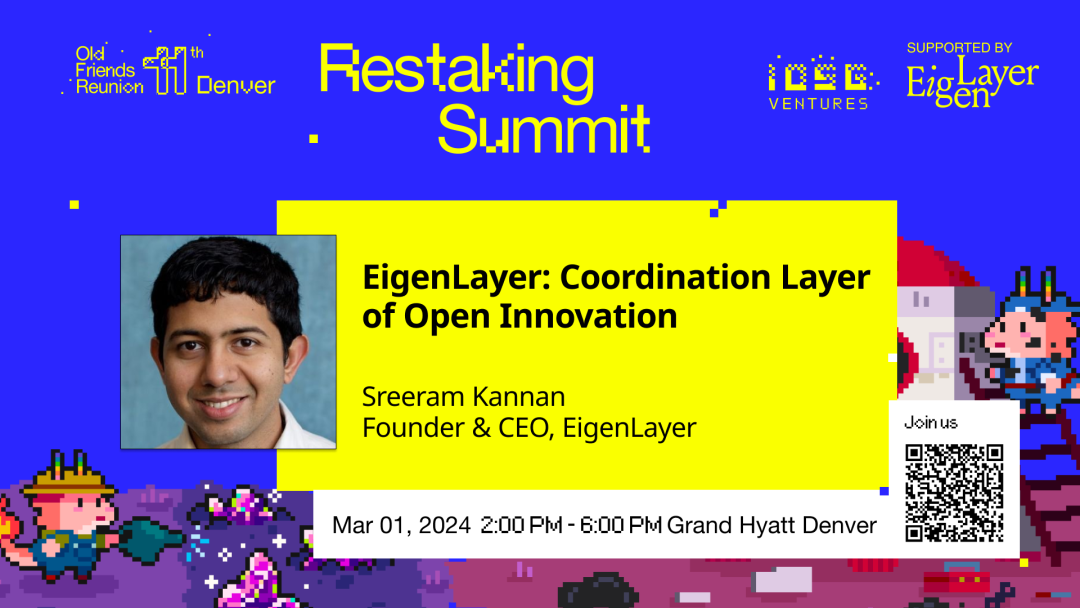
MC: Let’s now warmly welcome our distinguished guest, the CEO & Founder of EigenLayer, Sreeram Kannan. He will present: Converting Cloud to Crypto.
Sreeram Kannan:
Thank you so much to the IOSG Ventures team for organizing this summit. I’m thrilled to be here and share with you. Since we’ve already introduced EigenLayer quite well, today I’ll focus on EigenDA and the themes we’re exploring. When and where do we build EigenDA? How do we bring the cloud into crypto?
When you think about rollups, you might consider two different goals. One is how to offload Ethereum L1 traffic to our L2s. But that’s not what we’re discussing today. Our argument is about how to bring cloud-scale computing into cryptocurrency.
First, why do cloud applications need cryptocurrency?
If you consider two types of applications, they lie on fundamentally different axes. “Value per bit” refers to how much value each bit of transaction carries, while “throughput” refers to your communication rate. Today’s crypto applications operate at high value per bit but low throughput. In contrast, cloud applications rely on the opposite: massive throughput with very low value per bit.
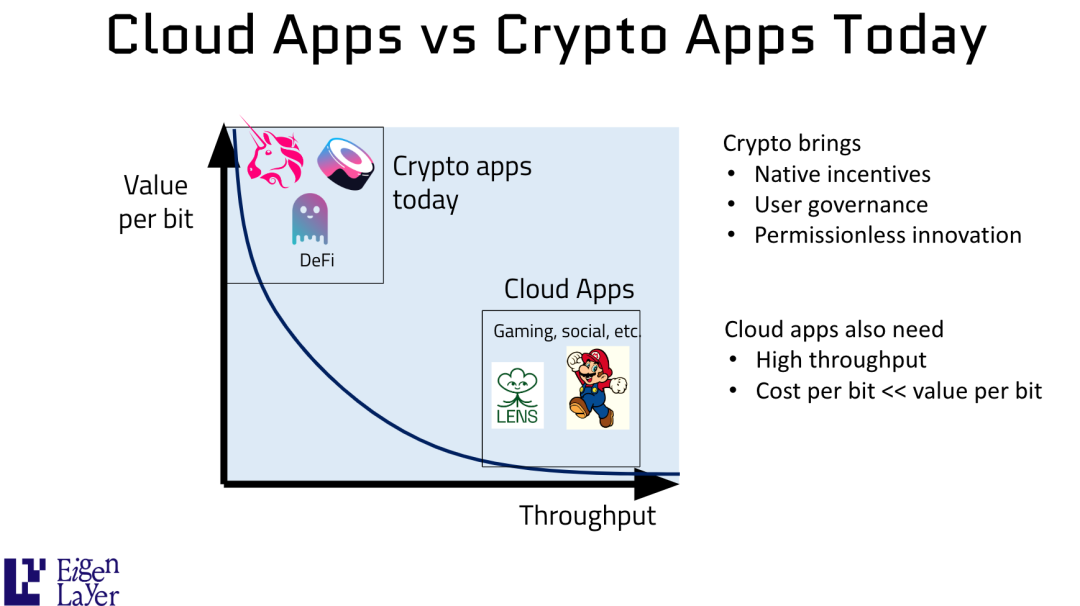
How much value does a single tweet have? But when aggregated across millions of tweets, they create immense value for social networks. So why do cloud applications need cryptocurrency? Because crypto enables native incentives, user governance, and permissionless innovation—the last being one of our favorite topics. How do we ensure anyone with a good idea can build on top of existing applications? If you're building on Twitter or Facebook APIs, you always worry about when those APIs might shut down or when you'll be internalized into their core protocol.
But in cryptocurrency, you have solid, immutable, and verified APIs to build upon. However, cloud applications also require extremely high throughput. Our current throughput levels cannot meet cloud application demands. We also need very low cost per bit—one of the two key dimensions EigenDA focuses on.
Before diving deeper, let’s first examine why use rollups?
When considering cloud and consumer applications, several dimensions don’t align with today’s crypto application deployment models.
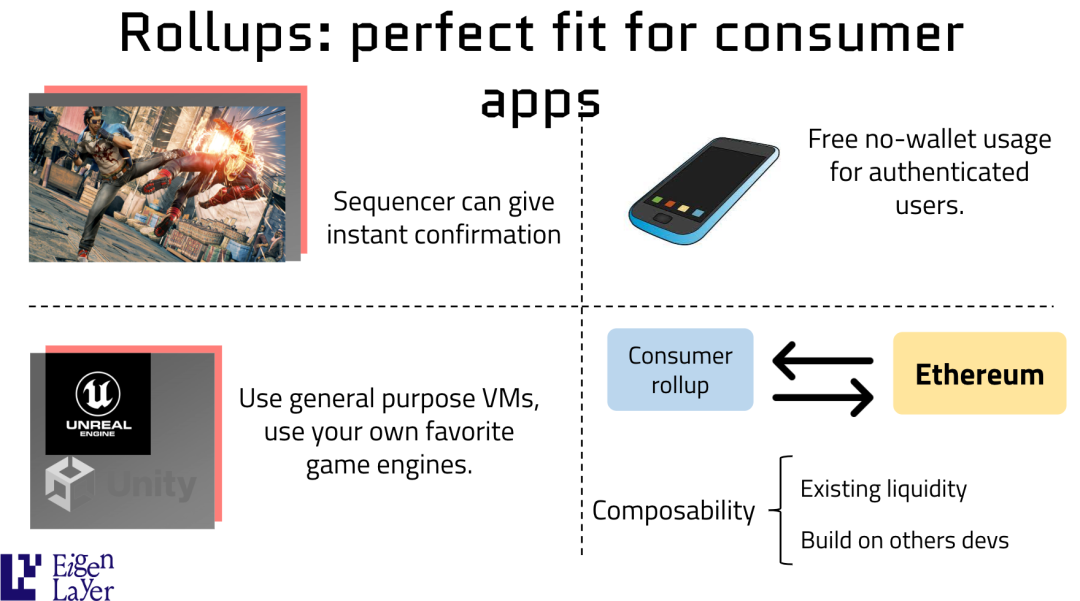
First is user experience—you want instant feedback and ultra-fast confirmations. What better way than having a single centralized sequencer?
This sequencer is maintained through various checks and balances: correctness of the state transition function is verified via validity proofs or optimistic challenges, while ensuring transactions are included back on Ethereum L1 or directly published to a data availability layer. Instant confirmation dramatically transforms the user experience.
Second, when introducing cloud-native applications, we cannot expect everyone to write programs in EVM. We need new virtual machines, programming languages, game engines, AI inference engines—all natively integrated into our blockchain infrastructure. This is exactly what rollups empower us to do.
Another often-underappreciated advantage of having a single centralized sequencer is the ability to implement subjective admission control—a capability impossible in decentralized blockchains. What is subjective admission control? For example, authenticated users should be able to use certain services for free. On traditional blockchains, this isn’t feasible because spam prevention requires fees. Yet pricing alone is a poor discriminator—it cannot distinguish between MEV bots and real users.
Rollups can achieve this. Why? Because a centralized sequencer can apply subjective admission control. For instance, if you already have a Facebook or Twitter ID, you could log in and use an app without paying any fees—or even needing a wallet—greatly simplifying onboarding. These are superpowers of rollups that few truly understand. Finally, we want all these benefits without sacrificing composability with other blockchain applications.
We want access to existing liquidity and the ability to build atop others’ work. At EigenLayer, we aim to help people build resilient systems without redundant effort. From a civilizational perspective, progress moves toward greater specialization and consumption of generalized tools—precisely where rollups and EigenLayer come into play.
Alright, rollups are great—but they also face significant challenges. Here are the issues we observe with current rollups.
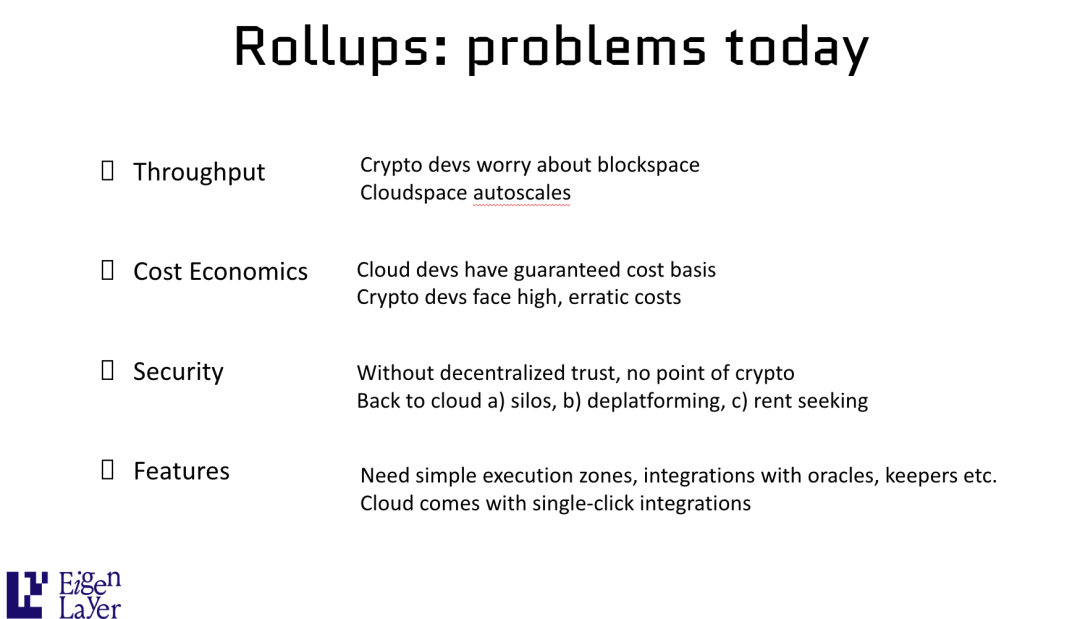
The first issue is throughput.
Ask any crypto developer, and they’ll likely express concern about block space. What happens if demand for block space increases? Could someone like Yuga Labs suddenly flood the network with their next Bored Ape launch, drowning out your transactions?
But this doesn’t happen in the cloud—cloud capacity scales automatically. If demand rises, more resources become available. That’s how crypto *should* work, but reality falls short.
Then there’s cost economics. Cloud developers are accustomed to predictable performance and stable costs. Crypto developers, however, face high and volatile costs. Even when fees are low, you never know when block space will fill up, leading to congestion spikes.
We also need security. While solutions exist for the first two problems—high throughput and low cost—we cannot compromise on security. Lastly, we need new functionalities: new VMs, deeper integrations, and more.

How does EigenDA solve all these issues? The high-level idea is that EigenDA operates at a scale an order of magnitude beyond anything currently available. Ethereum’s EIP-4844, part of the upcoming Dencun upgrade, offers tens of KB per second. In contrast, EigenDA launches with 10MB per second—a throughput level exceeding today’s application needs. Next-generation developers will learn to harness this scale. EigenDA represents an order-of-magnitude improvement over current crypto infrastructure. But we believe it’s still not enough. Our goal is to convert the entire cloud into crypto, which demands even greater scale—and we’re actively working toward that.
One challenge in crypto is that nominal decentralization trades off against scalability: increasing node count typically requires lowering per-node requirements. Thus, decentralization and scalability are often at odds. EigenDA scales horizontally, meaning its decentralization is scalable. The more nodes you add, the greater the network’s total throughput—no single node needs to download all the data. That’s the architecture of EigenDA.
Now, what about economics—volatile pricing, and so on? If you compare a rollup to a Layer 1, you’ll find rollups struggle to compete in several dimensions.
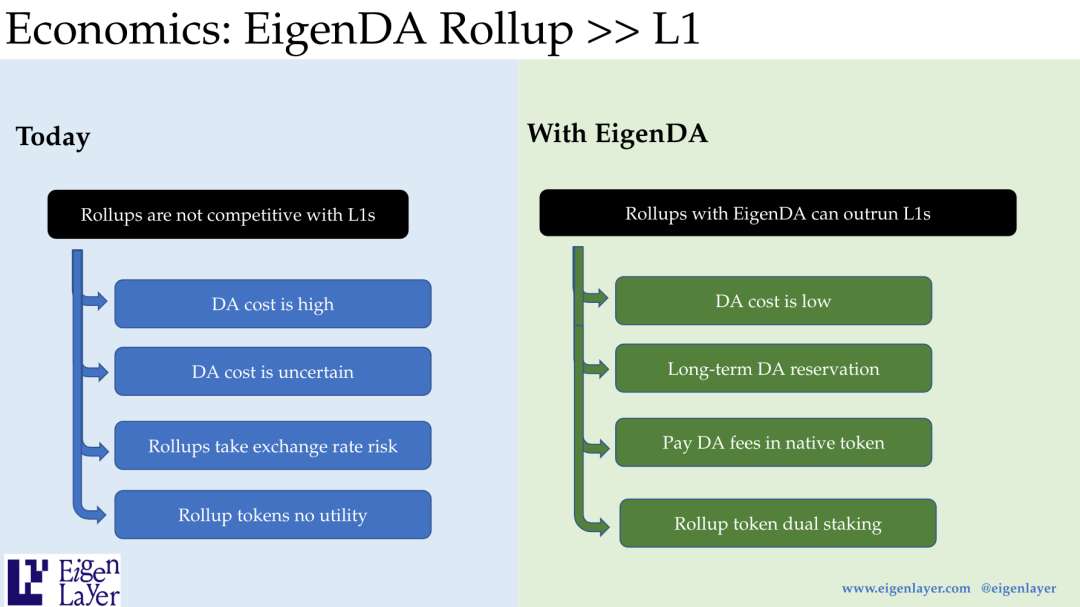
First, data availability (DA) costs: writing data to a shared repository is expensive. Second, DA costs are unpredictable. Even if prices are low today, once 4844 launches, you might think, “Great, costs will stay low,” so you build all your apps around it—only for some new inscription trend to suddenly consume all bandwidth.
I suspect that even with increased bandwidth, 4844 won’t significantly reduce gas costs due to this uncertainty—a major problem. As a Layer 1 builder, you don’t face this issue because you know your cost base precisely, with no external interference.
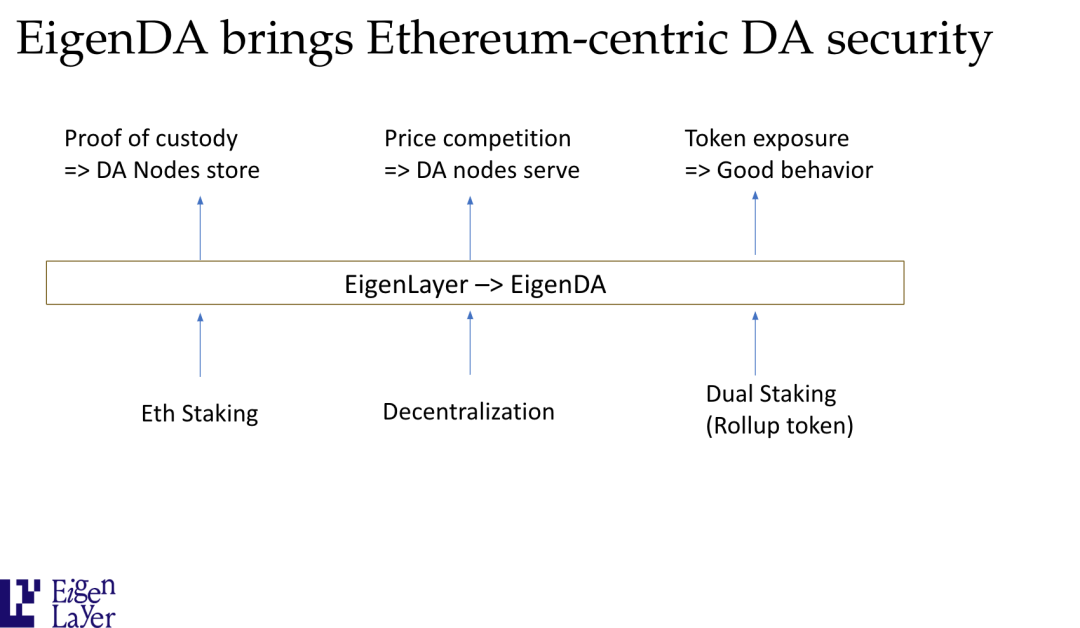
Finally, rollups bear exchange rate risk. If a rollup has a native token used for fees, it cannot predict fee volatility due to potential fluctuations between its token and ETH—creating swap risk.
However, this isn’t the case for Layer 1s, where you can simply allocate part of your own inflation. How do we address this in EigenDA? How can rollups outcompete Layer 1s?
First, we offer low data availability costs by building massive DA capacity on a hyperscale system. Second, EigenDA enables long-term reservations—like reserving a dedicated AWS instance exclusively for yourself. You can reserve a private DA channel in EigenDA.
Next, even when making such reservations, while you nominally pay in ETH, you can also pay using your own native token—effectively locking in a fixed portion of your token’s inflation to fund DA operations. Finally, rollup tokens can be used for dual staking within EigenDA.
This means the data availability system is secured not only by ETH stakers but also by validators bonded in your own token. All of this coordination is outsourced to the EigenLayer and EigenDA systems. This is what EigenDA delivers for rollups: Ethereum-centric security. In EigenDA’s architecture, ETH stakers participate in EigenLayer and can restake into EigenDA. We also inherit decentralization from Ethereum node operators. And we allow rollup tokens to be used in dual staking.
Together, these features ensure high data availability security when building on EigenDA. Finally, there are limitations beyond raw data bandwidth.
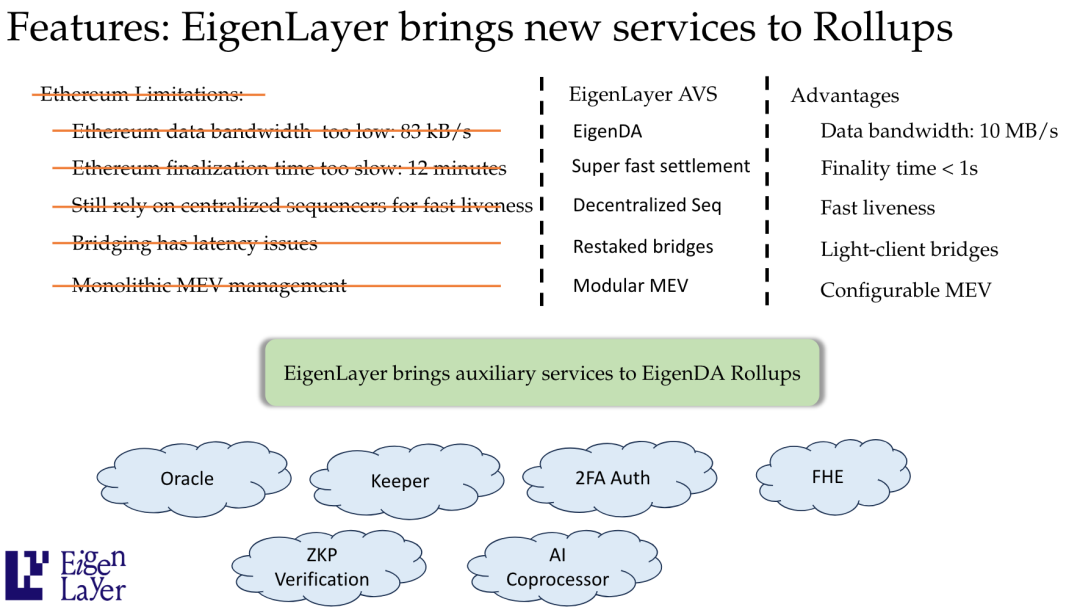
Other constraints seen on Ethereum today include slow finality—requiring 12 minutes to finalize a block. New blockchains now promise sub-second finality, creating strong competition.
So what can we do? We can build new services on EigenLayer to solve these issues. For example, you could deploy a fast finality layer similar to what NEAR is building, or use a decentralized sequencer like Espresso. You could replace bridges—which are fragile and low-trust—with distributed sequencers.
When someone wants to move data from one L2 to another, can we have a truly robust bridge? One where sufficient stake secures the connection, enabling immediate receipt validation and value transfer on the destination chain. Using restaked bridges, near-instant confirmation becomes possible. Additionally, rollups on EigenDA gain access to stronger MEV management tools—they can integrate directly.
Thus, EigenDA provides numerous auxiliary services for EigenDA-based rollups.
I’ve mentioned some limitations of Ethereum, but there’s also additive potential: new oracles, watchers enabling event-driven actions, fully homomorphic encryption, ZK proof verification, AI coprocessors, and many emerging categories that will make collaborating with the EigenLayer ecosystem increasingly seamless over time.
Thank you again to IOSG Ventures for organizing this summit.
Join TechFlow official community to stay tuned
Telegram:https://t.me/TechFlowDaily
X (Twitter):https://x.com/TechFlowPost
X (Twitter) EN:https://x.com/BlockFlow_News
 IOSG Ventures