What Does Restaking Bring? Exploring the Future and Limitless Possibilities of Octopus 2.0
TechFlow Selected TechFlow Selected
What Does Restaking Bring? Exploring the Future and Limitless Possibilities of Octopus 2.0
The Octopus 2.0 strategic plan primarily revolves around three major directions: NEAR Restaking, NEAR IBC Port, and Adaptive IBC.
 Navigating Web3 tides with focused insights
Author | Bob
Since the launch of Ethereum's Beacon Chain, the LSD market has rapidly expanded into the second-largest sector in crypto, revealing massive opportunities behind the tens of billions of dollars in POS staking assets. EigenLayer further innovated by introducing Restaking—a highly popular concept enabling ETH staked on Ethereum to be restaked onto other consensus protocols for additional yields.
For users, compared to LSDs that charge certain protocol fees, Restaking is like "getting multiple meals from one fish," offering layered returns. As a result, many believe Restaking could represent an even larger opportunity than LSD—the next big "cake" in crypto.
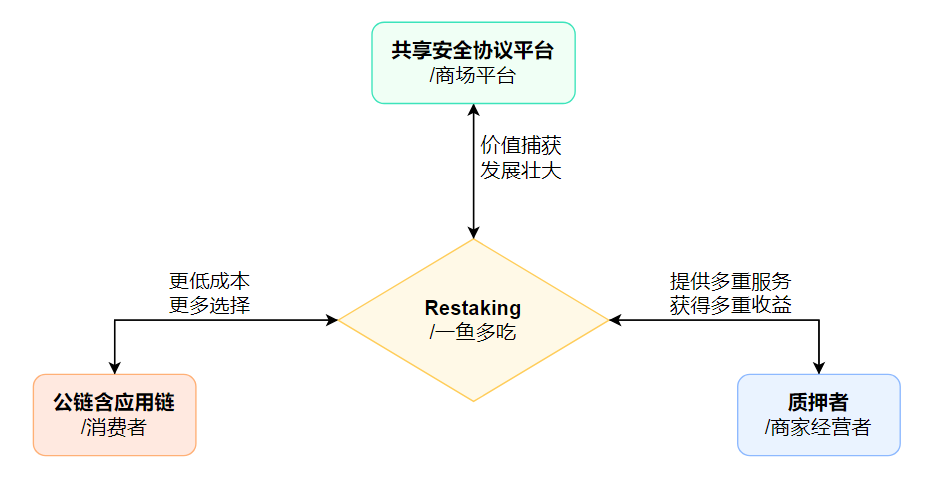
Figure: Restaking likened to "getting multiple meals from one fish"
Recently, Octopus Network—one of the pioneering projects developing Restaking infrastructure—announced its next major version plan, "Octopus 2.0," drawing significant attention.
01 Octopus 2.0: Tackling Key Pain Points of Appchains with Upgraded "Shared Security"
As a veteran appchain solution provider, Octopus Network has previously delivered essential services such as a "security leasing market," cross-chain interoperability, and foundational tooling—significantly lowering barriers and costs for launching, deploying, and operating appchains.
The core value offered by Octopus Network lies in its "security leasing market"—a shared security solution that, to some extent, accelerates the adoption of appchain technology.
With continuous innovation in solutions—especially the emergence of Restaking—Octopus Network is now building upon this foundation to further enhance its shared security model. Restaking, as a novel shared security mechanism, brings undeniable advantages.
Simply put, the Restaking mechanism allows validators on major public chains to simultaneously stake their primary assets both on their native chain and on appchains, earning multiple rewards. Meanwhile, appchains can access high-level security at low cost through shared validation resources. For shared security protocols, this strengthens the attractiveness and value capture potential of the "shared security market." It creates a win-win-win scenario among stakers, appchains, and shared security protocols within the POS staking ecosystem.
On April 14, Octopus Network unveiled Octopus 2.0 at HK Web3 Festival. According to public reports, this strategic upgrade centers around three key directions: NEAR Restaking, NEAR IBC Port, and Adaptive IBC.
First is the much-anticipated NEAR Restaking—applying EigenLayer’s Restaking concept mentioned earlier. Octopus Network enables $NEAR holders to not only stake on the NEAR mainnet but also perform Restaking for appchains, providing security in exchange for staking rewards from those appchains. Of course, looking ahead to broader cross-chain appchain markets, Octopus Network aims to bring Restaking solutions to more Layer1 blockchains in the future.
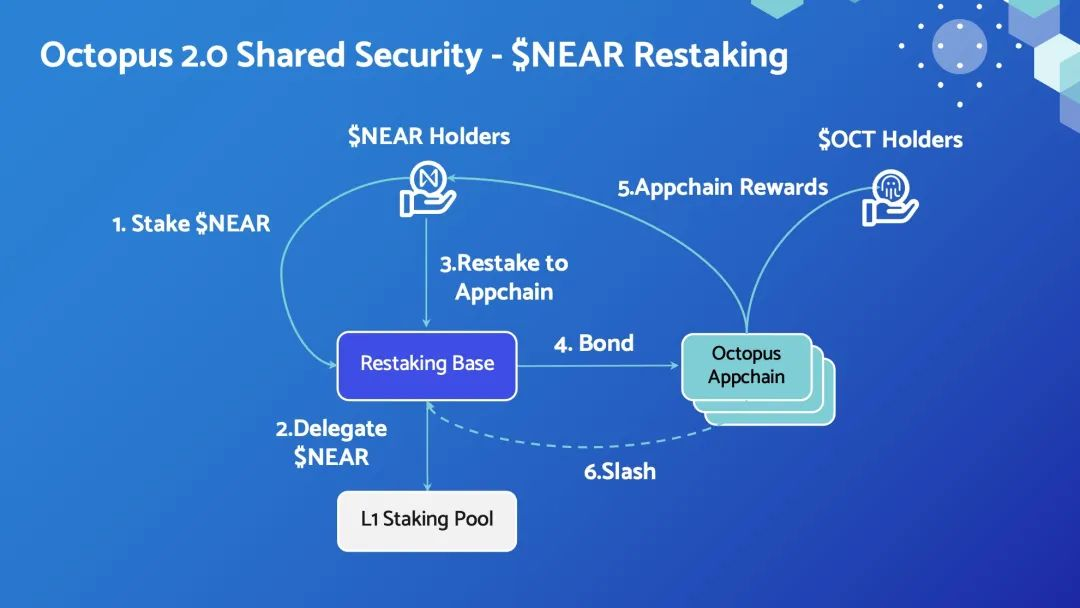
Next are NEAR IBC Port and Adaptive IBC. Interoperability with the Cosmos ecosystem via the IBC protocol was a key component of Octopus Network’s early roadmap, and it is now steadily becoming a reality—an essential step toward empowering appchains with cross-chain capabilities.
NEAR IBC Port aims to become a "cross-chain gateway" for the NEAR ecosystem, connecting via IBC to the widely respected Cosmos ecosystem known for its strong technical community and innovative projects. In the future, it will also support connections to EVM-compatible blockchains such as Ethereum, BNB Chain, and Avalanche—ecosystems currently hosting the largest developer and user bases in crypto.
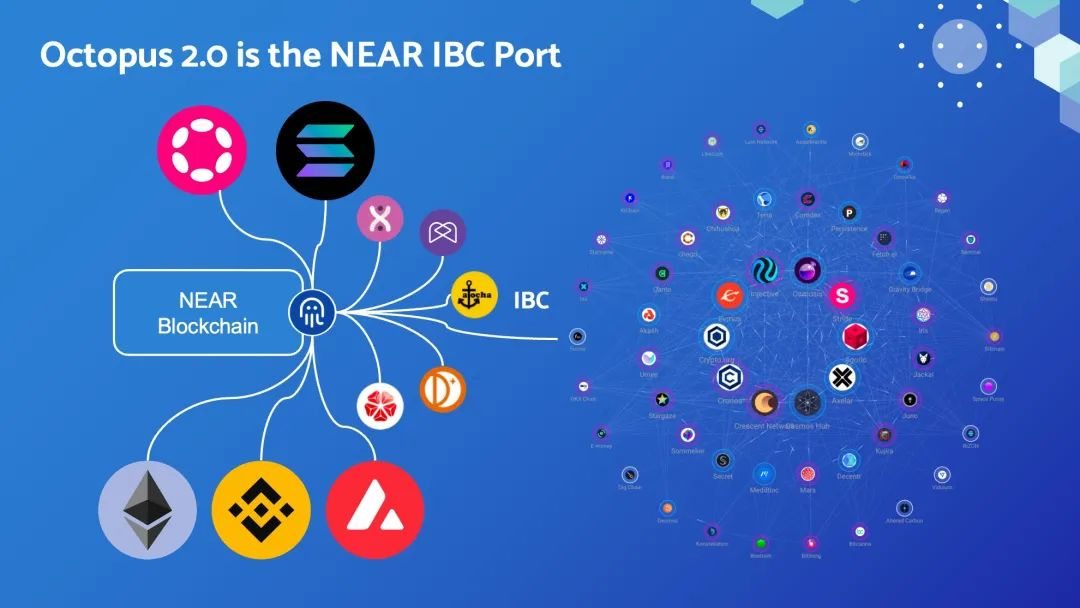
Notably, Octopus Network began developing Substrate IBC back in 2020, becoming the first team worldwide to implement IBC on non-Cosmos blockchains. Their ongoing development of Adaptive IBC is a unique technological breakthrough that allows non-Cosmos blockchains (like NEAR) to verify cross-chain messages originating from Cosmos-based chains.
02 What Does Octopus Network’s Restaking Bring?
As the second major player to quickly adopt Restaking after EigenLayer, Octopus Network—with its "Octopus 2.0" strategy—paints a picture of a sustainable, open Web3.0 infrastructure solution. Compared to EigenLayer, it holds several distinct advantages:
a. Proven Experience in Shared Security Development
Few projects in crypto have deeply explored and successfully implemented "shared security." Octopus Network’s accumulated R&D experience provides a solid foundation for seamlessly transitioning its security leasing market to support Restaking.
b. High-Speed, Low-Cost Infrastructure Based on NEAR
Built atop NEAR’s excellent scalability solutions, Octopus Network overcomes blockchain scalability bottlenecks, delivering higher-performance and more secure shared security services. It also benefits continuously from technical and ecosystem support provided by the NEAR community.
c. Joining the IBC Ecosystem for Broader Cross-Chain Market Access
From the outset, Octopus Network did not limit itself to the NEAR blockchain but chose to integrate into the broader IBC ecosystem. By equipping appchain solutions with cross-chain capabilities, it gains access to vast resources within the IBC ecosystem. More importantly, thanks to Cosmos’ highly open development philosophy, the IBC community has become one of the largest open cross-chain ecosystems. Through deep integration with NEAR IBC Port and Adaptive IBC, Octopus Network positions itself for expansive growth in the cross-chain landscape—the possibilities are endless.
Currently, the largest "island" in the cross-chain ecosystem is Ethereum. In the future, leveraging composability across chains—one of the key directions championed by the NEAR community—Octopus Network could extend into the Ethereum ecosystem. For example, integrating EigenLayer’s Restaking as a source of security would enable powerful collaborations, offering enhanced shared security services to diverse appchains.
In summary, while EigenLayer focuses exclusively on the Ethereum ecosystem, Octopus Network builds on NEAR while targeting the broader IBC cross-chain ecosystem. Each has its own focus, yet both contribute uniquely to advancing shared security.
Of course, EigenLayer specializes in Ethereum, whereas Octopus Network centers on NEAR while embracing the IBC cross-chain ecosystem—two different focal points. Rather than competing, they may collaborate to deliver superior shared security services for appchains, each with a bright future ahead.
03 Restaking Is a Double-Edged Sword—Used Wisely, Its Potential Is Limitless
On May 21, Vitalik published an article titled “Don’t overload Ethereum’s consensus,” arguing that repurposing Ethereum validators—or even Ethereum’s social consensus—for external uses poses high systemic risks and should be resisted. He specifically questioned concepts like the “ultimate oracle,” “Restaking,” and “L1-driven L2 project recovery.”
The main criticisms regarding "Restaking" can be summarized as follows:
(1) Validators’ incentives would no longer align solely with Ethereum, making them susceptible to influence from other protocols.
(2) Validators could face slashing due to errors or attacks in external protocols, thereby threatening Ethereum’s security.
(3) Validators might be coerced into participating in governance or community decisions of other protocols, undermining Ethereum’s stability and fairness.
Shortly after, EigenLayer’s founder responded to Vitalik’s concerns, acknowledging the risks posed by misuse of Restaking and affirming alignment with Vitalik’s cautious stance. Sreeram Kannan, EigenLayer’s founder, argued that EigenLayer’s Restaking model reduces systemic risk and benefits the Ethereum ecosystem:
(1) EigenLayer features a transparent and auditable marketplace where validators and applications freely trade risk and reward.
(2) EigenLayer limits the number and scale of protocols to prevent excessive fragmentation of validator attention and resources.
(3) EigenLayer is cultivating a culture of "alignment" and assembling teams committed to best practices and standards to prevent faults or attacks.
Clearly, Restaking can boost staker yields and promote participation in and development of the Ethereum ecosystem—but poor implementations carry risks. Restaking is indeed a double-edged sword; mastering its responsible use will be the key focus going forward.
Many of the views and principles proposed by EigenLayer’s founder resonate with Octopus Network’s original design for its security leasing market back in version 1.0—such as auditability, limiting the number and scale of shared-security appchains, and so on.
Decentralized trust sharing isn’t a new invention of Restaking—it stems from prior explorations in shared security. Octopus Network’s ability to rapidly adopt Restaking is largely due to its existing expertise, allowing it to deepen its exploration of responsible Restaking applications and the values of open, shared security.
04 Summary
Over the past two years, as cross-chain and appchain scalability solutions have matured, blockchain bottlenecks are gradually fading, and the market’s focus has shifted toward the accelerating arrival of Web3.0. As a leading project in the NEAR ecosystem, Octopus Network leverages its strengths and integrates top-tier solutions to build better infrastructure for Web3 applications serving the next billion internet users. Alongside EigenLayer, Octopus Network advances decentralized shared trust and expands the shared security market. What new landscape will these two Restaking pioneers create? The world watches with anticipation.
Join TechFlow official community to stay tuned
Telegram:https://t.me/TechFlowDaily
X (Twitter):https://x.com/TechFlowPost
X (Twitter) EN:https://x.com/BlockFlow_News
 白话区块链
白话区块链