








Besides INJ and TIA, what are some other promising projects in the Cosmos ecosystem?
TechFlow Selected TechFlow Selected
Besides INJ and TIA, what are some other promising projects in the Cosmos ecosystem?
As the popularity of public blockchain sectors like Solana and Avalanche continues to rise, could Cosmos be next?
 Navigating Web3 tides with focused insights
By Kaori, BlockBeats
Recently, the term "InCel" has been trending frequently within the crypto community, referring to Injective— a Cosmos-based Layer 1 blockchain—and modular blockchain Celestia. Many even believe that "InCel" could become this cycle's equivalent of "SoLunAvax".
The emergence of "InCel" is due to the impressive price performance recently shown by INJ, Injective’s native token, and TIA, Celestia’s native token.
On December 12, INJ broke through $25, rising 20.02% in 24 hours, reaching $26.57 at press time; TIA surged past $11.5, up 14.9% over 24 hours, hitting an all-time high, priced at $11.7 at press time.
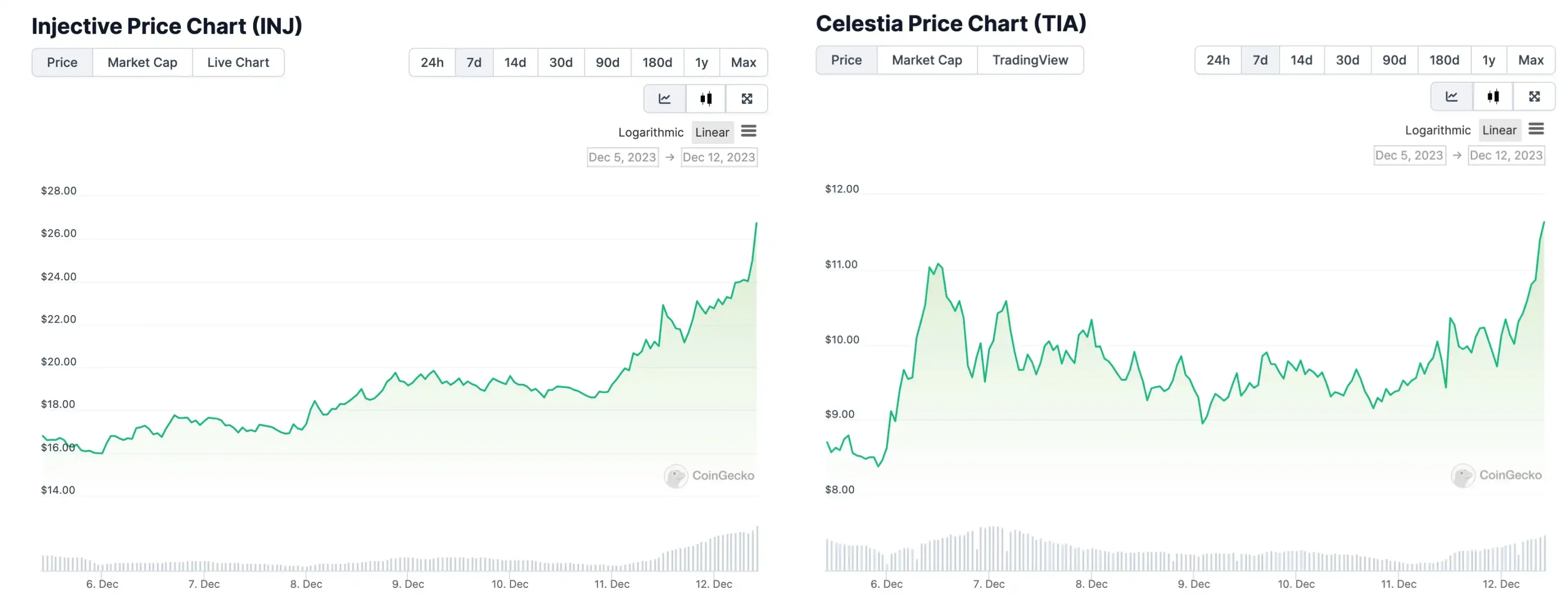
According to CoinGecko data, INJ currently has a market cap of $2.246 billion, ranking 36th among cryptocurrencies; TIA currently has a market cap of $1.296 billion, ranking 45th.
"In+Cel": Cosmos' New and Old Layer 1s
Both Injective and Celestia are Layer 1 blockchains built on the Cosmos ecosystem.
Injective mainnet launched in November 2021. The Injective protocol provides decentralized order book trading infrastructure, enabling zero gas fee access to cross-chain spot and derivatives markets.
Specifically, Injective is an application-specific blockchain built using the Cosmos SDK, designed to serve as an interoperable decentralized trading infrastructure layer. Its architecture differs from DEXs operating on Ethereum or other Layer-1s, as the protocol delivers trading services on its own execution layer and allows third parties to build trading platforms permissionlessly on Injective. All trading platforms built on Injective share the same order book, maximizing capital efficiency.
Although the Injective Chain is built with the Cosmos SDK, it uses custom Ethereum accounts and application-generated wallets to parse EIP-712 type data.
In terms of value accrual, Injective burns 60% of all exchange fees managed by community-led auctions, creating deflationary pressure across the entire token supply. The remaining 40% goes to relayers, incentivizing exchange liquidity depth. In other words, INJ token value accrual is a function of trading volume, not transaction count like other alternative protocols.
INJ tokens can also be used as collateral for derivatives, serving as an alternative to stablecoins unlike other derivative markets. Additionally, Injective integrated with Skip Protocol to return MEV revenue to stakeholders, strengthening its value accrual case in early February this year.
In August, Injective upgraded its tokenomics, allowing all dApps built on Injective to contribute to INJ burn auctions without limits on the fees they wish to burn. This strengthens the INJ-powered on-chain economy, enabling burn auctions to capture value from all dApps within the rapidly growing Injective ecosystem.

Injective ecosystem dApps; Image source: Injective official website
Celestia, as a powerful new project in the Cosmos ecosystem, matches Injective—the established L1—in both technological innovation and market attention.
Celestia is also a Cosmos SDK-based Layer 1 chain focused on modularity, with its base layer consisting of consensus and data availability—collectively referred to by the team as the DA layer. The DA layer features two key components: data availability sampling (DAS) and Namespaced Merkle Trees (NMT).
Unlike monolithic blockchains that independently handle execution, settlement, consensus, and data availability, modular blockchains decouple these functions across multiple specialized layers as part of a modular stack—similar to Lego blocks—providing greater flexibility and scalability for each module.
On September 26, Celestia announced the launch of its Genesis Drop, allowing eligible participants to claim up to 60 million TIA tokens starting October 17. Subsequently, Helix—a DEX in the Injective ecosystem—launched pre-launch token futures trading, enabling users to trade tokens before their official release or listing. Celestia (TIA) became the first supported futures token on this market.
On October 31, Celestia's mainnet went live, followed by TIA listings on several major CEXs. For the first ten days after launch, TIA fluctuated slightly around $2.5, then began a strong upward trend starting November 11, peaking at $7.4. On December 12, TIA broke past $11.5, reaching a new all-time high.
What Other Hot Projects Are in the Cosmos Ecosystem?
With surging interest in public chains like Solana and Avalanche lately, the community is wondering whether Cosmos might be next.
In November, the Cosmos Hub community proposed #848—"ATOM Reduction: Setting Max Inflation Rate to 10%"—and called for community voting. According to official documents, the proposal aims to reduce ATOM inflation from approximately 14% to 10%, lowering staking annual yields from about 19% to 13.4%. In the following days, Cosmos ecosystem tokens broadly rose, with ATOM gaining 12% over seven days.
With recent standout performances from Injective and Celestia, what other projects in the Cosmos ecosystem deserve attention?
Osmosis
Osmosis is the leading DEX in the Cosmos ecosystem, primarily offering cross-chain trading, where users can earn returns via staking or liquidity pools. In October 2021, Osmosis announced a $21 million private token sale funding round led by Paradigm Ventures.
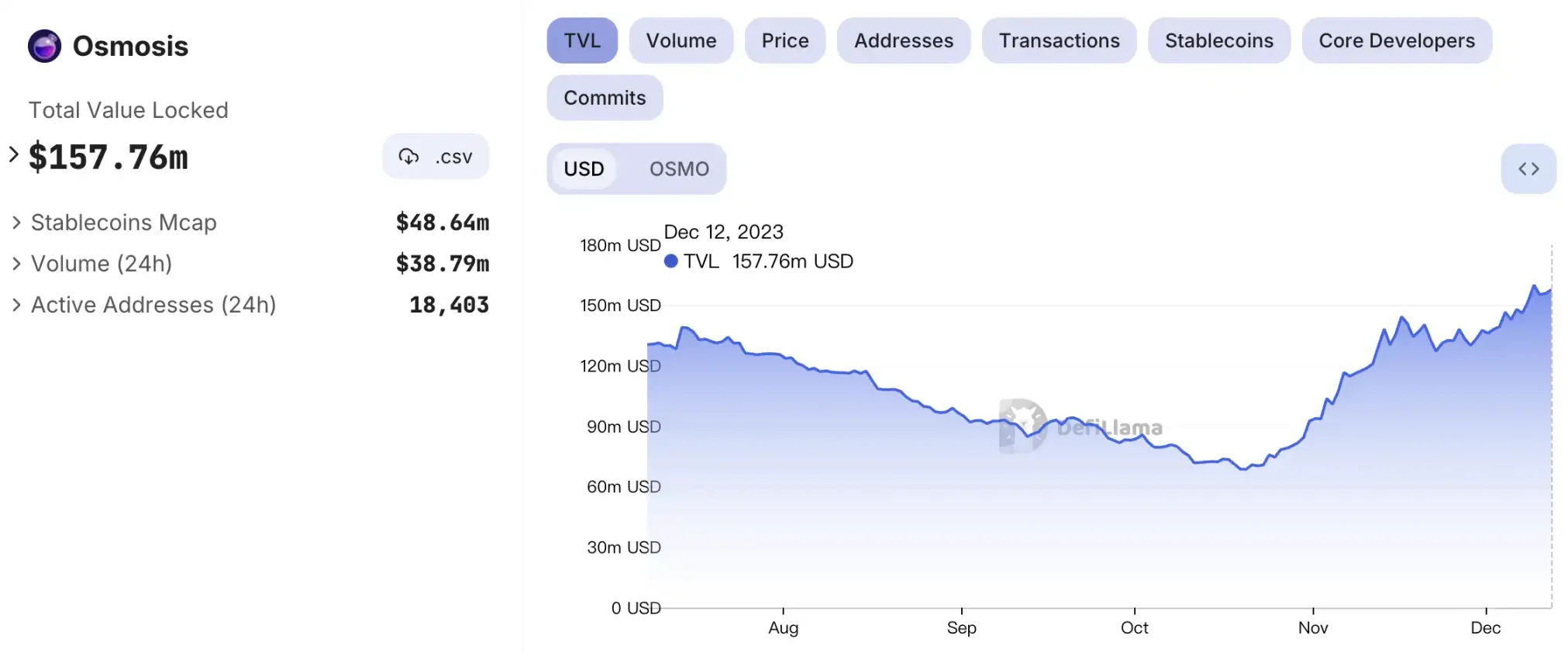
According to DeFiLlama data, Osmosis currently has a TVL of $157 million, up 18.67% over the past month. Its native token is currently priced at $0.9, with a 7-day gain of 22.9%.
Kujira
Kujira is a Cosmos Layer 1 platform that has created an ecosystem of dApps and infrastructure. According to official statistics, as of November 14, Kujira's ecosystem matrix includes 22 protocols/products spanning liquidation of collateral, DEXs (margin trading, limit orders, etc.), liquidity yield farming, lending markets, launchpads, wallets, strategy trading, OTC trading, P2P trading, NFT marketplaces, LSTs, on-chain ETFs, and more.
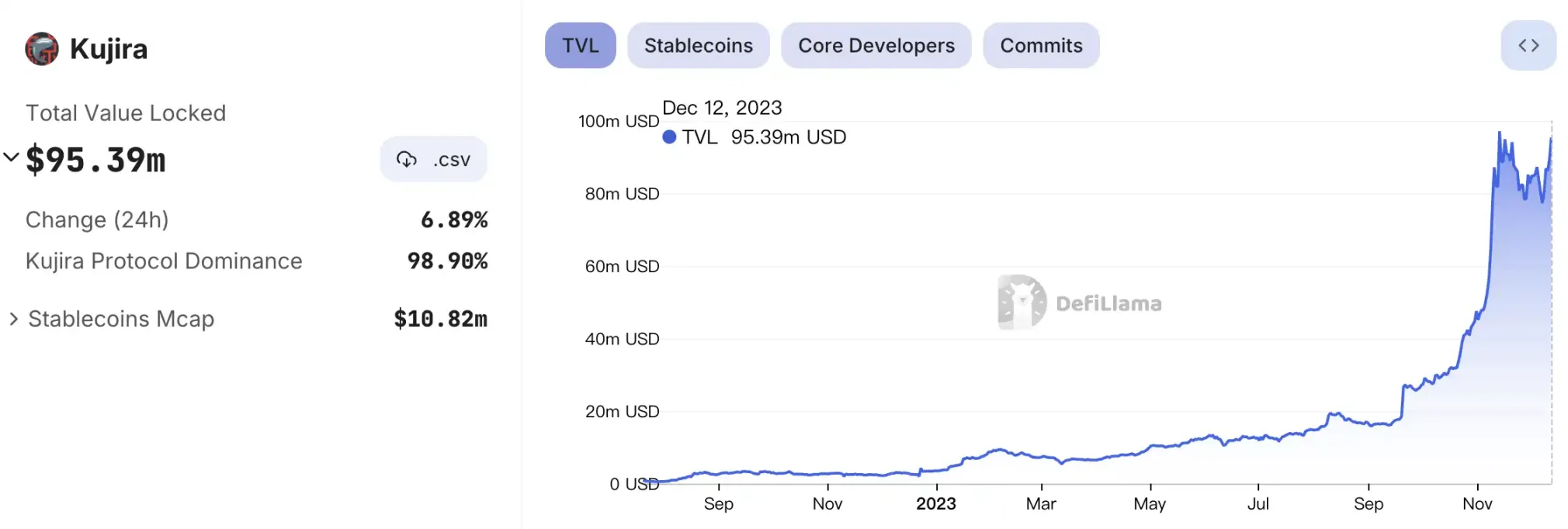
According to DeFiLlama data, Kujira's ecosystem TVL has grown significantly since September, reaching $95.39 million, with a 7-day increase of 13.35%. Its token KUJI is currently priced at $4.26, up 28.9% over the past 7 days.
Neutron
Neutron is a permissionless smart contract platform built using the Cosmos SDK, enabling developers to deploy applications once and scale them across the entire IBC network of interconnected blockchains, without needing to deploy or maintain multiple customized versions of their protocol.
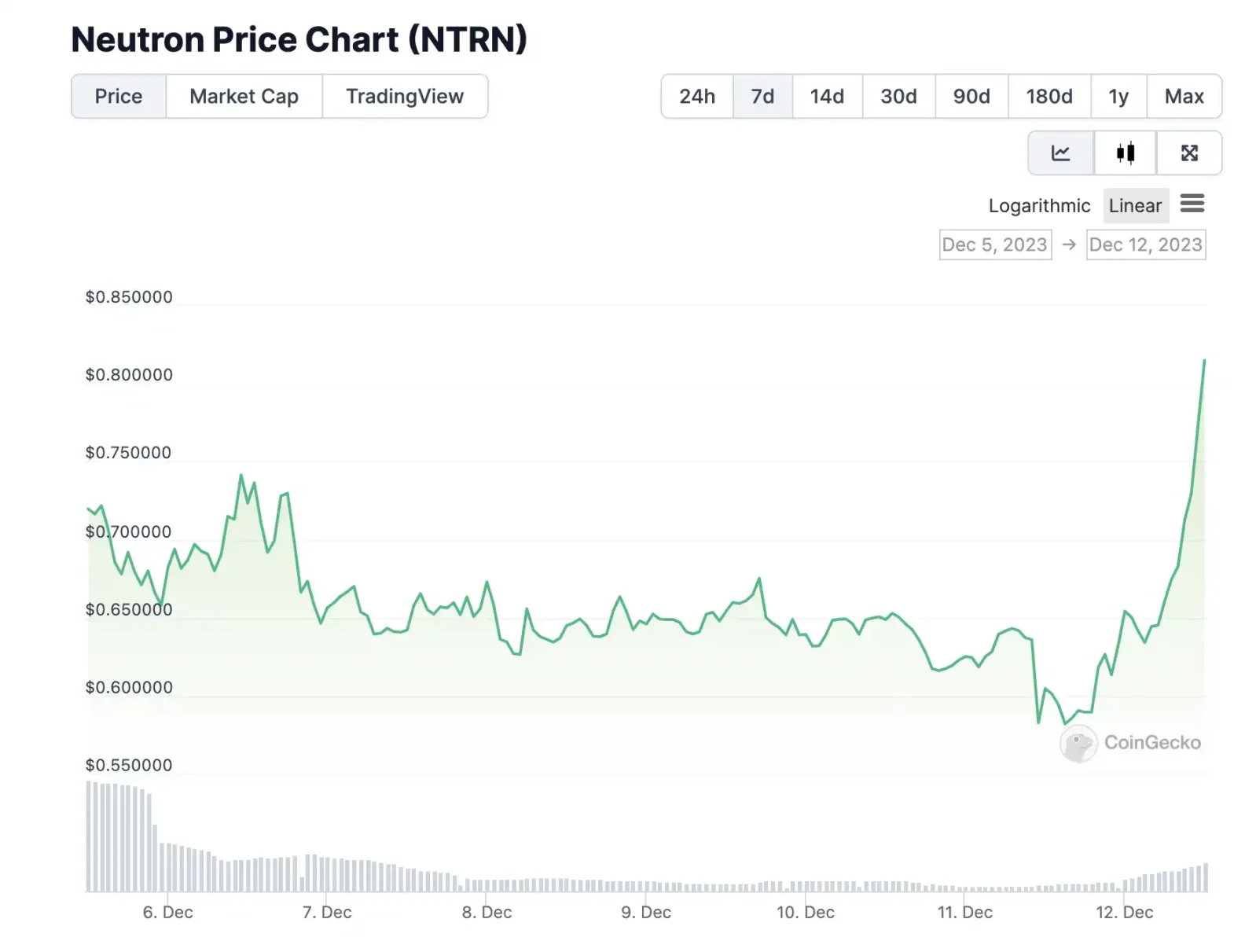
Neutron's native token is NTRN. On November 14, Binance listed NTRN 1-50x U-margined perpetual contracts. At press time, NTRN was priced at $0.81, up 38.3% in 24 hours.
Sei Network
Sei Network is a Layer 1 blockchain built using the Cosmos SDK and Tendermint Core, specifically designed to serve order book infrastructure and enable high-performance DeFi products. In August 2022, it raised $5 million in a funding round led by Multicoin Capital.
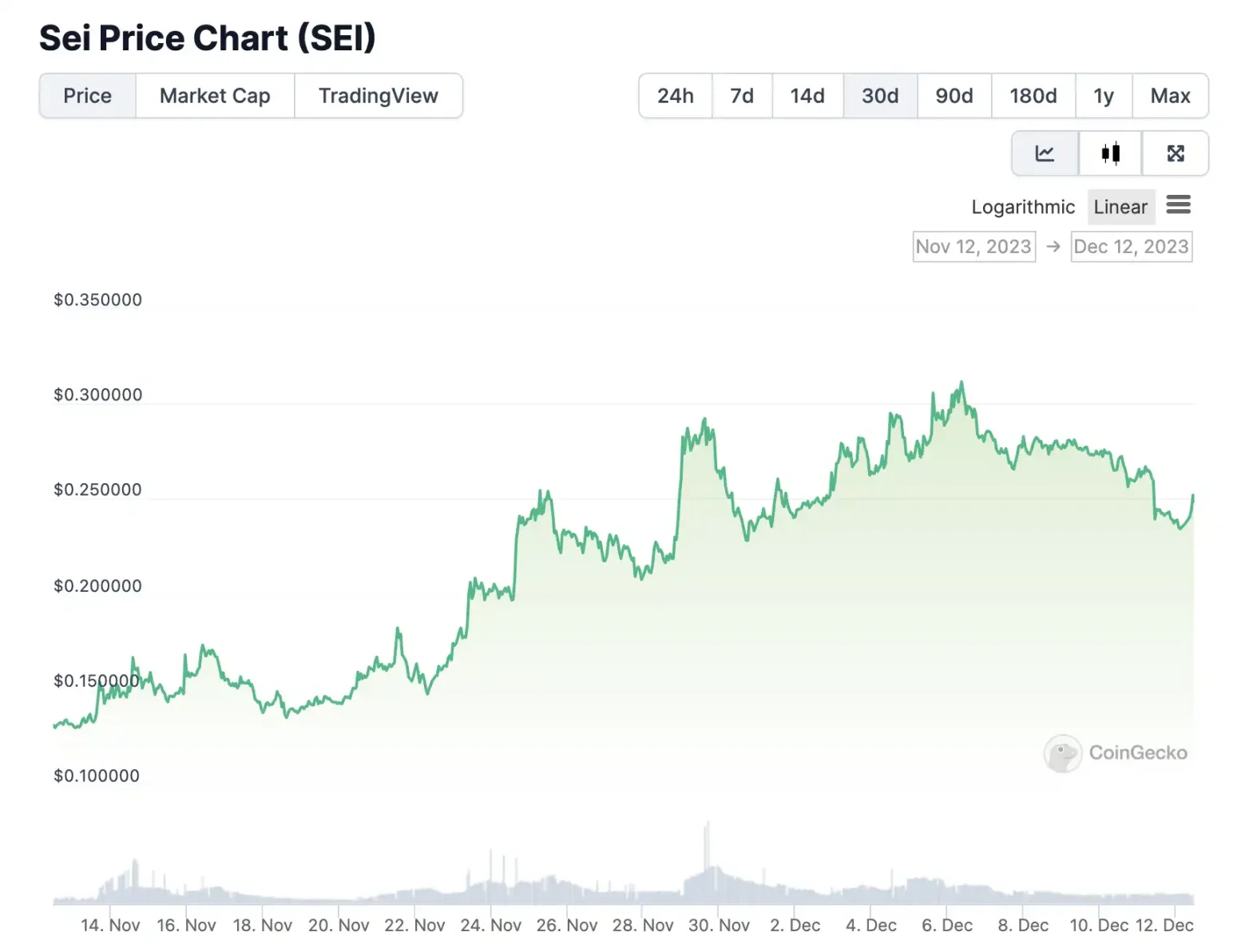
On November 15, Circle announced a strategic investment in Sei Network, supporting the launch of native USDC on the network. Following the announcement, its native token SEI briefly surpassed $0.29, rising 32.96% in 24 hours. On November 29, Sei Network unveiled its V2 strategic plan, introducing the world’s first parallel EVM. After review, the upgrade will launch on public testnet in Q1 2024 and deploy to mainnet in the first half of 2024.
Its native token SEI is priced at $0.24, up 91.4% over 30 days.
Fetch.ai
This year, the AI+Crypto concept has drawn significant attention. Fetch.ai is an AI-focused appchain built on the Cosmos SDK, aiming to create a decentralized intelligent world by combining blockchain technology with AI algorithms to deliver self-organizing systems, smart contracts, and intelligent agents.
Fetch.ai has its own AI agent framework and algorithms, applicable across various domains and scenarios. Currently, Fetch.ai has developed a series of ecosystem applications based on its proprietary AI technology, including Resonate (Social+AI Feed), MOBIX (Move to Earn), and Atomix (DeFi protocol).
Its native token FET is currently priced at $0.51, up 2.20% in 24 hours.
Join TechFlow official community to stay tuned
Telegram:https://t.me/TechFlowDaily
X (Twitter):https://x.com/TechFlowPost
X (Twitter) EN:https://x.com/BlockFlow_News
 BlockBeats






