New Trends in the Bitcoin Ecosystem: Lightning Network, Ordinal, Atomical, bitVM
TechFlow Selected TechFlow Selected
New Trends in the Bitcoin Ecosystem: Lightning Network, Ordinal, Atomical, bitVM
Bitcoin's inherent non-Turing completeness has significantly constrained the further expansion of its ecosystem.
 Navigating Web3 tides with focused insights
Author: Beam, Everest Ventures Group
I. Introduction to the Bitcoin Ecosystem
Bitcoin's position within the cryptocurrency ecosystem is not only historic but also pivotal. As the first and most renowned cryptocurrency, Bitcoin has not only ushered in a new era of digital currencies but also laid the foundation for the widespread adoption of DeFi and blockchain technology. Its decentralized nature, limited supply (capped at 21 million bitcoins), and its role as a store of value and investment vehicle have secured its prominent place in the crypto market.
Interest in the Bitcoin ecosystem stems largely from its innovation, its challenge to traditional financial systems, and its potential economic impact. Over time, Bitcoin has become both a component of asset diversification and a central topic in global financial discourse. However, after several bull and bear cycles, it has become increasingly clear that Bitcoin’s non-Turing completeness significantly limits the further expansion of its ecosystem.
Turing completeness refers to a system's ability to simulate any Turing machine, typically associated with systems capable of executing arbitrary computational instructions including loops and branching. Bitcoin’s scripting language is relatively simple, primarily designed to handle transaction conditions such as multi-signature setups or time-locked transfers, rather than perform complex computations. This design prioritizes network security and stability. In contrast, blockchain platforms like Ethereum offer a Turing-complete environment enabling the execution of complex smart contracts.
When discussing Bitcoin, it is crucial to recognize its limitations, particularly regarding the execution of complex programs and smart contracts. Therefore, to explore the development of the Bitcoin ecosystem, we must first summarize and analyze the core problems it needs to solve.
Broadly speaking, there are three main challenges: First, how to improve network efficiency and reduce transaction fees without compromising Bitcoin’s security; second, how to enable native asset issuance on the Bitcoin network without overburdening it; and third, how to support more smart contracts and complex applications despite Bitcoin’s lack of Turing completeness.
Here are some key exploration directions:
-
Enhancing Bitcoin Script Functionality: While Bitcoin’s scripting language is minimal, developers continue exploring ways to add functionality within the existing framework—such as developing more complex transaction types and conditions, including improved multi-signature mechanisms and advanced locking scripts.
-
Sidechain Technology: Sidechains are independent blockchains linked to—but separate from—the main Bitcoin chain. They allow for more complex features, including Turing-complete smart contracts, without affecting the security and stability of Bitcoin’s main chain.
-
Lightning Network: As a Layer 2 solution for Bitcoin, the Lightning Network enables faster, lower-cost microtransactions while reducing congestion on the main blockchain. While primarily aimed at scalability, it also provides a platform for developers to experiment with new functionalities.
-
Rootstock (RSK): RSK is a smart contract platform connected to Bitcoin via a sidechain. It aims to bring Turing completeness to the Bitcoin ecosystem, allowing users to create and execute complex smart contracts within Bitcoin’s secure framework.
-
RGB: The project’s core goal is to enable smart contracts and asset issuance on the Bitcoin blockchain while preserving its decentralization and security. Using Bitcoin’s Layer 2 technology, RGB allows users to create and manage non-fungible tokens (NFTs) and other complex assets atop the Bitcoin network. This brings advanced capabilities—such as tokenized assets, smart contracts, and digital identities—to Bitcoin without compromising the stability and security of its main chain. RGB represents the Bitcoin community’s effort to expand Bitcoin’s core functionality and could significantly broaden its use cases and value. However, such attempts face technical implementation and community adoption challenges.
-
Taproot/Schnorr Signatures: These upgrades enhance privacy and efficiency on the Bitcoin network. While they do not make Bitcoin Turing-complete, they lay the groundwork for future functional expansions.
-
Stacks (STX): A smart contract layer for Bitcoin designed to extend Bitcoin’s functionality to support smart contracts and decentralized applications. Its primary goal is to introduce smart contract capabilities on the Bitcoin blockchain, enabling developers to build decentralized applications (DApps) and expand Bitcoin’s utility. Stacks 2.0 uses the Proof-of-Transfer (POX) consensus mechanism, where participants earn rewards in BTC—the stable underlying chain currency—which incentivizes early participation and strengthens network consensus.
-
Empowering BTC: By transforming BTC into an asset used to build DApps and smart contracts, this approach increases the vitality of the Bitcoin economy.
-
Ordinal Protocol: Without altering Bitcoin’s foundational architecture, this protocol introduces an innovative method for data storage and tagging on the Bitcoin network. It leverages the ordinal numbers of Bitcoin transaction outputs, allowing users to embed small pieces of data within specific satoshis. Although this increases demand for data storage on the Bitcoin blockchain, it opens up new possibilities for Bitcoin as a multi-functional, multi-dimensional asset platform.
-
Atomical Protocol: A recently emerged, simple and flexible protocol for minting, transferring, and updating digital objects on UTXO-based blockchains like Bitcoin. At its core, it defines a set of straightforward rules governing minting, transfer, and update operations.
-
BitVM: BitVM is an innovative attempt to enhance the functionality and flexibility of the Bitcoin network. As a virtual machine implementation, it aims to provide higher-level programming capabilities and smart contract functionality on the Bitcoin blockchain. This would allow developers to build more complex and versatile applications on Bitcoin, extending its use beyond being merely a digital currency. By implementing such a virtual machine, BitVM seeks to maintain Bitcoin’s core security and decentralization while introducing greater programmability and interoperability. The project reflects the Bitcoin community’s ongoing exploration of technological innovation and blockchain capability expansion, potentially bringing Ethereum-like smart contract functionality to Bitcoin. However, it may face challenges related to technology and community consensus.
In this article, we will compare several of the most promising projects in the Bitcoin ecosystem, evaluating them based on key factors such as community consensus, technical difficulty, and future application scenarios, leading to several general conclusions:
(1) Community consensus is critical to the success of these projects. The Bitcoin community has long prioritized network security and decentralization, and any significant change requires broad agreement. Projects like bitVM and RGB aim to expand Bitcoin’s functionality but must ensure they do not compromise its core attributes—a point that may spark intense debate within the community.
(2) Technical difficulty is another major factor. These projects attempt to introduce new functionalities through Layer 2 solutions or other techniques without destabilizing Bitcoin’s main chain—an inherently challenging task.
(3) From a future application perspective, these projects hold immense potential. By providing advanced programming capabilities, bitVM and by enabling smart contracts and asset issuance, RGB could greatly expand Bitcoin’s use cases, transforming it into more than just a store of value. However, realizing these applications depends on successful technical implementation and broad community acceptance.
(4) At this stage, the focus of breakthroughs in the Bitcoin ecosystem remains on “solving asset issuance.” We therefore expect a period of active meme coin activity, driven by significant wealth creation effects, attracting more users and developers into the ecosystem to discover real-world applications and network value, ultimately achieving a true ecological closed loop.
II. On SegWit and Taproot
Before diving into various protocols and projects in the Bitcoin ecosystem, it is essential to briefly understand SegWit and Taproot.
Since Bitcoin’s inception, its elegant technical design and ingenious economic incentive model have made it a belief system for many decentralization advocates. Through repeated community debates and iterations, the network has undergone multiple key upgrades: BIP 34 introduced version numbers into blocks, laying the foundation for future protocol upgrades; BIP 66 enhanced network security by requiring digital signatures in transactions to follow a standardized format; BIP 65 (OP_CHECKLOCKTIMEVERIFY) enabled time-locked transactions, increasing flexibility for complex script creation. Among these, SegWit (Segregated Witness) and Taproot stand out as the most impactful upgrades for expanding the Bitcoin ecosystem, improving scalability and efficiency, and laying a solid foundation for later innovations such as the Ordinal protocol.
SegWit, introduced in 2017, primarily solved the transaction malleability issue by separating signature data (witness data) from transaction data, effectively increasing block capacity, enhancing network throughput, and lowering transaction fees. Additionally, SegWit provided a better foundation for Layer 2 solutions like the Lightning Network, making microtransactions more viable.
Taproot, activated in 2021, marked another major upgrade to the Bitcoin protocol. By introducing Schnorr signatures, it improved privacy and security while optimizing the efficiency and flexibility of smart contracts. Taproot makes all transactions—whether simple payments or complex smart contracts—appear identical externally, thereby enhancing user privacy. Moreover, by simplifying data requirements for multi-signature transactions, it reduces their cost, making complex contracts more feasible on the Bitcoin network.
Overall, the SegWit and Taproot upgrades together have significantly enhanced Bitcoin’s performance, scalability, and functionality, laying a robust foundation for its future development.
III. The Booming Bitcoin Ecosystem
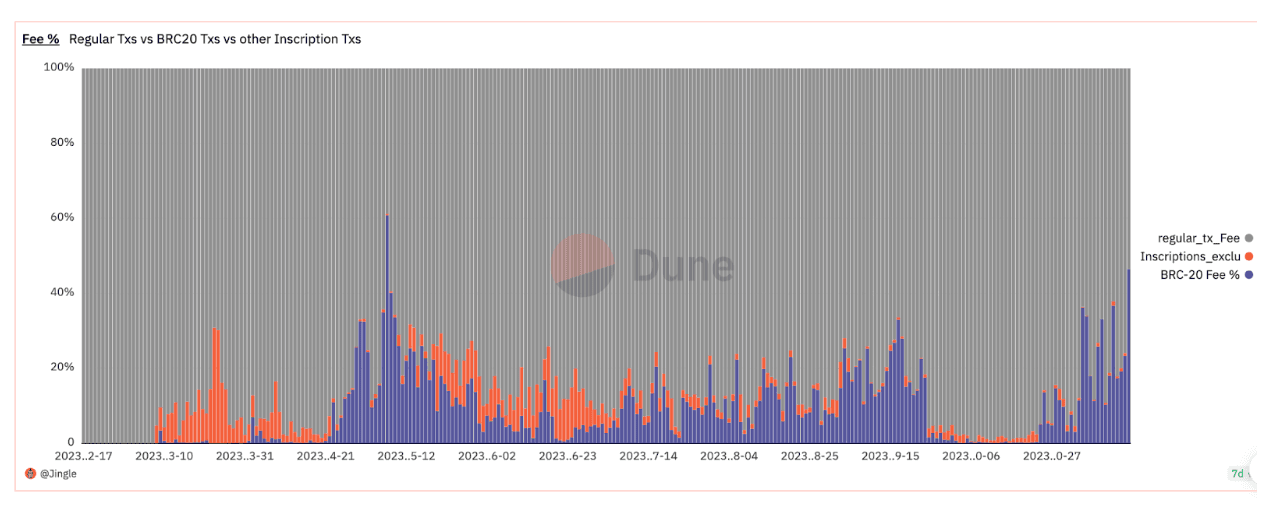
When analyzing total Bitcoin miner revenue across the network, we can clearly see that by May 2023, miner income had reached 70–80% of bull market levels, reflecting a growing trend in on-chain transaction activity. During this process, miners’ revenue models have been significantly impacted. Bitcoin miners earn income from two primary sources: block rewards in newly minted bitcoins and transaction fees. While the rate of new bitcoin issuance is fixed, transaction fees fluctuate with network activity. The root cause of this shift lies in the introduction of the Ordinal protocol, which has increased the number of transactions on the Bitcoin network—especially if digital art and other NFTs become popular asset classes on Bitcoin, driving up transaction fees and indirectly boosting miners’ total income.

Daily Miner Revenue
In this article, we will focus on analyzing key components of the Bitcoin ecosystem, including the Lightning Network, Ordinals, BRC20, Atomicals, ARC20, and bitVM.
Sidechains and Layer 2 Solutions: The Case of the Lightning Network
For a long time, sidechains and Layer 2 solutions were the focal points of the Bitcoin ecosystem and represented key technological innovations addressing Bitcoin’s scalability and efficiency. Notable projects include the Lightning Network, Rootstock (RSK), Stacks, Liquid, MintLayer, and RGB. Among these, the Lightning Network—often regarded as the "orthodox king"—originated from Satoshi Nakamoto’s concept of "payment channels." From 2016 until the explosion of the Ordinals ecosystem, it attracted over half of the Bitcoin ecosystem’s developers and participants. Around 2020, the Lightning Network gained broader recognition across the crypto community through Nostr.
A sidechain is an independent blockchain that runs parallel to the main Bitcoin chain and interacts with it via a specific anchoring mechanism. This design allows users to move assets from the Bitcoin main chain to the sidechain, which can offer faster transaction confirmations, lower fees, and even support complex smart contracts and applications. By offloading many transactions from the main chain, sidechains help alleviate congestion and improve overall network performance.
Layer 2 solutions, such as the well-known Lightning Network, are protocol layers built on top of the Bitcoin main chain. These solutions enable fast and efficient transaction processing through off-chain channels, interacting with the Bitcoin main chain only when opening or closing a channel. They are especially effective for supporting small, high-frequency transactions, greatly expanding Bitcoin’s applicability in daily payments and microtransactions.
However, for a long time, the Lightning Network was limited to small payments and did not support the issuance of other assets. With limited use cases, it was eventually overtaken in popularity by Ordinals. In October 2023, Lightning Labs launched the Taproot Assets protocol on mainnet, enabling the issuance of stablecoins and other assets on Bitcoin and the Lightning Network. As Director of Development Ryan Gentry noted, Taproot Assets will provide developers with “the tools needed to make Bitcoin a multi-asset network, while maintaining Bitcoin’s core values in a scalable way.”
With a Taproot-centric design, Taproot Assets delivers assets on Bitcoin and the Lightning Network in a more private and scalable manner. Assets issued on Taproot Assets can be deposited into Lightning Network channels, where nodes can provide atomic swaps between Bitcoin and Taproot Assets. This enables interoperability between Taproot Assets and the broader Lightning Network, benefiting from its reach and strengthening its network effect.
However, as @blockpunk2077 pointed out, currently “users cannot directly send transactions on the BTC mainnet to self-mint tokens. Instead, a project team address issues (or registers) all tokens at once, then distributes them onto the Lightning Network. Therefore, Taproot Assets tokens are not fairly distributed through open minting; they often require a centralized project team to conduct airdrops, and the team itself can reserve tokens—as seen with the recently issued $trick and $treat.” This centralized characteristic has drawn criticism, falling short of the Bitcoin community’s ideals of decentralization and disintermediation.
Ordinals, BRC20, and the Pandora’s Box They Opened
We will not elaborate extensively on the Ordinal and BRC20 protocols here. As an innovative application, Ordinals introduced a novel data storage method on the Bitcoin blockchain by assigning unique serial numbers to each satoshi and tracking them within transactions, allowing users to embed non-fungible, complex data into Bitcoin transactions. With the emergence of inscriptions enabling NFTs on Bitcoin, development naturally progressed toward fungible tokens. On March 9, an anonymous Crypto Twitter user named @domo posted about a method called BRC-20, which could create a fungible token standard on top of the Ordinals protocol. Essentially, this method involves engraving text onto sats to create fungible tokens. The initial design supports only three operations: deploy, mint, and transfer.
We believe the Ordinal protocol and the derived BRC20 design are exceptionally elegant, solving the long-standing problem of asset issuance on Bitcoin in a simple and efficient way, aligning perfectly with Bitcoin’s design philosophy, thus gaining widespread attention and support from the Bitcoin community. Within the ecosystem, it plays a bridging role—leveraging new features introduced by Bitcoin’s Taproot upgrade, enabling large-scale data storage within single transactions. Through this mechanism, the Ordinals protocol allows direct creation and transfer of digital artworks, collectibles, etc., on the Bitcoin chain, introducing the concept of NFTs (non-fungible tokens) to Bitcoin, differing from NFT implementations on platforms like Ethereum.
The BRC20 standard, derived from the Ordinals protocol, aims to implement a token standard on the Bitcoin blockchain similar to ERC20 on Ethereum. BRC20 seeks to provide a standardized definition and interface for tokens in the Bitcoin ecosystem, enabling developers to create, issue, and manage tokens on Bitcoin—similar to token operations on Ethereum. This means that, in the future, complex token transactions and smart contract operations could be possible on the Bitcoin chain, although this would require advanced programming and data storage techniques. The proposal of the BRC20 standard represents an extension of Bitcoin’s functionality, reflecting the maturation and diversification of the Bitcoin ecosystem. However, realizing such a standard requires broad community support and further technical development.
The innovation of Ordinals mainly lies in this: previously, bitcoins were fungible—interchangeable—with no way to distinguish one satoshi from another on the blockchain. Ordinals changed this by leveraging two updates to the original Bitcoin protocol: Segregated Witness (SegWit) and Taproot. In simple terms, SegWit allows cheaper data to be placed in the witness section of transactions, effectively increasing block size, while Taproot enables advanced scripting within the witness section. Together, these two upgrades are crucial for inscriptions, as they allow more arbitrary data storage within the witness portion of any Bitcoin block.
Overall, the emergence of Ordinals and BRC20 not only ignited the Bitcoin market (changing the source of miner income—see chart below) but also pointed the way forward for subsequent improvement protocols. For example, TRAC, a BRC20 standard deployed by Beny, an active Bitcoin community developer, and CRSD, the first cursed inscription with a total supply of 2.1 million, led to the launch of Tap Protocol—a BRC-20 improvement focused on OrdFi. Tap Protocol is a protocol-level enhancement over BRC-20, issuing TAP and -TAP tokens, and introducing the Pipe protocol, an improved version of Runes.
Miner Revenue Analysis
In September, another anonymous Bitcoin community developer, after refining his ideas, identified certain design flaws in the Ordinal protocol and launched the Atomicals Protocol. From a technical aesthetics standpoint, Atomicals mints and propagates based on BTC’s UTXO model without adding extra burden to the BTC network, aligning more closely with Bitcoin’s technical principles and earning support from some Bitcoin purists. In contrast, the Ordinal protocol has a stronger “experimental” flavor—an organic, spontaneous outcome—and its BRC20 protocol is, in a sense, an unforeseen “derivative product,” even surprising Ordinal’s creator Casey. Thus, the Ordinal ecosystem lacks “planning.” Atomicals, however, benefits from deliberate design and the founder’s foresight, giving its ecosystem a clear roadmap.
Here we offer a brief introduction to the Atomicals Protocol.
The Atomicals Protocol is a simple and flexible protocol for minting, transferring, and updating digital objects (traditionally known as NFTs) on UTXO-based blockchains like Bitcoin. Atomicals considers “NFT” a highly technical term that fails to convey the full range of practical uses, so it opts for the term “digital objects” to highlight the protocol’s diverse potential applications—more intuitive for ordinary users and more developer-friendly.
An atomical (or atom) is a way to organize the creation, transfer, and update of digital objects—it essentially defines a chain of digital ownership governed by simple rules. The protocol is open-source and free for anyone to use. All libraries, frameworks, and services are released under MIT and GPLv3 licenses to ensure no single entity controls the tools or protocol.
Compared to other Bitcoin ecosystem protocols, Atomicals’ main advantage is that it does not require centralized services or intermediaries as trusted indexers. It requires no changes to Bitcoin, nor sidechains or auxiliary layers. It is designed to work in harmony with other emerging protocols (e.g., Nostr, Ordinals). Each protocol has its strengths, and Atomicals digital objects expand the options available to users, creators, and developers.
According to @bro.tree, “The Atomicals Protocol is the first to use a POW process to mine token inscriptions—anyone can personally mine tokens / realms / NFTs using a CPU. This is the most fascinating feature of the protocol.”
In terms of future use cases and real-world applications, Atomicals primarily considers three asset categories and their derivative scenarios: ARC20 (fungible tokens), non-fungible digital objects (NFTs), and realms (digital identities). Relevant application scenarios include: digital collectibles, media, and art; digital identity, authentication, and token-gated content; web hosting and file storage (a Bitcoin-native file system); peer-to-peer exchanges and atomic swaps (natively supported); digital namespace allocation (DAO building and domain revolution); virtual land and property registration; dynamic game objects and states (GameFi); social media profiles, posts, and communities (verifiable SBTs, SocialFi), among others.
Overall, compared to the Ordinal protocol, ARC20 and $ATOM are still very early-stage. They await wallet and market maturity. But due to their technical design and mining mechanisms aligning more closely with Bitcoin, their “orthodoxy” holds higher status—something invaluable in the Bitcoin community. In terms of potential, they may achieve true BTC-native DeFi. From an ecosystem development perspective, the community has seen a few minor surges (see chart below), but not yet experienced large-scale hype, indicating substantial untapped potential.

Atomicals Minting Activity
Additionally, it is worth noting that all tokens under the Atomicals protocol are denominated in native satoshi units and can be split and combined like regular Bitcoin. One token equals one satoshi; one atom equals 1,000 tokens, or 1,000 satoshis of BTC. This may require some adjustment for beginners—if atoms are mistakenly sent as regular BTC transaction fees, they will be burned.
bitVM—The Holy Grail of the Bitcoin Ecosystem?
Within the Bitcoin ecosystem, bitVM, Ordinals, and Atomicals represent different directions of technological innovation and expansion. bitVM aims to provide Bitcoin with advanced programming capabilities and smart contract functionality, broadening its applications and increasing its utility. This approach seeks to introduce greater programmability and flexibility while preserving Bitcoin’s core attributes—security and decentralization.
Simply put, bitVM is a computational model that allows developers to run complex contracts on Bitcoin without changing its fundamental rules. Since its proposal and whitepaper release in October 2023, bitVM has generated widespread interest and anticipation in the Bitcoin community. Developer Super Testnet boldly declared, “This may be the most exciting discovery in the history of Bitcoin scripting.” Abstractly, bitVM works similarly to the Lightning Network and is considered by some in the community as the future of Bitcoin payments, as it also uses off-chain mechanisms to scale Bitcoin transactions.
As mentioned earlier, Bitcoin is the digital gold standard among cryptocurrencies, but lags behind other public chains in handling complex, Turing-complete smart contracts. bitVM addresses this gap. Created by Robin Linus—who also founded ZeroSync, an exciting initiative bringing zero-knowledge proofs to Bitcoin focused on Stark Proofs implementation—bitVM marks a significant step forward.
In one sentence: Under bitVM, computation occurs off-chain, with verification on-chain—similar to the optimistic rollup mechanism on Ethereum.
Similarly, bitVM involves two main actors: the prover and the verifier. The prover initiates the computation or claim, essentially stating, “Here is a program, and this is what I assert it will execute or produce.” The verifier is responsible for validating this claim. This dual-role system creates a check-and-balance mechanism, ensuring accurate and trustworthy results.
bitVM’s innovation lies in how it handles computational workload. Unlike traditional blockchain operations that place heavy computation on-chain, bitVM performs most complex calculations off-chain. This drastically reduces the amount of data stored directly on the Bitcoin blockchain, improving efficiency and lowering costs. This off-chain approach also offers higher speed and flexibility, as developers or users can run complex programs or simulations without overburdening the blockchain.
However, bitVM does employ on-chain verification when necessary—particularly in case of disputes. If a verifier challenges the legitimacy of a prover’s claim, the system refers to Bitcoin’s immutable, decentralized ledger to resolve the issue. This is achieved through so-called “fraud proofs.”
If the prover’s claim is proven false, the verifier can submit a concise fraud proof to the blockchain, exposing the dishonest behavior. This not only resolves the dispute but also maintains the system’s overall integrity. By integrating off-chain computation with on-chain verification, bitVM achieves a balance between computational efficiency and strong security—what we know as Optimistic Rollups. The core idea assumes all transactions are valid (“optimistic”) unless proven otherwise. Only when disputes arise are relevant data and computations published and verified on the main blockchain. This significantly reduces on-chain data volume, freeing space and lowering fees.
In bitVM, Optimistic Rollups are especially useful. Most computation happens off-chain, reducing data stored on the Bitcoin blockchain. When transactions are initiated, bitVM can bundle multiple off-chain transactions into a single on-chain transaction using Optimistic Rollups, further minimizing blockchain footprint.
Moreover, in case of disputes, bitVM’s use of fraud proofs aligns well with the inherent “challenge-response” system of Optimistic Rollups. If a prover makes a false claim, the verifier can quickly expose the dishonesty by providing a succinct fraud proof, which is then reviewed within the Optimistic Rollup framework. If validated, the dishonest party is penalized.
The difference is that while both bitVM and Ethereum’s EVM provide smart contract functionality, their approaches and capabilities differ. Ethereum’s EVM is more general-purpose, supporting multi-party contracts and a wider range of on-chain computational tasks, though this can lead to higher costs and blockchain bloat. In contrast, bitVM focuses on two-party contracts and executes most computation off-chain, minimizing Bitcoin’s on-chain footprint and reducing transaction costs. However, bitVM’s current design limits its applicability in complex multi-party environments—a domain where Ethereum’s EVM excels.
Not everyone believes bitVM deserves attention—some express concerns. As Paradigm researcher Dan noted, the protocol only applies to two-party interactions, making it unsuitable for rollups or other multi-party applications. Moreover, he argues it isn’t particularly novel—for instance, programmer Greg Maxwell proposed a superior protocol (“ZK contingent payments”) long ago to solve the same problem. Nevertheless, it must be acknowledged that if bitVM proves effective, it could have wide-ranging implications for development on Bitcoin. Another criticism is that even though computation is “off-chain,” on-chain verification may still incur significant overhead. However, the bitVM proposal asserts it will not add substantial transaction volume to the network or cause gas fees to spike—as happened during the surge in Ordinals popularity.
Overall, bitVM remains in the conceptual stage. As Linus stated, “The purpose of releasing the whitepaper is to describe the idea in simple terms and spark community interest, but it is not yet a complete solution.”
Conclusion
Compared to other public chain ecosystems, Bitcoin—being the most established and highest-consensus decentralized experiment—has a community deeply committed to orthodoxy and purism. To fairly compare different Bitcoin ecosystem explorations, one must heavily consider community sentiment and the principle of causing no harm to the Bitcoin network.
-
Sidechains and Layer 2 solutions, exemplified by the Lightning Network, represent the longest-standing ecosystem exploration and practice. The Lightning Network alone has attracted over half of Bitcoin’s developers and enjoys unmatched consensus and cohesion within the community. Designed to solve Bitcoin’s scalability issues, it creates payment channels atop the main chain to enable fast, low-cost microtransactions, effectively alleviating network congestion and high fees. However, for a long time, it was limited to small payments and lacked support for other asset issuance. With limited use cases, its popularity was surpassed by Ordinals. Its parent company, Lightning Labs, timely launched the Taproot Assets protocol on mainnet, supporting stablecoin and other asset issuance on Bitcoin and the Lightning Network, offering developers “the tools to make Bitcoin a multi-asset network while maintaining its core values in a scalable way.”
-
Multi-asset issuance protocols represented by the Ordinal protocol are ingeniously designed and highly innovative, solving the long-standing “asset issuance” challenge in a simple and rapid way. In a short time, they captured massive market attention, creating wealth effects and drawing in developers reminiscent of DeFi Summer. Derivative innovations from Ordinals—such as BRC20, Rune, and Atomicals—demonstrate strong technological iteration. Despite criticisms within the Bitcoin community—like “overburdening the mainnet”—we believe asset issuance protocols like Ordinals will remain a market hotspot, serving as transitional or phased innovations in the Bitcoin ecosystem.
-
bitVM and similar virtual machines or smart contract platforms occupy a uniquely important position in the Bitcoin ecosystem. Their emergence reflects the community’s desire for functional expansion and technological innovation, especially in smart contracts and advanced programming, opening new use cases and enhancing Bitcoin’s value. Though still in early development, the long-term integration of smart contract capabilities is crucial for Bitcoin’s competitiveness and evolution, potentially becoming a key driver of innovation and diversification. However, their success will depend on community acceptance, technical feasibility, and alignment with Bitcoin’s core tenets of security and decentralization.
Join TechFlow official community to stay tuned
Telegram:https://t.me/TechFlowDaily
X (Twitter):https://x.com/TechFlowPost
X (Twitter) EN:https://x.com/BlockFlow_News
 Everest Ventures Group (EVG)