Charlie Munger's Final Interview Before His Death: The World Is Full of Deception, and Life Is Getting Harder for Young People
TechFlow Selected TechFlow Selected
Charlie Munger's Final Interview Before His Death: The World Is Full of Deception, and Life Is Getting Harder for Young People
When you realize you have an edge, you should bet big. You must go all in on your best investments!
 Navigating Web3 tides with focused insights
Authors: Bu Shuqing, Ge Jiaming, Wall Street Insights
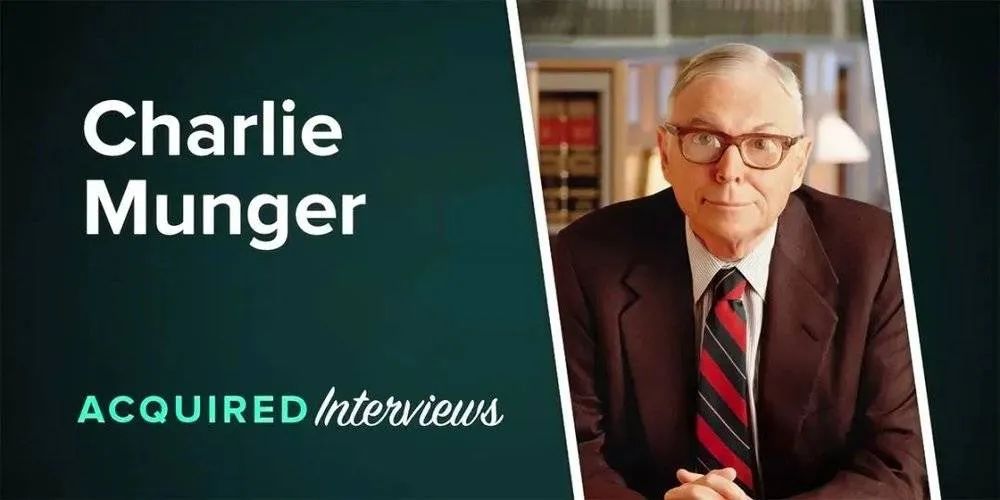
Charlie Munger, Warren Buffett’s legendary partner and Wall Street investing icon, will turn 100 years old next year. Recently, he made a rare appearance on the popular business podcast Acquired to discuss his investment philosophy, experiences, and lessons learned.
During the episode, Munger shared insights into his investment journey with well-known companies such as Costco, Coca-Cola, Apple, BYD, Tesla, and General Motors, offered perspectives on China and Japan's economies and investment landscapes, and revealed his outlook on the future.
Notably, this was the first time in his life that Munger appeared on a podcast. Acquired is known for uncovering untold stories behind tech industry giants and has consistently ranked among the top U.S. podcasts this year.
Below are key takeaways from Munger’s interview compiled by Wall Street Insights:
1. Retail investors merely chase price movements up and down. If I were in charge, I’d tax short-term gains to drive speculators out of the market.
2. Repeated success in venture capital investing is nearly impossible. All deals are hot, requiring quick decisions—meaning most people are just gambling.
3. China’s economic prospects over the next 20 years are better than any other major economy. Its leading companies are stronger, superior, and far cheaper in valuation. Naturally, I’m willing to include some Chinese risk assets in my portfolio.
4. After holding a stock for five years, you may gradually integrate into it or gain deeper understanding. But when you recognize your advantage, you should bet big. You must go all-in on your best investments!
5. If we (Berkshire) had used slightly more leverage throughout, our current leverage would be triple without significantly greater risk—but we don’t want leverage undermining our safety margin.
6. This (Japan) is an obvious investment opportunity. Japan’s interest rates have been just 0.5% annually for a decade. These are deeply rooted legacy firms owning cheap copper mines and rubber plantations—you can borrow money long-term at low rates to buy stocks paying 5% dividends.
7. Opportunities will emerge, but they’re getting harder to find. The chance of finding businesses like See’s Candies or Hermès is extremely low, so I don’t even look. I only seek opportunities I believe are realistically attainable.
8. I love brands like Apple that truly own their identity. Great brands must be bought at appropriate prices—the key is seizing those rare, genuinely cheap bets.
9. Even if a company is poor quality, if its stock is really cheap, I’ll consider holding it temporarily.
10. Wang Chuanfu is passionate, obsessed with hands-on manufacturing—he stays close to the front lines. In other words, Wang Chuanfu is better at manufacturing than Musk.
11. Walmart clings too tightly to existing ideas—that’s everyone’s problem. They can’t accept new things because mental space is already occupied by old ones.
12. I won’t casually give advice to young people—I carefully consider timing and audience. I don’t want to be a spiritual mentor. The world is full of deception and madness; life is becoming harder for youth.
Below is Wall Street Insights’ full translation of the podcast transcript:
Welcome to Acquired, a podcast about great tech companies and the stories behind them. I’m Ben Gilbert. I’m David Rosenthal.
Host: This episode is particularly unique for David and me. Our good friend Andrew Marx arranged dinner with Charlie Munger and a few others at Charlie’s home in Los Angeles. You’ll hear Andrew asking Charlie questions off-mic several times. We’re quite certain this is the only podcast Charlie has ever done.
Charlie, along with his partner Warren Buffett, ranks among history’s most prolific investors. Charlie is now 99 years old and will turn 100 on January 1st next year. Of course, our conversation was fascinating because he’s Charlie Munger—but equally so because of the perspective of someone who’s lived through 99 years of human history.
We discussed Costco with Charlie—his 50-year history investing in retailers—and also heard his views on partnership dynamics, global securities markets, the line between investing and gambling, and today’s investment landscape.
01. Retail Investors Are Just Gambling
Host: Charlie, I watched NFL games last weekend, and now it seems every ad is related to sports betting. Is that good for America?
Munger: No, certainly not. Is horse racing or casinos good for America? Of course not. They’re simply very popular. That’s all.
Host: But Warren has placed bets.
Munger: Well, Warren never gambled heavily—he’s cautious. Remember, Warren isn’t ordinary; he wouldn’t risk one-tenth odds lightly. It’s that simple.
Host: Next topic: retail trading in the stock market. For many Americans, this resembles gambling.
Munger: Exactly why it’s structured that way. Retail investors know nothing about companies or what’s happening—they just chase price movements up and down. If I were in charge, I’d tax short-term profits to drive these speculators out of the market. It benefits every participant.
Host: What do you think about algorithms used by quant funds like Renaissance Technologies?
Munger: Renaissance’s first algorithm was very simple. It scanned historical data—what could they determine?
They found that two consecutive days of rising prices followed by two falling days occur more often than alternating patterns.
They realized this stemmed from “reward psychology”—humans naturally follow trends, especially during short-term wagers. Quant firms use computer programs to automatically buy on the first rise and sell before closing the next day. Repeat daily. Each day, clearinghouses report $8.5 million settled today, maybe $9.43 million tomorrow.
The easiest trades come first—the index fund rebalancing trades. Yes. Year after year, they leveraged returns higher and higher. Thus, their trading volume grew while profit margins shrank, creating massive risks. I’d never do this. Leverage is their only easy path to returns—if you’re rich enough, it drives you crazy.
02. Why Invest in Costco?
Host: I’m curious—how did you first get the idea to invest in Costco (originally Price Club)?
Munger: Rod Hills (one of Munger’s partners) knew Sol Price (founder of Price Club) and understood his business. He told me, “You need to meet him.” So I drove straight to his store and talked with Sol. Of course, Sol was brilliant—a lawyer until age 39, then started a membership discount store targeting government employees.
Host: Was this during the Fedco era?
Munger: He wasn’t with Fedco anymore. In 1975, Germany’s Hugo Mann acquired two-thirds of Fedmart.
Host: Did you invest in Price Club before merging with Costco?
Munger: Yes, I bought shares myself on the open market—no assistance.
Host: How did you eventually meet Jim Sinegal (Costco co-founder)?
Munger: Well, Sinegal wanted Warren on Costco’s board—he sought investors with outstanding financial reputations.
Host: As an independent director?
Munger: Yes. Warren declined and said, “Let Charlie do it.” I accepted shorter flights for board meetings—that’s how it happened.
Host: Did Berkshire ever try to become a shareholder or customer?
Munger: I once suggested Buffett buy Carrefour’s stake when they exited India, but he refused—he dislikes retail.
Host: Just dislikes retail, or any specific objection?
Munger: He fears retail—and rightly so. Gradually, everything strong in retail vanished, partners left. Retail has too much competition—it’s tough. He’s worried.
Host: Didn’t he have a bad experience with Diversified Retailing?
Munger: No—we made a lot of money from Diversified Retailing. We didn’t profit from operating retail itself.
The whole story is simple: Buffett and I bought a small department store chain in Baltimore. A huge mistake—competition was fierce! Right after signing, we realized our awful error. So we decided to reverse course, endure seemingly foolish consequences instead of letting it go bankrupt. During those recessionary years, we kept buying—putting all our money into those stocks—and naturally quadrupled our investment.
Host: But that led to Blue Chip (from late 1960s to early 1970s, Munger, Gelain, and Buffett gradually acquired controlling stakes in Blue Chip Stamps, a small company issuing retailer coupons collected by consumers for redemption).
Munger: We should do something unknown to others. Yes—we spent about $20 million acquiring a small savings and loan company. When we exited, we took back over $2 billion in securities from that “small investment,” forming part of Nebraska insurance subsidiaries’ initial capital base. That’s the perfect starting point everyone needs.
Host: On our Costco episode, we began with a joke from a Berkshire meeting about ten years ago—Warren joked about you being on a hijacked plane where the hijacker grants your final wish, and you say you want to give a speech.
Munger: That reminds me.
Host: Buffett’s reply was essentially “shoot me.” We hope you can tell us about Costco’s strengths?
Munger: You rarely know in life when you’re right and confident actions will succeed. Maybe only five or six times in a lifetime, perhaps trying two or three earlier. Many go bankrupt thinking it’s easy—when it’s actually difficult and rare.
Host: What made you realize Costco was one of those rare moments?
Munger: Their prices were lower than anywhere else in America, and they operated large, efficient stores. Costco offers ample parking—every spot ten feet wide—as special perks rewarded via points; suppliers wait for payment until Costco receives customer funds.
You have a business as big as Costco relentlessly executing “extreme value” strategy, plus generous parking—can you afford to miss it?
The company maintains an “extreme value” strategy—low prices, high-quality goods, focusing on 3,700 fast-selling SKUs—driving higher unit sales and inventory turnover. High volume and fast turnover further reduce costs and expenses, creating a virtuous cycle. Membership fees constitute primary profits—nearly equal to net income—fueling sustained, high-quality growth.
Host: Have you seen another company succeed using low SKU count and low cost?
Munger: Gelson’s, a small California grocery chain, adopted a similar approach to Costco but operates less efficiently—thus failing to achieve comparable success.
03. Bet Big on Your Best Investments
Host: Looking back at these rare great companies—should you go all-in? As young investors, what advice would you give David and me?
Munger: After holding a stock five years, you may slowly integrate into it or deepen understanding. But when you recognize your edge, bet big. You know you’re right—but business schools don’t teach this. It’s unbelievable. You must go all-in on your best investments!
Host: How do you cultivate such conviction?
Munger: Through relentless work and exploration—you recognize it via extensive reading and thinking.
Host: You and Warren have worked together harmoniously for half a century—has anything changed?
Munger: In our early collaboration, many things were uncertain—nothing easily yielded clear answers.
Host: How do you maintain harmony?
Munger: We’re very similar—we both want family safety, want to serve investors well, etc. We share similar attitudes.
04. Berkshire Should Use More Leverage
Host: Over decades, have your views changed?
Munger: No. Warren still prioritizes safety—cares deeply about Berkshire shareholders above all. If we’d consistently used slightly more leverage, our current leverage would be triple without substantially greater risk. We just don’t want leverage compromising our defensive position.
Host: Berkshire’s leverage consists entirely of non-callable funds—“sticky money.” Suppose you launch a new store—of course you’d use leverage. Without capital, who wouldn’t want a no-inventory business? Owe suppliers heavily on day one while quickly selling goods. What’s your view?
Munger: Such situations eventually reverse.
Host: Your thoughts on debt?
Munger: Now, many manufacturers force suppliers to bear all inventory costs. By partnering with suppliers, they shift inventory burdens onto them.
Host: Returning to partnerships—David and I have collaborated on this podcast for ten years. Of course, different from investing, but still a joint endeavor. After 50 years with Warren, what advice do you have for lasting partnerships?
Munger: Liking each other and enjoying working together helps. But I don’t follow formulas. Many enduring partnerships last because one excels at one thing, the other at another. Natural division of labor—each enjoys their role.
Take Costco’s Jeffrey Brotman and James Sinegal—Brotman was brilliant but not a retailer. When all board members voted for Brotman as chairman and CEO, Sinegal objected. A very unpleasant board meeting, major internal conflict—eventually Brotman relented.
Host: Did this happen after you joined the board?
Munger: Before.
Host: Do you think living in different cities helped sustain your partnership with Warren?
Munger: Might’ve helped me. But Buffett maintains tight relationships with everyone—eats lunch weekly at Berkshire HQ. Younger, Warren and I spent lots of time together—fewer distractions then. As we aged, more responsibilities piled up—life changes. Different from youth.
Investment success is extremely hard—in venture capital, repeated wins are nearly impossible.
05. VC Industry Performs Poorly Overall
Host: What’s your view on venture capital?
Munger: Some projects get extremely hot—you must decide fast. Everyone’s just gambling.
Host: Do you think VC fulfills its social role?
Munger: No. I think the VC industry overall performs poorly.
Additional comments by Charlie Munger on VC weren’t recorded, but the topic shifted to Bitcoin.
Host: On Bitcoin—you’ve commented extensively. I’m curious about this angle: Is Bitcoin, as an independent store of value unlinked to nations, a positive development?
Munger: Globally, having a widely accepted currency is beneficial. Historically, the British pound dominated international investment, then gradually shifted to the dollar—still dominant today. Countries like China hold vast dollar reserves from purchasing U.S. goods and services, while America autonomously issues dollars.
Host: What about ordinary people unable to access dollars?
Munger: When people have sufficient funds, they can always obtain dollars. Dollars are easily exchangeable—accessible wherever you are.
Host: Returning to VC’s societal role—if you could design a perfect national funding system, how would you do it?
Munger: Done well, VC is a legitimate business. To empower the right people and nurture them, you help. You understand the game—so you assist their business without excessive interference. Otherwise, they’ll hate you. Overall, after interacting with many VCs, entrepreneurs often deeply dislike them.
They don’t see VCs as partners—not helping them—but caring only about themselves. Hence, they dislike VCs.
Host: Are there alternative approaches?
Munger: Berkshire isn’t like that. Berkshire doesn’t rush to invest just because others raise prices. If a business faces problems we can’t solve, we might sell. If it’s halfway decent, Berkshire usually holds. This builds reputation and sustains long-term relationships.
Host: Is the buy-and-hold strategy key to aligning investor and asset manager interests and goals?
Munger: Most handle affairs conventionally—lawyers use standard documents. In specific investment environments, most achieve similar results. You shouldn’t profit by deceiving investors. Many VCs use unethical or exploitative methods. The world abounds with private equity funds launched by Goldman-like partners raising billions, charging investors 2% management fees plus extras. This generates handsome returns—for managers—but investors gain little.
Host: Do you think this stems from fund fee structures?
Munger: Unless you deliver extraordinary results, you shouldn’t charge extra fees. Pretending to achieve stellar performance is easier than actually doing so—thus attracting unsuitable people to VC, viewing it as a means to rich rewards rather than genuine investment success. Those earning most from VC resemble investment bankers deciding which trendy new field to enter.
Host: Then how should large endowments act?
Munger: They’ve begun acting. These endowments say they’re still willing to pay high management fees but will double capital in the next cycle without paying any management fees. This halves fee rates—a shift occurring across America. High fees anger and mislead them, deemed unreasonable.
06. Investing Is Getting Harder
Host: Regarding your earlier VC comments—with abundant capital and fierce competition, today’s environment differs vastly from the “Cigar Butt” (cheap stock) era—are undervalued, worthwhile opportunities still available?
Munger: People will find opportunities—but it’s getting harder. One simplest case: Home Depot decided to mimic Costco’s model directly in furniture. A smart move—Home Depot earned substantial profits.
Host: Who else mimics Costco’s model?
Munger: Another one—Floor & Decor—they copy Costco in flooring sales but keep adding various other categories—might become problematic.
Host: Why couldn’t Walmart compete with Costco?
Munger: They cling too tightly to existing ideas—everyone’s affliction. Unable to accept new things—mental space already filled by old ideas. They formed habits acquiring real estate—even worthless locations—so occupancy costs often zero. And they know how to build large stores—that’s their strategy.
Thus, paying to occupy affluent areas offends them. Costco focuses exclusively on prime neighborhoods where wealthy live—Walmart ignored this for years. A serious mistake.
Host: Did you know Sam Walton, Walmart’s founder?
Munger: Never met him—I know one of his sons. He split Walton Enterprises into six parts—thus never paid much tax.
07. BYD Is a Miracle
Host: Share your thoughts on auto industry and manufacturing.
Munger: It’s very hard now to enter auto industry and earn high profits—nobody knows who’ll ultimately win. Electric vehicles revolutionized the entire sector, requiring massive capital. Sales models changed, plus powerful unions in auto manufacturing. So he doesn’t even follow the industry.
Host: Due to EV disruption, is today’s auto industry more attractive for investment than 50 years ago?
Munger: Perhaps yes—for one or two truly high-quality EV makers. Definitely not for others.
Host: Do you consider BYD one of them?
Munger: BYD is a miracle. That guy (Wang Chuanfu) works 70 hours weekly with sky-high IQ. He does things you can’t—he studies competitors’ car parts and figures out how to manufacture them himself.
Host: You invested in Hyundai—how did that go?
Munger: They’re smart too. I lost some money—but not much. Stubborn, held nearly to breakeven before selling.
08. Japan Is an Obvious Investment Opportunity
Host: On Berkshire’s investment in Japanese trading companies—why is Buffett’s choice in Japan a no-brainer?
Munger: It’s an obvious opportunity. If you’re as smart as Buffett, maybe twice per century you get such ideas. Japan’s interest rates stayed around 0.5% annually for a decade. These are deeply entrenched legacy firms owning cheap copper mines and rubber plantations—you can borrow all needed funds for ten years, buy stocks, and collect 5% dividends.
No need to invest, no need to think—massive cash flow. How often do you find such chances? Lucky to get one or two per century. We can do this—thanks to Berkshire’s credit—but others can’t.
Munger: Reminds me—I recently studied Nike. But I don’t like fashion companies. I’d invest in Hermès, but otherwise avoid fashion firms.
09. Strong Brands Possess Pricing Power
Host: Your thoughts on LVMH?
Munger: With enough time, patience, and exceptional ability, you might achieve LVMH-like success over a lifetime—or three to four generations. Yet even with all that, matching their success isn’t easy.
Host: What gives Hermès and LVMH—the world’s best brands—their enduring value? What makes them timeless?
Munger: They possess brand loyalty—built over a century.
Discussion turned to comparing Kirkland Signature with Hermès.
Host: Your view on brand value?
Munger: We struggle not to love brands. We once bought See’s Candies for $20 million—one of our earliest acquisitions. Quickly discovered we could raise prices 10% annually—nobody cared. Profits rose without increasing sales volume. Over roughly 40 years, we raised prices 10% yearly. A remarkably satisfying company.
Zero need for new capital—that’s the benefit. Pre- and post-acquisition, fundamentals unchanged—still two main kitchens and leased shops. After Charlie See’s eldest son Laurence See died, the See family urgently needed liquidity for hefty estate taxes—prompting sale desire. When we bought See’s Candies in 1972, pre-tax earnings were merely $4 million.
Host: So the buying opportunity arose solely because the See family needed liquidity for estate taxes?
Munger: We knew because Charlie See met Robert Flaherty—an investment advisor to Blue Chip Stamps—on a cruise to Hawaii. We paid Robert a finder’s fee, though never again since.
Host: Your thoughts on pricing power determined by brands in categories like See’s Candies or Hermès?
Munger: I think chances of buying such companies are extremely low—so I don’t even search. I only believe in and pursue opportunities I deem realistically possible.
Host: Thoughts on well-known brands in other categories—packaged foods, etc.?
Munger: Many professional investors buy only famous brand stocks and nothing else. They typically start with Nestlé, then fill gaps. They may slightly outperform averages—but won’t achieve spectacular success.
Host: Why does Heinz have pricing power but Kraft doesn’t?
Munger: Interesting. Certain category brands matter greatly to consumers—like Heinz ketchup. People may switch brands due to specific taste preferences, willing to pay more. So we can raise Heinz ketchup prices. But for products like Kraft cheese, people care less about brand—raising prices risks market backlash, including end consumers (housewives).
Host: Because sauce offers hard-to-replicate unique flavors—creating commercial opportunity—thus delivering pricing rewards.
Munger: Yes. People grow accustomed and attached. Happened in Korea—where a Chinese person captured 95% market share of every major sauce.
Host: Same with Coca-Cola?
Munger: Yes, of course.
10. Three Traits of Successful People
Host: At 99, what do you believe that 70-year-old-you wouldn’t agree with?
Munger: At 70, I knew investing was hard—but now I grasp just how hard. But some high-fee, high-carry managers claim it’s easy and begin self-deceiving. Investing is extremely difficult.
Host: If you were 30–40 again, would you still choose investing?
Munger: Probably yes—it suits my nature. But I dislike high-fee, high-carry models—prefer investing personal capital. I believe this is better—offers greater freedom. Avoid forced interactions with investment banks, advisors, VCs—don’t need others. One purpose of wealth is independence from others.
Host: If you and Buffett were both 30 today, starting together—would you recreate a company like today’s Berkshire?
Munger: No, we wouldn’t. Nearly all exceptional achievers possess three traits: extremely intelligent, extremely hardworking, extremely lucky. Starting early and persistently trying long enough, you might acquire one or two.
Host: If restarting today, would insurance still be your choice?
Munger: Depends on personality. Insurance suits certain temperaments—requires immense patience and time for returns. Long battles against competitors—hard to profit.
Host: I recall your view—once wealthy enough to self-insure, you should minimize insurance purchases.
Munger: Think of people causing trouble from excessive drinking then filing huge claims—why pay your share to cover losses from others’ reckless behavior?
Host: Do you carry insurance now?
Munger: No fire insurance.
Host: Auto insurance?
Munger: Must have it—to stay legal.
11. Tech Giants Are the Biggest Winners
Host: Everyone focuses on technology now. Curious—though not tech-trained yourself—how did you feel about investing in Apple? What gave you such confidence?
Munger: Every investor needs significant exposure to about 12 companies to outperform peers. Need to go big on at least two or three to enhance performance. With that mindset, Apple is a rational choice—not hard to see.
Host: Listing targets isn’t hard—FAANG, meme stocks, Microsoft, Apple, Google, Facebook (now Meta). But choosing one and deploying hundreds of billions—creating trillions in value—that’s incredibly hard for me. How did you do it?
Munger: We couldn’t find other worthy stocks.
Host: Valuation?
Munger: Yes—we bought cheap, gained roughly 10x returns.
Host: Possibly first bought around 2015. This concept fascinates me—if you examine distressed debt, I believe Warren noted in last year’s Berkshire letter, these were excellent decisions. Or look at venture capital—it follows classic power law distribution. Any single asset’s performance traces back to a few superb decisions spanning an entire career.
Munger: Exactly.
Join TechFlow official community to stay tuned
Telegram:https://t.me/TechFlowDaily
X (Twitter):https://x.com/TechFlowPost
X (Twitter) EN:https://x.com/BlockFlow_News