Dovey Wan: The bear market’s “dead silence” has yet to arrive; 2026 will be a golden year for volatility-harvesting traders.
TechFlow Selected TechFlow Selected
Dovey Wan: The bear market’s “dead silence” has yet to arrive; 2026 will be a golden year for volatility-harvesting traders.
Primitive Ventures Founder on AI Restructuring Liquidity, White-Collar Workers’ Five-Year Unemployment, and Geopolitical Competition with TSMC.
 Navigating Web3 tides with focused insights
Host: Mr. Z (@168MrZ)
Guest: Dovey Wan (@DoveyWan)
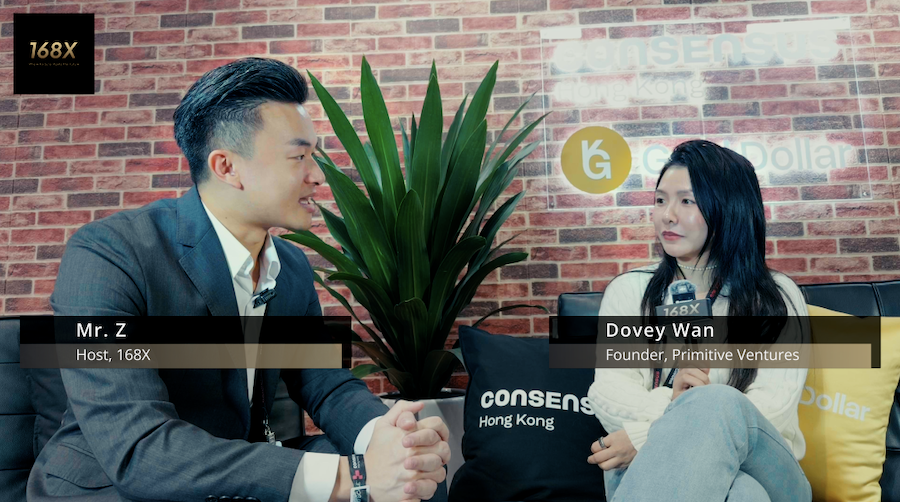
“Bitcoin can no longer keep up with ARKK—AI is siphoning global liquidity, and the crypto market hasn’t even reached true dead silence yet.” In an exclusive interview on the East-West capital dialogue program 168X, Dovey Wan, founder of Primitive Ventures, delivered a deep analysis—drawing on her years of hands-on experience bridging U.S. and Chinese tech and capital ecosystems—of AI’s disruption of global liquidity flows, the existential crisis facing white-collar workers, and the philosophy of “emotional resilience” as a survival strategy in the crypto bear market.
Dovey Wan, a technologist by training, holds a Master’s degree in Information Systems from Carnegie Mellon University. She previously served as Managing Director at DHVC (Danhua Capital), leading early-stage investments in dozens of blockchain infrastructure projects including Dfinity, Cosmos, and StarkWare. In 2018, she founded Primitive Ventures, a permanent capital fund fully backed by her own resources—no external LPs—and dedicated to backing crypto-native innovators. Even during the deepest winter of the crypto bear market, Primitive Ventures funded independent Bitcoin Core developers. Today, its portfolio spans over 50 projects across frontier domains including DeFi, zero-knowledge proofs, Bitcoin Layer 2s, and AI infrastructure.
This article summarizes key insights from 168X (@168X_Fortune)—a premier dialogue platform that deeply connects Eastern wisdom with Western innovation, focusing on AI, blockchain, robotics, space technology, and bioengineering to explore how technology, capital, and humanistic intelligence will reshape the future of civilization. The show is hosted by ex-banker Mr. Z.
The Great Liquidity Split: When Bitcoin Can No Longer Keep Up With ARKK
“Back in 2024, I repeatedly tweeted that crypto’s own liquidity supply chain had undergone profound structural changes,” Dovey began bluntly.
She used the relationship between Bitcoin and the ARKK (ARK Innovation ETF) as an illustrative example:
Prior to the GPT moment, ARKK and Bitcoin moved in near-perfect lockstep—both were fundamentally liquidity-driven assets, characterized by “valuation expansion without value expansion.”
But after the GPT moment, AI growth stocks began generating real earnings and cash flow. Following the DeepSeek moment, their valuation logic became increasingly clear.
By mid-2025, a critical divergence emerged: Bitcoin could no longer keep up with ARKK’s gains. This signals a rotation of liquidity—from purely valuation-expansion assets toward AI growth stocks priced on real cash flows.
Dovey noted that for this reason, Primitive Ventures began tracking AI core supply chain companies like TSMC and SK Hynix very early on.
She also observed a telling trend: U.S. equities are becoming “crypto-ized.”
Driven by retail participants and high-leverage traders, exhibiting extreme volatility—the recent flash crashes in silver and gold displayed characteristics eerily reminiscent of crypto markets. “Many models historically used by institutions are now largely obsolete,” she stated candidly. “The profile of traders themselves is also changing.”
Beneath this lies a deeper driver: white-collar professionals displaced by AI are collectively flooding into trading markets.
White-Collar Workers Are the Horses Pulling the Carriage: A Five-Year Countdown to the AI Apocalypse
Dovey shared a startling statistic: In the first half of 2025, New York City added only 1,000 new jobs.
“Finance bros are unemployed,” she said bluntly. “Junior lawyers are unemployed too. So what do they do? They possess financial literacy, access to various financial tools, and domain expertise—so they’ve essentially all become basement traders.”
This trend echoes her earlier writings during the GameStop episode—when financial populism converges with cultural currents, the composition of market participants undergoes fundamental change.
Dovey predicts AI will evolve into a new ideology. She has personally witnessed friends’ three-year-old children, barely able to speak, already chatting daily with AI—because their parents simply cannot satisfy their boundless curiosity.
“The world ahead will become very strange—but many people aren’t prepared for it.”
Yet what truly concerns Dovey is a deeper structural rupture.
Traditional economic models assume employment grows alongside rapid economic expansion—a premise underpinning the Federal Reserve’s dual mandate of “maximum employment and price stability.”
But AI may soon break this equation, ushering humanity into a world defined by “hyper-growth coexisting with hyper-unemployment.”
“People always compare AI to the steam engine replacing textile factory workers,” Dovey said. “But I think it’s not textile workers—it’s the horses pulling carriages. When cheaper horsepower becomes available, capital will naturally choose the lower-cost option.”
Her forecast is highly specific: Within five years, major Silicon Valley firms will no longer need engineers specialized in narrow functions; accountants, Big Four auditors, and large swaths of documentation-intensive service roles will likewise be replaced by AI within five years.
Even if these companies delay layoffs due to managerial inertia or social responsibility, once operational cost burdens begin threatening their ecosystem standing, layoffs will become unavoidable. Overall, within roughly ten years, AI productivity will completely reshape society’s operating model.
She offered a vivid illustration: After Musk took over Twitter and executed massive layoffs, Twitter actually improved. Even if Google cut one-third of its engineers, she believes it would still function just fine.
“For every individual, how to maintain resistance—and immunity—to AI is the most critical challenge of the next decade,” Dovey concluded.
TSMC’s Geopolitical Balancing Act: How a ‘Stunning Beauty’ Navigates Between Two Powerful Suitors
Another thought-provoking topic in the interview was Dovey’s deep geopolitical analysis of TSMC. Primitive Ventures not only holds TSMC stock but has spent two to three years conducting systematic research on the company.
“We love TSMC—not only because it’s a monopoly in wafer fabrication, but also because its founder, Morris Chang, possesses extraordinary wisdom and has laid out an excellent succession plan,” Dovey said. She even traveled to Taiwan specifically to purchase the second volume of Chang’s autobiography, believing it contains rich insights on leadership continuity.
She outlined TSMC’s core paradox: If its Arizona fab rapidly advances to 3nm, TSMC risks being “undermined from beneath”—the U.S. could leverage TSMC as its biggest bargaining chip against China, and once domestic U.S. capacity matures, TSMC’s strategic value as Taiwan’s “national guardian mountain” would sharply diminish.
Hence, TSMC chose to upgrade its collaboration with Japan—from 6nm to 3nm. This is an exceptionally sophisticated strategic move. On one hand, it prevents the U.S. from undermining TSMC; on the other, U.S. progress is inherently slow due to professional ethics and bureaucratic constraints. For both public and private reasons, TSMC needs to secure an alternative pathway.
Dovey captured Taiwan’s predicament with a vivid metaphor: “Taiwan is like a stunning beauty caught between two powerful suitors vying for her affection.” She believes that while the two suitors compete, this “beauty” should aggressively strengthen her own fundamentals—launching her own ventures using the knowledge and insight gained from her suitors—so that even when the suitors eventually stop competing over her, she’ll still thrive.
She extends this logic to a broader framework: Historically, Taiwan relied on military defense, but today AI and computing power are emerging as a new form of national defense asset.
NVIDIA’s decision to locate its overseas headquarters in Taipei, the quasi-father-son professional mentorship between Jensen Huang and Morris Chang, and newly appointed Japanese Prime Minister Sanae Takaichi’s push for manufacturing repatriation—all these moves are reshaping the geopolitical power structure of the global semiconductor supply chain.
Dead Silence Hasn’t Arrived Yet: SpaceX’s Bloodletting, Emotional Resilience, and Bear-Market Survival Rules
When discussing market outlook, Dovey’s famously incisive essay “Who’s Paying for the Bull Market?” was brought up by host Mr. Z. Facing current pessimism in crypto markets, her assessment remained calm and razor-sharp.
“Sentiment will surely sink further, and prices will fall further. A true bear market should feel extremely quiet—there should be a sense of dead silence,” she said. “But right now, there’s fresh drama every day, constant infighting. We’re nowhere near dead silence yet.”
She highlighted a major 2026 liquidity risk event: SpaceX’s IPO. Reports indicate SpaceX plans to go public around mid-2026 at an estimated $1.5 trillion valuation, potentially raising up to $50 billion—the largest IPO in human history, if realized.
“Just the IPO alone requires $1.5 trillion,” Dovey analyzed. SpaceX’s investors have held positions for a long time and need to realize gains; combined with its complex equity structure following the merger with xAI, this will constitute a ‘massive retail bloodletting event’ spanning both private and public markets, delivering a huge liquidity shock to the entire risk-asset ecosystem.
She also observed growing market caution: Even strong earnings reports trigger profit-taking; trillion-dollar giants like Microsoft can swing ±15%—“like meme stocks.”
Extreme volatility is transforming market ecology. 2026 will not be an easy year.
For different types of traders, Dovey offered starkly divergent advice:
If you’re a volatility-harvesting trader, 2026 will be a ‘golden year’—quant firms like QRT and HRT are raking in record profits. But if you’re a directional, discretionary trader, extra caution is warranted.
As a long-term allocator like Primitive Ventures, she opts for “emotional resilience”: maintaining ample cash reserves, remaining relatively insensitive to short-term fluctuations, and patiently waiting until true dead silence arrives.
About Primitive Ventures
Primitive Ventures is a crypto venture capital firm led by Dovey Wan, operating entirely on proprietary capital with no external LPs, investing in crypto-native innovators with 100% alignment of interests. Its portfolio spans frontier domains including DeFi, zero-knowledge proofs, Bitcoin Layer 2s, and AI infrastructure.
About 168X
168X is a premier dialogue platform that deeply connects Eastern wisdom with Western innovation, exploring how technology, capital, and humanistic intelligence will reshape the future of civilization. Focusing on AI, blockchain, robotics, space technology, and bioengineering, it engages global leaders and thought architects in conversations that reveal, through a uniquely dual Eastern-Western lens, the core drivers of future wealth and innovation. Hosted by ex-banker Mr. Z.
X | YouTube | Apple Podcasts | Substack
Join TechFlow official community to stay tuned
Telegram:https://t.me/TechFlowDaily
X (Twitter):https://x.com/TechFlowPost
X (Twitter) EN:https://x.com/BlockFlow_News
 @168X_Fortune