








Interview with HTX Marketing Center Head: Product + Brand—HTX Unveils Major Moves in 2026
TechFlow Selected TechFlow Selected
Interview with HTX Marketing Center Head: Product + Brand—HTX Unveils Major Moves in 2026
Follow Molly’s narrative to explore her unique Chinese management philosophy and branding methodology, and gain deeper insight into HTX’s global ambitions for 2026.
 Navigating Web3 tides with focused insights
Author: TechFlow
“In 2026, HTX will go all out—I’ve prepared some major moves.”
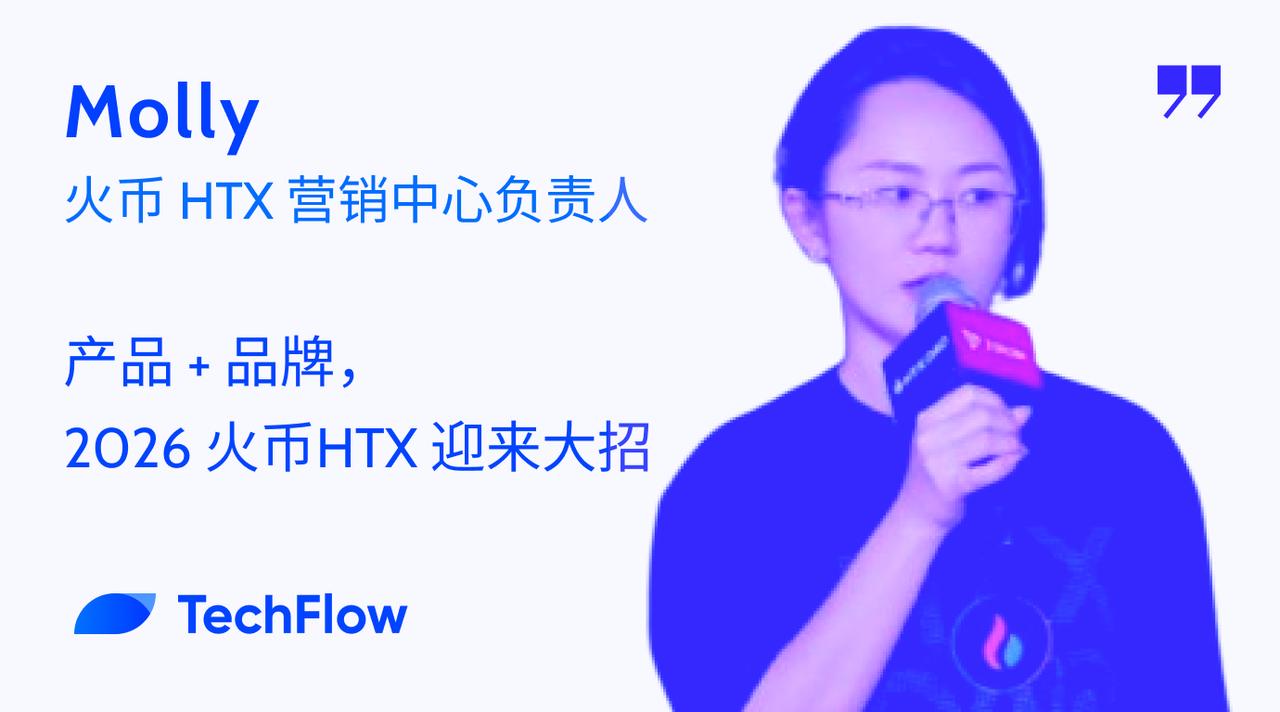
At HTX’s year-end conference before the Lunar New Year, Sun Yuchen—HTX’s leader—shared his strategic outlook for 2026. Beside him stood Molly, Head of HTX’s Marketing Center—the person entrusted with executing and communicating those “major moves” effectively.
Motivated by curiosity about these “major moves,” and as HTX’s Marketing Center enters its third year, we sat down with Molly for an in-depth conversation to explore how this veteran exchange is rethinking strategy and charting action paths for the new cycle.
“2026 will absolutely be a year of breakthrough progress for HTX across both brand and product dimensions.”
This was Molly’s most resolute statement during our interview. In fact, this rationality and composure permeated the entire conversation—a rare quality in today’s crypto marketing world, where traffic anxiety reigns supreme.
Exchange marketing is intensely competitive—and increasingly obsessed with “traffic.” When asked about traffic anxiety, Molly responded:
Blindly chasing traffic can backfire; we must maintain deep thinking amid the noise.
In practice, Molly says she’s willing to invest time in activities that appear less directly tied to traffic: refining product experience, embodying “users first,” resolving user issues one by one, and refusing to make excuses during every public relations incident. As Molly sees it, brand and marketing are:
During the early, zero-to-one phase of HTX’s Marketing Center, I truly experienced confusion and chaos. But the more incidents I handled, the more convinced I became that honesty, openness, and transparency constitute the best PR. This confidence stems from my firm belief that both Sun Ge and HTX consistently uphold their bottom lines and original intentions—giving me the space to reflect on matters that genuinely advance industry development.
Looking ahead to 2026, Molly still leaves a bit of suspense:
It’s not quite convenient to reveal the “major moves” yet—but whether on the brand or product front, we’re entering an entirely new breakthrough phase.
In this edition, let’s follow Molly’s narrative into her uniquely Chinese management philosophy and brand methodology—and gain deeper insight into HTX’s global ambitions for 2026.
From “Darkest Hour” to “Sudden Clarity”: HTX Gave Me Confidence
TechFlow: Welcome back, Molly! What have you been working on lately?
Molly:
Recently, I’ve been collaborating with colleagues from the marketing department to map out HTX’s full-year brand plan. So right now, I’m primarily focused on two things:
First, breaking down our annual brand goals. My team and I have been holding numerous brainstorming sessions to continuously refine and challenge this year’s brand positioning and objectives. For example, if we want users to perceive HTX as “warm,” how do we define “warmth”? And more concretely—how do we ensure users actually feel it? These questions demand detailed execution strategies.
Second, building and refining our team’s talent capability model. I need to reassess our team structure, evaluate individual capabilities, and determine whether our current team possesses the skills required to achieve this year’s goals. If not, should we develop talent internally—or recruit externally? That’s precisely what I’m pondering now.
All in all, there’s plenty on our plate this year.
TechFlow: February 2026 marks the second anniversary of HTX’s Marketing Center. Over these past two years, you’ve led your team through many tough battles and achieved a series of milestones. Could you share: What were your “darkest hours” over the past two years? And what achievement stands out most?
Molly:
Regarding “darkest hours,” I’d say they stemmed largely from self-imposed challenges at the outset.
Two years ago, I was on a business trip to Egypt—six hours ahead of Beijing time. So when meetings started at 10 a.m. in China, I had to wake up around 3 a.m. local time. During one such drowsy pre-dawn session, the meeting suddenly announced the establishment of the Marketing Center—with me appointed as its head.
For me at that moment, it was an enormous challenge. First, I simultaneously served as HTX DAO Ambassador, official spokesperson for HTX, and head of the Marketing Center. Juggling three roles meant managing teams, executing projects, handling operational tasks—and balancing and allocating responsibilities across all three functions.
Second, during the Marketing Center’s startup phase, I faced what felt like “internal turmoil and external pressure”: as official spokesperson, I bore the brunt of direct user engagement—and negative PR. Meanwhile, our new team needed to build everything from scratch: processes, mechanisms—nothing was standardized, and no one offered clear guidance. That period brought immense psychological pressure—my workdays regularly exceeded 14 hours for half a year.
Yet I’ve always believed: “All beginnings are hard—but once rules and habits are established, everything flows smoothly.” Like learning to ride a bicycle: initially chaotic, but once balance is mastered, control becomes effortless.
After roughly ten months of adjustment, by end-2024, I suddenly felt a “sudden clarity after darkness”: workflows smoothed out, talent matured, and the team began taking on greater responsibility. That marked my emergence from the so-called darkest hour.
As for the “most meaningful achievement,” I’d say it’s simply “this very moment.”
Two years ago, we were lost and scrambling. Today, not only has our team grown—we dare aim higher. We’re also increasingly capable of approaching branding from an industry-wide, international, and global perspective, such as recent collaboration agreements with Tsinghua University and Peking University—not just focusing on exchange operations, but jointly exploring topics like AI–blockchain integration from a broader industry advancement standpoint.
Now I feel like I hold many strong cards—and I’m strategizing how to play them as coordinated combinations to construct a larger vision. That sense of accomplishment is deeply rewarding.
Additionally, our team has expanded significantly—from initial uncertainty to now fully understanding each member’s strengths, assigning tasks appropriately, and watching colleagues grow into independent contributors. That growing sense of control and confidence in the future is among my greatest achievements.
TechFlow: After two years on the front lines, what new insights have you gained about exchange marketing?
Molly:
I’d rather highlight a shift in mindset.
Early on—as marketing head and spokesperson—my instinctive reaction to negative PR was tension and urgency to quell the situation immediately.
Today, I respond more calmly, because my approach has shifted from “searching for techniques” back to “focusing on fundamentals”: clarifying root causes and communicating transparently—in language users understand. With increasing experience, I’ve gradually realized that honesty, openness, and transparency are the best PR. Attempts to conceal or obscure facts often backfire spectacularly—while laying things bare helps users accept reality more readily.
This confidence also springs from HTX’s core values. Since joining HTX, both Sun Ge and the team have conveyed a profoundly positive value system. Looking back over the past two years, none of the PR incidents, FUD, or controversies I’ve handled have ever resulted in reputational damage—on the contrary, the more incidents I resolve, the stronger my confidence grows.
So now, when issues arise, I know they’re unlikely to be serious—because I feel HTX’s unwavering commitment to its bottom line and original mission.
My core insight on exchange marketing is this: As long as we uphold our bottom line—and our intent and core values remain sound—the overall direction won’t stray. We operate with confidence, able to return to fundamentals rather than relying on tactical maneuvering.
Facing Traffic: Let Go of Anxiety, Focus on Delivering Positive Value
TechFlow: Exchange marketing is notoriously competitive—and increasingly “traffic-obsessed.” As head of HTX’s Marketing Center, do you experience “traffic anxiety” amid the dizzying array of exchange marketing tactics?
Molly:
To be honest, I did experience traffic anxiety—but not anymore.
For example, recently Sun Ge posted something about Huizhou. A colleague asked whether we should jump on the trend. My immediate reply was: “Traffic gained this way doesn’t belong to us.” Though I ultimately followed the suggestion and contributed based on personal experience, this small incident reflects my current mindset toward traffic.
I admit, early in my tenure leading the Marketing Center, I was extremely anxious. I wanted every campaign and promotion seen by more people—and craved growing personal influence. To chase traffic, we explored many approaches: heavy ad spending, partnerships with top KOLs—even briefly considering unconventional, attention-grabbing stunts.
So why has that anxiety faded? Three key reflections:
First, traffic is a double-edged sword—blind pursuit invites backlash. Over the past two years, we’ve seen numerous competitors—or individuals—sacrifice ethical grounding for virality, only to suffer severe consequences—becoming slaves to traffic itself. Without rational perspective, traffic’s harm often outweighs its benefits.
Second, traffic peaks aren’t sustainable—what matters is “worthiness.” We can’t stay perpetually hyped, nor expect every campaign or post to go viral—that defies natural law. Worse, pushing low-quality experiences aggressively risks triggering major PR disasters.
So now, I first ask: Is this initiative truly worth broad exposure? If yes, I’ll concentrate all resources behind it. If not, standard promotion suffices. For exchanges, what matters most is ensuring every public appearance delivers positive, valuable information—and that, I believe, is enough.
Third, sometimes “slow is fast”—we must preserve deep thinking amid noise. Constant traffic anxiety breeds restlessness and erodes capacity for reflection. Once freed from that obsession, I can step back as an observer—studying formerly high-traffic individuals or projects over longer timeframes—and see how much fleeting buzz vanishes almost instantly.
That’s why I constantly tell my team: Don’t rush. Invest time in crafting quality products and content. Only once we’ve built something truly valuable do we marshal full momentum to launch it—that’s the more enduring, effective strategy.
TechFlow: Many projects treat “female leaders” as traffic magnets—unintentionally reinforcing stereotypes about “Web3 female executives.” How do you view your role as “Head of HTX’s Marketing Center”? As a Web3 female executive, what image do you hope to project to the industry?
Molly:
I’ve actually reflected deeply on this question—including how I manage my own social media presence. My team and I have agreed on a core principle: I want people to develop goodwill toward Web3 and crypto through me as an individual.
We shouldn’t merely enjoy the spotlight and traffic conferred by titles—we must shoulder the responsibilities they entail. When representing a group or company under the spotlight, audiences define the entire platform, community, or industry through you. So we can’t act impulsively—we must set an example.
Specifically, I break this responsibility into three layers:
First, responsibility toward outsiders—I represent Web3 practitioners. I aim to convey to outsiders that we’re no different from builders in traditional industries: diligent, hardworking, and committed to long-term values.
Second, responsibility toward insiders—I represent HTX’s corporate culture. When interacting with clients, KOLs, or media, my words and actions naturally reflect HTX’s culture. Thus, I must constantly self-regulate and improve—to safeguard the company’s brand image.
Third, responsibility toward the “female leader” label. Society remains curious about female leaders—how we balance family and work, navigate emotion versus logic, address gender equality. We should appreciate the advantages this label brings—but never exploit it. At work, I consciously avoid favoring female employees, because professionalism demands fairness and objectivity—not special treatment based on gender. Through objective, professional conduct, I aim to dismantle stereotypes about women.
In summary, my role carries multiple overlapping labels—each weighted differently depending on the audience. But the core question remains singular: What values do I ultimately wish to communicate? I hope those values are positive—and meaningfully guiding.
Users First: No Excuses—Poor Experience Means Failure
TechFlow: Whether responding in communities or sharing on social media, we frequently hear you emphasize “users first”—and consistently see you actively engaging on the frontlines. Yet this is incredibly difficult—if “users first” isn’t implemented authentically, it becomes empty rhetoric.
So could you share: Why do you prioritize “users first” over “embracing traffic”? Practically speaking, what trade-offs exist between “embracing traffic” and “users first”? And how exactly do you and your team implement “users first”?
Molly:
“Users first” may sound like a marketing tactic—or politically correct jargon—but if deeply understood, it serves as an excellent operational guideline.
I find concrete examples more persuasive than abstract reasoning. The recent USDE wealth management incident perfectly illustrates this.
During the Spring Festival holiday, we launched a USDE wealth management product offering 15% APY. I promoted it on the 19th, and Sun Ge shared it on the 20th urging attention. The next day, however, the product disappeared from the platform—sparking intense user anger. I was equally furious—and immediately confronted the business team.
Upon investigation, the business team argued the issue wasn’t serious because:
First, the product was originally scheduled to end on the 17th—so the 19th launch was already delayed; second, it involved stablecoin yield, and price discrepancies existed across other platforms—posing no real loss to users, merely reduced gains (or even net gains for earlier participants); third, the product wasn’t developed by HTX—the rate changes were controlled by the project team, and termination occurred once budget was exhausted. With hundreds of wealth management products daily, comprehensive notifications weren’t feasible.
Though these points were objectively valid, I firmly countered: “We must consider things more from the user’s perspective.”
First, were announcement channels sufficient? In today’s information-saturated environment, users can’t remember every product’s end date. Sudden delisting without prior notice rarely elicits rational acceptance. Second, if the product wasn’t removed on the 17th as planned, then abruptly pulled on the 22nd, the logic seems inconsistent.
Based on this discussion, we conducted an in-depth review and reflection with the business team. We acknowledged the oversight and compensated affected users with welfare packages. Mechanism-wise, we instituted new rules: All major wealth management adjustments must trigger email notifications, advance internal alerts—and future product-level enhancements to warnings are underway.
I believe this incident exemplifies “users first” well:
We often face situations where “many excuses exist”—yet we choose instead to empathize with users’ perspectives, addressing issues comprehensively from both product and human angles.
When problems arise, we don’t seek excuses—we reflect and adjust from a “users first” lens. Poor user experience—or user losses—means we failed. To me, “users first” isn’t reserved for big decisions—it applies to everything, concretely implemented, or it remains hollow rhetoric.
TechFlow: Through these efforts, what kind of HTX brand image do you hope to cultivate in users’ minds?
Molly:
Simply put, we want users to see us as “honest and reliable.”
Concretely, users should trust that reaching out to us solves problems—and never suspect dishonesty or excuse-making.
Achieving this isn’t easy—but we’ll persist.
A Chinese Management Philosophy: Allowing Space to Grow, Permitting Mistakes
TechFlow: Over two years, under your leadership, HTX’s Marketing Center grew from two people to dozens: During the zero-to-one phase, what criteria guided your hiring? Also, we noticed your recent job-posting tweets—have your hiring standards evolved? Do new positions signal HTX Marketing Center’s next strategic direction?
Molly:
Hiring standards indeed differ across stages.
In the zero-to-one phase, frankly, “anyone would do.” Back then, I hadn’t yet clarified the Marketing Center’s exact function—so criteria were simple: agile thinking, not overly slow-witted.
Today, it’s different—I now segment roles. Currently, I’ve divided the entire marketing system into six functional lines, each with distinct requirements.
For instance, the marketing strategy role serves as the center’s “brain.” My requirements here: no rigid adherence to convention. I don’t need obedient followers—I need critical thinkers with courage to challenge norms, creative ideas, and the ability to rationally assess and execute those ideas.
For the social media matrix role, my top requirement is dedication—even holidays demand consistent updates. Social media interacts most directly with users, whose impressions of team culture and atmosphere come straight from posts. So candidates mustn’t be rigid—they should enjoy chatting with users, possess wit and personality. Given our frequent social media campaigns, prompt prize distribution also demands strong execution.
Though standards vary per role, I hold one universal expectation for all members: no complacency—only genuine drive to deliver results.
I reject passive inertia. Even when others advise me not to take things too seriously, I still strive to accomplish meaningful things—and I don’t want team members thinking, “If I get along well with Molly, I can slack off like a ‘connections hire.’”
I want everyone to have goals and ambition. Goals needn’t be grand—I’ll assign proportionally simpler tasks—but no “just going through the motions” mentality. Conversely, those with ambition, hunger, and real drive will receive abundant opportunities.
Regarding recent job postings: the previous round mainly filled vacancies caused by staff turnover. But now we’re launching another recruitment wave, as I’m developing a broader brand strategy—specifically targeting brand upgrading and globalization, requiring fresh talent. This signals our increased focus on brand communications this year.
TechFlow: How would you describe your management style? Do your team members see you as a “wolfish” leader?
Molly:
I lean toward a relatively gentle management style. Lately, I’ve grown increasingly fond of Chinese culture. Recently, I shared two phrases—I believe they capture Chinese culture’s core values—and align precisely with my team leadership approach.
One is: “Heaven’s movement is ever vigorous; thus the gentleman ceaselessly strives.” The other: “Earth’s condition is receptive devotion; thus the gentleman carries all things with depth of virtue.”
The first means we must embody relentless striving—like heaven’s vigor—courageously exploring and challenging the unknown. In team management, I want everyone to grow continuously here.
Our team has grown rapidly—I’ve been with HTX for five years, and many members have worked alongside me for a long time. I often tell them: “I hope three years from now, you’ll look back with pride—not fear of being left behind.” Every quarter, I hold deep discussions to reset goals and ensure fresh developmental pathways.
The second phrase emphasizes tolerance. Earth is vast and gentle—accommodating everything, granting ample room for growth. In team management, we must allow mistakes to happen.
At work, I frequently point out issues—but never dismiss someone over a single error. I often tell them: “Mistakes are normal—anyone who tries to accomplish things will inevitably err. What truly matters is whether you recognize the problem afterward—and whether you grow from it. Progress proves potential. So I aim to foster an environment where people dare to act, safely make mistakes, and genuinely grow.”
TechFlow: Regarding crypto marketing, Sun Yuchen is widely regarded as a benchmark figure. How do you see Sun Ge? What’s the most valuable lesson you’ve learned from him professionally?
Molly:
I’ve known Sun Ge for over three years—and my perception of him has evolved significantly.
Initially, he seemed incomprehensible—too “abstract,” unwilling to explain himself. Later, working closely with him, I realized he often felt unfairly treated. Eventually, I came to understand: He doesn’t need people to understand him—and people don’t need to understand him. He simply focuses on doing what he believes is right.
Three years of collaboration have strengthened my confidence—knowing he won’t intentionally cause harm, and many negative perceptions stem less from his personal conduct.
For example, last year, Meme tokens drew massive attention. Sun Ge’s 2024 launch of SunPump became a pivotal catalyst enabling Memes to achieve economic closure—and ignite explosive trading activity. So when BSC-chain Memes surged last year, many urged me to convince Sun Ge to leverage his influence and lead the charge.
When I raised it with him, he insisted market forces should drive such trends—not personal influence. Many didn’t understand, yet he offered no explanation—believing timing, conditions, and market dynamics must align, preferring to entrust outcomes to market mechanisms.
That’s the biggest lesson I’ve learned from him: Respect the natural laws governing development—and allow things to unfold organically.
As the saying goes: “Man proposes, Heaven disposes.”
So my current mindset is calmer. I’ll exert maximum effort—but if results fall short, I accept them gracefully, avoiding excessive intervention.
This especially applies to business promotions. Previously, promoting wealth management products or new assets, I’d enlist many promoters—even if the product was solid, I later realized this approach risked irresponsible interference in users’ judgment. Now, I focus on objective presentation—highlighting investment potential without manufacturing FOMO—enabling users to decide within a rational framework.
2026: HTX Enters a New Breakthrough Phase
TechFlow: At HTX’s recent year-end conference, Sun Yuchen revealed: “In 2026, HTX will go all out—I’ve prepared some major moves.”
Could you share what those “major moves” are? And what are your key priorities for 2026 to prepare for them?
Molly:
The “major moves” aren’t quite ready for disclosure yet—but it’s certain that 2026 will be a year of breakthrough progress for HTX across both brand and product dimensions.
On the brand side, we’ll undertake significant initiatives in marketing and traffic generation.
Product enhancement will be our focal point. As I’ve previously mentioned, the R&D team presented a three-year product upgrade and iteration roadmap at the year-end conference.
As summarized at the conference: HTX weathered turbulence in 2022–2023; 2024 was dedicated to strengthening fundamentals; 2025 delivered steady growth; and 2026–2027 will mark our new breakthrough phase.
This holds great significance for me—since product usability is judged most directly by users. At the conference, leadership stated: “If the R&D team needs more people, hire them—even expand by 50%. Just get the product right.” Such substantial investment in personnel and cost signals my strong anticipation for HTX’s overall product upgrades this year.
TechFlow: You’re constantly on the front lines—perhaps sensing market sentiment more acutely. Amid today’s bleak market conditions: How has the crash impacted your work? And do you believe we’re at a “bottom”? How do you view the market trajectory for 2026?
Molly:
First, the crash hasn’t substantially affected me—but it has triggered extensive strategic reflection.
I believe today’s crypto sphere remains stuck in a “narrative era,” lacking genuine real-world applications. Unlike Taobao, WeChat, or Douyin—which permeate daily life and form true economic loops—crypto lacks tangible utility. Endless capital inflow without output is unsustainable. Based on this, I’ve adjusted my team’s resource allocation this year: I’ll assemble a team deeply versed in both content and technology—to pursue meaningful work.
First, we’ll refocus on technical implementation—becoming true Builders. For example, we’ll collaborate with universities and developer ecosystems to explore practical blockchain and AI applications. Success isn’t guaranteed—but as resource holders, we bear responsibility to push forward.
Second, rejecting “junk time”—deepening high-quality content. Many compare current market conditions to basketball’s “junk time”—Twitter flooded with gossip, drama, and arguments yielding little progress, only distracting the industry. I refuse to let my team sink into such inefficient traffic wars—instead, leveraging our resources and expertise to produce substantive, high-caliber content for those genuinely seeking it.
Regarding market direction—honestly, prediction is difficult. Global developments move too quickly now, unlike last year’s U.S. election, which offered clearer contours. But I don’t dwell on “Are we at the bottom?”—I focus instead on “Does this industry have a future?”
My investment logic is simple: I invest in the future—not the present. As long as I believe the industry has a future—and the current price is acceptable—I buy. No need to obsess over 2026 specifics—so long as the direction is right, I’m happy to grow alongside it.
Join TechFlow official community to stay tuned
Telegram:https://t.me/TechFlowDaily
X (Twitter):https://x.com/TechFlowPost
X (Twitter) EN:https://x.com/BlockFlow_News
 深潮TechFlow


