2026 Cryptocurrency Market C2C Trust Reconstruction and User Behavior Insights Report | A $30-Billion Surge and the “Zero Freeze” Oasis: Securing Wealth in Users’ Pockets
TechFlow Selected TechFlow Selected
2026 Cryptocurrency Market C2C Trust Reconstruction and User Behavior Insights Report | A $30-Billion Surge and the “Zero Freeze” Oasis: Securing Wealth in Users’ Pockets
A new C2C paradigm centered on “trust” is taking shape.
 Navigating Web3 tides with focused insights
In the journey toward mainstream adoption of crypto assets, wealth’s ultimate destination is never just a number on a balance sheet—it is the secure, real-world realization of value.
By 2026, the crypto industry is entering a mature phase of “price revaluation,” and the logic governing capital flows is undergoing profound change. From on-chain yield to fiat conversion, the C2C (customer-to-customer) layer has become the critical gateway bridging the virtual and physical worlds. Based on one year of operational data from HTX Select—a curated C2C marketplace—and combined with macro industry trends and authentic user experience, this report unveils, for the first time, a new C2C paradigm fundamentally rebuilt around “trust.”
Macro Contrast: A $31.1 Billion “Liquidity Island” and a Crisis of Trust
According to CoinGecko’s 2025 Annual Crypto Industry Report, 2025 witnessed a highly dramatic “asset misalignment” in the crypto market: although total crypto market capitalization declined by 10.4%, stablecoin market cap surged逆势 by 48.9%, surpassing $31.1 billion and reaching an all-time high.
This stark contrast reveals a sobering industry truth: users are not without profits—they simply dare not exit.
Vast sums of capital remain stranded on-chain as stablecoins, forming isolated “liquidity islands.” At its root lies the collapse of safety in traditional C2C models—specifically, the “cash-out panic” triggered by unreliable fiat on/off-ramps. This “panic” is evident in an HTX C2C user survey conducted by HTX OTC. Drawing on thousands of user feedback items gathered from public social media channels (@HTX_c2c) and daily operations, HTX systematically categorized and analyzed typical pain points across C2C trading scenarios, identifying six core user challenges.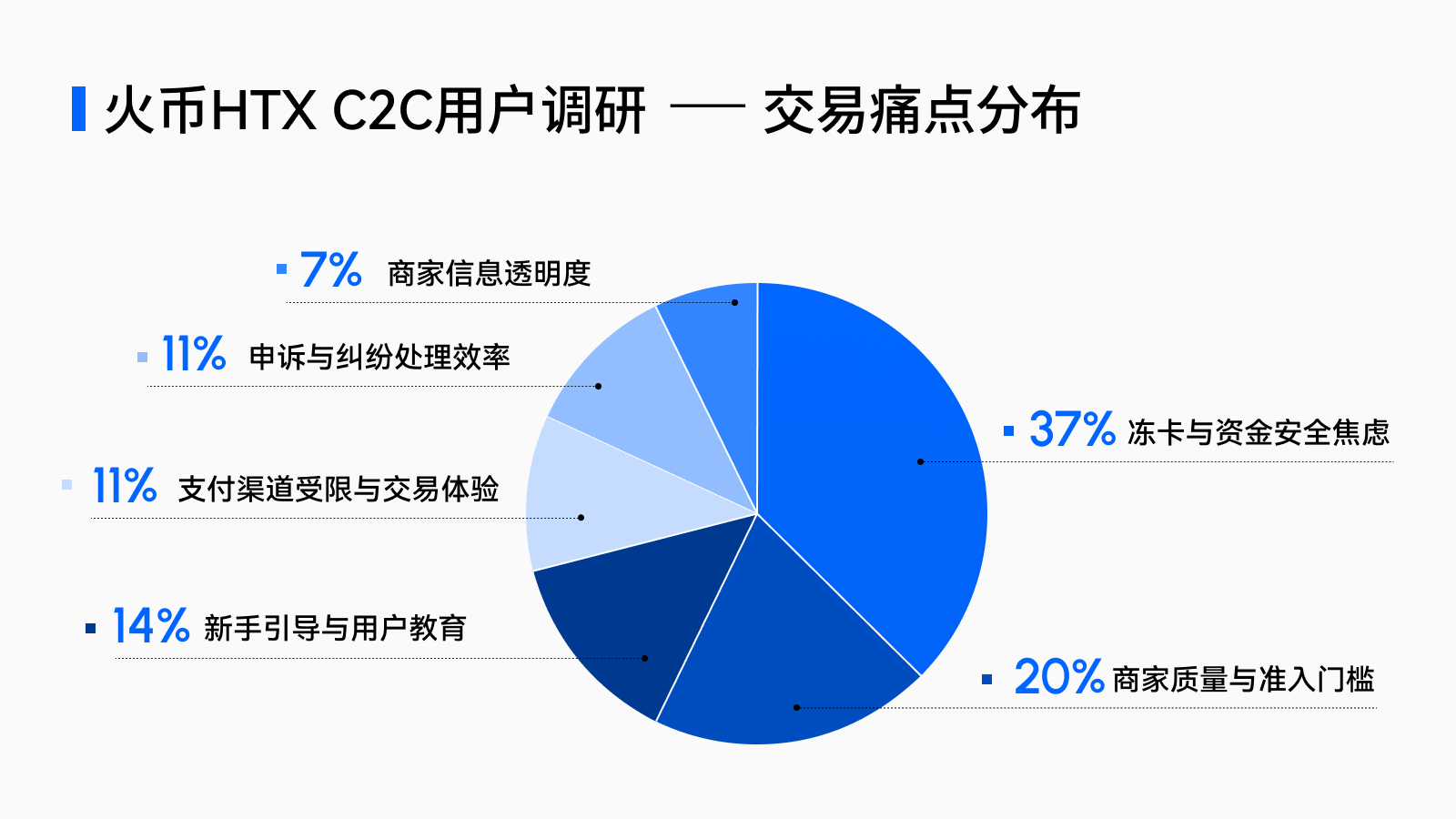
Among the many factors affecting user trading experience, “frozen cards and anxiety over fund security” topped the list at a dominant 37%. This means nearly four in ten traders, when attempting to cross the boundary between digital and physical worlds, worry first—not about price volatility—but about whether their assets will land safely in reality. Additionally, 20% of users struggle with merchant quality and entry barriers; 14% feel lost during onboarding; while payment channel limitations (11%), slow dispute resolution (11%), and lack of merchant transparency (7%) act like hidden reefs scattered across the $31.1 billion liquidity artery.
The conclusion is unequivocal: friction in fiat on/off-ramping has evolved beyond mere “exchange rate slippage” into uncertainty over account status caused by “opaque fund origins.” This crisis of trust directly blocks the flow of hundreds of billions of dollars. The market urgently needs a fiat on/off-ramp “oasis”—one that delivers absolute security and tackles, at its source, the 37% core anxiety.
A Micro Portrait Beneath the Reefs: Folded Trading Truths and Psychological Defenses
When macro data descends into individual lived experience, the stagnation of $31.1 billion in stablecoins ceases to be merely a financial term—it becomes repeated hesitation and fear at the very edge of “exiting.”
The most visceral manifestation of this fear is what the industry jokingly calls “frozen-card PTSD”—a psychological trauma. Consider an ordinary urban white-collar worker who regularly allocates crypto assets alongside a demanding job, seeking dignified asset appreciation. Yet a seemingly routine cash-out request—matched with a counterparty of complex background—instantly freezes all his linked bank cards. This sudden freeze severs not only cash flow but also his connection to everyday life: overdue mortgage reminders, workplace concerns arising from failed payments, and deep-seated fears about personal creditworthiness instantly dilute the joy of wealth growth into raw survival anxiety. In HTX user feedback, that 37% security anxiety stems precisely from such “risk spillover”—passive harm that drives countless defensive users to endure exchange-rate losses in near-obsessive pursuit of a “sanctuary” where funds are absolutely safe.
Meanwhile, on the other end of the market, frequent “swing hunters” suffer in another dimension. As professional traders, their lifeline is efficiency. During volatile markets—where seconds decide profit or loss—they urgently need to deposit funds to buy the dip or withdraw to hedge risk. Reality, however, often delivers: inexplicable payment channel disruptions, evasive low-quality merchants, or risk-control systems applying blanket, delayed “overreactions.” For ordinary users, the 11% payment restrictions and 11% dispute delays mean waiting; for them, it means real monetary “missed-opportunity costs.” These frontline “offensive traders,” active across the industry, do not seek zero risk—but rather crave, with urgency, an oasis offering “deterministic feedback”: one that balances absolute safety with capital turnover, eliminating opportunity cost erosion through inefficient communication.
For “steady whales” who have weathered multiple bull and bear cycles, the C2C market resembles a “dark forest” rife with hidden threats. Large-scale fund movements follow logic entirely distinct from retail participants. They know their transaction size shines like a beacon on the transparent blockchain—making them easy targets for illicit funds. Historically, due to insufficient merchant transparency (7%), these large players could only rely on “probabilistic selection” or past experience when choosing counterparties. Such information asymmetry generates, when facing massive off-ramp demands, a demand akin to private banking: they require not just transactions, but a credit-backed guarantee—capable of isolating risk at its source and, under extreme circumstances, delivering “full compensation” in real money.
This micro-level “real folding” resonates widely on social media. As @Yep_Cooper noted in their in-depth X thread comparing on/off-ramp realities across three major exchanges—“The Truth About Freezes and Compensation Is the Litmus Test for Platform Integrity”—real-life experiences converge on a shared demand: at the precipice of eroded trust, the market urgently needs a deep-trust model that transcends simple order matching—a foundational infrastructure of trust.
A New Industry Paradigm: From “Price Arbitrage” to “Trust Infrastructure”—HTX Select Maintains Zero Frozen Cases Since Launch
Through one year of stable operation, HTX Select has successfully validated a high-standard trust model. Addressing long-standing industry pain points, HTX Select built a three-layer protection system centered on “pre-trade identification + in-trade intervention + post-trade assurance,” shifting C2C trading from pure “price competition” to “service-and-trust competition.”
1. Dynamic Risk Control: From “Post-Event Handling” to “Pre-Event Prevention”
To address the 37% security anxiety, HTX Select continuously upgrades its risk-control system. By training behavioral models covering thousands of anomalous patterns, it enables real-time monitoring during trade communication. Coupled with 7×24 human support, risk events are accurately intercepted before they occur.
2. Rigorous Merchant Screening: Resolving the 20% Quality Concern
HTX Select employs strict merchant admission and evaluation criteria, maintaining an exceptionally high merchant attrition rate. All onboarded merchants must undergo verified fund-chain tracing, with “zero frozen cases since onboarding” serving as a hard, non-negotiable requirement—ensuring clean, healthy fund sources along the entire transaction chain. This “hell-level” merchant screening doubles as credit screening: only merchants with demonstrably clean funding capacity gain access to this “oasis.”
3. Transparent Track Record: Zero Real Freezes and 100% Full Compensation
Over its first anniversary, HTX Select has maintained a record of “zero real frozen cases.” What truly establishes its leadership, however, is the industry-first “100% full-compensation mechanism.” It provides deterministic safety nets for users even in extreme scenarios—not out of mere financial muscle, but from absolute confidence in its proprietary risk-control algorithms and merchant management models. This mechanism elevates the C2C risk floor from “user-borne” to “platform-guaranteed,” completely eliminating users’ lingering concerns.
On this first anniversary, as the sturdiest security bridge within the $31.1 billion ecosystem, HTX Select pledges continued investment in risk-control infrastructure—committed to becoming the most stable safe harbor in the vast crypto ocean, safeguarding every trader’s right to “secure realization.” When “full compensation” becomes an industry standard, and “zero freezes” a trading baseline, true prosperity for crypto markets will finally arrive. The meaning of wealth will ultimately resonate—in every secure realization.
About HTX
Founded in 2013, HTX has evolved over 13 years from a cryptocurrency exchange into a comprehensive blockchain business ecosystem, spanning digital asset trading, financial derivatives, research, investment, incubation, and more.
As a global leader in Web3 infrastructure, HTX pursues strategic pillars of global expansion, ecosystem prosperity, wealth creation, and security compliance—delivering comprehensive, secure, and reliable value and services to cryptocurrency enthusiasts worldwide.
For more information about HTX, please visit https://www.htx.com/ or HTX Square, and follow us on X, Telegram, and Discord. For further inquiries, contact glo-media@htx-inc.com.
Join TechFlow official community to stay tuned
Telegram:https://t.me/TechFlowDaily
X (Twitter):https://x.com/TechFlowPost
X (Twitter) EN:https://x.com/BlockFlow_News
 @HTX_Global