Microsoft’s Stock Price Plunged 25% in Q1—the Worst Performance Since 2008—as AI “Burn Rate Anxiety” Weighs on the Trillion-Dollar Giant’s Valuation
TechFlow Selected TechFlow Selected
Microsoft’s Stock Price Plunged 25% in Q1—the Worst Performance Since 2008—as AI “Burn Rate Anxiety” Weighs on the Trillion-Dollar Giant’s Valuation
Despite the steep decline, Wall Street’s ratings for Microsoft remain heavily concentrated in the “buy” range.
 Navigating Web3 tides with focused insights
Author: 🪽, TechFlow
Microsoft’s stock fell approximately 25% in Q1, marking its worst single-quarter performance since the 2008 global financial crisis—and the steepest decline among the “Magnificent Seven.” Despite a staggering $146 billion in AI capital expenditures, Copilot has failed to achieve scale: its daily active users stand at just 6 million—less than 1/73rd of ChatGPT’s. Meanwhile, the escalating dispute with OpenAI over their exclusivity agreement has further eroded investor confidence. Microsoft’s forward P/E ratio has contracted to roughly 20x—the lowest since 2016—and briefly dipped below the S&P 500 index level.
Microsoft has just endured its most brutal quarter since the 2008 global financial crisis.
According to CNBC’s March 31 report, Microsoft’s share price dropped nearly 25% in Q1 2026—from a year-start high of $481 to around $356. It closed at approximately $365 on March 31, with its 52-week high at $555.45. This decline far exceeded the Nasdaq’s ~7% drop over the same period—and was the worst among the “Magnificent Seven,” while NVIDIA declined only ~4.2%.
As reported by Bloomberg, Microsoft finds itself at the confluence of two disruptive trends roiling the tech sector: massive capital investment in AI infrastructure is yielding no commensurate revenue returns, and investors fear that AI startups—including Anthropic and OpenAI—are developing intelligent agents capable of displacing Microsoft’s own products. Jonathan Cofsky, portfolio manager at Janus Henderson Investors, noted that markets worry customers may bypass Microsoft entirely and go straight to AI vendors—undermining pricing power and margins across Microsoft’s core businesses.
Copilot Adoption Is Disappointing: 6 Million DAUs vs. ChatGPT’s 440 Million
The core issue behind Microsoft’s sharp stock decline lies in the yawning gap between its massive AI investments and actual product adoption.
Per Sensor Tower data cited by CNBC, as of February 2026, Microsoft’s Copilot app had approximately 6 million daily active users (DAUs). By comparison, OpenAI’s ChatGPT had 440 million DAUs; Google Gemini, 82 million; and even Anthropic’s Claude reached 9 million DAUs in March. Within Microsoft’s own commercial ecosystem, only about 3% (~15 million) of its ~450 million Microsoft 365 commercial subscribers have purchased the Copilot add-on service.
A more alarming finding comes from independent research firm Recon Analytics’ survey of over 150,000 U.S. paid AI users: Copilot’s market share slid from 18.8% in July 2025 to 11.5% in January 2026—a 39% contraction over six months. Crucially, the survey revealed that when employees were restricted to using only Copilot, adoption stood at 68%; introducing ChatGPT as an option drove adoption down to 18%; adding Gemini further reduced Copilot’s share to just 8%.
Microsoft clearly recognizes the severity of the problem. On March 17, CEO Satya Nadella announced a comprehensive restructuring of Copilot’s leadership: Jacob Andreou, former Snap executive, was appointed Executive Vice President of Copilot, overseeing both consumer and commercial products; meanwhile, Mustafa Suleyman—who previously led Copilot—was reassigned to focus exclusively on developing “superintelligence” models. In an internal memo, Nadella characterized the move as shifting “from a collection of excellent products to one truly integrated system.”
Yet whether organizational realignment can reverse Copilot’s competitive weakness remains uncertain. On May 1, Microsoft launched its new Microsoft 365 E7 enterprise plan, priced at $99 per user per month—65% higher than the existing E5 tier—and for the first time bundled Copilot directly into its flagship enterprise offering. This marks Microsoft’s first new enterprise-tier pricing layer in a decade.
$14.6 Billion in Capex: Capacity Expansion Can’t Keep Pace With Spending
Microsoft’s scale of spending on AI infrastructure is unsettling markets.
Per Bloomberg-compiled analyst estimates, Microsoft’s fiscal-year 2026 (ending June) capital expenditures—including leases—are projected at $146 billion, up 66% from $88 billion in FY2025. Analysts expect this figure to climb to $170 billion in FY2027 and $191 billion in FY2028. These investments are primarily aimed at expanding Azure’s AI compute capacity and supporting Copilot’s integration across productivity suites.
However, last quarter’s earnings report revealed Azure’s growth rate slowed for the first time in years. Constraints on data center capacity, power supply bottlenecks, and extended equipment delivery timelines continue to limit Azure’s ability to meet demand—a situation persisting into 2026. Investors increasingly question whether such enormous capital outlays will translate into durable revenue growth sufficient to justify Microsoft’s premium valuation over recent years.
Valuation metrics already signal the answer. Per Bloomberg data, Microsoft’s forward P/E ratio has contracted to ~20x—the lowest since June 2016—and briefly fell below the S&P 500’s valuation multiple—the first such occurrence since 2015. Its stock price deviation from its 200-day moving average is now the largest since 2009. Overall, its valuation has been reset to pre-ChatGPT levels—prior to the AI boom ignited in late 2022.
OpenAI Rift Deepens: $50 Billion Amazon Deal Sparks Legal Tensions
Another major pressure point stems from Microsoft’s deteriorating relationship with OpenAI.
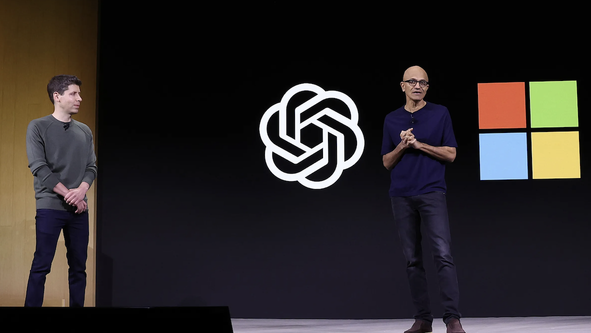
According to the Financial Times’ March 18 report, Microsoft is considering legal action against both OpenAI and Amazon. The crux of the dispute is Amazon’s ~$50 billion cloud computing agreement with OpenAI—which designates AWS as the “exclusive third-party cloud distribution provider” for OpenAI’s enterprise platform Frontier. Microsoft contends this violates its exclusivity clause with OpenAI covering Azure.
OpenAI and Amazon counter that Frontier employs a “stateful runtime environment,” which falls outside the scope of Microsoft’s exclusivity rights covering “stateless API calls”—and therefore does not constitute a breach. A source familiar with Microsoft’s position told the Financial Times: “If they breach, we’ll sue. If Amazon and OpenAI want to bet on their lawyers’ creativity, I think the odds are in our favor.”
The dispute has not yet escalated to formal litigation, and negotiations remain ongoing. Yet Microsoft has already begun implementing hedges: the Copilot Cowork feature launched on March 9 runs on Anthropic’s Claude model—not OpenAI’s. Microsoft is also accelerating development of its in-house MAI series foundation models and expanding its Maia 200 AI accelerator chips and Fairwater data center network—to systematically reduce reliance on any single AI vendor.
Wall Street Divided: “Buy” Ratings Abound—but Consensus Is Cracking
Despite the steep decline, Wall Street ratings for Microsoft remain overwhelmingly clustered in the “buy” range. Per Bloomberg data, among the 67 analysts covering Microsoft, 63 issue “buy” recommendations, three “hold,” and one “sell.” Their average 12-month target price stands at $592—implying upside potential exceeding 64%, the highest level Bloomberg has recorded since it began tracking such data in 2009.
Yet cracks are appearing beneath the consensus. UBS cut its Microsoft target price from $600 to $510, stating Copilot’s narrative “needs improvement” to drive a re-rating. Melius Research analyst Ben Reitzes warned that Azure’s upside is limited and bluntly stated Microsoft needs to “fix Copilot.” More optimistic is Bank of America analyst Tal Liani, who recently resumed coverage of Microsoft with a “buy” rating, citing the company’s “enduring multi-year growth” in cloud and AI.
Jake Seltz, portfolio manager at Allspring Global Investments, believes Microsoft stock offers “high long-term value,” asserting its AI strategy will ultimately be validated—and that current panic creates opportunity.
Microsoft’s next quarterly earnings report is scheduled for April 28. Amid persistently weak Copilot adoption, mounting tensions with OpenAI, and still-expanding AI capital expenditures, Nadella faces one central question: When will Microsoft’s tens-of-billions-dollar AI bet finally deliver returns?
Join TechFlow official community to stay tuned
Telegram:https://t.me/TechFlowDaily
X (Twitter):https://x.com/TechFlowPost
X (Twitter) EN:https://x.com/BlockFlow_News
 深潮TechFlow