Will Microsoft also invest in Bitcoin?
TechFlow Selected TechFlow Selected
Will Microsoft also invest in Bitcoin?
Listed companies are embracing the Bitcoin trend.
 Navigating Web3 tides with focused insights
By Tuoluo Finance
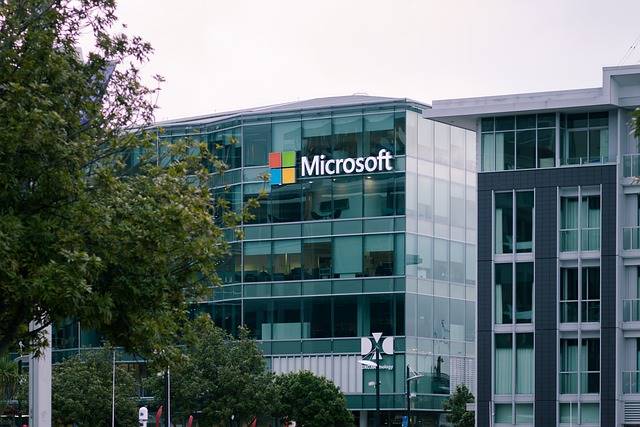
Publicly traded companies are catching the Bitcoin fever.
Recently, Bitcoin has once again become the star asset in financial markets. Just yesterday, Bitcoin surged to $73,660, only 0.4% below its all-time high of $73,881.3 set on March 14 this year. Against the backdrop of rising odds for Trump’s election victory, market sentiment widely predicts Bitcoin could reach $100,000 by year-end.
Public companies appear to be eyeing this lucrative opportunity. Recently, Microsoft filed a document with the U.S. Securities and Exchange Commission (SEC) indicating that it will put the topic of "evaluating investment in Bitcoin" to a vote at its shareholder meeting on December 10. Although the board has already recommended voting against the proposal, shareholders themselves hold divergent views.
As one of the world's most renowned corporations, Microsoft’s mere consideration of investing in Bitcoin carries profound significance. Meanwhile, early movers like MicroStrategy have reaped massive gains, offering a compelling case study for other public firms.
01 Is Microsoft Proposing to Invest in BTC? Board Says No
Fueled by the so-called “Trump trade,” Bitcoin has recently attracted widespread attention. Despite a slight pullback after nearly reaching its historical peak on October 30, Bitcoin’s performance this year—up over 56%—has outperformed major global asset classes including large-cap, mid-cap, and small-cap growth stocks; U.S. and European equities; commodities; government bonds; gold; cash; emerging markets; and real estate investment trusts—highlighting its strong inflation-hedging and counter-cyclical characteristics.
The notion of Bitcoin as “digital gold” is gaining ground. Not only retail investors are FOMO-ing, but also capital-rich public companies are renewing their interest. According to an SEC filing dated October 24, Microsoft appears to be considering Bitcoin investments. The company has added the item “evaluation of Bitcoin investment” to the voting agenda of its upcoming shareholder meeting on December 10.
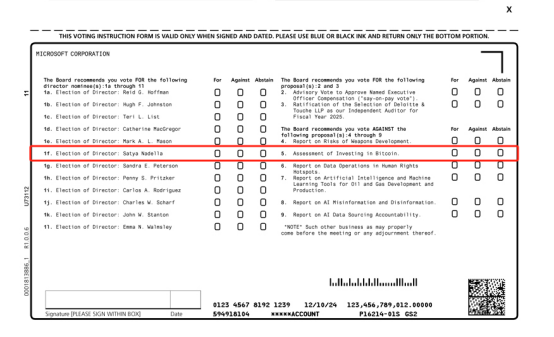
The proposal was initiated by the National Center for Public Policy Research, a conservative think tank affiliated with Microsoft’s “Project 2025” advisory committee. It recommends that Microsoft allocate at least 1% of its total assets to Bitcoin, arguing that “companies should consider Bitcoin as a hedge to protect shareholder value.” Given Bitcoin’s price performance, this rationale holds water, and portfolio diversification is certainly justifiable. However, beneath the proposal, Microsoft’s board has clearly noted: “Vote against this proposal.”
Microsoft stated that the board opposes the proposal, deeming the vote unnecessary, and claims to have thoroughly evaluated it. The filing explains: “Microsoft’s global finance and investment services team conducts comprehensive assessments of various investable assets to support the company’s ongoing operations. This includes assets expected to provide diversification and inflation protection, as well as those that mitigate significant financial risks from rising interest rates. In past evaluations, Bitcoin and other cryptocurrencies have been considered. Microsoft will continue to monitor trends and developments related to cryptocurrencies to inform future decisions.”
Regarding evaluation criteria, Microsoft emphasized that volatility is a key factor when assessing cryptocurrency investments. In short, while Microsoft does not entirely rule out crypto assets, the pronounced price swings of Bitcoin pose risks to corporate balance sheets, making it an unsuitable choice for stable asset allocation.
Of course, even though the board has effectively rejected Bitcoin, the final decision rests not with the board but with the majority of shareholders. According to data from Tonghuashun, Vanguard and BlackRock are currently Microsoft’s largest institutional shareholders, holding 8.95% and 7.30% stakes respectively.

BlackRock is no stranger to crypto. This year, through its spot Bitcoin and Ethereum ETFs, it has rapidly gained traction. As of October 30, BlackRock’s Bitcoin ETF (IBIT) surpassed $30 billion in assets under management, leading among first-wave Bitcoin ETFs. In an interview on October 15, BlackRock Chairman and CEO Larry Fink reiterated: “Bitcoin itself is an asset class. It serves as an alternative to gold and other commodities.”
While BlackRock supports Bitcoin, the other major shareholder, Vanguard Group, holds a far less favorable stance. Earlier this year, Vanguard explicitly stated it would not allow clients to purchase any of the 11 newly launched spot Bitcoin ETFs and confirmed it has no plans to launch a Vanguard-branded Bitcoin ETF or other crypto-related products: “Our view is that these products do not align with our focus on equities, bonds, and cash—the core building blocks of balanced, long-term investment portfolios.”
With two giants taking opposing positions, smaller shareholders are likely divided as well, making the final outcome uncertain. Nevertheless, initial voting on the proposal has already begun among Microsoft shareholders. If approved, Microsoft—as an industry benchmark—would significantly strengthen Bitcoin’s public perception, triggering a chain reaction that could lead more public companies to adopt Bitcoin into their treasury strategies, reinforcing its status as digital gold and accelerating mainstream adoption. Conversely, even if the vote fails, Microsoft’s very consideration sends a powerful signal: when one of the world’s most valuable public companies shows interest in Bitcoin, it underscores Bitcoin’s growing legitimacy in the mainstream financial world.
02 Investing in Bitcoin Is Nothing New for Public Companies
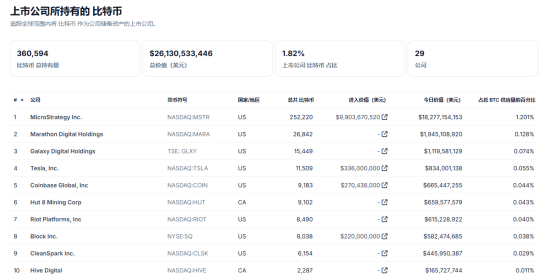
In fact, Bitcoin investment among public companies is nothing new. According to Coingecko, 29 publicly listed companies currently hold Bitcoin, collectively owning 360,000 BTC worth over $2.6 billion. Among them, MicroStrategy stands out as the most prominent example.
Flash back to August 11, 2020, when MicroStrategy first announced its entry into Bitcoin, purchasing 21,454 BTC for $250 million, officially incorporating Bitcoin into its corporate treasury. This move sent shockwaves through the market and marked what many call Bitcoin’s pivotal “1995 moment” toward mainstream recognition.
Since then, regardless of bull or bear markets, MicroStrategy has stuck firmly to one principle—buy and hold. From 2020 onward, the company consistently executed this strategy. As of Q3 2024, MicroStrategy acquired approximately 252,220 BTC for around $9.9 billion, making it the public company with the largest Bitcoin holdings globally. In its recent earnings report, MicroStrategy announced plans to raise $21 billion in equity and issue $21 billion in debt over the next three years, using the additional capital to buy more Bitcoin as treasury reserves to maximize returns.
The bet has paid off handsomely. MicroStrategy’s average purchase price per Bitcoin is about $39,266, while Bitcoin now trades above $72,000. Its stock price has skyrocketed to $247.31, hitting a 25-year high and pushing the company into the $50 billion market cap club. According to Bloomberg, MicroStrategy’s stock performance over the past two years has outperformed nearly every major U.S. stock—including Nvidia. The report attributes over 1,700% of its surge to the company’s “unconventional” decision four years ago to buy Bitcoin as an inflation hedge.

MicroStrategy’s strategy has since drawn widespread admiration. Overseas KOL Glenn Hodl pointed out that under current valuation models, MicroStrategy’s heavy reliance on BTC creates a dual valuation framework: one based on discounted cash flow from its core business operations, and another tied directly to the market value of its Bitcoin holdings. So long as there is positive forward expectation for Bitcoin, MicroStrategy can continuously boost its market cap by adjusting the ratio between Bitcoin holdings and share issuance. With such a successful precedent, other firms are following suit. For instance, Luxembourg-based digital securities platform STOKR announced it will emulate MicroStrategy by actively expanding its Bitcoin reserves in the coming years.
Besides MicroStrategy, Tesla also holds a substantial amount of Bitcoin. Tesla first purchased $1.5 billion worth of Bitcoin in February 2021. Later that year, Elon Musk briefly suggested Tesla vehicles could be bought with Bitcoin, but the idea was dropped amid concerns over price volatility. As of Q3 2024, Tesla’s financial filings show $763 million in Bitcoin holdings, ranking fourth among public companies—behind only MicroStrategy, Marathon Digital, and Galaxy Digital.
Notably, although Tesla made large transfers of Bitcoin—$75.18 million, $76.08 million, and $77.16 million—to anonymous wallets during Q3, there has been no confirmation of actual sales. This means Tesla has not sold any Bitcoin since reducing its holdings by 75% in Q2 2022, signaling Musk’s continued long-term bullishness on Bitcoin. Similarly, SpaceX holds approximately $560 million in Bitcoin. Together, the two companies own roughly 19,788 BTC, valued at around $1.3 billion.
03 Conclusion
Returning to Microsoft, overall given the board’s current stance, the upcoming Bitcoin vote carries more symbolic than practical weight. However, in the long run, as Bitcoin’s value grows and its path to mainstream adoption progresses, holding Bitcoin as part of diversified asset allocation may gradually become standard practice among public companies. That said, Bitcoin’s volatility and regulatory uncertainties remain significant hurdles.
On a positive note, regulatory progress is being made in the U.S., with changes in accounting standards serving as a prime example. At the end of last year, the Financial Accounting Standards Board (FASB) issued new guidance mandating that fair value accounting for Bitcoin be formally adopted for fiscal years beginning after December 15, 2024. Prior to this change, public companies were required to record impairment losses on Bitcoin if prices fell, but could only reflect appreciation at cost basis—a major disincentive for firms eager to present strong financial statements. Under the new rules, Bitcoin can now be recorded at market fair value, effectively resolving this issue.
Thus, the ship of Bitcoin adoption among public companies may finally be setting sail.
Join TechFlow official community to stay tuned
Telegram:https://t.me/TechFlowDaily
X (Twitter):https://x.com/TechFlowPost
X (Twitter) EN:https://x.com/BlockFlow_News