Volt Capital Partner: Why ZK State Channels Are the Best Scaling Solution for On-Chain Multiplayer Games
TechFlow Selected TechFlow Selected
Volt Capital Partner: Why ZK State Channels Are the Best Scaling Solution for On-Chain Multiplayer Games
For multiplayer games, zk state channels are a better scaling option.
 Navigating Web3 tides with focused insights
Author: Mohamed Fouda
Compiled by: TechFlow
For on-chain games, horizontal scaling via Rollups works well for single-player games. However, for multiplayer games, zk state channels offer a better scaling solution. So, what exactly are zk state channels?
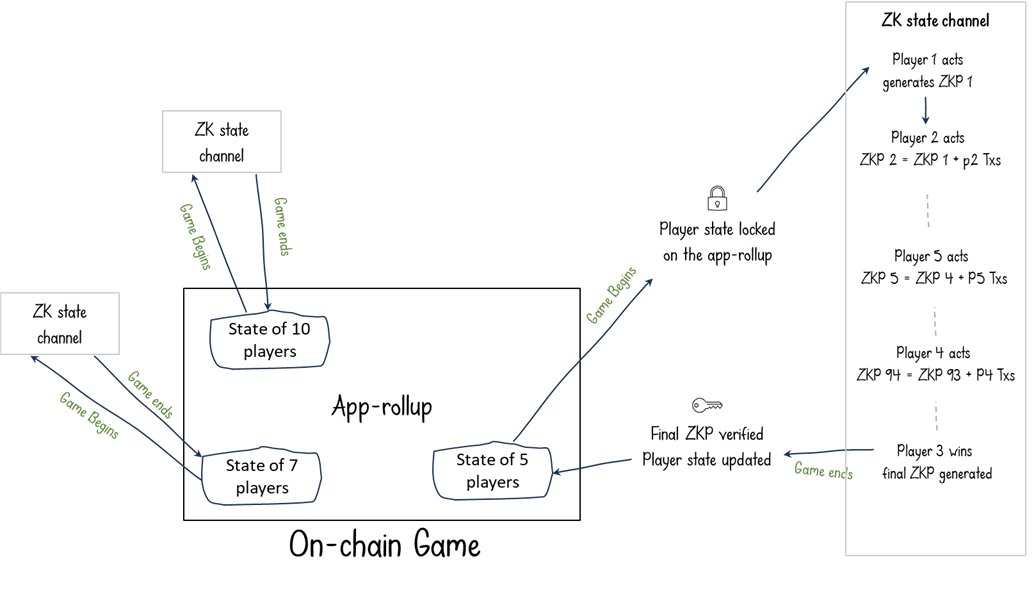
State channels are not new. In fact, they were among the earliest scalability solutions proposed for Ethereum. At their core, state channels involve:
-
Taking a portion of the on-chain state;
-
Continuously updating this state off-chain;
-
Submitting the final state back on-chain when needed.
Clearly, this concept extends from the design of Bitcoin’s Lightning Network, which is essentially a payment channel.
However, without zero-knowledge proofs, state channels offer limited benefits. Without ZKPs, all signatures authorizing state changes (off-chain) would still need to be verified on-chain—providing little cost reduction compared to regular on-chain transactions.
Zero-knowledge proofs elegantly solve this issue. Participants in a state channel simply generate an off-chain proof that verifies the validity of all their interactions and signatures. This proof can be cheaply verified on-chain, significantly reducing costs.
So how does this relate to scaling on-chain multiplayer games?
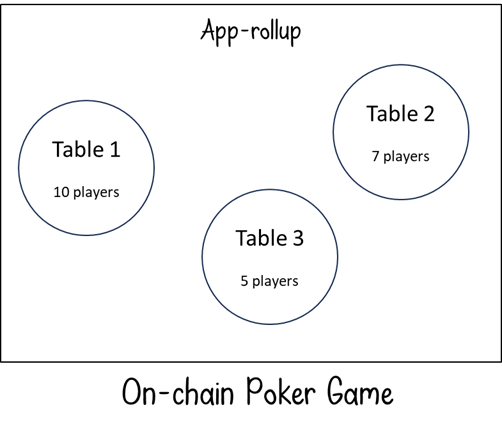
Many multiplayer games, such as poker, are match-based—where a group of players create a game, compete within it, and update their individual assets based on the outcome.
For such games, you need a shared layer to store each player's assets.
The detailed in-game actions matter less than the final result of the game—which updates asset balances. Moreover, players typically cannot participate in multiple games simultaneously.
This makes these types of games ideal candidates for zk state channels. Once a game starts, the participants' states are locked into a Rollup. During gameplay, players generate ZKPs to prove the validity of their moves. These ZKPs are recursively built upon previous ones, forming a chain of proofs.
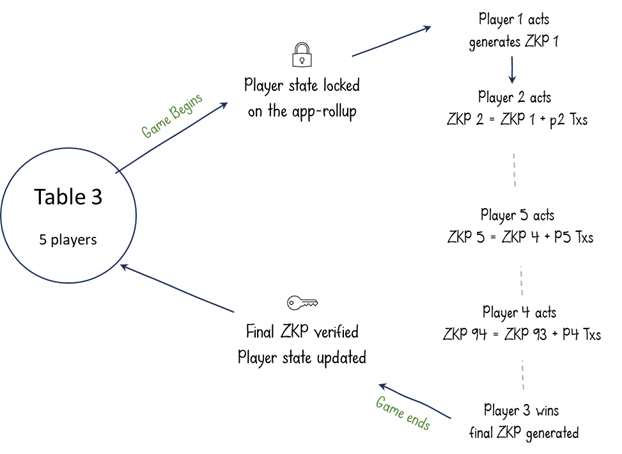
When the game ends, only the final ZKP and the resulting state changes are submitted to the Rollup for settlement. Since intermediate transactions are not processed on the Rollup, this approach achieves up to 100x scalability.
This method also applies to non-turn-based games like "Among Us." In such cases, however, a designated entity must act as a temporary sequencer, ordering transactions within the channel and generating intermediate recursive ZKPs. I refer to this setup as a "transient L3."
The main challenge with zk state channels is the liveness requirement for participants. A player going offline may force others to execute on the Rollup, thereby imposing higher costs on the remaining players.
Despite this, the potential of this approach is immense, and several teams are actively working in this direction, including Ontropy, Paima Studios, and Cartridge.
Join TechFlow official community to stay tuned
Telegram:https://t.me/TechFlowDaily
X (Twitter):https://x.com/TechFlowPost
X (Twitter) EN:https://x.com/BlockFlow_News
 @MohamedFFouda