Interview with Gitcoin Co-Founder: Public Goods Are a Worthy Goal, But Not All Web3 Projects Are Suitable
TechFlow Selected TechFlow Selected
Interview with Gitcoin Co-Founder: Public Goods Are a Worthy Goal, But Not All Web3 Projects Are Suitable
Not all Web3 projects are public goods.
 Navigating Web3 tides with focused insights
TechFlow: Sunny
Gitcoin: Scott Moore
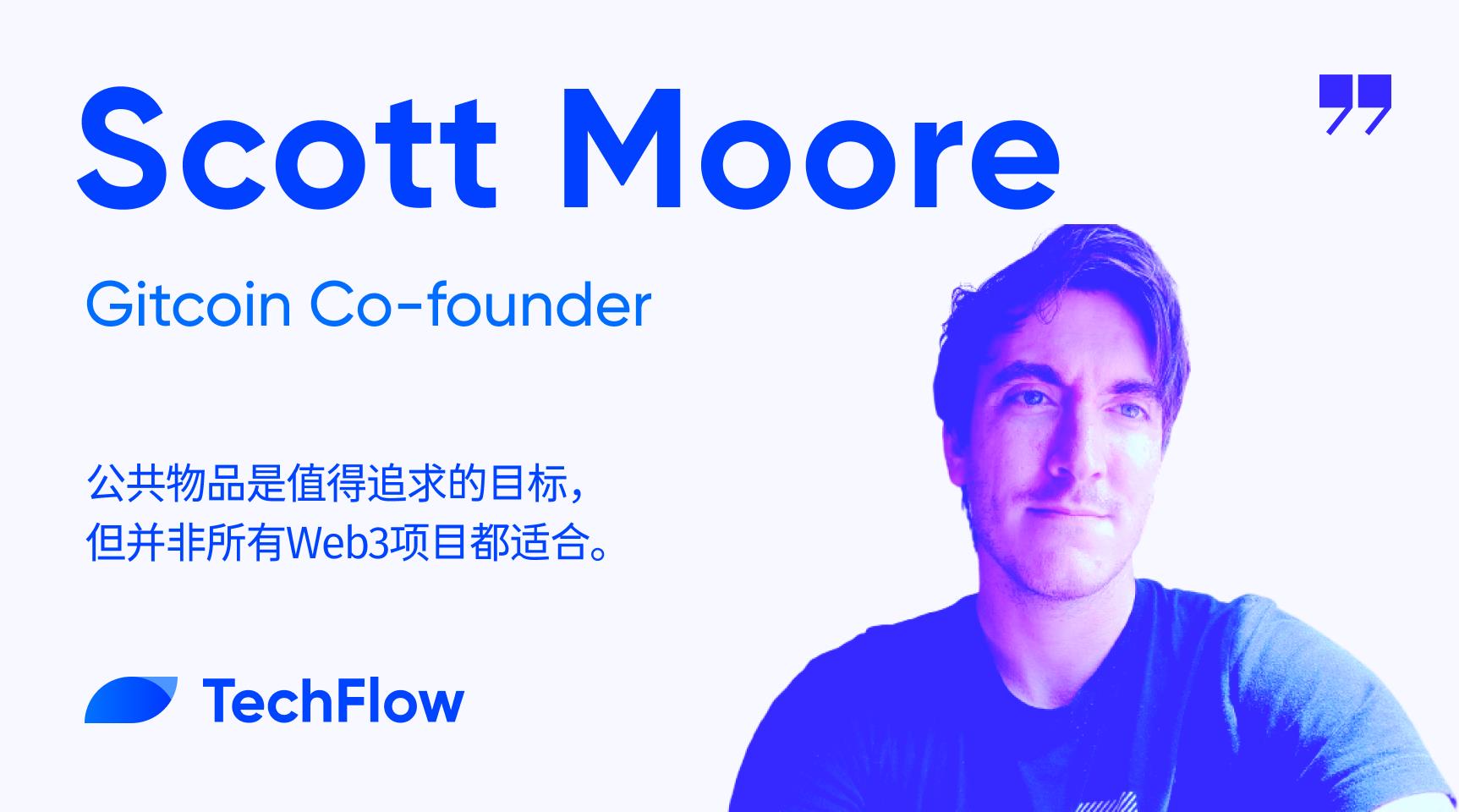
“The more open and accessible something is, the harder it becomes to maintain—and the more vulnerable it is to the 'tragedy of the commons.'”
-- Scott Moore
Public goods are foundational to the prosperity of any society. By maintaining the parks, roads, and transit systems we rely on in our cities, we generate meaningful positive externalities. But sustaining these public goods isn't easy—it requires carefully designed economic mechanisms (such as taxes, subsidies, or regulations) to properly or optimally fund both the goods themselves and their ultimate impacts.
One of the greatest challenges with these public goods is measuring the value they create not just for a local community, but for broader society, and funding them accordingly. For example, a local park does more than offer people a place to gather; those gatherings spark creative and innovative ideas, as well as social harmony.
Unfortunately, in many markets, assessing the value of externalities is not always straightforward. As a result, numerous negative externalities from market failures lead to inefficient or unfair resource allocation, and overall societal instability. For instance, if an oil spill devastates a local waterfront, the community may suffer irreversible damage.
These same issues arise in the context of cyberspace. Gitcoin was one of the first organizations to recognize these problems—particularly in the realm of open-source software, where maintainers often find themselves overworked and underpaid due to similar market failures, while other organizations extract value by taking their code for private gain.
The Story Behind Gitcoin: A Funding Engine for Open-Source Software
Scott Moore is not only a co-founder of Gitcoin, but also a creative thinker and contributor to new models for building and funding digital public goods in the digital age.
Before entering the world of digital public goods, Scott studied a unique combination of political science and mathematics, and organized several initiatives in Toronto, Canada, focused on open financial markets and software tools.
Scott recalls: “Before I got into cryptocurrency, I was struggling with what I wanted to do in this world.” What initially drew him in was an Ethereum meetup in Toronto. “As I dove deeper into machine learning, I started using open-source software more and more, and began wondering: How do the people maintaining this software make a living? What would the world look like if everyone kept developing tools openly like this? When I attended some early meetups in 2015, I found many others asking the same questions, trying to find new social and economic models—models whose impact would ultimately extend far beyond those initial concerns.”
These diverse gatherings explored many ideas that have since become reality—ranging from decentralized finance (DeFi) to non-fungible tokens (NFTs). But Scott was particularly drawn to decentralized autonomous organizations (DAOs). Chance encounters with like-minded individuals such as Ethan Wilding and Nick Dodson motivated him to dive deeper and begin building in this space.
Scott says: “As someone who has spent a lot of time on networks and open-source software, I deeply care about preserving internet-native communities. But platforms like GitHub don’t actually engage with their users in that way—they treat the platform purely as a product. I believe DAOs offer a better economic architecture for connecting real people online.”
In 2016, Scott made his first attempt to realize this vision through a project fundamentally different from existing platforms. He began building an exchange and system for creating DAOs, which he called the Venture Equity Exchange, and started reimagining what a new toolkit for online coordination might look like. However, after the 2016 "DAO Hack," he realized that any new economy would be better off launching from established platforms like GitHub, where contribution histories already exist.
“That event changed my perspective—we need to go where people already are, and grow slowly and patiently. I started believing it’s better to build upon existing foundations rather than starting from scratch or rushing ahead,” a philosophy that ultimately gave rise to Gitcoin.
Since then, Gitcoin has not only become the first organization to implement and popularize the quadratic funding mechanism invented in 2018 by Vitalik Buterin, Zoe Hitzig, and Glen Weyl—now used by organizations ranging from Fortune 500 companies to governments—but has also emphasized the importance of developing better frameworks for understanding and supporting digital public goods.
To date, Gitcoin has disbursed nearly $70 million in funding for various forms of open-source software and other public goods, primarily using quadratic funding to measure community sentiment and allocate value according to participants’ unique preferences.
Scott explains: “Gitcoin’s core mission is to prove that, with the right tools and structures, we can coordinate value online just as effectively as we coordinate information. By establishing credible commitments online, we can not only make economies more efficient, but also better serve the public good—a kind of good we can all observe in our local communities.”
Beyond technology-driven projects, Gitcoin has expanded into ecological sustainability and other major social issues. By addressing public goods challenges across diverse domains, Gitcoin is realizing its long-term vision and hopes to inspire other organizations—including corporations and governments—to join this movement.
Modern Solutions to Modern Public Goods Problems
You may have noticed the term “public goods” becoming increasingly popular at web3 industry conferences, but this hasn’t always been the case. It took considerable effort and time to convince the community that this isn’t merely about altruistic charity, but part of building a better socioeconomic system—one built upon its own digital public goods, such as Bitcoin and Ethereum.
Scott sees this as part of a broader historical movement aimed at helping communities recognize their collective interests—a spirit that truly flourished during the academic early days of software development. He says: “Starting in the 1970s and 1980s, when open-source development really began to take off, it became a significant form of collective creativity. Trust and collaboration among developers in building public infrastructure wasn’t taken for granted—it was a conscious choice that many had to make together, continuously.”
Scott notes that this bears similarities to other public goods movements around the world. For instance, like Hong Kong’s public transportation, open-source software represents an effort sustained by people that generates economic value for their communities. But as Scott explains: “The more open and accessible something is, the harder it is to maintain—and the more vulnerable it is to the ‘tragedy of the commons.’” In contrast, a local subway system is easier to manage in some ways because it’s confined to specific geographic areas and use cases. Software, like the internet itself, is global infrastructure.
“Governments have figured out how to fund public goods in the physical world, but digital public goods lack a single government—or a cohesive group of citizens—willing to take full responsibility for supporting them due to their global nature,” Scott observes. “We need organizations that serve the public interest to help these developers, leveraging tools like Ethereum to achieve these shared goals.”
Gitcoin hopes to eventually become one such organization, collaborating with institutions worldwide to make this vision a reality.
The State of Web3 Public Goods
Bitcoin and Ethereum are more than just cryptocurrencies and smart contract platforms; they are themselves quintessential public goods within the Web3 ecosystem, providing foundational support for otheropen-source software. These blockchain platforms have their own foundations to support development. For example, Ethereum was initially driven by the Ethereum Foundation, but as the ecosystem matured, governance gradually shifted toward decentralization.
Scott points out: “These self-regulating networks demonstrate that it’s possible to securely verify and maintain a global state of value—one that anyone can use in an internet-native way, supported across different jurisdictions. For example, miners in China often handle transaction validation and processing on the Bitcoin network.”
In networks like Bitcoin, transaction fees paid by users help make the system economically sustainable, and the fees earned by miners incentivize them to further support core network development.
With Ethereum, the scope of possible infrastructure and applications expands significantly. Decentralized exchanges like Uniswap, for instance, often operate as DAOs, enabling open-source communities to actively contribute. Since DAOs depend on Ethereum-based languages like Solidity and libraries such as Web3.js and Ethers.js, they frequently support the developers of these tools through Gitcoin Grants.
However, even successful ecosystems like Ethereum face challenges in securing sustainable funding, requiring ongoing collective effort. This leads to regular community meetings among stakeholders, decision-making processes, and public debates on platforms like X.
As more projects undergo tokenization (and in some cases, DAO-ification), they are reallocating the value of their tokens across the entire tech stack.
To further advance research on public goods governance, specialized research organizations such as MetaGov (where Scott serves as an advisor) are exploring and incubating new frameworks and tools, opening up more possibilities for managing on-chain public goods in the future.
Not All Web3 Projects Should Be Public Goods
As the influence of public goods in web3 grows almost meme-like in popularity, a critical question often arises: Should every web3 project be a public good?
To explore this complex issue, we spoke with Scott and other industry leaders.
So, what is web3? In short, Scott sees it as encompassing projects like Bitcoin and Ethereum that are developing new cryptographic tools enabling globally verifiable computation and online value coordination via shared ledgers (blockchains), secured by native cryptocurrencies.
Scott emphasizes that while not every project in this space needs to be a public good, the importance of generating “positive externalities” is undeniable.
He says: “My core belief is that everything works best when we create a sustainable, shared ecosystem—that’s crucial for real users online.” He adds that this doesn’t mean everything should be free, but rather that trade-offs must be considered to support all stakeholders in the ecosystem. “We need to think about what can be monetized to support things that would otherwise be difficult or impossible to sustain. There must be real value circulation within the system.”
SEDA’s co-founder believes that a purely public-goods-based ecosystem may be more suitable for infrastructure layers. But others, like the founder of Zerion, express concern about broader “public-goods-ification” at the application layer. They argue that community governance models aren’t yet mature enough to successfully tokenize application-layer projects, especially before they’ve built widely adopted open-source tools or their own chains (L1s or L2s).
Despite differing opinions, a common theme emerges: being a public good isn’t necessarily the end goal, but it remains a worthy aspiration. More importantly, projects must be sustainable. Scott notes: “We often treat public goods as a standalone island, but sometimes it’s better to consider Ostrom’s work on commons—commons need management and require a sustainable flow of economic resources.”
Achieving this requires thoughtful strategy and clear execution plans to maximize value creation for broader society.
Gitcoin Today and Tomorrow
Scott notes that scaling models like grants and venture funding in web3 could significantly improve conditions for grassroots participants and marginalized communities. However, to effectively address these inequalities, the key lies in prioritizing support for the areas most in need. Determining these priorities is currently one of Gitcoin’s main agendas. Through quadratic funding, Gitcoin is also experimenting to validate the effectiveness of new models.
To ensure accurate use of community feedback, Gitcoin is also developing core tools like “Gitcoin Passport.” By analyzing existing on-chain user data, Gitcoin Passport builds a reputation system that more accurately identifies donors and helps determine where institutional capital should be directed based on generated priorities.
Beyond quadratic funding, Gitcoin is also collaborating with teams like Optimism on “retroactive funding.” In this model, a project or activity receives funding only after it has begun or completed. This aims primarily to compensate projects that have already demonstrated value or impact but initially lacked sufficient funding relative to the value they created.
In the digital world—especially in crypto—experimenting with different economic funding mechanisms is undoubtedly bold and important. Perhaps it is precisely the transparency and openness of blockchain that enables quadratic funding mechanisms and subsidy processes, implemented via smart contracts, to operate more efficiently. Or perhaps it’s inherent in the shared currency that underpins these ecosystems.
Only time will tell how these ecosystems evolve, but we’re excited about the work Gitcoin is doing and hopeful to see the web3 ecosystem continue building “for the public good.”
Join TechFlow official community to stay tuned
Telegram:https://t.me/TechFlowDaily
X (Twitter):https://x.com/TechFlowPost
X (Twitter) EN:https://x.com/BlockFlow_News
 深潮TechFlow