Gitcoin Grants Round 20 Minimalist Guide
TechFlow Selected TechFlow Selected
Gitcoin Grants Round 20 Minimalist Guide
Gitcoin Grants donation rounds have been conducted 19 times so far, helping projects grow while offering donors rewards such as token airdrops. An increasing number of users are entering the Web3 world through Gitcoin.
 Navigating Web3 tides with focused insights
Reprinted from the "Biteye" community
Author: Shouyi, Core Contributor of Biteye
Editor: Crush, Core Contributor of Biteye
Community: @BiteyeCN
*Approximately 5,000 words, estimated reading time: 10 minutes
Gitcoin is a donation platform for open-source software, allowing users to support various decentralized open-source projects. Early-stage projects can also receive funding on Gitcoin to sustain operations.
Well-known projects such as Uniswap, 1inch, MaskNetwork, and ENS have all participated in Gitcoin Grants, earning Gitcoin the nickname "the armory of Ethereum."
In each round of Gitcoin Grants, projects not only receive user donations but also benefit from quadratic funding—a matching mechanism used by Gitcoin to allocate grants from the Ethereum Foundation to high-quality projects. This allocation method has been endorsed by Vitalik Buterin (Vitalik), significantly enhancing Gitcoin Grants' community influence.
Quadratic Funding:
https://www.youtube.com/watch?v=HJljTtLnymE
To date, Gitcoin Grants donation campaigns have run 19 times (17 rounds + Alpha Round + Beta Round). While helping projects grow, they’ve also rewarded donors with token airdrops, enabling more and more users to enter the Web3 world through Gitcoin.
Gitcoin continues to explore more efficient donation models, aiming to shift from quadratic funding (centralized grant distribution) toward GitcoinDAO—creating a decentralized and customizable grants protocol.
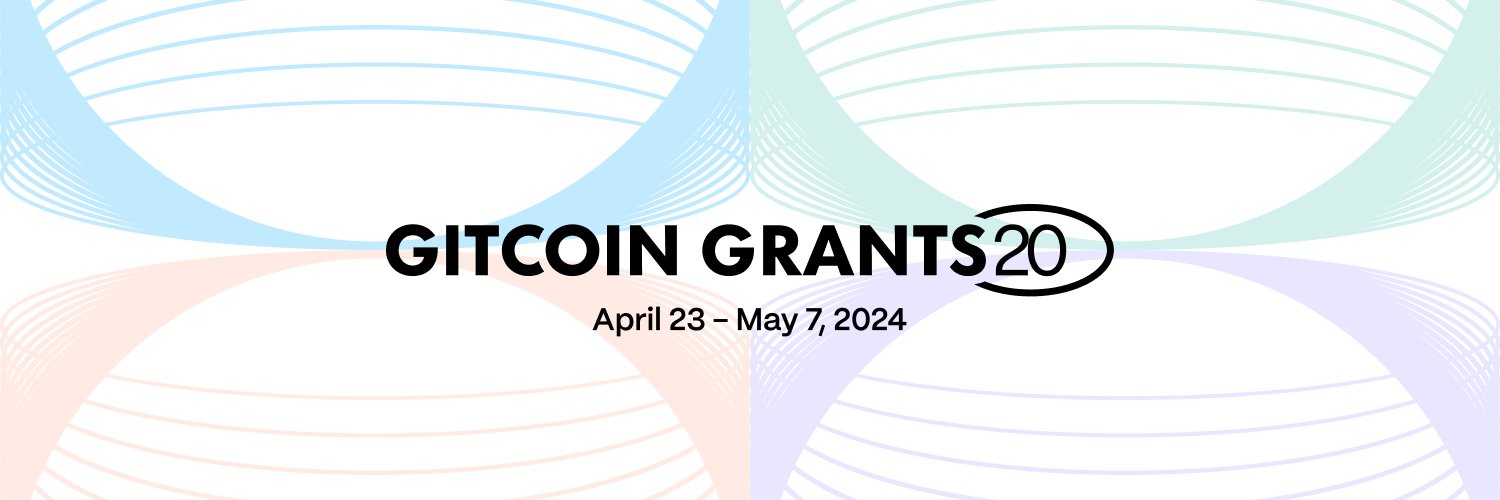
Through the Gitcoin Alpha Round in January 2023 and the Beta Round in April 2023, Gitcoin refined its donation mechanisms. From April 23 to May 7, 2024, the first donation drive of the year—Gitcoin Grants 20—is officially live.
https://www.gitcoin.co/blog/announcing-gg20
Next, Biteye will briefly introduce the key differences between Gitcoin Grants 20 and previous donation rounds, highlight several high-potential projects, and provide an easy donation guide.
Table of Contents
1. Introduction to Gitcoin Grants 20
2. Gitcoin Grants 20 Donation FAQ
3. Gitcoin Grants 20 Donation Guide
4. Recommended Projects for Gitcoin Grants 20 (Updated Continuously)
01 Introduction to Gitcoin Grants 20
In past guides for Gitcoin donation rounds, we explained Gitcoin’s donation philosophy, round structure, and prize pool size. But as a minimalist guide, it should be as concise and readable as a 140-character tweet 📖:
⏰ Gitcoin Grants 20 starts at 20:00 Beijing Time on April 23 and ends at 08:00 on May 8
💰 Gitcoin donation rounds are divided into Program Rounds (OSS Program rounds) and Community Rounds. The $1 million in the Program Round comes from the Gitcoin Foundation, while the $500,000 in the Community Round comes from partners or community fundraising.
This round, donations will take place on Arbitrum. User Passports will be automatically verified—no need to manually claim Stamps as before. Users with extensive mainnet transaction histories will receive higher matching weights.
https://grants-portal.gitcoin.co/passports-model-based-detection
02 Gitcoin Grants 20 Donation FAQ
Q1: Why should I participate in Gitcoin donations?
A1: Donating on Gitcoin is a valuable on-chain activity. Projects like Optimism and Celestia have previously used “Gitcoin donations on mainnet” as one of the criteria for airdrop eligibility. It’s also a low-cost way to boost your Passport score.
Q2: How much should I donate?
A2: While there's no minimum donation amount set by Gitcoin, each project requires a donation of at least over $1. Due to ETH price volatility, consider donating with DAI. If using ETH, given price fluctuations, it’s recommended to donate at least 0.0005 ETH. (Note: Some project airdrops only require any donation, while others weigh donation amounts.)
Q3: When should I make my donation?
A3: Avoid donating too late—network congestion in the final days may cause you to miss the deadline. This round features automated Passport verification, so simply use a wallet with mainnet transaction history to gain weight. You can also visit Passport.gitcoin.co and connect your Eth Activity Stamp to check eligibility.
Passport:
http://passport.gitcoin.co/
Q4: Can I use multiple accounts to maximize airdrop gains?
A4: Unfortunately, expected airdrop returns from Gitcoin are far lower than before. Now, participation mainly serves as “one of several factors” for other project airdrops. According to this round’s Sybil detection guidelines, multi-account users should prioritize diversity—adopt a 2+1 strategy: donate to two target projects and one random project, avoiding overly regular donation amounts and timing.
Q5: What tools can I use to track donations?
A5: Use Chaineye to view projects by donation amount and number of donors. You can also use MiniBridge to transfer funds to the ARB chain, minimizing network fees.

(Source: chaineye.tools/gg20)
Chaineye: https://chaineye.tools/gg20
MiniBridge: https://minibridge.chaineye.tools
03 Gitcoin Grants 20 Donation Guide
Donating on Gitcoin is straightforward and can be broken down into three steps:
(1) Acquire Funds
Bridge funds to Arbitrum. You can use MiniBridge to transfer ETH from other chains. For small transactions like Gitcoin donations, MiniBridge offers faster settlement and lower fees.
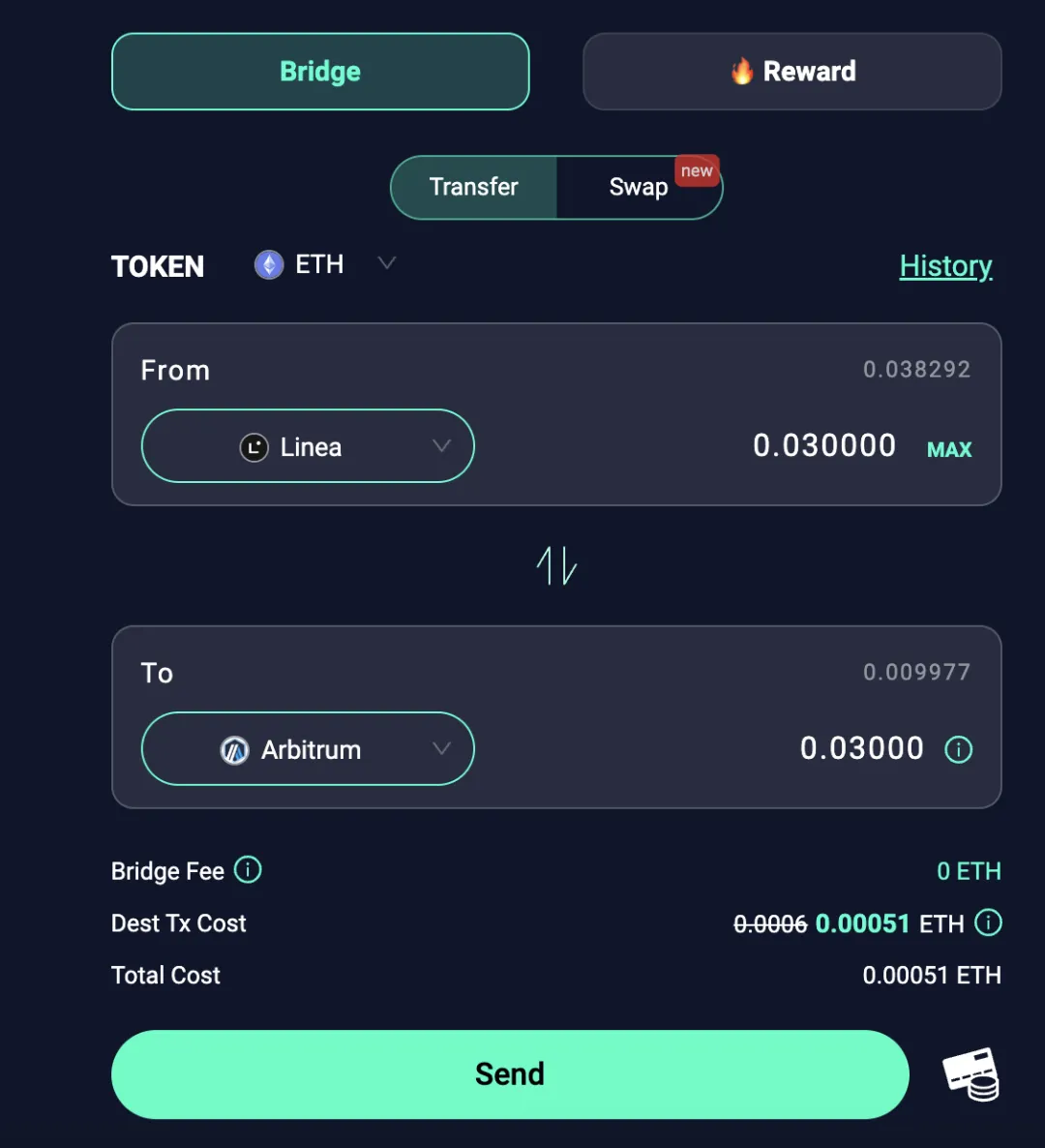
(Using MiniBridge for cross-chain transfers)
(2) Select Projects
You can view all categories and their donation stats on the donation homepage:
https://explorer.gitcoin.co
Choose any category—for example, Web3 Infrastructure—to see that it currently includes 63 projects with a prize pool of $300,000 USDC.
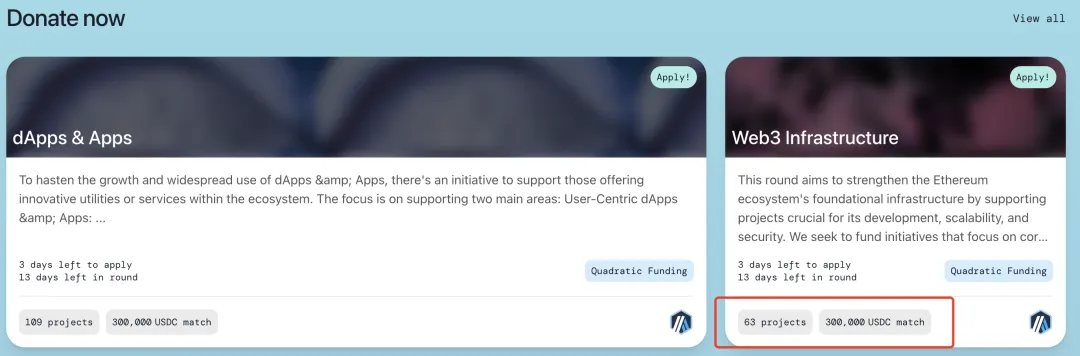
(Viewing categories in the Program Round)
Search for a project by name—e.g., search 🔍 Minibridge—then click the shopping cart icon in the lower right corner of the project, and proceed to checkout via the cart in the top right.
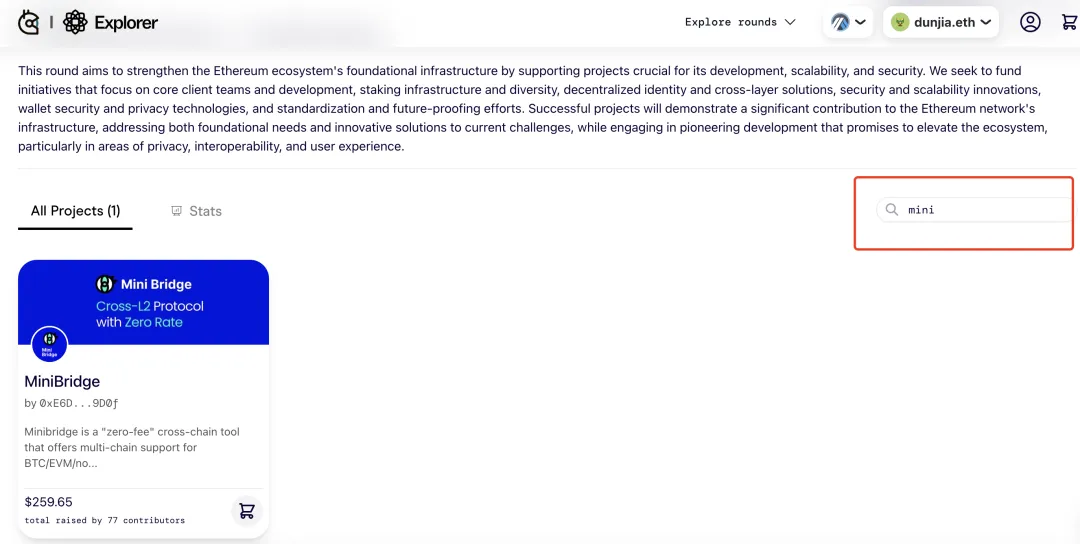
(Searching speeds up finding donation targets)
Enter your desired donation amount. Click “Apply to all” to apply the same amount across multiple projects. On this screen, you’ll see projected matching funds—for example, if I donate 0.005 ETH, MiniBridge could receive $864 in matching funds based on current pool dynamics. Click submit, and your donation is complete! ✅
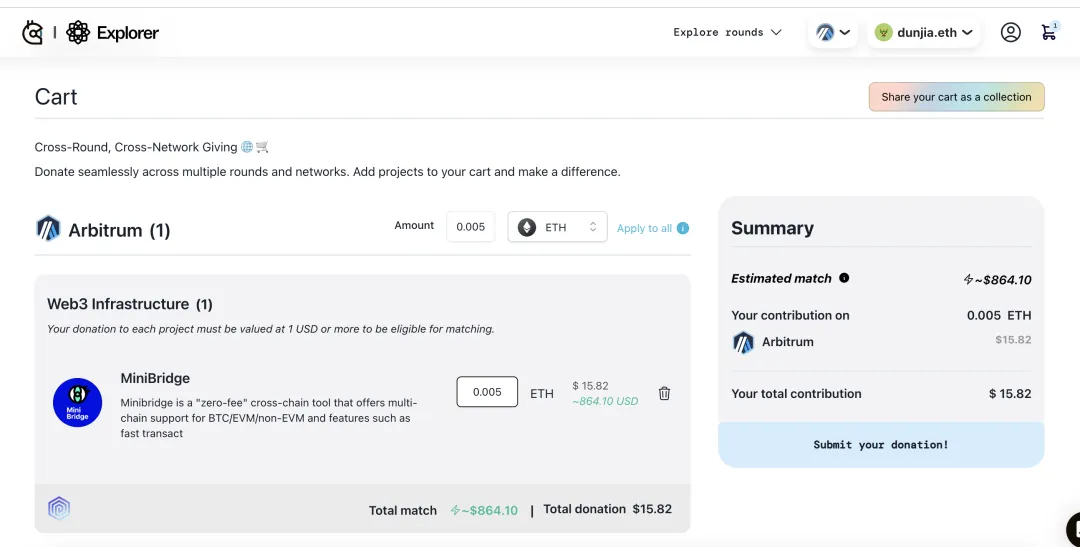
(Wallets with mainnet history receive higher matching weight)
04 Recommended Projects for Gitcoin Grants 20 (Updated Continuously)
(1) Web3 Infrastructure
This category supports infrastructure development focused on scalability and security within the Ethereum ecosystem, especially in privacy, interoperability, and user experience.
https://explorer.gitcoin.co/#/round/42161/26
1. Mini bridge
https://explorer.gitcoin.co/#/round/42161/26/26
MiniBridge is a "zero-fee" cross-chain tool developed by the Chaineye team for small-value transfers, supporting multiple chains and offering fast confirmation. Chaineye was a winner at the 2023 Shanghai Ethereum Developer Conference and has received funding from Gitcoin, Optimism, and Arbitrum. In dappsheriff.com’s UX rankings, MiniBridge ranks first among all cross-chain bridges.
2. Facet
https://explorer.gitcoin.co/#/round/42161/26/51
Facet is a secure, decentralized, and cost-effective computation protocol that can reduce Ethereum transaction costs by up to 99% without modifying the Ethereum protocol itself.
3. L2BEAT
https://explorer.gitcoin.co/#/round/42161/26/66
L2BEAT is a dedicated analytics and research platform for Layer 2 scaling solutions. It introduces key metrics and provides in-depth analysis of every L2 project, clarifying their technical workings and associated risks.
(2) Decentralized Applications (dApps & Apps)
This category accelerates the growth and adoption of dApps and applications. It prioritizes those improving Web3 accessibility, financial inclusion, education, and creating positive social impact.
1. Hey.xyz
https://explorer.gitcoin.co/#/round/42161/25/1
Hey.xyz (formerly Lenster) is a decentralized, permissionless social media app running on Polygon, enabling seamless dApp interactions without gas fees. No content can be removed—even by admins. Hey.xyz is powered by Lens Protocol, a decentralized social graph built by Aave.
2. Revoke.cash
https://explorer.gitcoin.co/#/round/42161/25/25
A one-stop platform to revoke token approvals. Users can immediately revoke token permissions via Revoke after receiving alerts about potential attacks.
3. JediSwap
https://explorer.gitcoin.co/#/round/42161/25/96
JediSwap is a DEX built on StarkNet—an Ethereum validity rollup that leverages Ethereum’s security while achieving infinite Web3 scalability. JediSwap is fully community-driven; anyone can contribute by joining the JediSwap Discord.
4. IDriss
https://explorer.gitcoin.co/#/round/42161/25/92
Makes Web3 more accessible by building tools like IDriss Book. IDriss Book is a decentralized Web3 address book that allows users to link their Twitter handles, emails, and phone numbers to public wallet addresses for easier, safer interactions.
(3) Developer Tools and Libraries
Supports initiatives that improve developer efficiency in open-source software (OSS) and the Web3 ecosystem. Focuses on developing environments, frameworks, testing tools, and libraries for secure and efficient smart contract development.
https://explorer.gitcoin.co/#/round/42161/27
1. OpenZeppelin Contracts
https://explorer.gitcoin.co/#/round/42161/27/41
Helps developers build secure smart contracts in Solidity by leveraging standardized, tested, and community-audited code to reduce vulnerabilities. Since the early days of Solidity in 2016, OpenZeppelin Contracts has been the go-to library for smart contract development. Today, it's used by teams behind the largest projects processing billions daily, as well as individual blockchain app builders.
2. Gaslite
https://explorer.gitcoin.co/#/round/42161/27/4
Gaslite focuses on gas optimization, aiming to help protocols create more efficient on-chain experiences.
3. WAGMI
https://explorer.gitcoin.co/#/round/42161/27/30
Wagmi is a React Hooks and VanillaJS library for Ethereum, widely used by ENS, Optimism, Coinbase, Stripe, Shopify, Farcaster, Zora, PancakeSwap, and Gitcoin.
4. Blockscout
https://explorer.gitcoin.co/#/round/42161/27/12
Blockscout is a fully-featured, open-source blockchain explorer that enables deep search, contract interaction, and contract verification on EVM (Ethereum Virtual Machine) blockchains.
Join TechFlow official community to stay tuned
Telegram:https://t.me/TechFlowDaily
X (Twitter):https://x.com/TechFlowPost
X (Twitter) EN:https://x.com/BlockFlow_News
 @BiteyeCN