Vitalik: Airdrops have subverted Gitcoin's ideals, considering solutions that do not support airdrop retroactivity
TechFlow Selected TechFlow Selected
Vitalik: Airdrops have subverted Gitcoin's ideals, considering solutions that do not support airdrop retroactivity
The impact of airdrop incentives has颠覆ed the ideal of using Gitcoin quadratic funding as an alternative solution for token distribution.
 Navigating Web3 tides with focused insights
Author: Vitalik Buterin
Translation: ChainCatcher
*Note: This article was written on April 2, 2021.
Last month, Gitcoin launched its 9th round of grant funding, achieving a record-breaking fundraising scale. Over 12,000 donors contributed $1.38 million to 812 different projects, reflecting strong enthusiasm among crypto users for emerging initiatives.
This enthusiasm is partly driven by expectations of token airdrops among many users. Since projects such as Mask Network previously airdropped tokens to Gitcoin donors, and this round supported lower-barrier ZkSync payments, many users participated in donations hoping to receive airdrops—some even registering multiple accounts to inflate their contributions.
Ethereum co-founder Vitalik Buterin published an article today summarizing this latest Gitcoin donation round and criticizing the aforementioned phenomena.
First, Vitalik pointed out that the most challenging new issue in this round was large-scale fraud: certain unidentified groups registered numerous accounts attempting to game the Gitcoin mechanism and made fraudulent donations. Because multiple sponsors match individual donations, this behavior caused sponsors to pay an extra $33,000.
Therefore, Vitalik believes Gitcoin needs to develop algorithms capable of preventing malicious manipulation, while also reducing fraud through manual account verification, third-party analysis, and community oversight.
Vitalik then used Mask Network as an example, noting that its retroactive airdrop set a precedent for the industry. Now, many projects are hinting on forums that they will airdrop tokens to Gitcoin donors. As a result, participants in this Gitcoin round fall into two categories: “Are you donating because you value the outcome of public goods being funded (an in-mechanism benefit), or because you value receiving something external (like tokens) as a result of your donation?”
“If there emerges a long-term pattern where projects offer retroactive airdrops to Gitcoin donors, users will feel pressured not to donate to projects they believe are genuine public goods, but rather to those they think might issue tokens in the future,” Vitalik noted. “This undermines the ideal of using Gitcoin’s quadratic funding as an alternative to token issuance for monetization strategies.”
To address this, Vitalik detailed a solution called MACI, whose code has already been released on GitHub. Below is ChainCatcher’s partial translation of Vitalik’s original text:
MACI is a toolkit that allows you to run collusion-resistant applications with several key properties:
First, correctness: invalid messages are not processed, and the actual output of the mechanism is the correct result computed from all valid messages;
Second, censorship resistance: if someone participates, the mechanism cannot selectively ignore their messages to falsely pretend they did not participate;
Third, privacy: no one can see how each individual participated;
Fourth, anti-collusion: participants cannot prove to others how they participated, even if they want to.
Anti-collusion is the key feature—it makes bribery (or retroactive airdrops) impossible, because users cannot prove they actually donated to or voted for a specific project.
The technical description of how MACI works is not difficult. Users participate by signing a message with their private key, encrypting the signed message to a public key published by a central server, and posting the encrypted signed message onto the blockchain. The server downloads messages from the blockchain, decrypts them, processes them, and then outputs the results along with a ZK-SNARK to prove the computation was performed correctly.
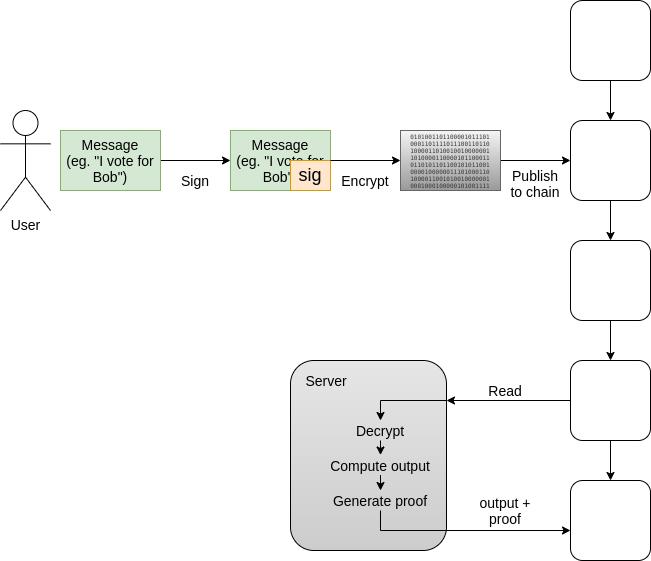
Users cannot prove how they participated because they have the ability to send a "key change" message to fool anyone trying to audit them: they could first send a key change message to switch their key from A to B, then send a forged message “signed with A.” The server would reject that message, but no one else would know the key change message had already been sent. There remains a trust requirement on the server, albeit only regarding privacy and coercion; the server cannot publish incorrect results by miscalculating or improperly checking messages. In the long run, multi-party computation could be used to partially decentralize the server, enhancing privacy and anti-coercion guarantees.
There already exists a quadratic funding system using MACI: clr.fund. It works effectively, though generating proofs is still relatively expensive. Ongoing work aims to reduce these costs significantly in the near future.
Note that adopting MACI does involve necessary trade-offs: it prevents specific projects from rewarding their donors directly. However, it still leaves ample room for users to express pride in their contributions. Projects could airdrop tokens to all Gitcoin contributors without distinguishing by specific project, and announce this via links to Gitcoin profiles. Users could still donate to other projects and still receive airdrops. Thus, this approach remains within the bounds of fair competition.
Still, this remains a long-term challenge. MACI may not yet be ready for integration in Gitcoin Round 10. For the coming rounds, Gitcoin's top priority should remain strengthening uniqueness validation—ensuring each participant is a unique human. The Gitcoin team has already taken excellent steps in this direction.
If the Gitcoin team successfully pioneers efforts to confront and overcome these challenges, we will ultimately achieve a secure and scalable quadratic funding system suitable for broader mainstream adoption.
Join TechFlow official community to stay tuned
Telegram:https://t.me/TechFlowDaily
X (Twitter):https://x.com/TechFlowPost
X (Twitter) EN:https://x.com/BlockFlow_News
 @VitalikButerin