70,000 on-chain data points reveal Meteora airdrop distribution: 4 whale addresses claim 28.5%, while over 60,000 retail users share only 7%
TechFlow Selected TechFlow Selected
70,000 on-chain data points reveal Meteora airdrop distribution: 4 whale addresses claim 28.5%, while over 60,000 retail users share only 7%
Controversial addresses also appeared in the airdrop, including individuals linked to insider trading scandals and large holders with suspicious behavior, further exacerbating the community's trust crisis and exposing the project to the risk of class-action lawsuits.
 Navigating Web3 tides with focused insights
Author: Frank, PANews
Meteora, a major DeFi project in the Solana ecosystem, held its TGE and airdrop event on October 23—an occasion meant to serve as a "redemption" for the protocol after earlier scandals. The team marketed it as a revolutionary, community-first "fair distribution." However, this highly anticipated airdrop quickly turned into a storm of distrust.
In response to Meteora's airdrop, PANews analyzed over 70,000 claim transactions on-chain to reveal the full picture behind Meteora’s airdrop.
Immediate Impact of the 48% “High Circulation” Experiment
Meteora’s TGE design is notable for its unique mechanism centered around “high liquidity” and a points-based allocation model.
The total supply of MET tokens is one billion. On TGE day, 48% (i.e., 480 million tokens) of the total supply was fully unlocked and immediately entered circulation. The team claimed this was “intentional,” aiming to eliminate “artificial scarcity” and enable “genuine market price discovery.”
This airdrop was based on an activity snapshot taken on June 30, 2025, with claims opening on October 23. Eligibility followed a points system, rewarding liquidity providers (LPs), Jupiter (JUP) stakers, and participants in the previously controversial M3M3 Memecoin staking program.
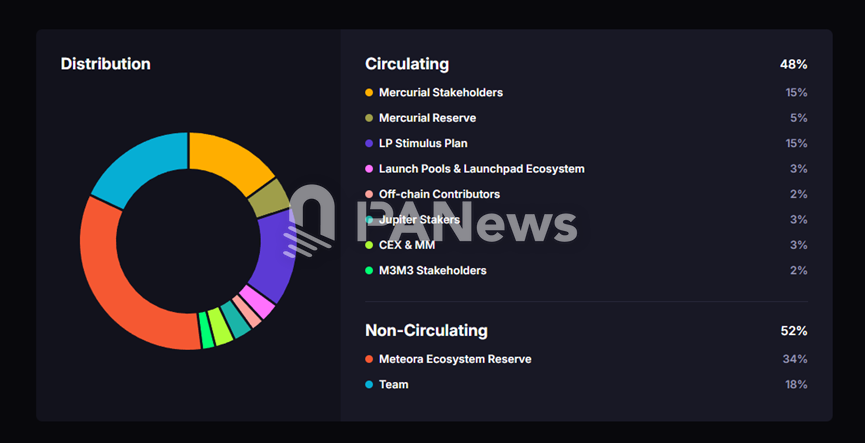
This aggressive model triggered an almost immediate “shock therapy” effect on the market. The massive 48% supply release created “overwhelming immediate sell pressure.” After launch, MET’s price rapidly dropped from an opening of about $0.90, hitting a low of $0.51 within hours—a harsh market reaction that marked the beginning of the crisis.
Four Whales Claimed Over 28% of Airdrop, 60,000 Retail Users Only Got 7%
According to PANews, by October 24, approximately 161 million MET tokens had been claimed through about 71,000 transactions. The average claim per transaction was 2,277 tokens.
In scale, the distributed airdrop amounted to roughly $83.7 million, with an average value of about $1,180 per address. At first glance, this might seem like a decent reward. However, deeper analysis reveals extreme whale concentration and stark inequality.
Among all claiming addresses, the largest single recipient received 12.15 million tokens—worth approximately $6.31 million. Four addresses claimed more than 10 million tokens each, collectively receiving about 45.94 million tokens, representing 28.5% of the currently claimed airdrop volume.
Beyond these, 12 addresses claimed over 1 million tokens each, totaling more than 28 million tokens (17.32%). There were 109 addresses claiming between 100,000 and 1 million tokens, receiving 23.99 million tokens (14.84%). Another 1,195 addresses claimed between 10,000 and 100,000 tokens, receiving about 31.29 million tokens (19.35%). The largest group consisted of 37,000 addresses claiming between 100 and 1,000 tokens, receiving 10.12 million tokens (6.26%). Additionally, 24,600 addresses claimed fewer than 100 tokens, collectively receiving 1.44 million tokens (0.89%).
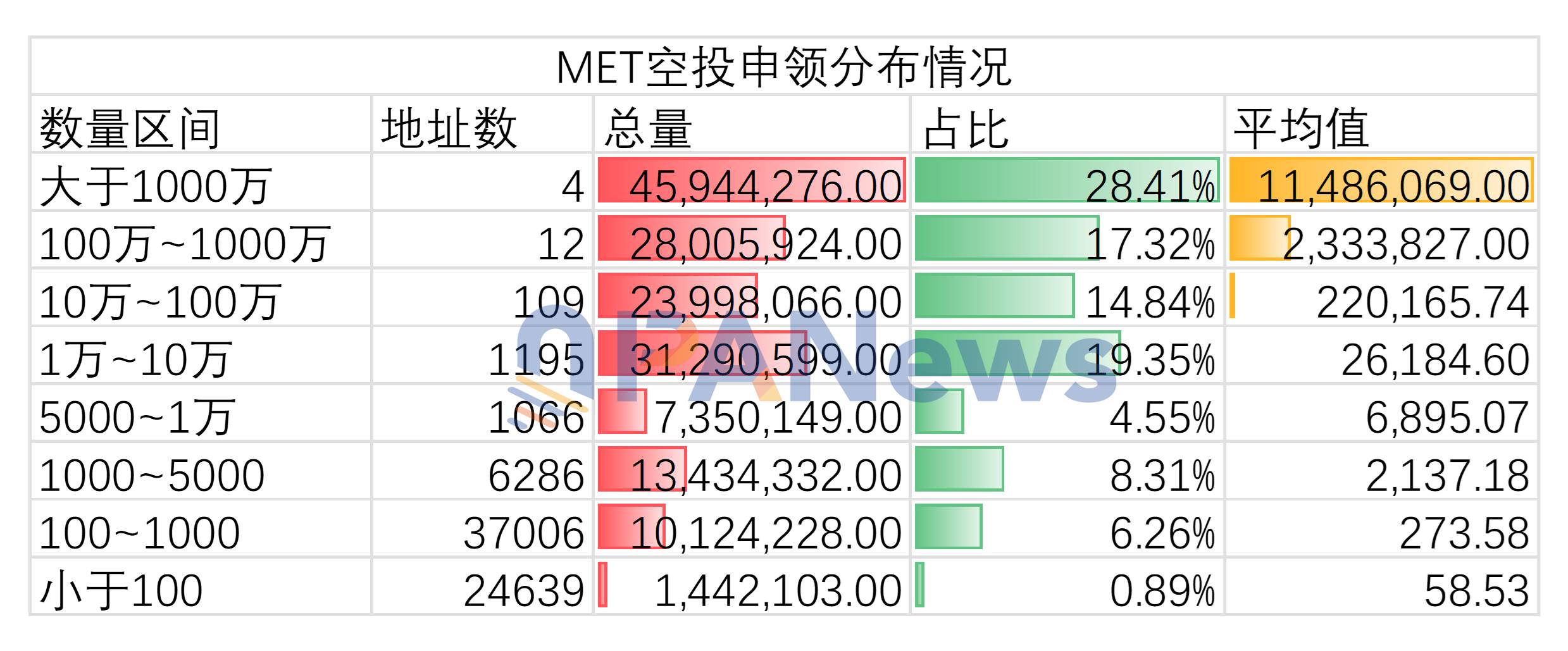
These figures reveal a harsh truth: the MET airdrop was far from a universal “everyone wins” community reward—it was an extremely skewed feast for the top-tier holders.
The Four Whales Are All Unusual
The largest recipient, address 3vAauDAR8er3HT8C3Vaj7WRbDoaoebi3KnvCdWuHj6ae, claimed over 12.15 million tokens, currently worth about $6.31 million. According to social media discussions, this address participated in the MER token airdrop (MER being the token of MercurialFinance, Meteora’s predecessor) and has held large amounts of JUP tokens, frequently transferring them to exchanges for selling. Some analysts believe this is a related address of the Meteora team.
Over the past eight months, this address has sold over 30 million JUP tokens.
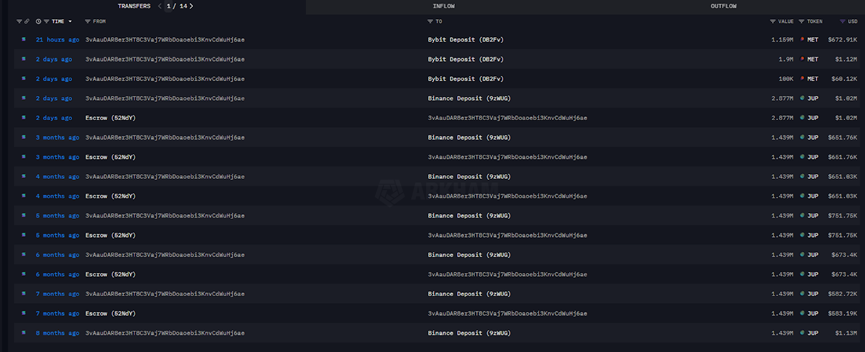
Now, the same dumping strategy is being applied to MET. As of October 25, this address has already transferred over 3 million MET tokens to the Bybit exchange.
The second- and third-largest recipients appear strongly linked. Both are large JUP holders and frequently add liquidity to Jupiter pools. Coincidentally, both have made multiple transfers of exactly 2,622,632.41 JUP tokens on the same days.


Their behavioral patterns strongly suggest both addresses are controlled by the same entity.
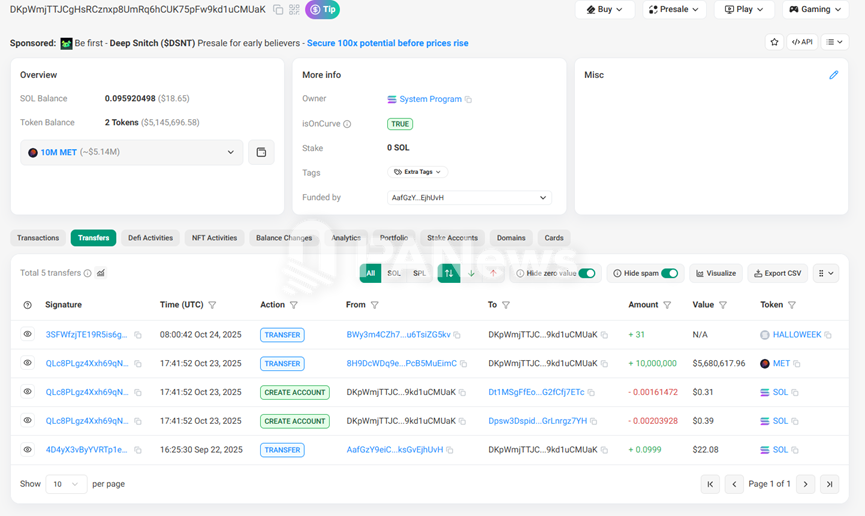
Additionally, the fourth-largest recipient, DKpWmjTTJCgHsRCznxp8UmRq6hCUK75pFw9kd1uCMUaK, is also suspicious. It received exactly 10 million MET tokens—an amount that doesn’t resemble normal points-based allocation. Notably, the address was created just a month ago, likely missing Meteora’s snapshot date. It has never performed any qualifying activities such as adding liquidity or staking JUP. To date, none of the tokens in this address have been moved. The eligibility and ownership of this address remain unknown.
“Insider Trading” Addresses Received Millions in Airdrops, Team Faces Class Action Lawsuit Crisis
Beyond these unusual large recipients, the MET airdrop contains numerous other controversies.
For example, Arkm pointed out that three addresses associated with insiders of the TRUMP token collectively received $4.2 million worth of MET airdrops. Immediately after receiving the tokens, they deposited all MET into the OKX exchange.
Moreover, Hayden Davis, a central figure in the LIBRA scandal, also received approximately $1.5 million worth of tokens in the MET airdrop.
These allocations sparked strong backlash from the community. One user posted on social media: “Why did Hayden Davis get the MET airdrop? You must be kidding... Thanks, Meteora, for giving Hayden Davis another $1.5 million.”
In fact, this isn’t the first time Meteora has faced a trust crisis. In December last year, Meteora launched the M3M3 platform and its namesake token, claiming it would transform the memecoin landscape. However, the project quickly collapsed, with the token losing 98% of its peak value, leading to subsequent class action lawsuits. In February this year, following the LIBRA scandal, the Meteora team again faced allegations of insider trading.
In summary, Meteora’s high-profile TGE and airdrop event failed to achieve the “community redemption” it promised. Instead, it became a disaster that widened the trust gap. From the radical 48% high-circulation model causing a price crash, to “insider” addresses tied to the TRUMP token and key figures from the LIBRA scandal receiving millions in airdrops, every move by Meteora appears increasingly detached from its proclaimed “community-first” ethos.
What was supposed to be a “redemptive” event merely added fresh wounds to the scars left by the M3M3 and LIBRA scandals, plunging the team deeper into a new wave of trust crises and class action lawsuits. For Meteora, the path to regaining community trust will clearly be far more difficult than anticipated.
Join TechFlow official community to stay tuned
Telegram:https://t.me/TechFlowDaily
X (Twitter):https://x.com/TechFlowPost
X (Twitter) EN:https://x.com/BlockFlow_News
 PANews