








Podcast Notes | Interview with CEO of Douro Labs: How Pyth Is Improving the Current State of Oracles?
TechFlow Selected TechFlow Selected
Podcast Notes | Interview with CEO of Douro Labs: How Pyth Is Improving the Current State of Oracles?
Pyth currently has no token; gaining early understanding of its design and development direction, and grasping how its oracle services address current market pain points, might help us gain a competitive edge in the upcoming market.
 Navigating Web3 tides with focused insights
Compiled & Translated by TechFlow
Oracles bring critical data—primarily asset prices—onto blockchains and are a key component of DeFi. Can the current oracle landscape be improved?
Oracle provider Pyth sees room for improvement and offers an alternative to Chainlink. Mike Cahill, CEO of Douro Labs—a new company affiliated with Pyth—joined a recent episode of the Unchained podcast to explain why he believes there's an opportunity to build a better oracle.
Since Pyth currently has no token, understanding its design and strategic direction—and how it addresses pain points in today’s market—could offer early insight for positioning ahead of future developments.
Spend 5 minutes reading this summary instead of 45 minutes listening to the full podcast.
Below are the key takeaways from the conversation, transcribed and compiled by TechFlow:
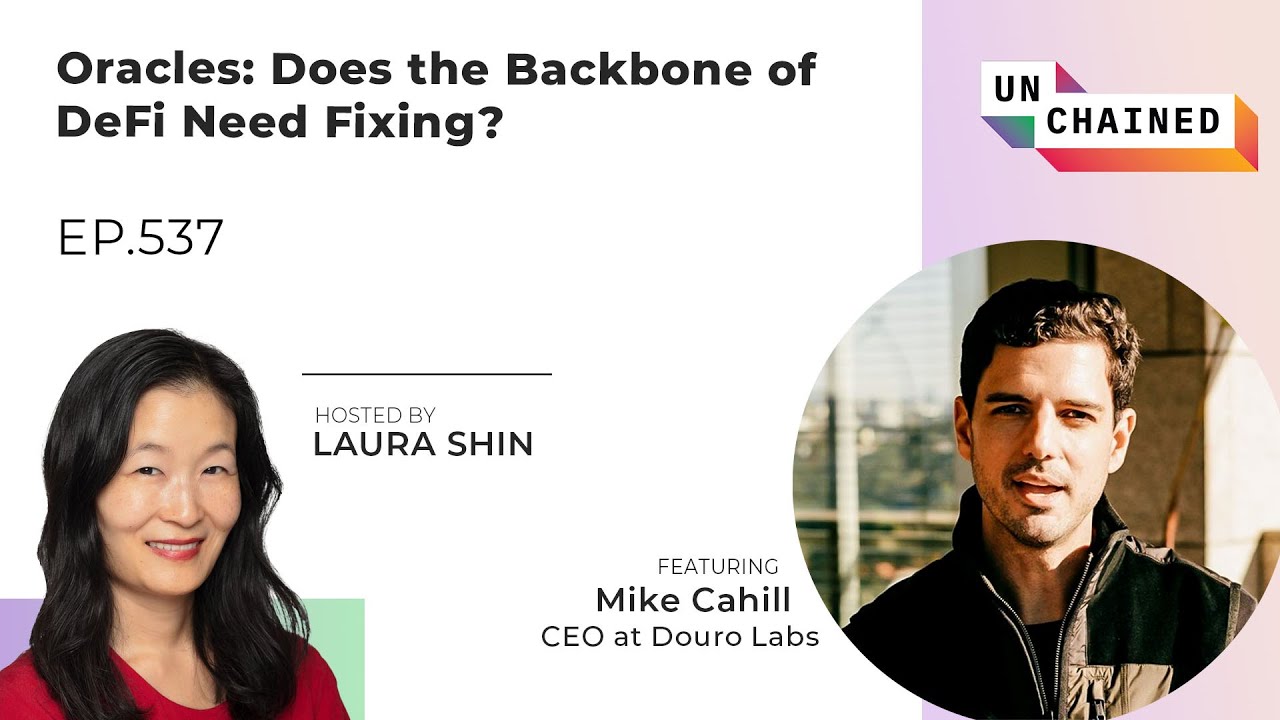
Host: Laura Shin, host of Unchained
Guest: Mike Cahill, CEO at Douro Labs
Credit: Unchained Podcast
Episode: Link
Release Date: August 29
How Did Mike Get Involved With Pyth?
-
Mike Cahill is the current CEO of Douro Labs.
(Note: More on Douro Labs will follow below.)
-
Mike began his career in traditional finance, specifically in foreign exchange sales and trading at Morgan Stanley. He observed the trend toward electronic markets and gradually transitioned into cryptocurrency.
-
He previously worked at KCG building FX trading operations and joined Jump Trading in 2019, where he began contributing to Pyth Network and has been a long-term contributor ever since.
Introduction to Pyth
-
Pyth is a data oracle network focused on bringing financial market data onto blockchains in a trusted, low-latency manner.
-
Pyth Network is designed to be inclusive and operates as a first-party data network. Its nodes are entities that actually publish or generate the data—such as trading firms and exchanges.
-
Pyth Network currently has 85 data providers, including nearly all major trading firms and large crypto exchanges.
-
Pyth aims to become the distribution platform for all global financial data—similar to how Spotify serves all the world’s music.
Challenges Facing Current Oracles
-
Mike believes current oracles face multiple challenges related to data providers, update mechanisms, and vulnerability to attacks. These can be broken down as follows:
-
Delayed Data Updates:
-
Current oracle solutions like Chainlink suffer from relatively slow data update speeds.
-
Such delays can impact the real-time performance and accuracy of on-chain applications.
-
-
Limited Data Sources:
-
Many oracle solutions rely only on free data, which may not be the most accurate or comprehensive.
-
For example, financial market data in traditional assets is often expensive—not freely available.
-
-
Risk of Oracle Attacks:
-
Oracle attacks are a common security issue, where attackers briefly manipulate prices on small exchanges and then exploit these price fluctuations on-chain.
-
To prevent such attacks, some solutions suggest slowing down data updates—but this creates trade-offs with latency and responsiveness.
-
-
Data Accuracy and Trust Issues:
-
Pyth Network uses an innovative approach requiring data sources to update every 300 milliseconds, including a confidence interval.
-
This means even if one source provides incorrect data, other sources help establish a broader confidence range, improving overall accuracy.
-
-
Motivation and Reliability of Data Providers:
-
Selecting reliable data providers is challenging. Pyth seeks institutionally strong firms with established reputations.
-
These companies have far more to lose across their other business lines than they could gain by manipulating Pyth prices.
-
-
Collaboration With Traditional Financial Institutions:
-
Partnering with traditional financial institutions remains a hurdle. For instance, engaging data providers from traditional finance to understand their willingness to collaborate with firms bridging TradFi and crypto.
-
-
Diversity Among Data Providers:
-
Some data providers have never monetized their market data before, while others—like Cboe (Chicago Exchange)—already do. This diversity requires different incentive and partnership models.
-
-
Variety of Oracle Solutions:
-
There are various oracle models—push vs. pull, fast vs. slow, first-party vs. third-party, single-source vs. aggregated. This complexity makes selecting and implementing solutions more difficult.
-
Pyth’s Specific Responses to These Challenges
-
First-Party Data Network:
-
Pyth is a first-party data network, meaning the nodes are the actual entities generating or publishing the data.
-
This contrasts with reporting networks that scrape data from the web and then post it on-chain.
-
-
Pull-Model Oracle:
-
Pyth uses a pull-model oracle, enabling low-latency data delivery and offering users an unprecedented trading experience.
-
TechFlow note: “Pull” means data consumers can request data on-demand, rather than passively receiving constant push updates.
-
-
Multi-Chain Oracle:
-
Pyth started on Solana but has expanded across multiple blockchains over time.
-
This multi-chain strategy allows Pyth to deliver data across diverse blockchains, broadening access.
-
Comparison to Facebook: Pyth’s expansion mirrors Facebook’s growth—from Harvard, to Ivy League schools, then U.S. colleges, and eventually globally.
-
-
Application-Specific Chain:
-
During periods when Solana became highly congested, Pyth recognized the need for a dedicated application-specific chain—Pythnet.
-
This dedicated chain enables more efficient data processing without interference from other blockchain activities.
-
-
Perseus Upgrade:
-
Mike highlighted this as a major upgrade for Pyth Network, using Merkle trees for proofs, enabling more customizable data delivery.
-
This upgrade improves cross-chain data efficiency and reduces transaction costs.
-
The Founding of Douro Labs
-
Creation and Goals of Douro Labs:
-
Douro Labs is a 20-person team comprising former contributors from Jump, Goldman Sachs, AWS, Chorus One, and others.
-
It is a blockchain infrastructure company whose primary focus is supporting Pyth Network by providing tools and development to accelerate its growth.
-
Mike Cahill and his co-founders Kieran and Jan have deep expertise and long-standing involvement with Pyth, giving Douro Labs strong foundational knowledge.
-
-
Future Plans for Douro Labs:
-
While currently focused on Pyth Network, Douro Labs may expand to support other projects in the future.
-
They plan to continue driving network development, including technical upgrades like the upcoming Perseus upgrade.
-
Douro Labs also intends to work with data providers through governance processes to further expand the network.
-
-
Vision for Douro Labs:
-
Mike Cahill envisions all financial data flowing through Pyth to blockchains—just as all music flows through Spotify.
-
He aims to use technology to expand access to capital markets, lower costs, and grow the user base.
-
Overall, Douro Labs is a newly formed company primarily focused on providing tools and development support to accelerate Pyth Network’s growth and expansion in the crypto ecosystem.
Perspectives on the Current Crypto Market
-
Current Market State:
-
The crypto market is in a particularly interesting phase. Trading volumes are down, market makers are pulling back, and exchanges like Binance appear unstable. The entire ecosystem seems to be undergoing transformation.
-
-
Market Observations:
-
Despite apparent market pessimism, Mike observes that the number of developers and builders remains steady.
-
Pyth integrates three new applications each week, indicating ongoing project development.
-
-
Optimistic Outlook:
-
Despite falling Bitcoin prices, Mike remains optimistic. While market sentiment may be temporarily dampened, he notes that tools and applications are now better than ever.
-
He believes that continued development during bear markets lays the foundation for future growth.
-
-
Broader Market Implications:
-
Mike believes the main technological trend is making things cheaper and more widely distributed.
-
He expects crypto and DeFi to benefit those who previously lacked access, enabling more people to use financial tools at lower cost.
-
Join TechFlow official community to stay tuned
Telegram:https://t.me/TechFlowDaily
X (Twitter):https://x.com/TechFlowPost
X (Twitter) EN:https://x.com/BlockFlow_News
 深潮TechFlow






