








DePIN and DeREN: Finding New Opportunities in the Niche of Decentralized Infrastructure
TechFlow Selected TechFlow Selected
DePIN and DeREN: Finding New Opportunities in the Niche of Decentralized Infrastructure
While DePINs and DeRENs can leverage tokens to subsidize initial resource costs, the most successful networks compete not merely on price, but by unlocking new demand or expanding markets in unique ways.
 Navigating Web3 tides with focused insights
Author: Mason Nystrom
Compiled by: TechFlow
Decentralized physical infrastructure networks—crypto networks that use token incentives to generate liquidity and fund the operation of physical infrastructure—are growing rapidly.
The value of these networks is clear: they provide better solutions for supplying consumable resources—from computing to energy to data. These resources are then consumed directly by companies, or more commonly, integrated into their own products and services. For example, decentralized networks like Hivemapper sell data directly to companies such as Uber, which uses image data to improve its products. Similarly, Livepeer enables live streaming applications to leverage its video transcoding marketplace and has been integrated by platforms like Bonfire, allowing creators to easily launch their own live streams.
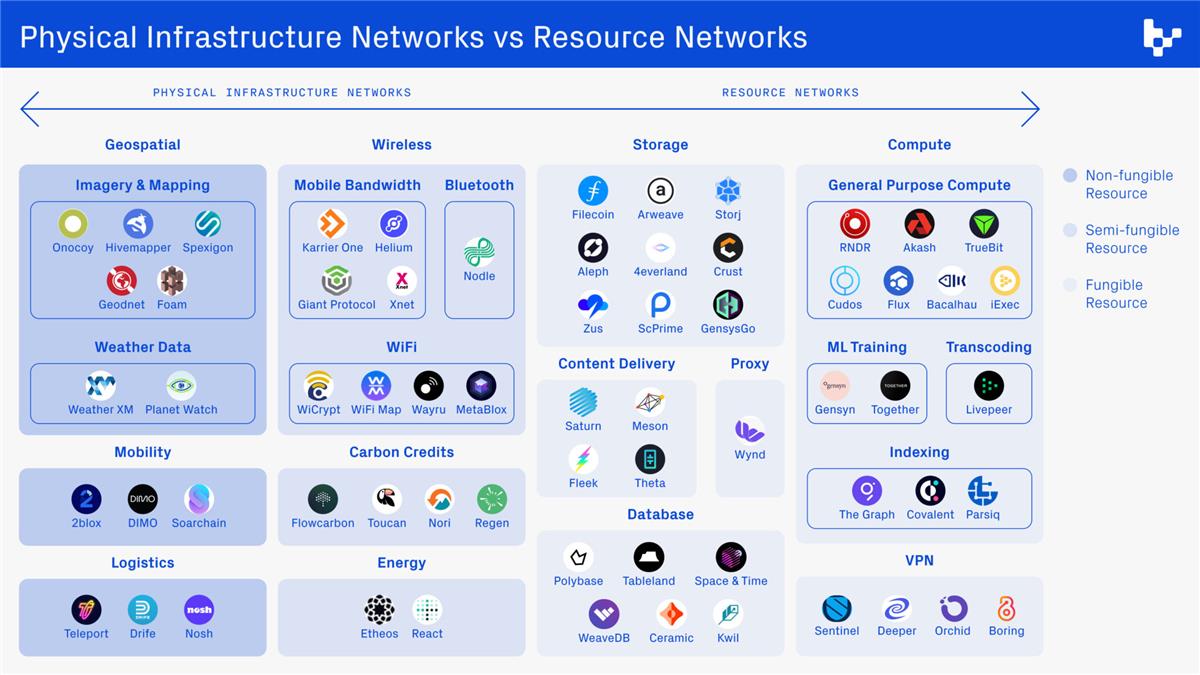
(TechFlow note: Projects on the left side of the diagram represent physical infrastructure networks; those on the right represent resource networks—storage, compute, data, etc.)
To better assess the potential of these networks, we need a more refined classification framework. The current popular industry term is DePIN (Decentralized Physical Infrastructure Networks), but I propose further subdividing decentralized infrastructure networks into two categories:
-
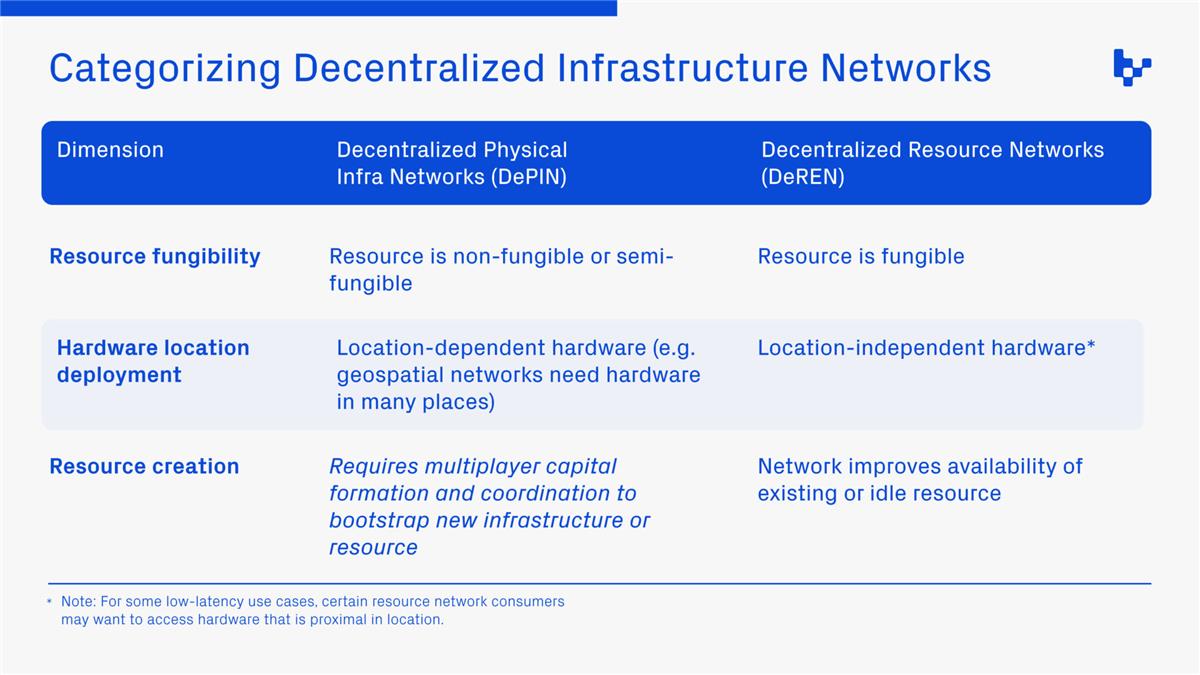
Decentralized Physical Infrastructure Networks (DePINs): crypto networks that incentivize the deployment of location-dependent hardware devices, providing consumable, non-fungible resources;
-
Decentralized Resource Networks (DeRENs): crypto networks that use incentives to build markets and increase supply of existing or idle consumable, fungible resources, relying on hardware independent of geographic location.
DePINs and DeRENs differ across three core dimensions:
-
Resource fungibility;
-
Hardware deployment location;
-
Resource creation.
Resource Fungibility
The most significant of these differences lies in the fungibility of the consumable resources.
In resource networks, consumable resources are fungible because the network's hardware assets are typically interchangeable. For instance, compute resources provided by networks like Akash or Render are highly homogeneous—the processing power of GPUs with identical specifications and capacity is equivalent. Except for highly specialized activities such as high-frequency trading, users generally do not care about the geographical location of their hardware, as long as network latency remains acceptable compared to centralized architectures.
In contrast, DePINs utilize non-fungible or semi-fungible resources. Here, consumable assets are not easily interchangeable, and the hardware is often unique to a specific network. For example, Hivemapper dashcams map specific locations, generating data unique to that place and time. Moreover, imaging networks like Spexigon cannot contribute their aerial imagery data to the Hivemapper network—each network’s assets consist of mapping data that is exclusive to that network.
Of course, there are intermediate cases along this spectrum. Energy, for instance, is semi-fungible—it can be used for various purposes, but its utility is limited by transmission distance.
Hardware Location and Resource Creation
Hardware location and resource creation are closely linked; deploying application-specific, location-dependent hardware usually coincides with building proprietary resources.
In this regard, DePINs face greater challenges in bootstrapping both supply and demand sides of the market. The supply side depends on setting up location-specific hardware, while creating demand relies on achieving sufficient scale so that the network becomes valuable to end users.
Resource networks find it easier to bootstrap supply, since idle resources can come from anywhere and typically don’t require new hardware or infrastructure. However, resource networks with fungible assets also face stronger competition, as switching costs between networks are low.
Building Moats in DePIN and DeREN
Crypto-based resource networks still need to compete with Web2 counterparts like AWS and Google. While both DePINs and DeRENs can use tokens to subsidize initial resource costs, the most successful networks compete not just on price, but by unlocking new demand or expanding markets in unique ways.
For example, Arweave did not compete primarily on file storage pricing, but instead offered a novel functionality—permanent storage—that brought convenience and eventually led to success in storing NFT metadata. In the DePIN category, mobility networks like DIMO aggregate previously siloed data, enabling a new wave of applications ranging from battery intelligence and energy management to improved vehicle commerce.
Another successful strategy is vertical integration—building initial products that leverage the underlying infrastructure or resource network to drive demand. Render combines its GPU rendering capabilities with Octane software, driving adoption of its underlying compute resource network.
Join TechFlow official community to stay tuned
Telegram:https://t.me/TechFlowDaily
X (Twitter):https://x.com/TechFlowPost
X (Twitter) EN:https://x.com/BlockFlow_News
 Variant






