Morgan Stanley Enters Bitcoin ETF Market with 0.14% Fee, Launching “Price War” Targeting $83 Billion Market
TechFlow Selected TechFlow Selected
Morgan Stanley Enters Bitcoin ETF Market with 0.14% Fee, Launching “Price War” Targeting $83 Billion Market
Morgan Stanley set its fee rate at 0.14%, not merely symbolically entering the competition but directly targeting the lowest price tier.
 Navigating Web3 tides with focused insights
Author: TechFlow
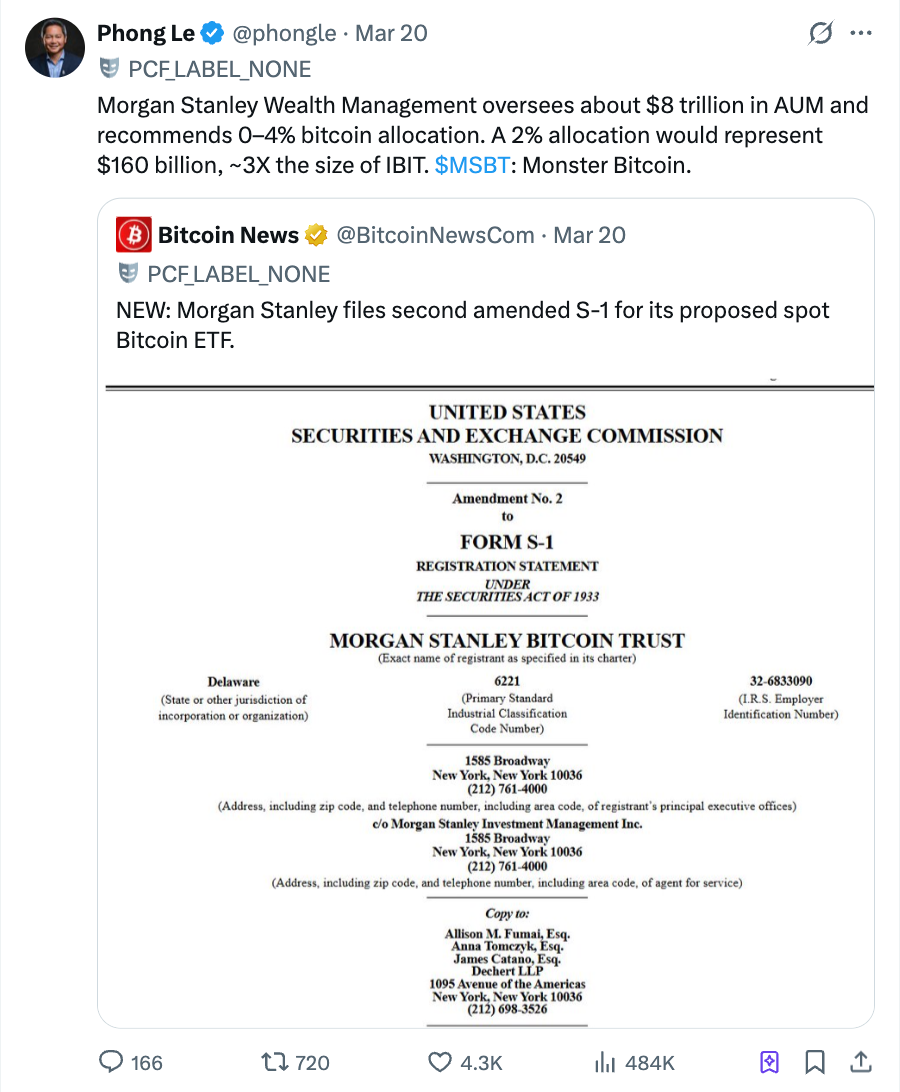
Morgan Stanley disclosed in its latest S-1 amendment filing that the management fee for its spot Bitcoin ETF, “MSBT,” will be set at 0.14%, lower than all existing competitors in the market. If approved by the SEC, MSBT will become the first spot Bitcoin ETF directly issued by a major U.S. bank. Morgan Stanley’s wealth management division oversees approximately $8 trillion in client assets and employs roughly 16,000 financial advisors. Phong Le, CEO of Strategy, estimates that even a modest 2% allocation would drive about $160 billion in inflows—nearly three times the current size of BlackRock’s IBIT.
Morgan Stanley has officially dropped a pricing bomb on the spot Bitcoin ETF market.
According to The Block, Morgan Stanley filed an S-1 amendment with the U.S. Securities and Exchange Commission (SEC) last Friday, revealing that the annualized delegated sponsor fee for its proposed spot Bitcoin ETF—the Morgan Stanley Bitcoin Trust (ticker: MSBT)—will be 0.14%. This rate is lower than all currently available comparable products: it is one basis point below Grayscale’s Bitcoin Mini Trust (0.15%) and eleven basis points below BlackRock’s iShares Bitcoin Trust (IBIT) (0.25%).
If approved, MSBT will be the first spot Bitcoin ETF directly issued and listed by a major U.S. bank—and the first new entrant since the initial wave of over a dozen such products launched in January 2024 (excluding Grayscale’s Mini Trust). The New York Stock Exchange (NYSE) issued a listing notice earlier this week, and Bloomberg ETF analyst James Seyffart expects MSBT could begin trading as early as early April.
Lowest Fee Across the Market: An Aggressive One-Basis-Point Pricing Strategy
In the spot Bitcoin ETF market—where all products hold Bitcoin directly and track its spot price—the expense ratio remains one of the few key differentiating factors. By setting its fee at 0.14%, Morgan Stanley isn’t merely symbolically entering the competitive arena; it is squarely targeting the lowest price tier.
Current key competitor fees are as follows: Grayscale Bitcoin Mini Trust at 0.15%, Bitwise BITB at 0.20%, ARK/21Shares ARKB at 0.21%, BlackRock’s IBIT and Fidelity’s FBTC both at 0.25%, and Grayscale’s flagship GBTC at 1.5%.
The impact of fee differences becomes substantial for large allocations and long-term holdings. For a $100,000 investment, MSBT would save approximately $110 annually versus IBIT; for institutional-sized positions, this gap compounds into a significant cumulative advantage over time.
Historical data already demonstrates how powerfully fees influence fund flows. According to The Block, Grayscale’s flagship GBTC charges 1.5% and has seen its assets under management shrink from roughly $29 billion to about $13 billion since converting to an ETF in January 2024.
Bloomberg ETF analyst James Seyffart responded to the fee disclosure on X, calling Morgan Stanley’s move “not messing around.”
An $8 Trillion Wealth Management Network
In a spot Bitcoin ETF market marked by highly homogenous product structures, the expense ratio is just one of Morgan Stanley’s chips at the table—the firm’s true differentiator lies in its distribution network.
Morgan Stanley’s wealth management division oversees approximately $8 trillion in client assets and employs roughly 16,000 financial advisors. Amy Oldenburg, Head of Digital Asset Strategy at Morgan Stanley, previously noted that about 80% of crypto ETF trading activity originates from self-directed investors—not advisor-managed accounts. A proprietary product with the lowest expense ratio in the market could eliminate “cost concerns” advisors face when recommending Bitcoin allocations, thereby unlocking advisor channels—a largely untapped source of incremental demand.
Bloomberg ETF analyst Eric Balchunas dubbed Morgan Stanley “the ultimate gatekeeper for affluent baby boomer capital.”
Phong Le, CEO of Strategy (formerly MicroStrategy), offered an even more aggressive estimate based on scale. In a post on X, he pointed out that Morgan Stanley’s wealth management division manages approximately $8 trillion in assets and currently recommends allocating 0–4% of client portfolios to digital assets. Assuming a 2% allocation, the potential capital pool would reach roughly $160 billion—nearly triple BlackRock’s IBIT’s current ~$55 billion in assets under management. He dubbed MSBT the “Monster Bitcoin.”
However, Joe Takayama of Backpack cautioned that actual allocation rates may fall far short of 2%—potentially approaching zero. Widespread activation of advisor channels remains unproven and will require time to validate.
More Than Just Bitcoin: Morgan Stanley’s Full-Spectrum Crypto Strategy
MSBT is not an isolated product but rather one component of Morgan Stanley’s systematic entry into the digital asset space.
The firm submitted simultaneous applications for spot Bitcoin and Solana ETFs in January 2026, followed shortly thereafter by an application for a staked Ethereum ETF. On February 18, Morgan Stanley applied for a national trust bank charter to offer clients digital asset custody, trading, and staking services directly. The firm now formally recommends allocating 2%–4% of investment portfolios to digital assets—including within Individual Retirement Accounts (IRAs) and 401(k) plans.
In terms of product architecture, MSBT has selected Coinbase as its custodian and prime broker, while BNY Mellon handles cash custody and fund administration. Initial seed capital is approximately $1 million, corresponding to 10,000 creation units. The fee for the Solana ETF has not yet been disclosed, and related filings remain unrevised—its progress clearly lags behind MSBT’s.
If the SEC ultimately approves MSBT, Morgan Stanley will become the first major U.S. bank to directly issue a spot Bitcoin ETF. Goldman Sachs, JPMorgan Chase, Bank of America, and other institutions each manage trillions of dollars in wealth assets, yet none have filed applications for their own Bitcoin ETFs. Analysts widely expect Morgan Stanley’s move to accelerate internal evaluations across the industry.
Join TechFlow official community to stay tuned
Telegram:https://t.me/TechFlowDaily
X (Twitter):https://x.com/TechFlowPost
X (Twitter) EN:https://x.com/BlockFlow_News
 深潮TechFlow