








Unlocking the Power of Data: How to Improve Efficiency and User Satisfaction Through Data-Driven Decision Making?
TechFlow Selected TechFlow Selected
Unlocking the Power of Data: How to Improve Efficiency and User Satisfaction Through Data-Driven Decision Making?
Data will enhance interoperability between on-chain and off-chain systems, promoting the integration of decentralized finance with traditional financial systems.
 Navigating Web3 tides with focused insights
Author: Momir@IOSG Ventures
Smart contracts have limitations due to their lack of ability to interact with the environment, which restricts the potential development of decentralized applications (dApps). To enable more complex functionalities, DeFi protocols have two options:
-
They can adopt flexible designs where users can personally handle various scenarios;
-
Or they can introduce external dependencies—relying on off-chain infrastructure such as oracles, keepers, or off-chain computation—to maintain a simple user experience.
In a recent thought-provoking article titled "Why DeFi is Broken and How to Fix It – Part 1: Oracle-Free Protocols," Dan Elitzer advocates for using zero-external-dependency DeFi primitives to minimize attack vectors. The idea is to eliminate the need for trust in third parties. However, a zero-dependency DeFi ecosystem would inevitably demand greater specialization. Most users lack the time, expertise, or resources to become market makers on Uniswap v3 or assess collateral quality within protocols without external dependencies, forcing them to rely on trusted intermediaries to participate.
Therefore, the pursuit of zero dependency might bring us back to square one—or worse, force non-professional users to trust complex entities or deposit funds into transitional smart contracts, increasing insecurity. Rather than striving to completely eliminate external dependencies, we should consider more practical approaches, such as conducting stricter audits of external dependencies and limiting potential black swan scenarios. We must recognize that a certain degree of dependency is inevitable and even essential for industry growth.
Among prominent DeFi projects, early versions of Uniswap came closest to achieving zero dependency. However, the recent introduction of Uniswap v4 signals a shift toward advancing the field through a highly modular approach ("Hooks").
Data Primitives
Discussions around external dependencies primarily revolve around smart contracts' ability to interact with external data. Today, data interaction typically relies on oracles to access off-chain information, albeit within limited scope (mainly prices of major cryptocurrencies).
As more activities migrate onto blockchains, vast amounts of valuable on-chain data can be used in an algorithmic and transparent way to enhance mechanism design. However, despite the transparency of on-chain data, integrating it with smart contracts is not straightforward. Reading, processing, and delivering meaningful data requires building a complex and trusted infrastructure. As a result, developers often rely on existing tools to meet their data needs. Yet, most existing data solutions are rooted in Web 2.0 frameworks, and even many Web3-native protocols cannot guarantee the accuracy of the data they provide.

Discussion about Sushiswap’s Polygon Sushi-Matic subgraph sending inaccurate data
Considering that smart contracts can manage deposits worth billions of dollars, directly connecting them to a trusted API source is neither desirable nor practical, as such dependency undermines the decentralized nature of blockchain ecosystems.
Building Tamper-Proof Data Solutions
Our investment philosophy centers on a fundamental belief that tamper-proof data will become the cornerstone of next-generation DeFi protocols. However, achieving tamper-proof data is no simple task—it requires complex infrastructure and extensive optimization to make it economically viable.
In this context, Space and Time has emerged as a pioneer in building tamper-proof data infrastructure. A key component is its SQL proofs—a refinement of SNARK proofs specifically designed for querying data from relational databases. This method provides guarantees that both queries and their underlying data remain untampered. Additionally, when retrieving data via RPC calls from archival nodes, it ensures data validity.
Other notable trustless data primitive projects include but are not limited to Nil Foundation, Axiom, Brevis, Herodotus, etc.
Tamper-proof data opens new horizons for DeFi protocols, enabling them to push beyond functional boundaries and drive further growth and innovation in the industry.
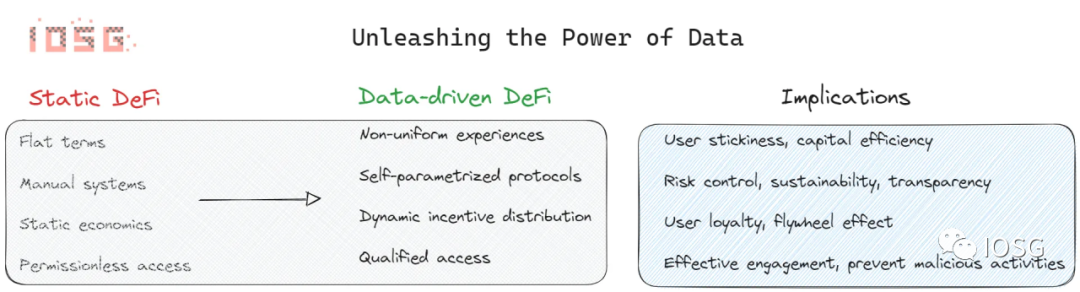
Below, we discuss how data-driven protocol design can be optimized under the following aspects:
1. Personalized User Experience
2. Self-Parameterizing Protocols
3. Protocol Economics
4. Qualified Access
1. Personalized User Experience
In the tech business world, offering tailored services to users is commonplace. However, smart contracts—essentially strings of code representing certain business logic—typically deliver a uniform user experience, which often equates to poor user experience. For example, on some lending platforms, User A is a beginner, User B is a long-term protocol user, and User C is an experienced trader. This lack of differentiation fails to account for user behavior, missing opportunities to enhance user stickiness, incentivize positive actions, and optimize capital utilization.
Protocols have a vested interest in identifying user behavior and adjusting accordingly. For instance, by leveraging credit ratings, better-performing customers could be offered cheaper credit or lower collateral requirements. Naturally, such a project would attract users away from platforms with uniform terms. Moreover, this approach provides implicit incentives for users to behave well to earn more favorable conditions.
Drawing from fintech, companies like SoFi gained market share by rejecting standardization. SoFi identified inefficiencies in the student loan market—Stanford graduates were charged the same interest rates as other borrowers despite having a higher likelihood of landing high-paying jobs after graduation. By adjusting rates to better reflect user risk profiles, SoFi achieved remarkable success.
Likewise, in DeFi, we envision opportunities for innovative protocols to incorporate user risk into interest and collateral factors. However, care must be taken not to simply under-collateralize loans based solely on historical data, as historical data becomes irrelevant when game-theoretic dynamics change.
It's worth noting that projects like Spectral and Cred Protocol are attempting to build credit scoring models from on-chain data. However, these projects run on centralized databases, so as long as the data and models they serve come from centralized sources easily subject to tampering, major DeFi protocols are unlikely to connect to their APIs. Conversely, if these projects adopt tamper-proof solutions, they could become ubiquitous DeFi credit oracles powering a wide range of innovative applications.
2. Self-Parameterizing Protocols (Minimizing Governance Intervention)
Many DeFi protocols still rely on manual governance processes, often guided by off-chain consulting firms, to adjust their parameters. For example, AAVE pays substantial fees to external consultants to monitor and guide protocol risk parameters.
However, this practice raises several issues:
1. Lack of real-time support: The system lacks responsiveness to changing market conditions or emerging risks.
2. Manual systems: Reliance on human intervention introduces delays and potential inefficiencies when adjusting protocol parameters.
3. Trust in off-chain entities: Dependence on external consulting firms raises concerns about transparency and the methodologies used in making recommendations.
This static approach was exposed during an attack on AAVE, resulting in bad debt that could have been avoided with appropriate lending parameters better reflecting the liquidity of borrowed tokens. Furthermore, the risk of using circulating tokens as collateral in lending protocols remains inadequately addressed.
To address these limitations, projects should transition toward real-time, automated, transparent, and trustless designs. For example, lending protocols could leverage infrastructure like Space and Time to monitor data in real time, enabling dynamic adjustments of collateral, lending parameters, and other key metrics.
Similarly, exchanges could introduce dynamic fee structures based on volatility or impermanent loss. Many liquidity pools atop Uniswap v3 struggle to achieve sustainable operations mainly because they cannot dynamically charge LPs. With Uniswap v4 Hooks or modules like Valantis, dynamic fees become feasible.
Additionally, aggregators could adapt to the evolving risks and returns of underlying protocols without interference from humans or fixed fees. The collaboration between Spool and Solity represents a step in this direction, with Solity using big data methods to analyze pool risk-return profiles.
3. Protocol Economics
Data-driven approaches have the potential to enhance protocol and token economics in DeFi, where projects can share incentives with qualifying users.
For instance, a DEX aggregator seeking user retention and loyalty could distribute slippage revenue to users who meet certain criteria, such as executing a specified number of trades and reaching a minimum trading volume.
Such incentives strongly motivate early users, build loyalty within the user base, and directly reward existing users to promote protocol usage within their own communities.
4. Qualified Access
While blockchains are permissionless by nature, they also allow for selective freedom. In multiple cases, permissioned access at the application layer can ensure protocols aren’t used for malicious purposes or effectively engage with target user groups.
For example, privacy protocols like Tornado Cash face regulatory scrutiny due to potential use in money laundering or other illegal activities. To prevent money laundering, protocol developers can take measures to block bad actors from interacting with their platforms.
Alternatively, for market makers, knowing their counterparties is highly valuable, yet DEXs typically lack access to such information. Assuming it’s possible to use data to build proof-of-personhood, DEXs could allow only non-bot addresses to interact, thereby solving this issue.
Demand for Verifiable Computation
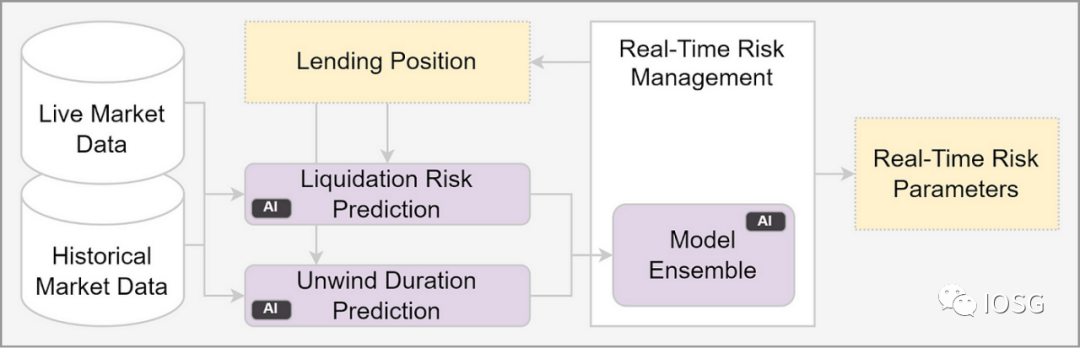
The integration of trustless data primitives can fully realize some of the concepts discussed above. However, others will require additional resources to perform statistical computations or machine learning. For example, credit scoring projects can leverage tamper-proof data but still need machine learning algorithms to generate credit scores.
Or under the premise of a Risk Oracle, obtaining data such as circulating supply, volume, transaction count, number of holders, and time since TGE for specific tokens is crucial to determining appropriate collateral and lending factors. However, precise calculations using machine learning techniques are needed on top of this data.
source: https://chainml.substack.com/p/web3-needs-ai-to-realize-its-potential
Other areas in DeFi requiring more sophisticated computation include but are not limited to:
● Yield aggregators: Estimating yields and risks of underlying protocols and finding optimal allocations.
● Portfolio optimization: Calculating target portfolio allocations based on predetermined criteria, adjusting directional exposure according to technical indicators, etc.
● Decentralized derivative exchanges: Systemic risk management, funding rate adjustments, derivative pricing, etc.
● Advanced trade execution algorithms
● Liquidity vault market-making logic
● Liquidation vaults
Projects like ChainML meet this demand by providing a verifiable off-chain computing layer supported by specially built consensus mechanisms. Others building distributed machine learning computing layers include but are not limited to GenSyn, Together.xyz, Akash, etc.
Likewise, ZKML presents an intriguing opportunity where ZK proofs can compress computations into succinct proofs that can be verified on-chain, or demonstrate the use of specific models without revealing their attributes. Examples include ZK projects like Modulus Labs and Giza.
However, implementing machine learning in ZK is currently very expensive, increasing the challenges of practical deployment. While hardware acceleration and circuit optimization may improve performance in the future, AI's computational demands are expected to grow even faster, making ZKML suitable only for niche computational methods and unable to accommodate state-of-the-art AI models. Therefore, consensus-based pessimistic approaches or fraud-proof-based optimistic approaches provided by projects like ChainML may represent the best opportunity to integrate cutting-edge AI algorithms into Web3.
Conclusion
The convergence of tamper-proof data, advanced computational capabilities, and data-driven decision-making has the potential to unlock new innovation, improve efficiency, and enhance user satisfaction within the DeFi ecosystem. While this article focuses on optimizations possible on top of on-chain data primitives, we are equally excited about opportunities arising from integrating diverse off-chain data via zk proofs. We believe data will enhance interoperability across on-chain and off-chain environments, fostering convergence between decentralized finance and traditional financial systems.
As the industry continues to evolve, protocols must embrace emerging technologies, collaborate with leading projects, and prioritize transparency and trustlessness—not only to build a robust and sustainable future for DeFi but also to make possible its profound impact on the global financial landscape.
Disclosure: Space and Time, ChainML, Nil Foundation, and Solity are part of IOSG’s portfolio.
Join TechFlow official community to stay tuned
Telegram:https://t.me/TechFlowDaily
X (Twitter):https://x.com/TechFlowPost
X (Twitter) EN:https://x.com/BlockFlow_News
 IOSG Ventures






