








Bloomberg Terminal earns $10 billion annually from data redistribution; now six institutions have directly put their data on-chain.
TechFlow Selected TechFlow Selected
Bloomberg Terminal earns $10 billion annually from data redistribution; now six institutions have directly put their data on-chain.
This breaks the 44-year monopoly held by data intermediaries such as Bloomberg.
 Navigating Web3 tides with focused insights
Author: Thejaswini M A
Translated by TechFlow
TechFlow Introduction: Six major Wall Street institutions—including Fidelity, Euronext, and Tradeweb—have begun publishing market data directly onto blockchain via Pyth. Any developer can access this data for free. This breaks Bloomberg’s 44-year-old monopoly over financial data distribution—no two-year contracts, no $27,000 annual fee, no proprietary keyboard required. More importantly, it represents a prerequisite for real-world assets (RWAs) to scale meaningfully in DeFi: data must go on-chain before assets do.
In 1981, Michael Bloomberg was fired from Salomon Brothers at age 39, after 15 years with the firm and a $10 million severance package. He was deeply frustrated by how Wall Street handled information. His response—by any reasonable standard—was insane: he began showing up each morning at Merrill Lynch’s offices with coffee, wandering hallways, handing cups to strangers, and explaining he was building a computer that “knew everything.” Traders accepted the coffee—but remained skeptical about the computer.
Forty-four years later, each of those computers costs $27,000 per year. There are 350,000 installed globally, generating roughly $10 billion annually for Bloomberg. Its structural genius lies in inserting itself between institutions that own data and users who need it—charging tolls on everything that passes through. Bloomberg never owned the data: Merrill had it, Goldman had it, every trading firm on Wall Street had it. Bloomberg simply built a toll booth—and convinced everyone the toll booth *was* the destination. Then it raised prices year after year, because what else could you do? Call your broker instead?
This model survived every technological shift for four decades, because no one devised a better distribution mechanism—until last Wednesday.
On April 9, six institutions that once fed data into that toll booth began publishing elsewhere: Euronext, Fidelity, Tradeweb, OTC Markets Group, Singapore Exchange’s FX division, and Exchange Data International—all launching their data directly on-chain via Pyth’s new data marketplace. Developers across 100 blockchains can now access it instantly—no contracts, no two-year minimum commitments, no yellow-and-green-button keyboards required.
Remember this: the irony of building a monopoly on others’ data is that those “others” eventually notice.
The financial data industry is worth ~$30 billion annually—the world’s least-discussed monopoly, perhaps because the only people paying attention are already paying for it.
Bloomberg commands ~33% of the global financial data market, generating over $10 billion yearly just from its terminal business. Refinitiv—now owned by the London Stock Exchange Group following its $27 billion acquisition—holds ~20% share. ICE Data Services reports $2.8 billion in market data revenue. Next come FactSet, S&P Global, Morningstar, and several regional players serving niche markets. Together, the top four suppliers control the vast majority of how financial data flows from originators to end users.
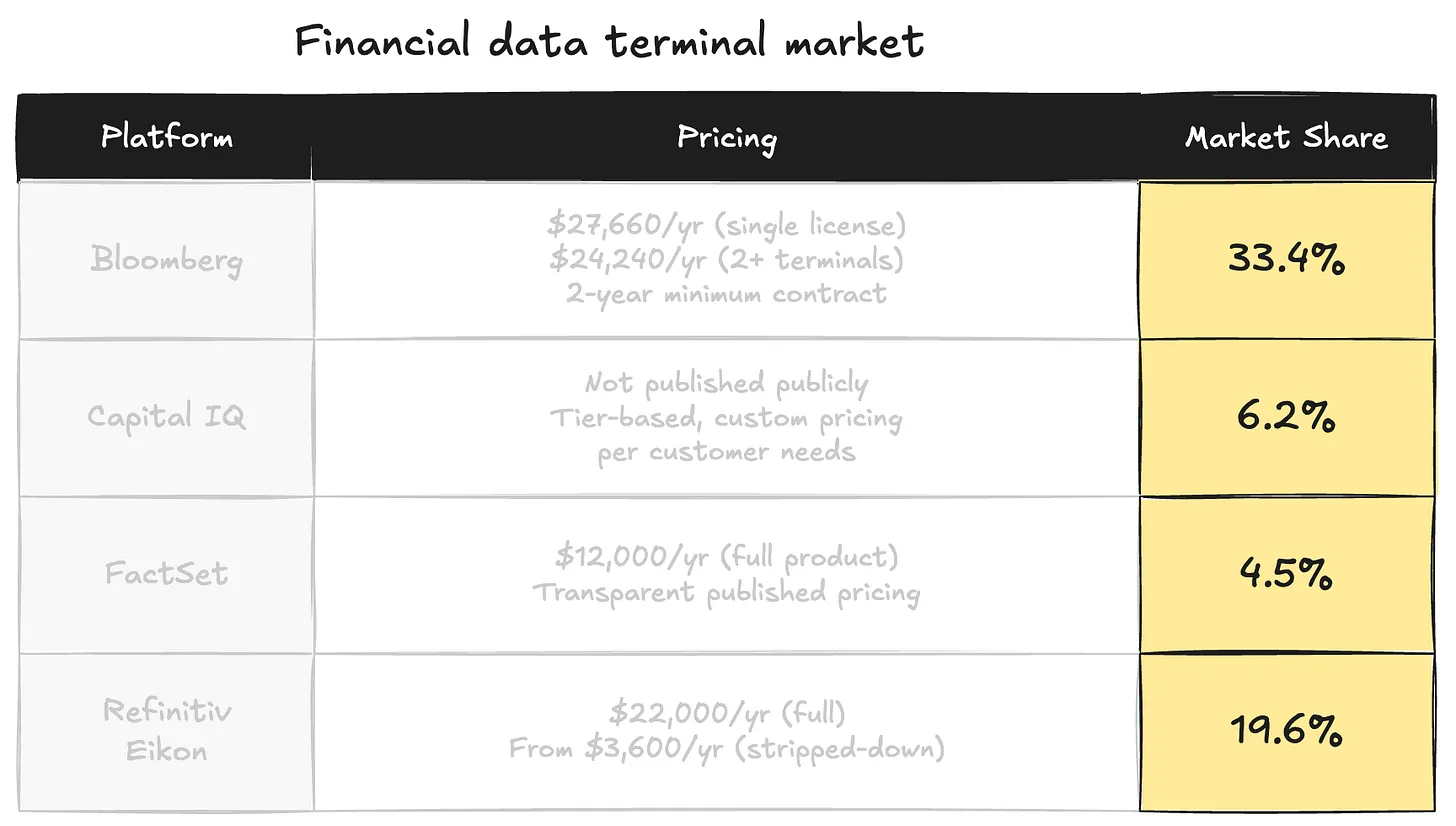
All these firms operate identically. Exchanges, trading firms, banks, and asset managers generate pricing data as a byproduct of their core operations. They sell or license that data to vendors. Vendors package and standardize it, layer on analytics tools, then resell it at steep markups—under long-term contracts, using proprietary access methods designed to make switching painful. A Bloomberg subscription locks you in for two years; canceling early incurs a 50% penalty on remaining contract value. And Bloomberg’s entire experience is engineered to make leaving feel harder than staying: different keyboards, different data formats—even half of Wall Street’s internal messaging system runs on Bloomberg terminals, meaning switching also means losing your contact list.
This model endured for forty years because vendors solved a genuinely hard problem: aggregating data from hundreds of sources, cleaning and standardizing it, and delivering it globally with low latency. Bloomberg earned its place.
But blockchain is a better distribution mechanism—perhaps not universally applicable, and not yet fully scaled, but structurally superior *for this specific use case*: connecting data-producing institutions with developers who want to build on that data. By turning data into APIs with zero switching cost, you enable permissionless, self-serve access for any developer on any chain. That’s exactly what Pyth is doing.
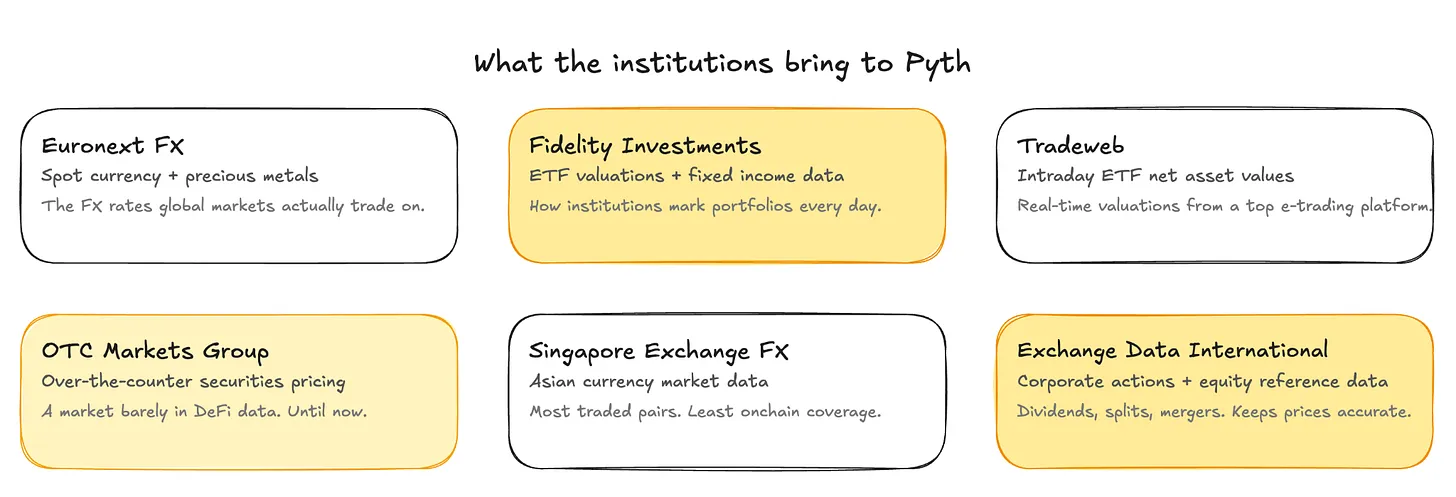
Euronext, Exchange Data International, Fidelity Investments, OTC Markets Group, Singapore Exchange’s FX division, and Tradeweb have begun publishing their proprietary market data directly on-chain via Pyth’s new data marketplace.
Euronext FX: Spot currency and precious metals rates—the actual exchange rates used in live global markets.
Fidelity: ETF valuations and fixed-income data—the same data institutions use daily to mark portfolios to market.
Tradeweb: Intraday ETF pricing—real-time valuations sourced from one of the largest electronic trading platforms.
OTC Markets Group: Over-the-counter securities—a market nearly absent from today’s DeFi data landscape.
Singapore Exchange FX: Asian currency pairs—the most actively traded yet least-covered FX market on-chain.
Together, these six institutions cover large asset classes that DeFi has historically failed to support reliably—because the data feeding them wasn’t institutional-grade.
Why Data Must Come Before Assets
Everyone in crypto has talked about the tokenization wave for two years: tokenized Treasuries, tokenized bonds, tokenized equities. The entire discussion assumes the hard part is putting assets on-chain.
The hard part is data. Before you can trade tokenized Treasuries in DeFi protocols, you need to know their exact value—down to the second—with the same precision Goldman Sachs uses on its trading desk. Before you can build lending protocols around real-world assets, you need continuously operating price feeds sourced from actual market makers—not scraped from websites and updated every few minutes.
DeFi protocols require accurate, real-time traditional finance data to power derivatives, loans, and structured products—but historically relied on limited or slow data sources. That’s why DeFi has been almost exclusively crypto-to-crypto since inception. The data feeding these products isn’t reliable enough, fast enough, or sourced from institutions credible enough to participate in regulated conversations.
Pyth Pro—the institutional subscription tier launched by Pyth in September 2025—delivers 1-millisecond latency price feeds across 2,200+ instruments. Polymarket integrated Pyth Pro in April 2026 to settle new markets covering major indices, commodities, and U.S. equities—replacing manual or exchange-specific inputs with standardized data aggregated from over 125 trading firms. Hyperliquid now runs perpetual oil and gold contracts using Pyth’s price feeds. Data quality has reached a point where serious financial products can be built on it—without apology.
The tokenization wave requires this layer to scale meaningfully. Without reliable fixed-income price feeds, you cannot build reliable fixed-income products on-chain.
The Oracle Wars
The original oracle problem in crypto was simple: smart contracts live on-chain; prices live off-chain. Something must bridge the two. Chainlink dominated as DeFi’s primary oracle for most of its history, solving this by running a large, independent node network that pulls prices from third-party sources—exchanges, aggregators, data APIs—and submits them on-chain. Multiple independent sources, multiple independent nodes, reasonable decentralization, acceptable latency.
Pyth took a fundamentally different approach from day one: going straight to institutions actively trading in the markets. Today, over 120 institutions publish data via Pyth—including global exchanges, trading firms, and market makers. Jane Street doesn’t *describe* Bitcoin’s price to Pyth—it *publishes* it. Data comes from the source—not from someone describing the source.
This yields faster, more accurate, and more tightly coupled pricing—directly anchored to real market activity. Structurally, however, it’s more centralized: a smaller club of publishers who know each other and mutually verify data. Pyth employs staking and slashing mechanisms designed to create economic incentives for accuracy. But more precisely: Pyth prioritizes speed and data quality over maximal decentralization—a potentially correct trade-off for institutional finance.
The Cost of Centralization
Pyth was heavily shaped by Jump Crypto—an organization whose role in the 2022 events remains largely unspoken across crypto circles. Its publisher network is a tight-knit club where institutions know each other and jointly validate data. Staking and slashing mechanisms incentivize accuracy, but Pyth is both faster and higher-quality than predecessors—and more centralized than its marketing suggests. You’re not replacing a monopoly with a commons. You’re replacing one centralized system with another centralized system—this one just happens to run on blockchain.

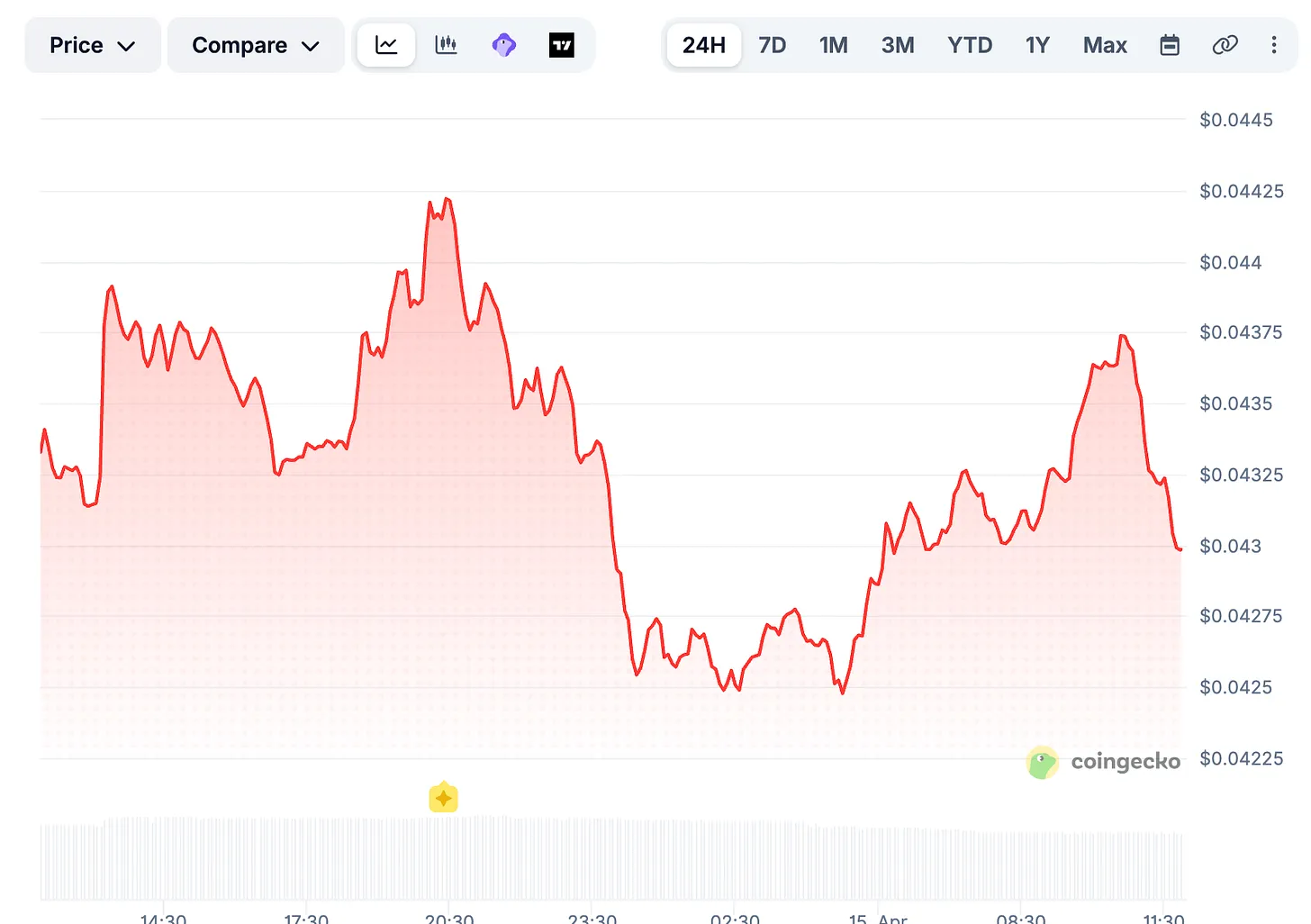
PYTH token peaked at $1.20 in March 2024 and currently trades near $0.046—a ~96% decline from its high. The obvious reason: using Pyth’s data requires no holding or purchasing of PYTH tokens. The network can grow substantially while the token remains range-bound—a known issue Pyth’s Reserve Program aims to address by allocating a portion of protocol revenue toward open-market PYTH buybacks.
The End of the Toll Booth
Getting data from producers to users’ desks requires hardware, proprietary networks, sales relationships, and ongoing support. Bloomberg solved all that—and charged accordingly. Data producers lacked alternative distribution channels, so they sold data to intermediaries who kept the margin. Blockchain eliminates *that specific friction*: not analysis, not workflows, not keyboards—just the act of moving data from Point A to Point B and charging for the privilege.
But Bloomberg sells workflows: terminals, keyboards, messaging systems, analytics, support teams. Traders build entire careers around it. Pyth sells none of that. It’s a data layer—a protocol-level insertion. The only overlap is the underlying data itself—and that part has just shifted.
This matters because if Fidelity publishes its ETF valuations on-chain, any developer anywhere can read that data—no licensing negotiations, no $32,000 annual fee, no waiting for vendors to standardize formats. Data becomes programmable infrastructure—not a proprietary product. Institutions retain full control over what they publish and maintain attribution rights. The intermediary’s job—moving data from source to user—becomes obsolete.
These six institutions are choosing Pyth as their *primary distribution channel*, a commitment categorically distinct from pilots. Pilots get shut down when advocates change jobs. Primary distribution channels become operational dependencies.
Tokenized bonds. Tokenized equities. Tokenized everything. Most remain months—or years—away from meaningful scale. But the raw materials enabling real-world asset products in DeFi are now available—contract-free, terminal-free, and without two-year minimums.
Michael Bloomberg spent months handing out free coffee in Merrill Lynch’s hallways because the data he needed was locked inside institutions with no incentive to give it to him. He built an entire business on that friction.
Toll booths won’t vanish overnight. Every monopoly in data distribution ends the same way—not through battle, not through litigation, not through revolution. Mostly, it ends when someone, somewhere, asks: *Why am I paying for something I already own?*
Join TechFlow official community to stay tuned
Telegram:https://t.me/TechFlowDaily
X (Twitter):https://x.com/TechFlowPost
X (Twitter) EN:https://x.com/BlockFlow_News






