With Layer2, why do we still need Layer3?
TechFlow Selected TechFlow Selected
With Layer2, why do we still need Layer3?
Will the Ethereum scaling narrative end at Layer 3?
 Navigating Web3 tides with focused insights
Author: Cynic
TL;DR
1. From Layer1 to Layer2
-
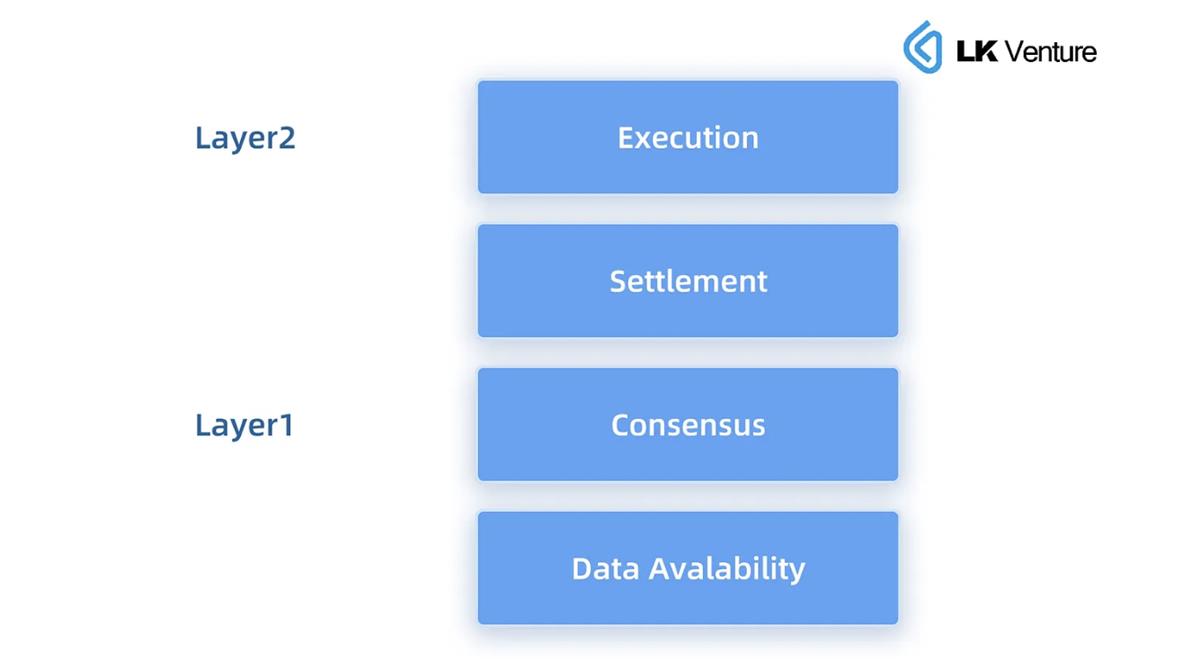
How is scalability achieved technically? Ethereum views Rollup as the sole Layer2 solution because it scales Ethereum without sacrificing decentralization and security. From a modular perspective, Layer2 handles execution, while settlement, consensus, and data availability are all managed by Layer1.
2. From Layer2 to Layer3
-
What’s the difference between Layer2-Layer3 and Layer1-Layer2? Although Rollup technology solves Ethereum's computational bottleneck, it does not solve the data availability issue. The upper layer needs to compress transaction data before passing it down, but compression cannot be recursively applied—Layer2-Layer3 stacking brings limited performance gains.
-
Why do we need Layer3 if we already have Layer2? Layer2 will remain decentralized as a general-purpose computation layer providing composability, while Layer3 should serve as application-specific chains meeting unique requirements such as compatibility, efficiency, and privacy.
-
Within the application chain ecosystem, how is Layer3 different from Cosmos? Layer3 benefits from Ethereum’s ecosystem, gaining easier access to users and capital. However, due to its tight coupling with Ethereum, it sacrifices some sovereignty, such as token value capture.
3. From Layer3 to LayerX?
-
Current state of Layer3 development: Arbitrum launched Orbit Chain on June 22; zkSync announced on June 26 that it would release ZK Stack within weeks; Madara in the Starknet ecosystem helped a team deploy a Starknet Layer3 appchain within 24 hours during a hackathon.
-
Now that Layer3 has arrived, are Layer4 and Layer5 far behind? LK Venture believes that from a technical standpoint, Layer3 can no longer achieve performance leaps through simple stacking. Although Layer1–Layer2–Layer3 ecosystems are tightly connected (within the Ethereum ecosystem) and offer stronger interoperability than traditional heterogeneous chains (cheaper cross-chain), they still cannot fully inherit each other's ecosystems. The narrative of Ethereum scaling may end at Layer3.
From Layer1 to Layer2: Scaling
Blockchain faces an impossibility triangle: security, decentralization, and scalability cannot all be maximized simultaneously. Ethereum prioritizes the first two, leaving scalability underdeveloped. Normally, a swap on Ethereum costs $3–$4 in gas fees, but during bull markets with high transaction volume, it can exceed $100, causing severe congestion.
Despite many new blockchains emphasizing scalability emerging since 2018, Ethereum maintains absolute market dominance due to its early-mover advantage and vast ecosystem. As a result, attention has turned to scaling solutions built atop Ethereum.
Among these, sidechains, Validium, and Rollup are widely adopted, each with distinct trust assumptions.
-
Sidechains are independent blockchains operating separately from Layer1, connected to Ethereum via bidirectional bridges. They can have their own block parameters and consensus mechanisms, enabling efficient transaction processing, but they do not inherit Ethereum's security.
-
Validium uses off-chain data availability and computation, processing transactions off-chain to increase throughput, then publishing zero-knowledge proofs on-chain for Layer1 verification, thereby achieving security.
-
Rollup performs computation off-chain but uses Layer1 for data availability, submitting fraud proofs or validity proofs to Layer1 smart contracts for verification, thus inheriting Ethereum’s security.
Ethereum regards Rollup as the only viable Layer2 solution, as it enables Ethereum scaling without compromising decentralization or security. From a modular perspective, Layer2 handles execution, while settlement, consensus, and data availability are delegated to Layer1.
Depending on the type of proof submitted, Rollups are categorized into Optimistic Rollup and ZK Rollup.
In Optimistic Rollup, transactions are batched and executed, and the batched transactions along with pre- and post-execution states are sent to a Rollup contract deployed on Layer1. Layer1 does not validate the state transition process; instead, it optimistically accepts the new state proposed by the Rollup, provided the initial state matches what is stored in the Layer1 contract. Fraud prevention relies on fraud proofs: during a dispute period, validators can challenge the state root by submitting a fraud proof to the Layer1 Rollup contract. This reverts the Rollup state to the last confirmed state and recomputes the correct state, penalizing malicious actors accordingly. In practice, fraud is rare, so optimistic state transitions save significant validation resources.
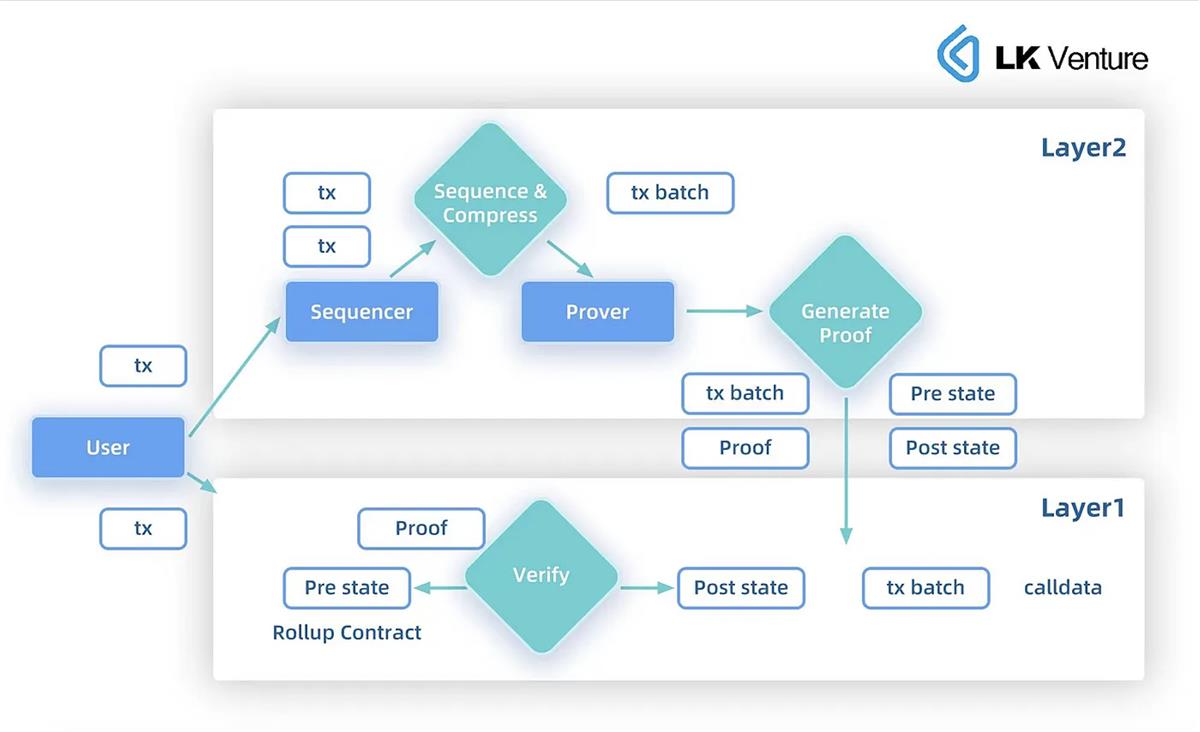
The key difference with ZK Rollup is that state transitions require verification—not by Layer1 nodes directly, but through validity proofs checked within the Layer1 Rollup contract. Once verified, state transitions are finalized immediately, eliminating the need for a week-long dispute window.
Among projects using Optimistic Rollup, Arbitrum and Optimism are the most mature, both operating on mainnet. Arbitrum has implemented fraud proofs but limits submissions to a whitelist, while Optimism’s fraud proof system remains under development. Both teams are actively advancing decentralization efforts, including decentralizing sequencers and validators. According to L2Beat data as of June 26, 2023, Arbitrum One and Optimism had TVLs of $5.81B and $2.25B respectively. Other Optimistic Rollup-based projects include Boba Network, Zora Network, Layer2.finance, Fuel, BNBOP, Coinbase, among others—some built using OP Stack, the open-source framework developed by the Optimism team.
ZK Rollup projects supporting virtual machines include zkSync Era, StarkWare, and Polygon zkEVM, which are already live on mainnet with TVLs of $618M, $68.11M, and $42.65M respectively. Those supporting only specific transaction types include dYdX, Loopring, and zkSync Lite, with TVLs of $350M, $98.47M, and $97.69M. Current ZK Rollup development focuses on improving Ethereum compatibility, with ongoing zkEVM projects like Taiko, Scroll, and Linea.
From Layer2 to Layer3: Customization
Layer2: 100x, Layer3: 100x² = 10,000x?
Moving from Layer1 to Layer2 reduces costs to ~1/100. Naturally, one might assume building Layer3 atop Layer2 could further reduce costs to 1/10,000. Unfortunately, this is not the case.
While Rollup solves Ethereum’s computation bottleneck by moving execution off-chain—and cryptographic recursion allows theoretically unbounded computational scaling—data availability cannot be stacked. Layer2 must submit compressed transaction data as calldata to Ethereum smart contracts. However, data cannot be compressed twice using the same method. Since Layer3 transaction data ultimately must be submitted to Layer1 (to inherit security), further compression is impossible. Thus, cost reductions at the data availability level cannot be achieved through layer stacking.
Therefore, Layer3 cannot rely on simple stacking. StarkWare proposes customization as the solution—assigning different roles to Layer3 and Layer2.
If we have Layer2, why do we need Layer3?
Ethereum provides security and decentralization; Layer2 adds scalability—this seemingly resolves blockchain’s trilemma. So why introduce Layer3?
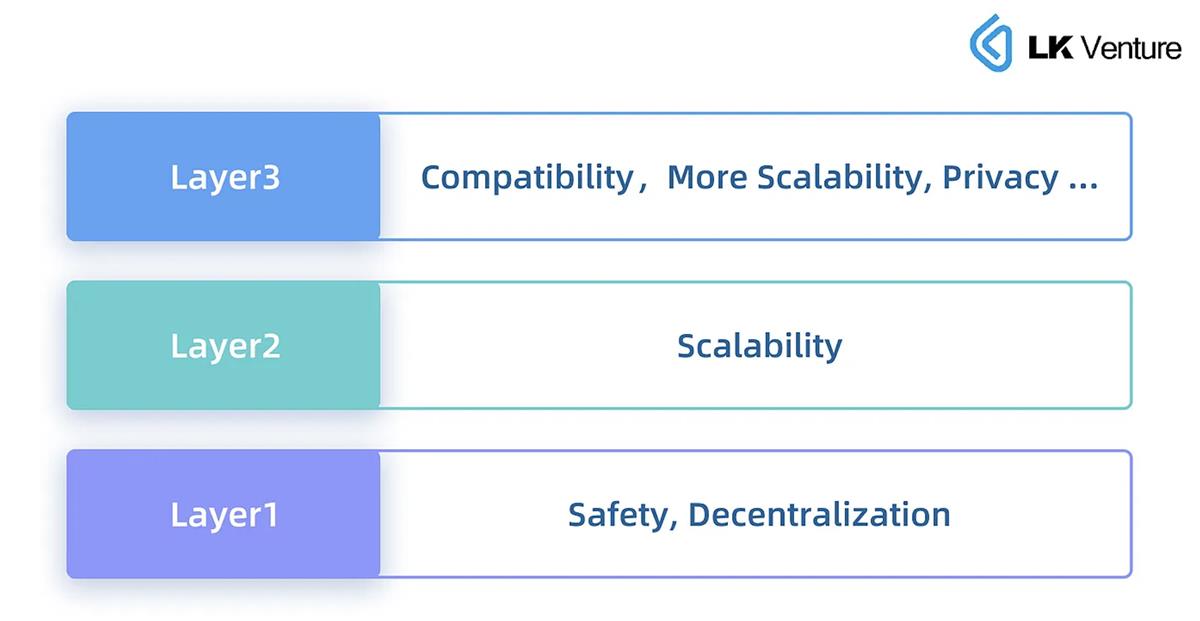
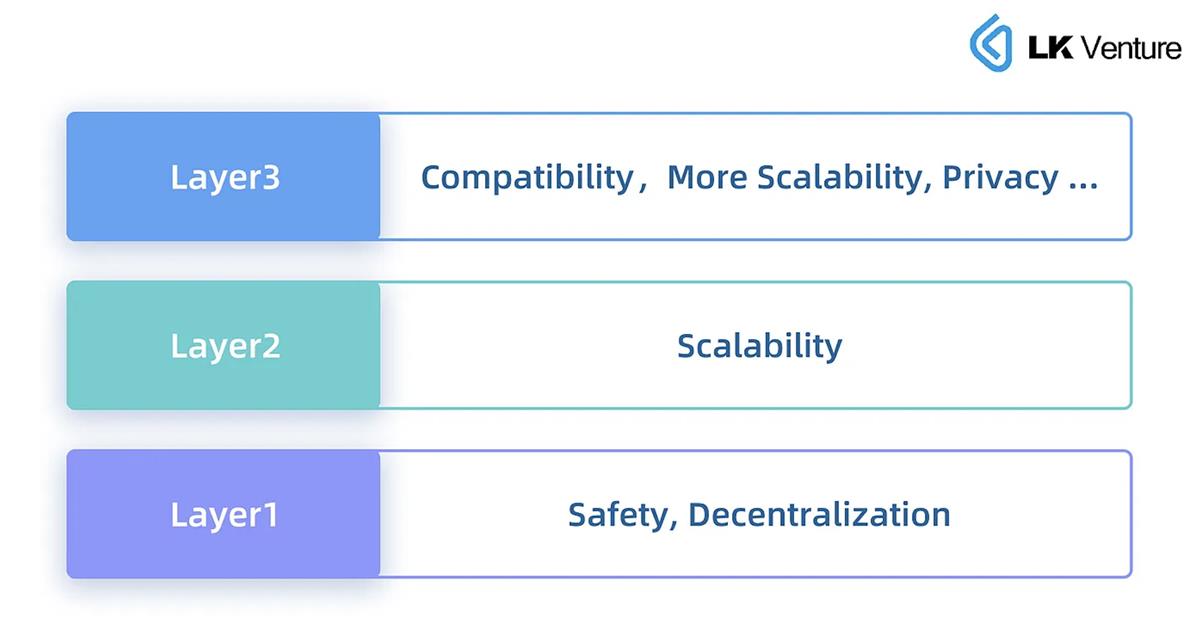
The concept of Layer3 was first introduced by StarkWare in their article "Fractal Scaling: From L2 to L3." StarkWare argues that hierarchical, encapsulated architectures are central to computer science’s vitality. Moreover, Layer2 will maintain decentralization as a universal computation layer offering composability, while Layer3 should act as application-specific chains catering to unique application needs. Turing completeness lays the foundation: once achieved, any conceivable application can theoretically be built atop it.
In reality, Layer2 must make trade-offs to preserve universality, making it unable to meet every application’s needs. A direct example is StarkWare developing Cairo language and CairoVM for more efficient proof generation—these are incompatible with Ethereum. Here, a Layer3 chain can resolve such issues.
Potential Layer3 use cases include:
-
Compatibility: Implementing interpreters for other languages/virtual machines atop a Layer2 VM to achieve cross-VM compatibility
-
Efficiency: Applications demanding ultra-high TPS (e.g., gaming, social media) may sacrifice some security using Validium-style solutions settled on Layer2; they can also customize transaction formats for higher compression ratios.
-
Privacy: Building dedicated private chains settled on Layer2 but not publicly observable.
Additionally, since appchains are specialized, they aren't affected by unrelated applications, resulting in predictable performance and costs. Bridge transactions don’t need to be sent directly on Layer1, reducing costs—L2-L3 and L3-L3 bridging are cheaper. For batched transaction submissions, Layer3 has a clear advantage: the fixed gas cost per batch is lower, eliminating the need to wait for large batches to reduce average gas, significantly alleviating the Layer2 dilemma between confirmation time and cost.
Same appchain ecosystem: How is Layer3 different from Cosmos?
Cosmos was arguably the first project to introduce the concept of appchains. Using the Cosmos SDK, users can easily customize and launch their own application-specific chains. Cosmos IBC aims to be the blockchain equivalent of TCP/IP, enabling native interoperability among chains built with the Cosmos SDK. Simply put, Cosmos envisions a universe of interconnected blockchains.
Layer3 also emphasizes interoperability. Due to shared technical architecture and low transaction costs, cross-chain interactions between Layer3 chains will be trustless, fast, and cheap—effectively allowing liquidity sharing across Layer3 chains. From an interoperability standpoint, Layer3 delivers nearly identical functionality to Cosmos.
According to LK Venture’s research team, the biggest difference between Layer3 and Cosmos lies in Layer3’s tight integration with the Ethereum ecosystem—both an advantage and a limitation.
The advantage stems from Ethereum’s massive liquidity and user base.
Despite Cosmos’ strong technology and adoption by major players, it struggles with low market share. According to DefiLlama data as of June 26, 2023, Ethereum’s TVL stood at $26.2B, while the entire Cosmos ecosystem totaled just ~$1B. For Layer3 success, Ethereum’s ecosystem is a critical factor.
The disadvantage lies in over-reliance on Ethereum, leading to partial loss of sovereignty.
For Cosmos-based chains, token models are fully customizable by project teams, enabling strong token utility. However, Layer3 native tokens face constraints from Ethereum. While projects can use their native token as gas, it's undeniable that final transaction data submission to Ethereum requires $ETH. If a non-ETH gas token is used, the team must continuously convert it to $ETH for submission—ultimately transferring value capture back to $ETH.
Another feature of Layer3 is that anything done on Layer3 could technically be migrated to Layer2—it depends solely on the choice of DA layer.
If the Layer2 upon which a Layer3 settles suffers a security breach or declining activity, the Layer3 can migrate at low cost to another Layer2—or even directly rely on Layer1 for DA and settlement, effectively becoming a Layer2. Due to its deep ties to Ethereum’s ecosystem, Layer3 may foster numerous innovative applications.
Outlook: From Layer3 to LayerX
Current State of Layer3 Development
On June 22, Offchain Labs released tools for launching Arbitrum Orbit Chains. Orbit Chains are Layer3 chains built atop Arbitrum Layer2, settling on one of three Layer2 options: Arbitrum One, Arbitrum Nova, or Arbitrum Goerli. Users can choose between Rollup or Anytrust technology—the latter uses a Data Availability Committee (DAC) instead of posting transaction data on-chain, reducing costs at the expense of slightly weaker security. Key advantages of Orbit Chain include simple chain deployment, seamless interoperability with the Arbitrum ecosystem, Nitro’s instant upgrades, and Stylus’ EVM+ compatibility (supporting Rust, C, C++ via WASM). Users can permissionlessly launch any Orbit Chain, though settlement must occur on Arbitrum Layer2 unless authorized otherwise by Offchain Labs or the Arbitrum DAO.
On June 26, zkSync announced plans to modify its existing open-source code and launch ZK Stack within weeks, enabling users to build custom ZK-powered superchains. Unlike Arbitrum’s Orbit Chain, ZK Stack emphasizes sovereignty and interoperability—users can fully customize chains, achieving bridgeless interoperability. ZK Stack supports both Layer2 and Layer3 construction, with no official restrictions or requirement to settle on zkSync. In this regard, ZK Stack appears to offer greater sovereignty.
StarkWare, the pioneer of the Layer3 concept, is actively nurturing Layer3 growth within its Starknet ecosystem. Madara is currently testing its public-facing stack. During the @PragmaOracle hackathon, a team used Madara to launch an application chain within 24 hours. However, due to Starknet’s use of the unique zk-STARK proving system and relatively lower technical maturity, further development is needed before Starknet Stack can be publicly released.
The Layer3 ecosystem remains in its infancy, but with various Layer2 platforms rolling out easy chain-launching tools, operational Layer3 chains are expected soon. As infrastructure matures, attracting users has become the top priority for all chains.
Now that Layer3 has arrived, is LayerX far behind?
Technically speaking, Layer3 can no longer achieve performance breakthroughs through simple stacking. While customization offers specific advantages, the loss of generality makes further layering increasingly difficult. In theory, such hierarchical stacking could continue infinitely—but LK Venture’s research team believes it currently serves no practical purpose and would exponentially increase system complexity.
Most critically, despite strong ecosystem alignment across Layer1–Layer2–Layer3 (within Ethereum) and superior interoperability compared to traditional heterogeneous chains (cheaper cross-chain), full ecosystem inheritance remains unachievable. Contracts deployed on Arbitrum One cannot be directly called on an Orbit Chain; liquidity from a DEX on zkSync cannot seamlessly flow into a ZK Stack chain.
Currently, the "shopping mall" has been built—and keeps growing taller—but there are few vendors or customers. While the ground floor is crowded (Ethereum), people hesitate to go upstairs because higher floors lack sufficient vendors.
Thus, LK Venture’s research team believes that until blockchain achieves widespread adoption, Layer3 is unlikely to attract substantial user traffic. As for Layer4, Layer5… LayerN—even if niche applications have specific needs, they likely won’t market themselves as “LayerN” anymore.
An ancient saying goes: “The Tao begot one, one begot two, two begot three, three begot万物.” Might Ethereum’s scaling narrative end at Layer3? Only time will tell.
Join TechFlow official community to stay tuned
Telegram:https://t.me/TechFlowDaily
X (Twitter):https://x.com/TechFlowPost
X (Twitter) EN:https://x.com/BlockFlow_News
 LK Venture