








How dappOS, Backed by Binance Labs, Builds a Web3 Operating Protocol
TechFlow Selected TechFlow Selected
How dappOS, Backed by Binance Labs, Builds a Web3 Operating Protocol
dappOS will launch its fully-featured V2 version.
 Navigating Web3 tides with focused insights
By angelilu, Foresight News
In November 1985, Windows 1.0 was released, officially opening the door to the "Internet era" in a real sense. The user-friendly interface and interactive experience provided by "operating systems" enabled the widespread adoption of computers. Now, as the Web3 industry gradually matures after its first decade of rapid growth, high entry barriers for new users and difficulties in cross-chain asset management for existing users remain key obstacles hindering Web3's development.
The current fragmentation of liquidity in the Web3 world is both a result of the competitive landscape among public blockchains and a driving force behind the evolution of cross-chain and interoperability protocols. Following the principle of "after long division comes union," dApps are seeking fast solutions for multi-chain deployment, while experienced Web3 users are looking for more convenient ways to operate across chains.
Backed by Binance Labs
Although not entirely equivalent to operating systems in the internet context, dappOS defines itself as a "Web3 Operating Protocol," offering its own solution to current Web3 pain points—abstracting existing public blockchain concepts to provide users and applications with a more friendly and comprehensive operational framework.
It’s easy to see that the emergence of a Web3 operating protocol holds significant importance for technology adoption and advancement, which explains why dappOS has received investment from Binance Labs.

The two core components of dappOS’s unified Web3 operating protocol are dappOS Account and dappOS Network, both of which align with cutting-edge technologies currently being explored in the blockchain space.
dappOS Account — Unifying the Web3 Account System
So, why can dappOS Account solve existing problems?
In his latest article "The Three Transitions," Vitalik wrote: "I have ETH in four different places, and over time this will become even more complex." As Vitalik envisioned, the future scenario where "a single user may hold multiple addresses" will introduce greater complexity and challenges to the crypto world.

dappOS Account may be the solution to this issue. It provides users with a "master account" applicable across decentralized applications on all public blockchains. The balance in this account can be used instantly across any dappOS-supported application with one click. Moreover, since dappOS Account uses a smart contract wallet instead of an EOA (Externally Owned Account), it allows recovery through multiple methods if a user loses their seed phrase.
dappOS Network — Making Blockchains Invisible to Users
Next is dappOS Network, which establishes smoother pathways across today’s fragmented blockchain landscape. By automating interactions across any number of public blockchains with various constraints, it enables users to operate without needing to be aware of underlying chains.
As mentioned earlier, ETH held by a user across Ethereum Mainnet, Optimism, Arbitrum, and Arbitrum Nova within a dappOS Account can be used freely anywhere, regardless of which chain the assets are actually on. Once the user signs and confirms the transaction, dappOS Network automatically handles everything behind the scenes—the assets are moved to the relevant chain, and gas and other fees are automatically converted and deducted. Users no longer need to be aware of the existence of individual public blockchains during operations.
The core mechanism enabling this functionality is dappOS’s use of service nodes to bundle and execute every interaction order initiated by users. These orders can include one or more services—not just bridging—greatly improving transaction efficiency.
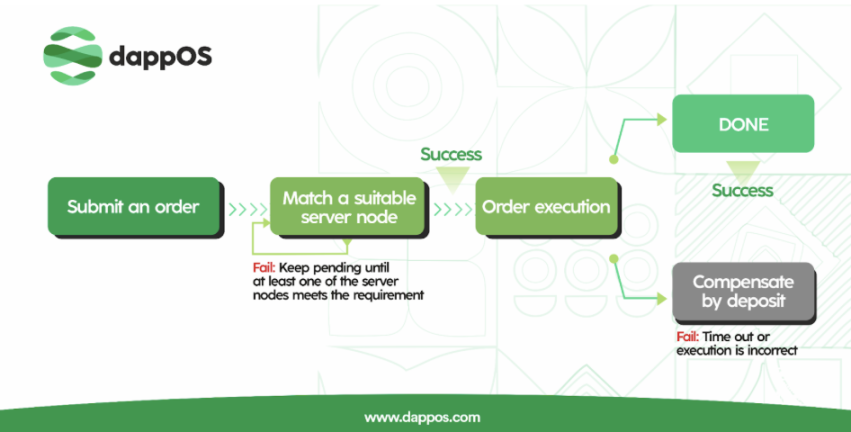
For service nodes accepting these orders, they must first stake a certain amount of funds. Only then can they earn fees for executing user transactions. However, if an order fails to execute properly, the staked funds will be used to compensate affected users.
dappOS to Launch V2 Version
After six months of MVP product validation and testing, dappOS is preparing to launch its first official version, V2. This version will offer full dappOS functionality and formally introduce two major features: unified accounts and task-linked order execution.
Unified Account: Enabling Universal Asset Usage
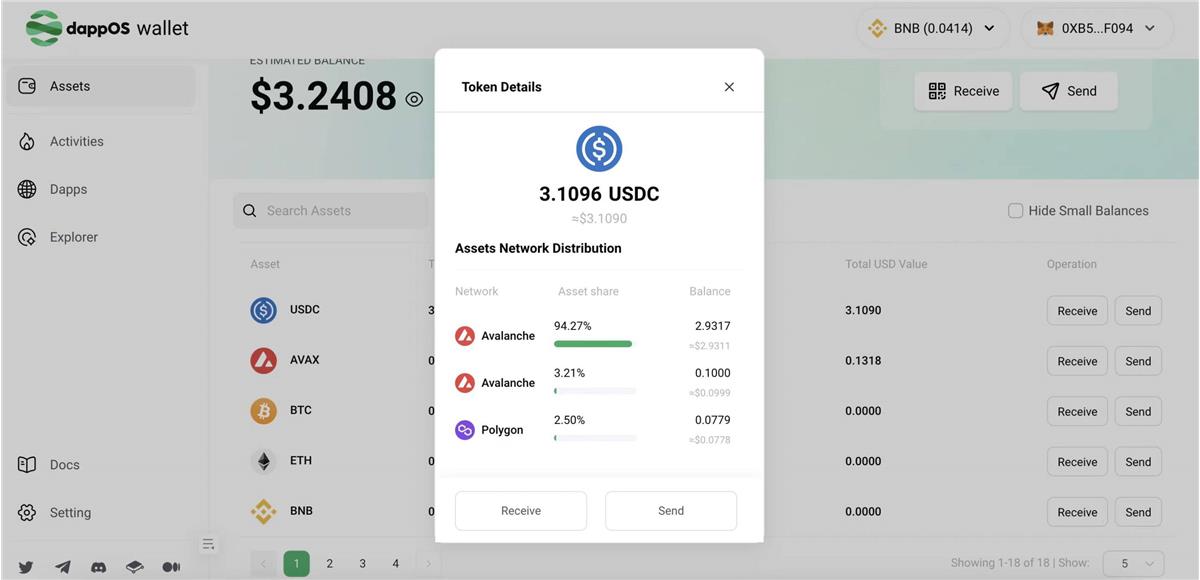
The V2 version officially introduces the unified account, allowing users to focus solely on their total asset balance. Assets become universally usable across any dApp on any chain—similar to centralized exchanges, where once funds are deposited, users don’t need to distinguish which chain they came from, and balances are shared across spot trading, finance, and other sections. For example, User A has a wallet balance of 100 USDC in dappOS—50 USDC on Ethereum and 50 USDC on BNB Chain. With just one signature confirmation, User A can use the full 100 USDC balance on GMX on Arbitrum or Benqi on Avalanche, without worrying about asset distribution or gas payment logistics.
Task-Linked Order Execution
When User A wants to perform operations involving multiple chains using their account funds, it typically requires multiple transactions across different chains, often with specific sequencing requirements. dappOS allows users to confirm everything with a single signature, with service nodes handling the rest. For instance, suppose User A wants to buy some ETH on Ethereum, transfer that ETH to the Polygon network, swap it for MATIC using QuickSwap, and finally send the resulting MATIC back to Ethereum and deposit it into their wallet. In traditional workflows, this would require switching repeatedly between Ethereum and Polygon wallets, performing multiple transactions, and signing each one individually. With dappOS V2, the user only needs to sign once; dappOS will automatically execute all steps in the specified sequence, eliminating manual wallet switching or additional actions.

Finally, the V2 version also introduces a fee-based bidding system to encourage healthy competition among service nodes, allowing them to earn revenue from transaction executions.
Conclusion
dappOS is an operating protocol tailored for Web3 characteristics, encapsulating public blockchains within its own framework to address usability challenges in Web3. The significance of dappOS lies in creating a more user-friendly and efficient environment for Web3 development. After its V2 upgrade, whether it can further enhance user experience and resolve technical hurdles remains to be seen.
Join TechFlow official community to stay tuned
Telegram:https://t.me/TechFlowDaily
X (Twitter):https://x.com/TechFlowPost
X (Twitter) EN:https://x.com/BlockFlow_News
 Foresight News






