In-Depth Analysis of Recursive Inscriptions: Infinite Creativity and Combinatorial Possibilities on Bitcoin
TechFlow Selected TechFlow Selected
In-Depth Analysis of Recursive Inscriptions: Infinite Creativity and Combinatorial Possibilities on Bitcoin
This article will provide an in-depth analysis of recursive inscriptions from four perspectives: their origin, implementation methods and extent, potential impacts, and possible risks, using an illustrative approach.
 Navigating Web3 tides with focused insights
Author: Darren, Everest Ventures Group
This article is for informational and educational purposes only and does not constitute any investment advice.
Abstract:
Since the launch of the Bitcoin-based protocol Ordinals—and the subsequent explosion of Brc20 tokens via Ordi—innovations built on top of Ordinals have been emerging rapidly. Recently, a particularly notable innovation has surfaced: recursive inscriptions. Recursive inscriptions can reference existing on-chain inscriptions and engrave vast amounts of code directly onto the Bitcoin blockchain. Moreover, because recursive inscriptions call code presented in text form, their file sizes are extremely small, enabling them to bypass Bitcoin's 4MB block size limit. This allows even complex 3D video games to be fully uploaded onto the Bitcoin chain. This breakthrough unlocks infinite possibilities for the evolution of Ordinals and makes scalability and interoperability on the Bitcoin blockchain a tangible reality.
This article provides an in-depth analysis of recursive inscriptions from four perspectives: origin, implementation methods and depth, potential impacts, and possible risks. Notably, all code examples discussed are highly accessible, allowing readers without a technical background to follow along and grasp the core concepts.
1. What Are Ordinals and Brc20?
Before discussing recursive inscriptions, it's important to first understand what Ordinals and Brc20 are. The Ordinals protocol is a system that assigns ordinal numbers to individual satoshis (sats), tracking each satoshi by its sequence number through transactions. In short, users can attach additional data to sats via Ordinals, making each satoshi unique—a process known as "inscription." The term "satoshi" honors Bitcoin’s pseudonymous creator, Satoshi Nakamoto, and represents the smallest unit of Bitcoin (BTC). One BTC equals 100 million satoshis, meaning each satoshi is worth 0.00000001 BTC. Sats are numbered based on their mining and transfer order: the numbering follows the order in which they were mined, while transfers follow the sequence of transaction inputs and outputs—hence the name “Ordinals.”
BRC20 refers to a token standard built on blockchain technology for Bitcoin. BRC stands for "Blockchain Token Standard," with the number 20 indicating the version. The BRC20 standard defines a set of rules and protocols for creating and managing blockchain-based tokens. Similar to Ethereum’s ERC20 standard, BRC20 offers a common framework for token creation and operations. BRC20 tokens can be issued, transferred, and traded on compatible blockchains. The standard specifies basic token features such as total supply, name, symbol, decimals, and standard interfaces and events for transactions. By adopting the BRC20 standard, developers can more easily create and deploy their own tokens and enable token circulation and trading on the Bitcoin blockchain. The emergence of the BRC20 standard has promoted the development of both the cryptocurrency and Bitcoin ecosystems, enabling better compatibility and interoperability among different projects.
2. The Origin of Recursive Inscriptions
The origin of recursive inscriptions follows a logical progression. After Brc20 gained widespread attention, the community began asking: if Brc20, inspired by Ethereum’s ERC20, could succeed, why not build a Brc721 modeled after ERC721? Thus, Brc721 emerged. However, since most ERC721 tokens store images in centralized servers requiring ongoing management fees, Brc721 aimed to directly etch images onto the Bitcoin blockchain—an approach that introduced significant cost challenges. As Ordinals grew in popularity, network congestion on Bitcoin intensified, further driving up inscription costs.
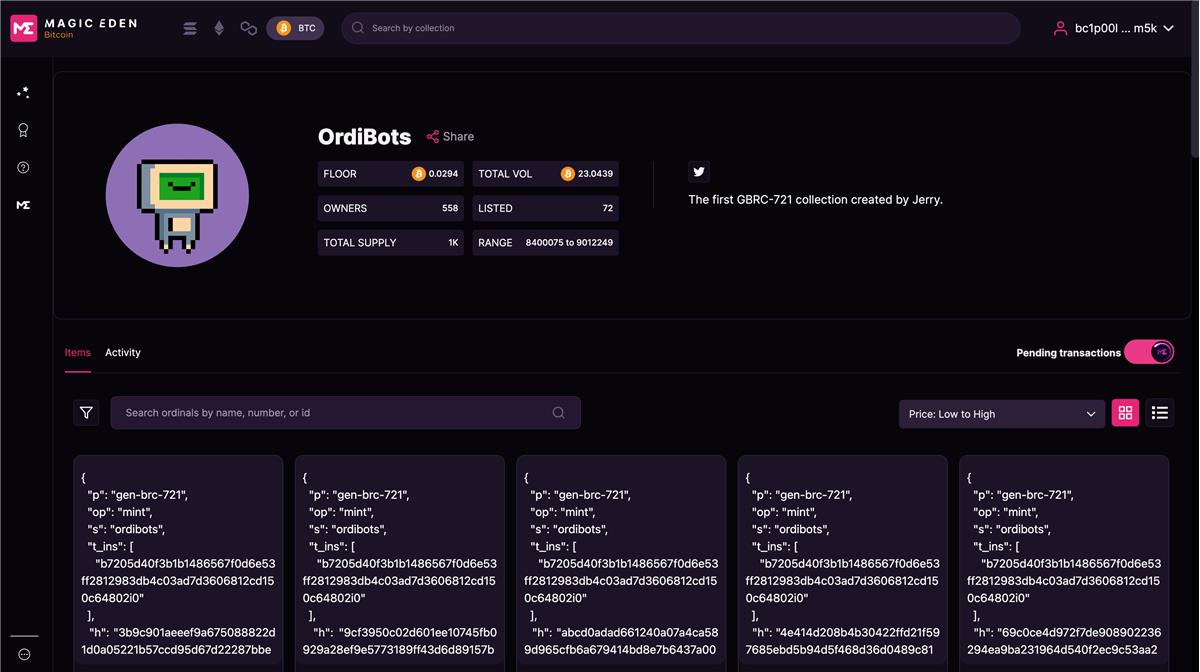
To address this issue, Gbrc721 was developed, successfully overcoming the high on-chain cost barrier. With Gbrc721, project creators upload only NFT components and then combine them cleverly—for example, a 10,000-piece collection might require just 200 components like mouths, ears, and noses. This drastically reduces on-chain costs. However, it introduces a new challenge: images must be rendered off-chain to be displayed. As a result, Gbrc721 projects like "Ordibots" on MagicEden currently appear only as strings of text (as shown below).
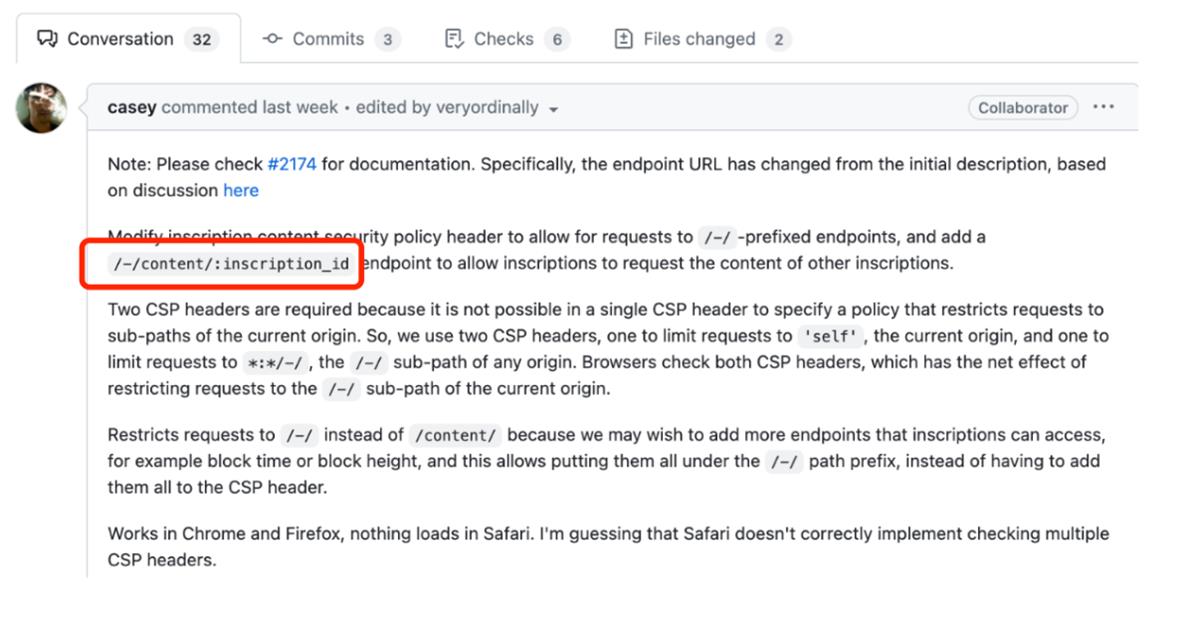
The concept of recursive inscriptions was proposed by the founder of the Bitcoin Ordinals protocol. On June 12, 2023, Raph, the new lead maintainer of Ordinals, announced a major update on GitHub: he merged the innovation called “recursive inscription” (Inscription #2167) into the Ordinalsd codebase (shown below). This update introduced the syntax "/-/content/:inscription_id", enabling inscriptions to reference each other’s content. This functionality surpasses Gbrc721 by being implemented entirely on-chain, eliminating reliance on off-chain rendering and fundamentally solving Gbrc721’s display issues. Thus, recursive inscriptions were born—this simple yet ingenious modification unlocked infinite creative potential within the Ordinals ecosystem.
3. Implementation and Impact: Exploring Infinite Combinatorial Possibilities
Having covered the origins of recursive inscriptions, we now turn to how they are implemented. We’ll also examine what led to the dramatic debut of the first prominent recursive inscription project—Recursive Punks—and how various components merge during recursion. Additionally, we will assess the extent of composability achievable with recursive inscriptions and whether combinations across different formats are possible. Let’s unravel these questions together and explore the boundless combinatorial potential enabled by recursive inscriptions.
How Recursive Inscriptions Work
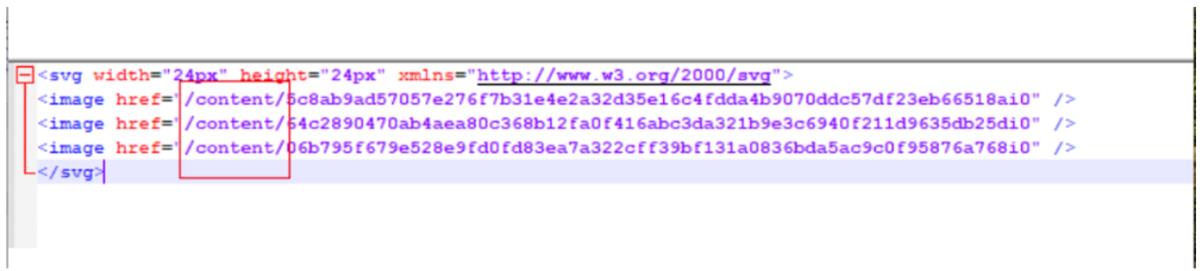
The implementation of recursive inscriptions relies on technical breakthroughs made by the founding team behind Ordinals. They embedded the code shown below into the base protocol, where "/content/" serves as the key syntax enabling developers to reference other inscriptions already stored on the Bitcoin blockchain. Careful readers may notice that the code shown here (version 2174) differs from version 2167 mentioned earlier—the "/-/" portion has been removed. Version 2167 was the initial implementation, but the Ordinals team later abandoned it in favor of version 2174. This shift laid the groundwork for the dramatic opening chapter of Recursive Punks.
The Dramatic Launch of Recursive Punks
On June 13, the Recursive Punks team announced a free mint of 10,000 Recursive Ordinals, sparking immediate buzz and viral sharing across the community. Following the “First is First” principle, the entire collection was quickly inscribed once discovered—so fast that the website temporarily crashed under the traffic. However, after the initial FOMO-driven rush, many users realized the official project used the outdated version 2167 of recursive inscriptions, employing the syntax "/-/content/:" instead of the correct "/content/". As a result, Recursive Punks failed to render images properly on Bitcoin inscription explorers, meaning strictly speaking, it wasn’t a true recursive inscription project.
The community soon circulated fixes and highlighted the syntax error. Surprisingly, upon realizing the mistake, the official team took an unexpected stance—tweeting that they hoped both the image-less and image-rendered versions would be recognized by the Ordinals developers and community. Even more shockingly, they deleted the tweet shortly after and directly listed the image-less version of Recursive Punks on MagicEden, displaying high-resolution images. Technical analysis revealed these images were rendered via frontend manipulation, allowing visual display on MagicEden. This move sparked backlash from parts of the community who argued it violated decentralization principles, with some calling it fraudulent.
Currently, both V1 and V2 versions of Recursive Punks are live on MagicEden. As of today (2023.6.20), V1 (image-less) shows higher trading volume, suggesting broader community consensus around the original release. The “First is First” ethos remains widely accepted. That said, as awareness of recursive inscriptions grows, the technically correct V2 version may eventually gain wider recognition and support.
Clever Component Composition in Recursive Inscriptions
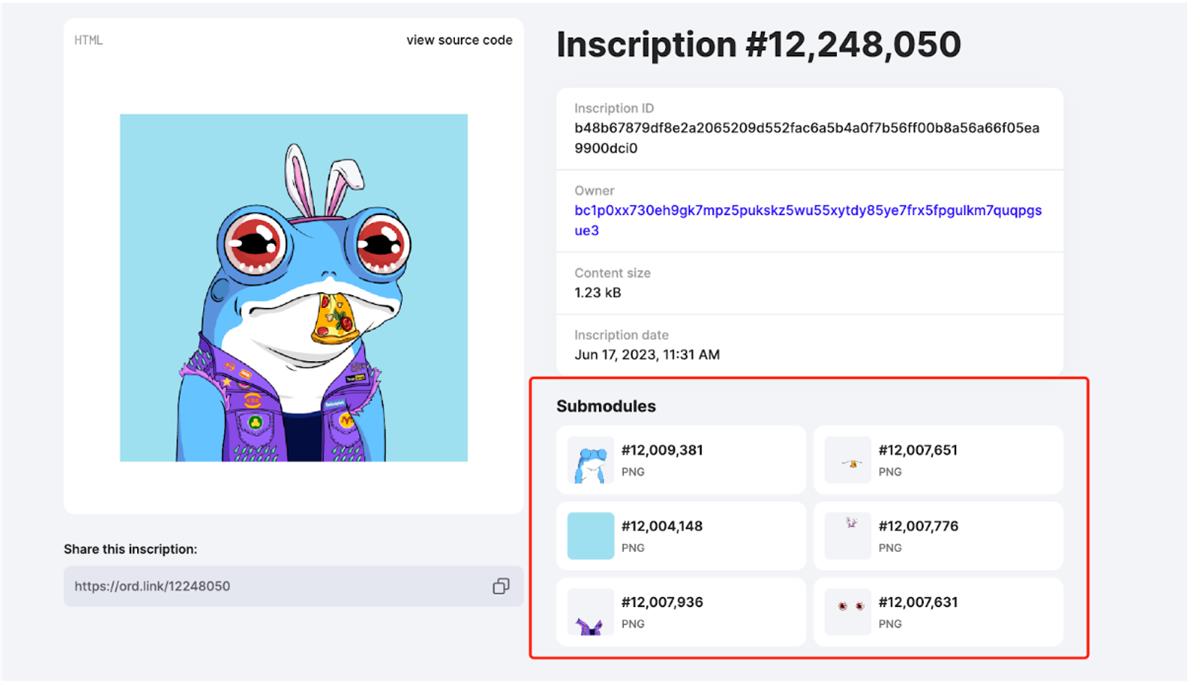
With recursive inscriptions, developers use the "/content/" syntax to directly reference existing NFT components on-chain when creating new NFTs. To illustrate this mechanism, consider the recursive inscription project "Recursive Frogs" (shown below). The red box highlights the component pieces of this NFT (Ordiscan now supports displaying recursive inscription components and provides one-click links to each component).
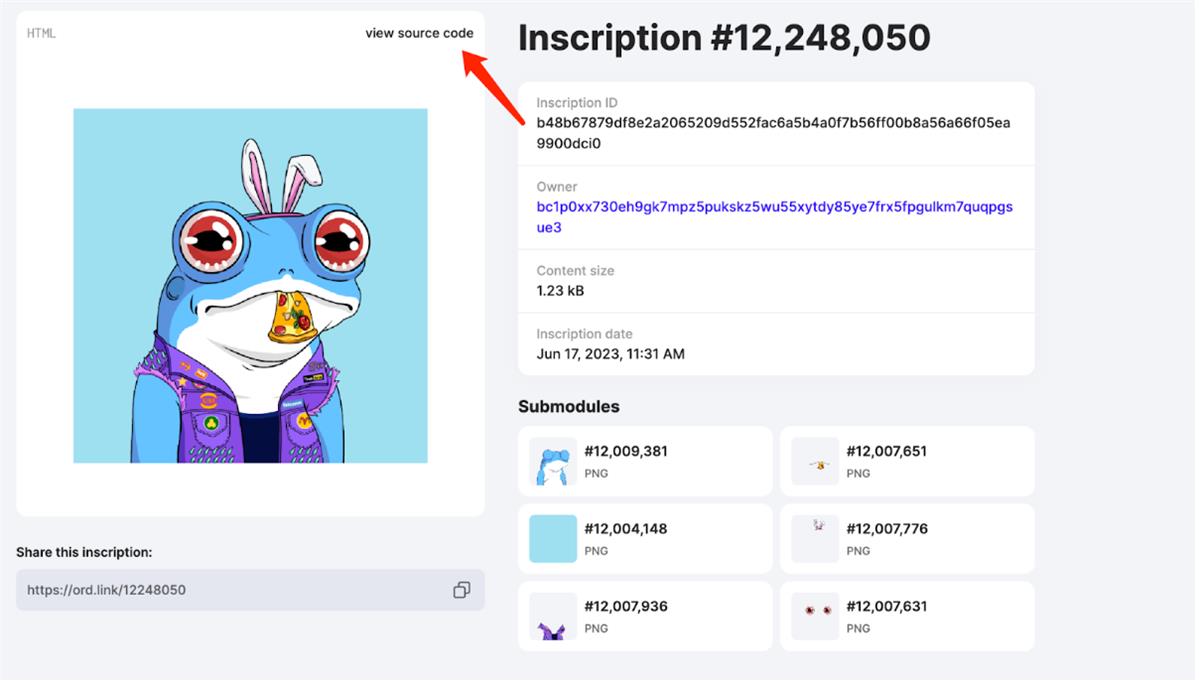
Next, clicking the "view source code" link indicated by the red arrow reveals the NFT’s underlying code.
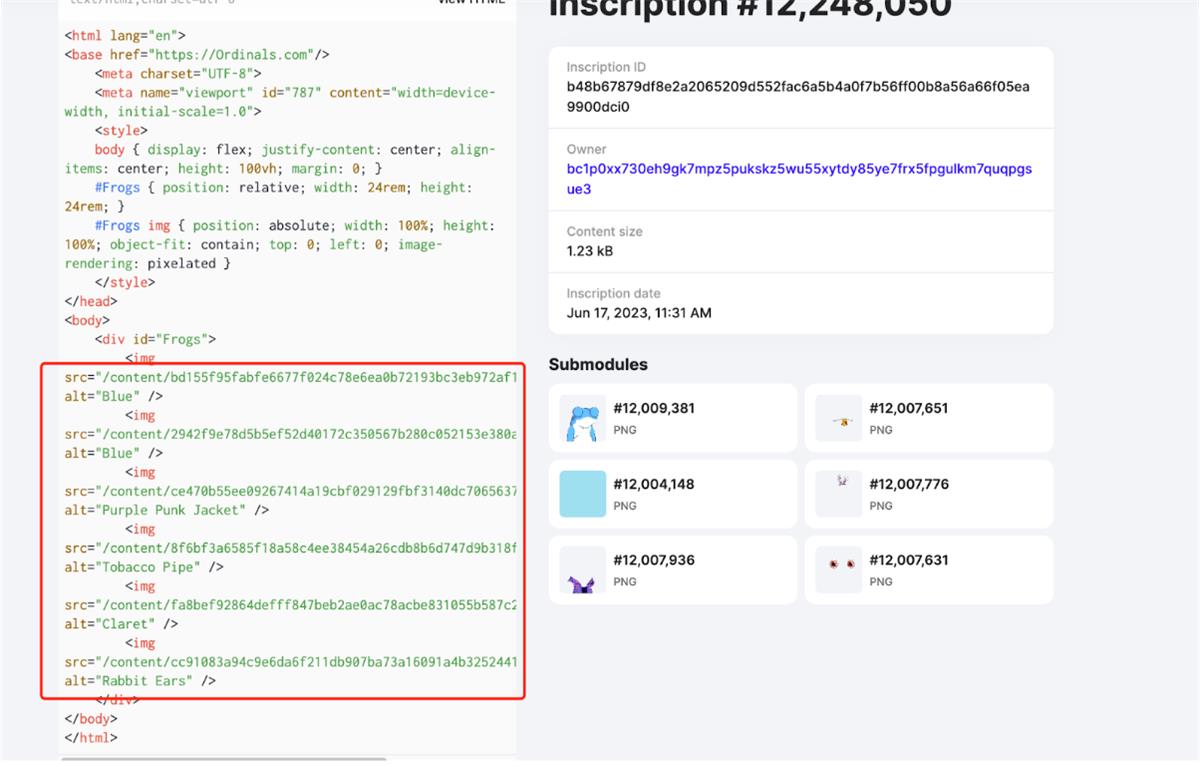
These six lines of code use the "content" syntax to reference six distinct components; the string following "/content/" corresponds exactly to each component’s "Inscription ID."
Through this elegant method of component referencing, recursive inscription creators can blend diverse elements into unique works. This infinite combinability not only fuels artistic imagination but also opens new dimensions for the development of recursive inscriptions. Whether in digital art, collectibles, or virtual reality gaming, the compositional power of recursive inscriptions brings unprecedented opportunities to creative fields.
Infinite Combinations and Cross-Format Integration
Recursive inscriptions offer theoretically limitless composability, allowing flexible integration of various types of inscriptions on the Bitcoin blockchain. This boundless flexibility has led industry pioneers to envision applications in GameFi and the metaverse. Recursive inscriptions can combine inscriptions of different formats into a single HTML-formatted webpage. Project creators can freely populate this page with any content available on-chain—music, videos, GIFs, etc. As a result, recursive inscriptions inject immense potential into the Bitcoin ecosystem, offering creators an unprecedented platform for open-ended innovation.
4. The Innovation Wave Triggered by Recursive Inscriptions and Future Applications
The emergence of recursive inscriptions brings infinite possibilities to the Bitcoin ecosystem. Below, we speculate on some potential impacts and future application scenarios.
1. Lowering Barriers and Costs for Bitcoin Ecosystem Startups
Recursive inscriptions dramatically lower startup barriers in the Bitcoin ecosystem. Entirely new NFT series can now be created with just minor code modifications—as demonstrated by Recursive Punks’ multiple versions (image-less, image-enabled, large image, HD image). Furthermore, startup costs are significantly reduced: a 10,000-piece collection that previously required uploading tens of thousands of images now needs only ~200 component images, combined via code.
2. Enhanced Richness of Inscriptions
Recursive inscriptions have pushed inscription browsers like ord.io and ordiscan.com to expand support beyond plain text to include SVG, HTML, JavaScript, and other media types. Recursive inscriptions are evolving into universal webpages capable of displaying nearly anything found online. By referencing other inscriptions, they transform isolated pages into interconnected networks—akin to upgrading standalone websites into the internet itself—greatly enriching inscription expression.
3. GameFi and the Metaverse
Recursive inscriptions make GameFi and metaverse applications on Bitcoin feasible. Early examples already exist—such as the mini-game developed by Ordz Games (shown below). Players can interact directly within inscription browsers using click-based mechanics similar to the popular game “Sheep It Up.” This demonstrates the “webpage” functionality described above.
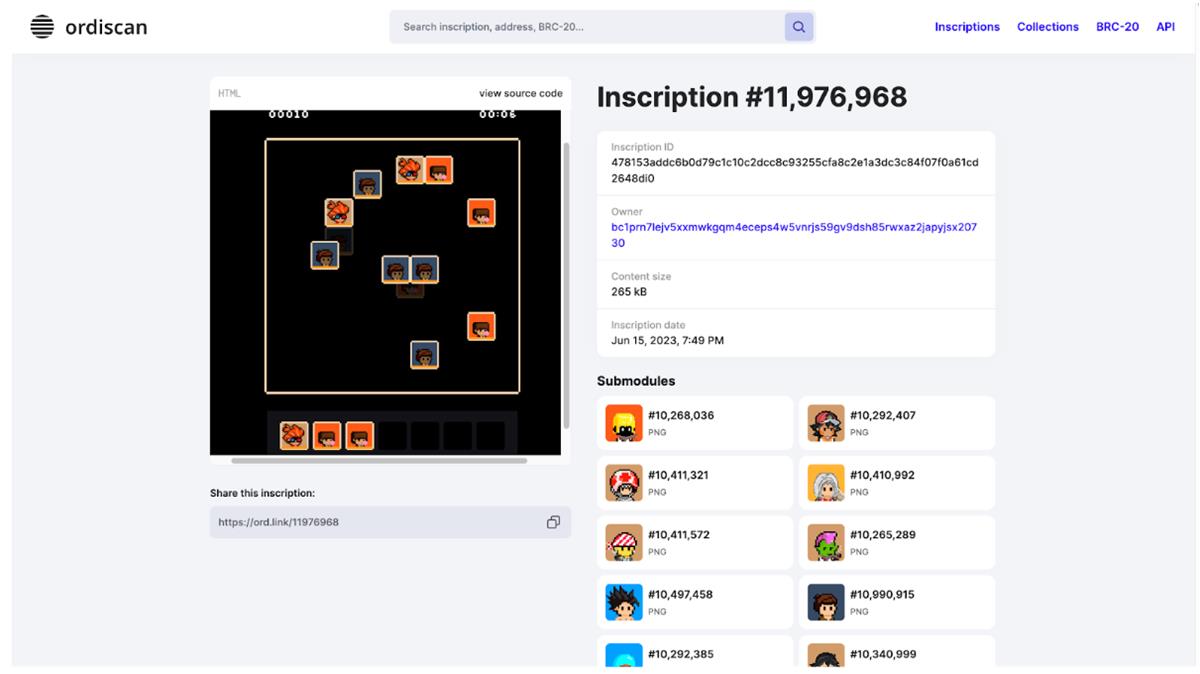
As previously noted, recursive inscriptions leverage code invocation to achieve minimal file sizes, effectively bypassing Bitcoin’s 4MB block size limit. In theory, this enables the construction of full-scale metaverses and GameFi experiences—even complex 3D games—entirely on the Bitcoin blockchain. Of course, recursive inscriptions remain in early stages, and realizing these visions will require sustained exploration and discovery.
5. Potential Risks of Recursive Inscriptions
1. Centralization Risk: Recursive inscriptions depend entirely on the Ordinals protocol. If the “referencing” functionality is not included or is later removed from the protocol, recursive inscriptions will cease to function.
2. Increased Burden on the Bitcoin Network: In the short term, recursive inscriptions may bring vitality to the Bitcoin ecosystem. However, over time, storing images, films, code repositories, software, and other data-heavy inscriptions could flood Bitcoin’s mempool. As inscription demand drives up transaction fees, regular users simply trying to send BTC may face prohibitively high costs. Long-term, this could lead to increased network congestion and higher fees.
3. Lowered Cost of Malicious Activity: Recursive inscriptions could make it easier for bad actors to distribute malware on Bitcoin. Attackers could split malicious payloads across multiple files and deliver them when users download games, documents, or software—potentially leading to fund theft.
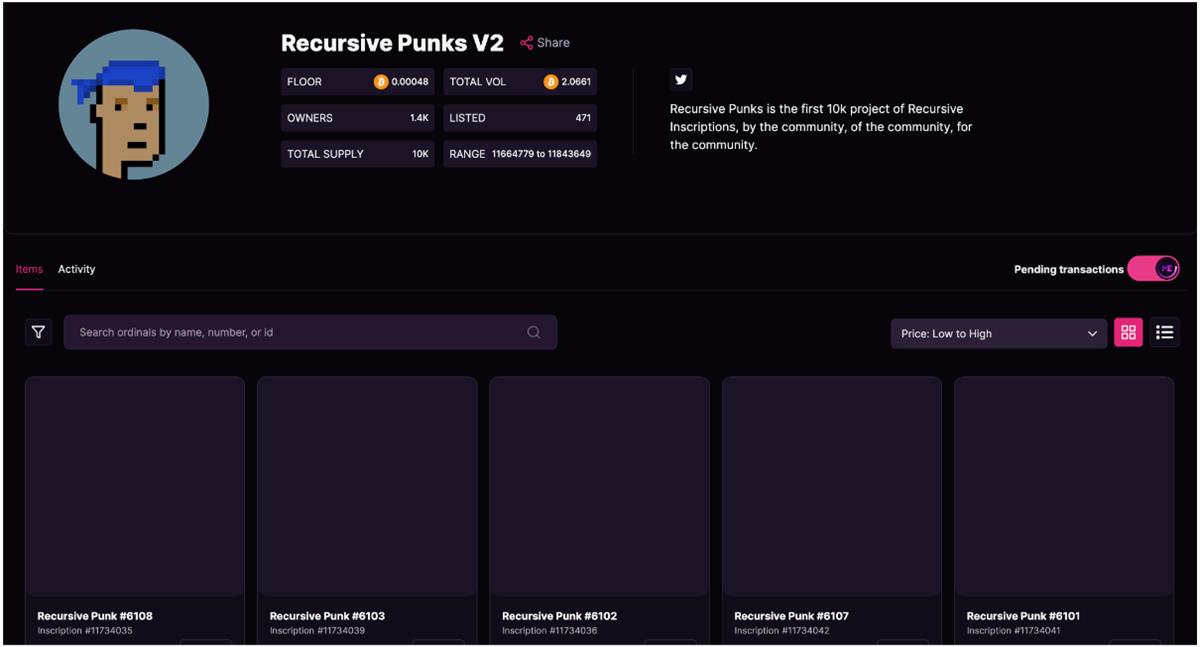
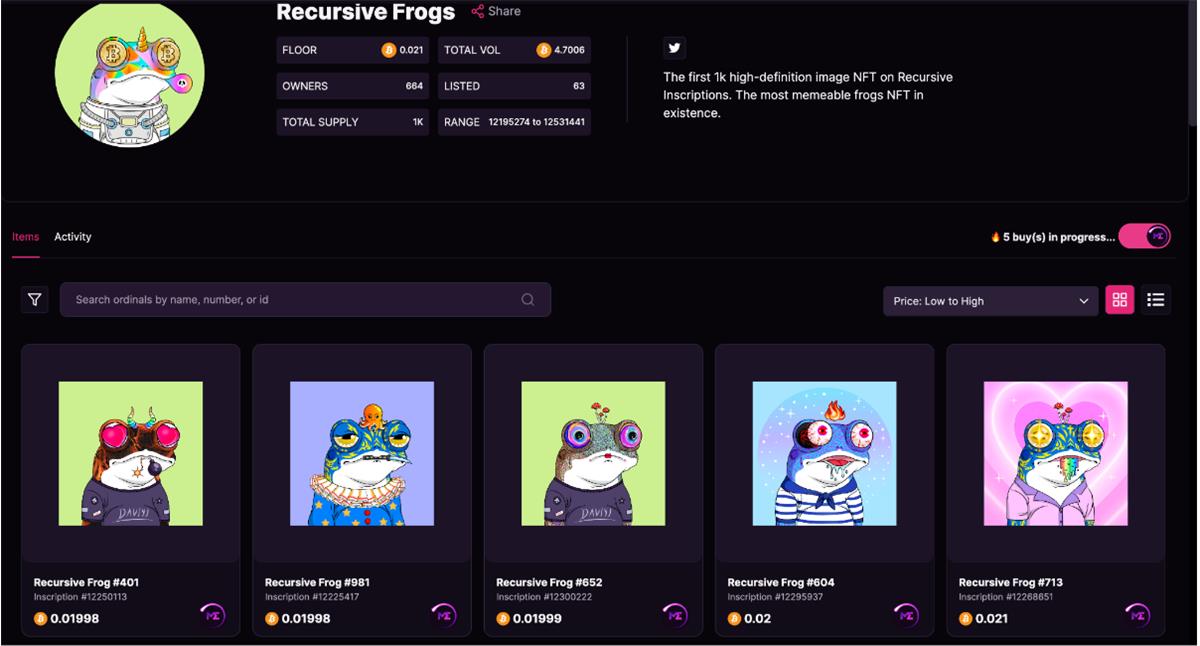
4. Dependency on Underlying Infrastructure Support: Recursive inscriptions require continued support from foundational infrastructure—including major marketplaces like Unisat and MagicEden, key inscription explorers, and centralized exchanges such as OKX and Binance. As of today (2023.6.20), MagicEden still does not support image rendering for Recursive Punks V2 (shown below), and Recursive Frogs only achieved proper display after a community KOL advocated for it.
6. Conclusion
The emergence of recursive inscriptions has sparked broad discussion within the Bitcoin ecosystem and may have far-reaching implications for the entire industry. While the potential of recursive inscriptions is exciting, it’s crucial to recognize that the technology is still in its infancy. Realizing its full promise will require ongoing experimentation, discovery, and support from developers and teams. Therefore, while exploring and investing in this space, we must remain vigilant about associated risks.
Join TechFlow official community to stay tuned
Telegram:https://t.me/TechFlowDaily
X (Twitter):https://x.com/TechFlowPost
X (Twitter) EN:https://x.com/BlockFlow_News
 Everest Ventures Group (EVG)