Hidden Gems in the Crypto World: Top 9 High-Quality Web3 Gaming Projects
TechFlow Selected TechFlow Selected
Hidden Gems in the Crypto World: Top 9 High-Quality Web3 Gaming Projects
Web3 gaming has immense potential, bringing new possibilities to the world of gaming.
 Navigating Web3 tides with focused insights
By veDAO
Games are often the biggest killer applications on new platforms. Today, there are over 3 billion video gamers worldwide, with 250 million younger-generation individuals expected to become lifelong players. Since their inception, video games have fostered a vibrant consumer ecosystem and evolved into a massive social network characterized by high user engagement. As one of the primary forms of entertainment in the digital age, gaming is generating tremendous economic value. Within the Web3 landscape, gaming has long been regarded as a potentially transformative application domain.
According to research by Bain & Company, the gaming market is projected to grow by more than 50% by 2025, exceeding $300 billion. With rising consumer demand and increasingly sophisticated expectations for gameplay experiences, the integration of blockchain technology into gaming is unlocking entirely new possibilities. An increasing number of games now leverage blockchain to enable player ownership of in-game characters and items, as well as enhanced virtual experiences.

In May 2022, crypto venture capital giant a16z announced its first dedicated gaming fund, Games Fund One, totaling $600 million. Within a year, the fund had made 25 investments. Cointelegraph’s March 2023 blockchain gaming report further highlights the growth and potential of Web3 gaming: beyond significant funding and project volume, Web3 games accounted for 49% of all on-chain transactions in 2022. Daily active users grew by 60% from 2021 to 2022, demonstrating both expanding user bases and the relative strength of Web3 gaming compared to other blockchain sectors.
Games can be categorized in various ways—by interactivity, playability, scalability—and with the addition of Web3 attributes, they can also be classified by degree of decentralization. For example, based on increasing levels of decentralization, Web3 games fall into three categories: optional-on-chain games, semi-on-chain games, and fully on-chain games. Optional-on-chain games are essentially traditional Web2 games augmented with NFTs derived from game IPs, and thus do not qualify as true Web3 games. Semi-on-chain games are the most common form within Web3 gaming: while player assets are stored on-chain, actual gameplay occurs off-chain. These games solve issues around verifying asset ownership and programmability, focusing primarily on in-game items and property rights. Fully on-chain games represent truly decentralized gaming—replacing traditional centralized game servers with blockchain infrastructure, storing all player data on-chain, and enabling indexing and writing directly to the chain. This approach grants games persistence, censorship resistance, and community-driven development capabilities.
In this article, the veDAO Research Institute selects three distinct categories across different classification frameworks to analyze Web3 gaming, highlighting nine high-quality Web3 gaming projects.
Traditional Web3 Games
Traditional Web3 games refer to the most common type of P2E (Play-to-Earn) games, typically featuring moderate interactivity, simple graphics, a core focus on P2E mechanics, and strong community-driven dynamics. They represent a prevalent form of Web3 gaming and are generally classified as semi-on-chain from a decentralization standpoint. Compared to Web2 games, these Web3 titles often offer lower playability, attracting primarily Web3-native users. Much like how 8-bit pixel art games maintain popularity even after the advent of Unreal Engine 5, game appeal encompasses more than just visuals and interaction—it includes narrative depth and community participation. In the Web3 space, this extends further: players can actively contribute to game creation itself.
AI Rein

AI Rein is a Japan-based global NFT project themed around an AI-powered future world. It features proprietary AI Motion technology that allows NFT holders to control their avatars in the metaverse using their computer's front-facing camera. The project's first NFT series represents citizens of a futuristic AI world. AI Rein also plans to launch a blockchain-based 2D pixel-style game where players can experience AI technology in a virtual world filled with adventure and challenges. Players can stake their AI Rein NFTs to earn rewards usable within the game.
Chainers

Chainers is a metaverse game focused on NFTs and community-driven development. Players can access the game for free and are encouraged to contribute creatively, building additional content. Positioned as “Play, trade, and create,” Chainers enables players to experience, socialize, interact, and generate income through creation—simultaneously delivering fun and economic value.
Degen Zoo

Built by DAOMaker founder Chris Zaknun and a former MakerDAO engineer, this game was developed with an ultra-low budget of just $20,000 and completed within 30 days. Inspired by the CryptoZoo NFT scam, Degen Zoo aims to demonstrate the incompetence of CryptoZoo’s creator, Logan Paul, by proving that a legitimate game can be built quickly and affordably—satirizing fraudulent metaverse projects that deceive investors. Additionally, as a charitable NFT initiative, all profits will be donated to endangered animal conservation charities. One of the project’s goals is to raise awareness about animal welfare and environmental protection, educating players about the consequences of species extinction through gameplay.
AAA-Level Games
AAA games, simply put, are those with high development costs, long production cycles, and extensive resource consumption. This sector resembles public blockchains—requiring considerable time before tangible results emerge. For general investors, getting in early on AAA games often yields substantial returns in the future. Moreover, AAA-grade Web3 games possess exceptional potential to break into the mainstream. If development teams maintain disciplined cost management and product execution, delivering a genuinely playable, high-quality game that fulfills Web3 principles, such projects could attract vast numbers of Web2 users into the Web3 ecosystem.
Delysium

Delysium is the world’s first playable AAA blockchain game—a truly open-world, vividly AI-driven, and fully player-owned MMO. It supports the creation of personalized physical and narrative assets, along with native AI MetaBeings. By distributing vast numbers of AI-powered MetaBeings across player-created and owned experiences, Delysium is crafting immersive, dynamic, and ever-evolving open-world experiences for all web3 pioneers globally.
Wildcard Alliance

Wildcard Alliance is a AAA-class PvP game combining real-time strategy, multiplayer online battle arenas, and card mechanics, built on the Polygon blockchain. It aims to create a decentralized, self-governed Web3 competitive social platform—delivering intense competitive thrills, pushing the boundaries of video game excitement, and blurring the lines between playing and spectating. Designed to be “easy to learn, but takes a lifetime to master,” it strives to become an enduring competitive title. The game also emphasizes collectibility, aiming to build Wildcard into a beloved IP and a community players want to join.
Citizen Conflict

Citizen Conflict is a free-to-play Web3 MMO shooter developed by QORPO Game Studio (formerly known as Crypto Citizen) using Unreal Engine 5 and deployed on the BSC chain. Set in a dystopian world on the Ether Islands, each match revolves around survival and securing valuable loot, incorporating both open-world exploration and battle royale elements. While the base game is completely free, players may optionally purchase or earn in-game assets as NFT collectibles to enhance their experience—though this is not required.
Fully On-Chain Games
Compared to optional-on-chain and semi-on-chain games, fully on-chain games currently offer lower playability and face greater challenges during initial bootstrapping and establishing positive feedback loops. However, in the medium term, aspects such as community governance and inflation control become smoother, potentially leading to stronger ecosystem moats and network effects.
In a truly decentralized environment, fully on-chain games feature economies driven by player actions and decisions rather than controlled by developers or central authorities. Players acquire and manage in-game assets and resources through trading, cooperation, or competition. They can also participate directly in governance and rule-making, achieving autonomy in the game world. This player-driven economic model and self-governing framework deliver richer, freer gaming experiences.
PandaFarm

Panda Farm aims to build a fully on-chain, panda-themed game metaverse. Users can profit from prize pools while participating in matches. It is a gaming platform centered on pandas, with all panda-themed games built on blockchain. Panda Farm seeks to bring blockchain into mainstream gaming by simulating real-world panda behavior while leveraging digital construction and cryptocurrency advantages—appealing to both crypto and non-crypto gamers, as well as panda enthusiasts. In the future, players will be able to build their own panda parks, summon alien creatures to play with pandas, integrate diverse IPs into a shared universe, cultivate farmland, and use decentralized farmer governance models where farmers can lock BAMBOO tokens via custom animal NFTs.
MetaLine

MetaLine is an open, transparent, and inclusive world where all information, assets, and content are fully decentralized. It is a large-scale Web3 multiplayer game combining maritime business management, adventure, and strategy, featuring six core systems: production and trading, leveling, ports, combat, NFTs, and ecology. Through interconnected task systems, players unlock rich gameplay and build their own maritime empires. As tasks roll out progressively, the integrated port system opens broader access to the metaverse for more users.
Arcadeum
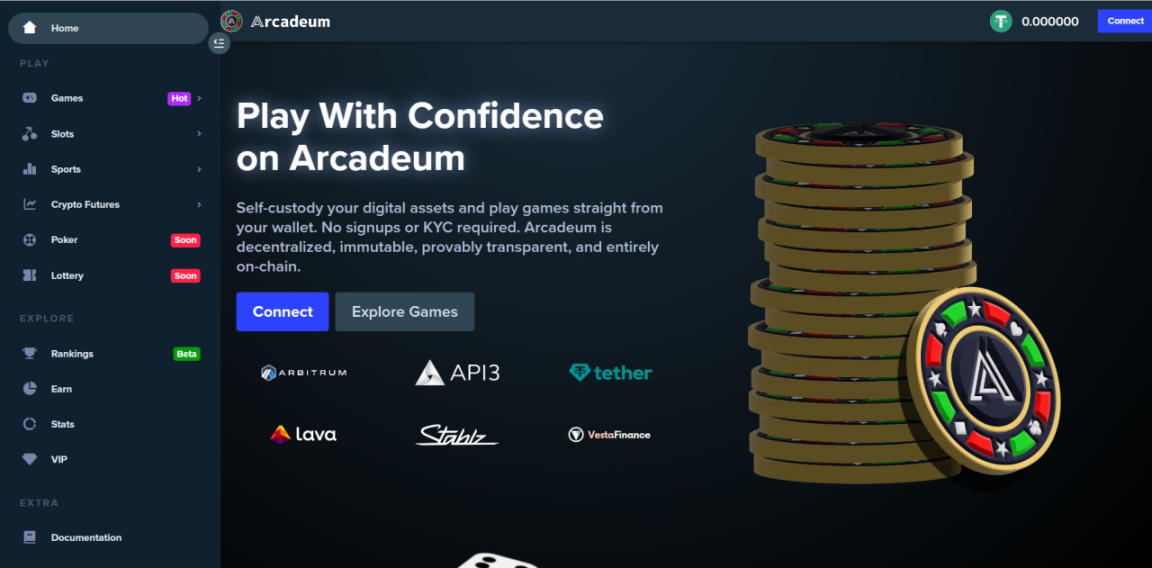
Arcadeum is a decentralized casino operating entirely on-chain and self-regulated, offering provably fair odds that are low yet competitively structured. A liquidity pool facilitates betting, with depositors receiving losses and paying out wins. Verified fairness is ensured through a custom API3 QRNG integration for verifiable random number generation.
Closing Thoughts
Web3 gaming holds immense potential, opening new frontiers for the gaming world.
Game creators must never forget the core priority of gaming: entertainment.
Likewise, earning assets in Web3 games should be part of the gameplay experience—not the sole reason for user participation. Therefore, focusing exclusively on P2E mechanics is insufficient for sustainable Web3 gaming.
Moreover, to achieve true Web3 gaming, games must be built upon bottom-up protocols, with tokenomics serving as a supporting mechanism to ensure economic sustainability. In such games, players gain genuine ownership of assets and can freely trade them without reliance on or control by centralized platforms or institutions.
Web3 gaming may well become one of the primary gateways for Web2 users to enter the Web3 space. As demonstrated by the projects highlighted in this article, by focusing on creating games with compelling visuals, engaging characters, and immersive storytelling—where playability, not incentives, drives user engagement—we can cultivate a vibrant, creative, and enduring Web3 gaming ecosystem. Only then can we unlock the full value of Web3 gaming and usher in a new wave of user adoption.
Join TechFlow official community to stay tuned
Telegram:https://t.me/TechFlowDaily
X (Twitter):https://x.com/TechFlowPost
X (Twitter) EN:https://x.com/BlockFlow_News
 @TrendX_official