A Deep Dive into the Past, Present, and Future of Fully On-Chain Games
TechFlow Selected TechFlow Selected
A Deep Dive into the Past, Present, and Future of Fully On-Chain Games
Fully on-chain games should leverage their full on-chain advantages, rather than simply migrating game logic onto the blockchain. In other words, they shouldn't go fully on-chain just for the sake of being on-chain—being fully on-chain is not the goal, but a means to an end.
 Navigating Web3 tides with focused insights
Producer: LK Venture
Author: Cynic
TL;DR
-
What is a fully on-chain game?
-
Challenges and solutions facing fully on-chain games
-
Why do we need fully on-chain games?
-
Which blockchain is suitable for fully on-chain games?
-
Which types of games are suitable for being fully on-chain?
-
The past of fully on-chain games: Decentralized, trustless — let's open a casino here
-
The present of fully on-chain games: High-performance public chains make fully on-chain games a viable option
-
The future of fully on-chain games: From fully on-chain games toward an on-chain society?
What Is a Fully On-Chain Game?
A fully on-chain game refers to a game where both game logic and data are entirely stored on the blockchain. These games operate and interact via smart contracts, thus fully leveraging the advantages of blockchain technology—decentralization, trustlessness, verifiability, transparency, and traceability.
Fully on-chain games contrast with partially on-chain games. In partially on-chain games, only certain elements—such as in-game assets or transaction records—are stored on the blockchain, while core game logic and data processing still rely on traditional centralized servers.
Partially on-chain games can be further categorized based on what aspects are placed on-chain: core logic, assets, or achievements.
Core logic on-chain typically involves storing key game data and algorithms on the blockchain to ensure fairness and transparency. For example, placing the random number generator (RNG) or combat resolution logic on-chain prevents cheating and manipulation. Alternatively, partially on-chaining the in-game economy enables more diverse and innovative incentive mechanisms—for instance, allowing players to earn tokens through mining, staking, or participating in in-game activities.
Asset on-chain means that virtual items, characters, or other resources within the game are represented as non-fungible tokens (NFTs) or fungible tokens (FTs), enabling players to truly own, trade, and manage these assets, providing economic incentives and encouraging participation in the game’s ecosystem.
Achievement on-chain usually refers to players unlocking certain milestones in the game and choosing to register them on-chain as proof of skill or eligibility for future airdrops. However, such achievements cannot be directly traded. Compared to asset on-chain, achievement on-chain offers much weaker economic incentives but brings gaming closer to its essence: "At the end of the day, the most important thing about a game is that it's fun."
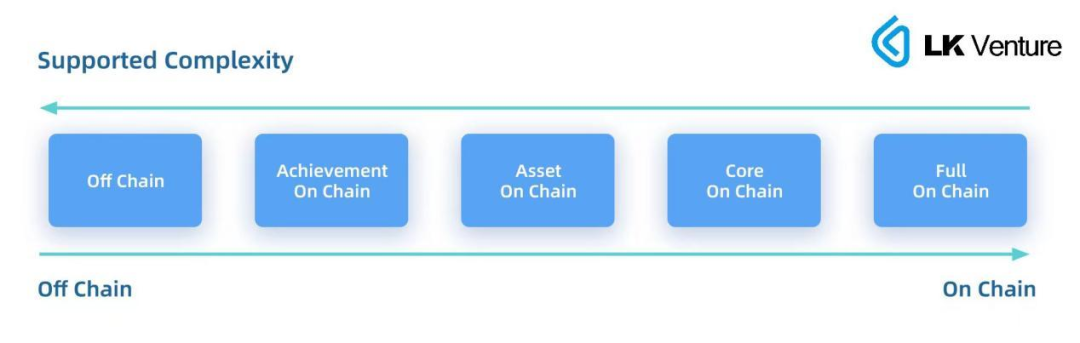
Game types defined by degree of on-chain integration
Challenges Facing Fully On-Chain Games and Potential Solutions
Despite the concept of fully on-chain games having been introduced years ago, widespread adoption remains limited. According to LK Venture, this is due to several practical challenges:
1. Performance and scalability: Blockchain networks have relatively limited processing capacity, especially in terms of transaction throughput and confirmation speed. Fully on-chain games could cause network congestion and latency, negatively impacting gameplay. To address this, developers must explore scaling solutions such as sharding, state channels, and Layer 2 scaling.
2. Transaction costs: Every action in a fully on-chain game must be submitted as a blockchain transaction, incurring fees (e.g., Ethereum gas). High transaction costs may limit player engagement and overall playability. Reducing costs requires optimizing transaction structures and adopting more energy-efficient consensus algorithms.
3. User experience: Compared to traditional games, fully on-chain games may pose usability challenges. Users must understand and use cryptocurrency wallets, manage private keys, and handle transactions—barriers that may deter mainstream adoption.
4. Privacy concerns: Due to blockchain’s public and transparent nature, player data and transaction histories in fully on-chain games risk exposure. Protecting privacy may require zero-knowledge proofs or secure computation techniques, though these add complexity and development overhead.
5. Game design limitations: Given current blockchain performance constraints, fully on-chain games may struggle to support complex mechanics or real-time interactions. This restricts their applicability to high-performance genres like massive multiplayer online (MMO) or action games.
High-performance Layer 1 blockchains and increasingly popular Layer 2 solutions are expected to reduce transaction costs and improve confirmation speeds, effectively mitigating issues 1 and 2.
Account abstraction (AA) can lower user barriers and resolve issue 3. ERC-4337 passed audit and was deployed on mainnet on March 2, 2023, paving the way for widespread adoption of AA.
Zero-knowledge proof technology has already demonstrated strong capabilities in protecting privacy, addressing issue 4. As for issue 5—do we really need every game genre on-chain? The answer is likely no.
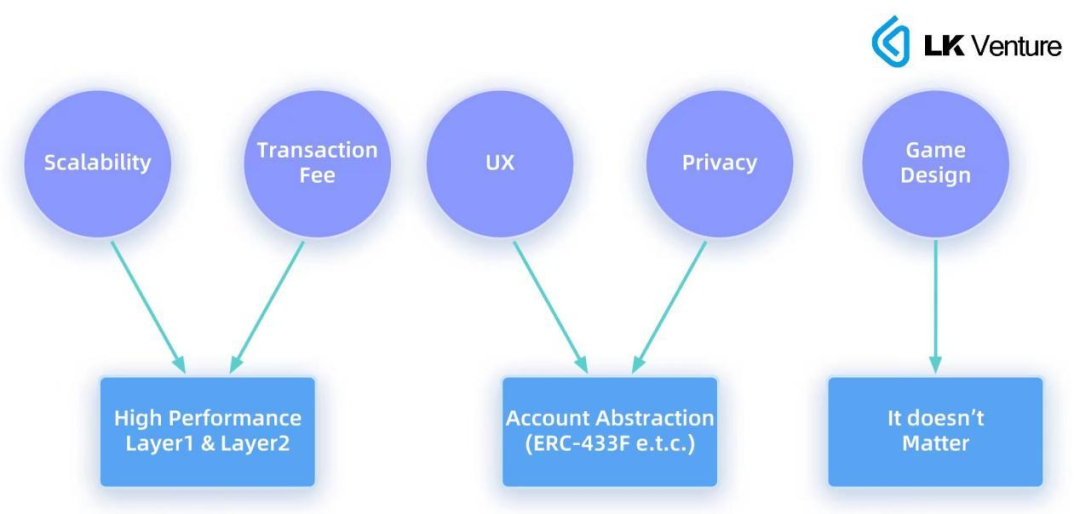
Main challenges facing fully on-chain games and potential solutions
Why Do We Need Fully On-Chain Games?
Given the numerous unresolved issues, why pursue fully on-chain games at all? This question is somewhat akin to asking: Why do we need permissionless blockchains?
LK Venture believes demand for fully on-chain games can be understood from the following perspectives:
1. A decentralized, open-access gaming world: Fully on-chain games eliminate reliance on centralized servers, making game operations more decentralized. This enhances security, censorship resistance, and reduces dependency on any single entity.
2. Trustless, verifiable fairness: With game logic and data stored on-chain, rules and states are transparent to all. Players can independently verify fairness and outcome correctness, increasing trust in the system.
3. Ownership, not just access: By representing in-game items and characters as NFTs, fully on-chain games grant players true ownership and control. This ownership incentivizes participation and provides tangible real-world value.
4. Once deployed, forever running: Since game state and logic reside on-chain, fully on-chain games exhibit high sustainability. Even if original developers cease support, the game continues as long as the blockchain produces blocks.
5. Community-driven, serving the community: Through smart contracts and decentralized autonomous organizations (DAOs), fully on-chain games enable community-led development and governance. This allows games to better adapt to player needs and market changes, extending their lifespan and appeal.
6. Open collaboration, user creation drives evolution: Open-source code and open systems foster collaborative innovation. Assisted by AI large models, users' creative potential is unleashed, and UGC or AIGC content leads to more diverse, rich, and sophisticated gaming experiences.
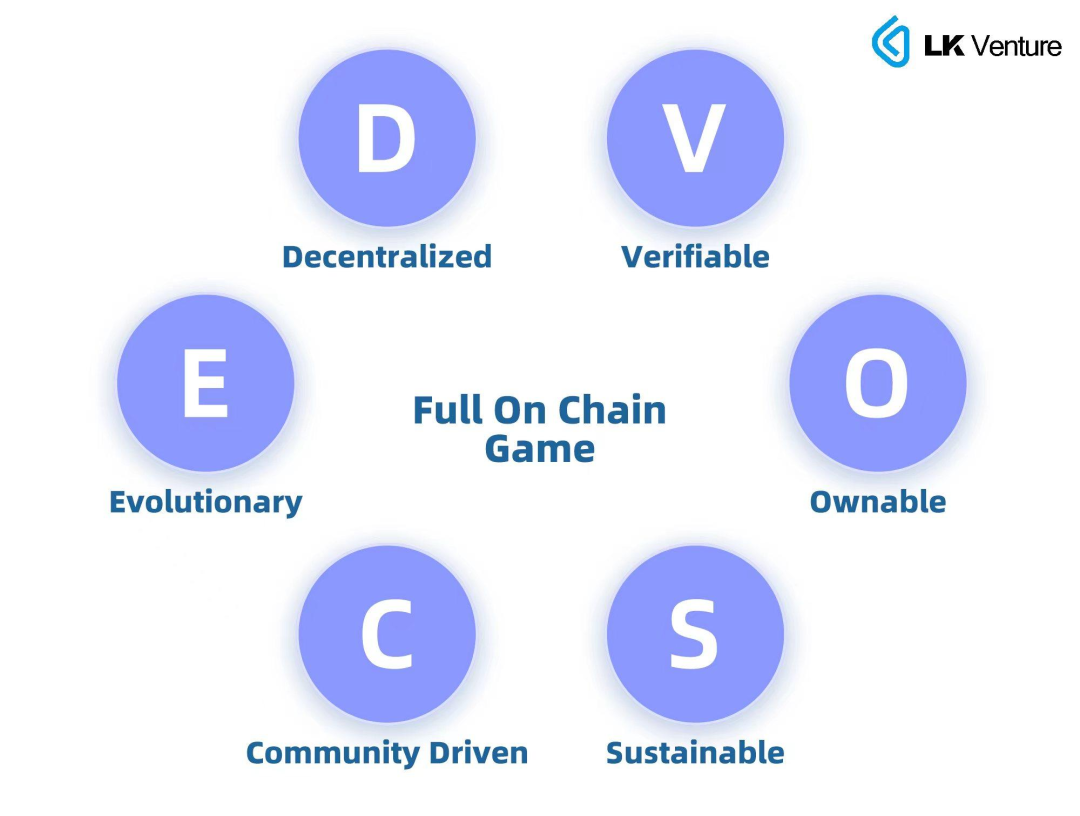
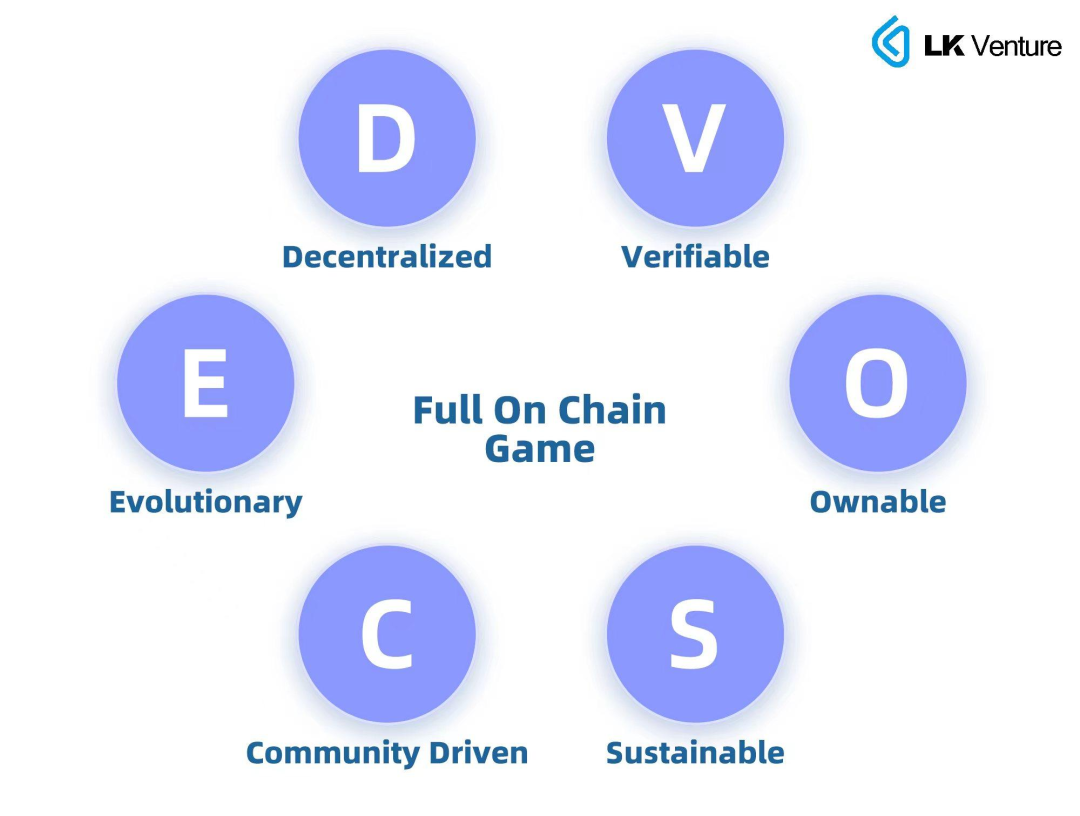
Analysis of market demand drivers for fully on-chain games
Which Blockchains Are Suitable for Fully On-Chain Games?
LK Venture compares major blockchains across five dimensions—TPS, confirmation time, transaction cost, security, and independence—with a maximum score of 5 points each.
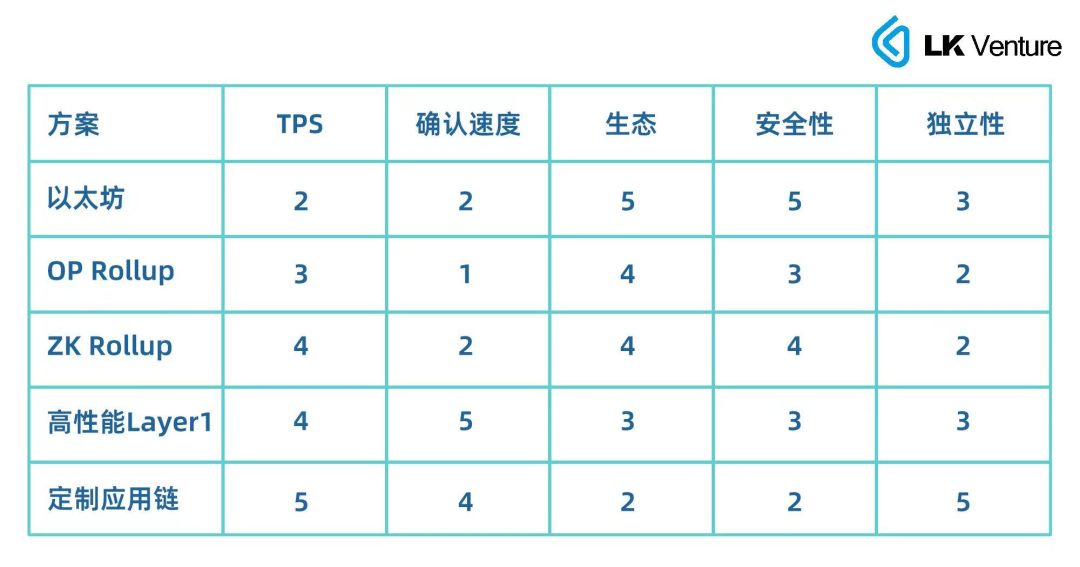
Comparison of infrastructure parameters across major blockchains for fully on-chain games
The primary prerequisite for fully on-chain games is excellent transaction performance. Fast confirmation times enhance gameplay, robust ecosystems provide supporting infrastructure, security is crucial for protecting in-game assets, and independence ensures games aren't disrupted by unrelated events causing network congestion.
In reality, there is no silver bullet—each solution has trade-offs. Game projects should choose based on their specific design requirements.
Which Types of Games Are Suitable for Being Fully On-Chain?
LK Venture argues that fully on-chain games should leverage the unique advantages of full on-chain deployment rather than simply porting existing logic onto the blockchain. In other words, don't go fully on-chain for the sake of it—full on-chain is a means, not an end.
Which game genres best exploit blockchain's strengths? LK Venture identifies two ideal categories.
The first is multi-party games (MPG)—leveraging blockchain’s openness, transparency, and verifiability. Interestingly, “game” here can mean both “game” and “strategic interaction.”
“Multi-party” implies the game isn’t single-player or just human vs fixed logic, but involves real-time human-to-human interaction. Permissionless blockchains allow anyone to participate.
“Strategic interaction” means participants are adversarial. Full on-chain execution guarantees fairness—the public, transparent, verifiable nature of blockchain ensures even developers cannot tamper with outcomes.
The most direct form of MPG is gambling. More broadly, various card, board, and turn-based strategy games also fall into this category. MPGs typically involve fewer interactions, emphasize strategic thinking over reaction speed, and rely on blockchain to deliver fair adjudication among competing parties.
The second type is user-generated games (UGG)—leveraging blockchain’s openness, autonomy, and ownership.
In UGGs, the initial designer sets only a minimal core rule set. Users then build upon this foundation, using imagination and creativity to invent new gameplay forms. With AI large models, users can more easily implement creative ideas and monetize them through blockchain-based ownership rights.
There’s no central authority—on UGGs, only individuals collaborating voluntarily. True autonomy means governance power resides with every individual, enabling broadest democracy. If dissatisfied with the original ruleset, anyone can modify and deploy a new contract, creating a new world.
Starting from a small seed, fueled by positive feedback loops, the game grows into a towering tree.
The Past of Fully On-Chain Games—Decentralized, Trustless Gambling Markets
On November 1, 2008, Satoshi Nakamoto published “Bitcoin: A Peer-to-Peer Electronic Cash System.” On January 3, 2009, Bitcoin’s genesis block was mined. As Bitcoin transactions gained popularity, people began using them for online gambling. In 2012, the first Bitcoin-based gambling game—SatoshiDice—appeared.
SatoshiDice was a simple blockchain-based gambling game. Players sent Bitcoin to a designated address to place bets, and the game returned win/loss results based on predefined odds and a random number generator. At this stage, blockchain gambling was largely confined to the Bitcoin ecosystem and offered limited game variety.
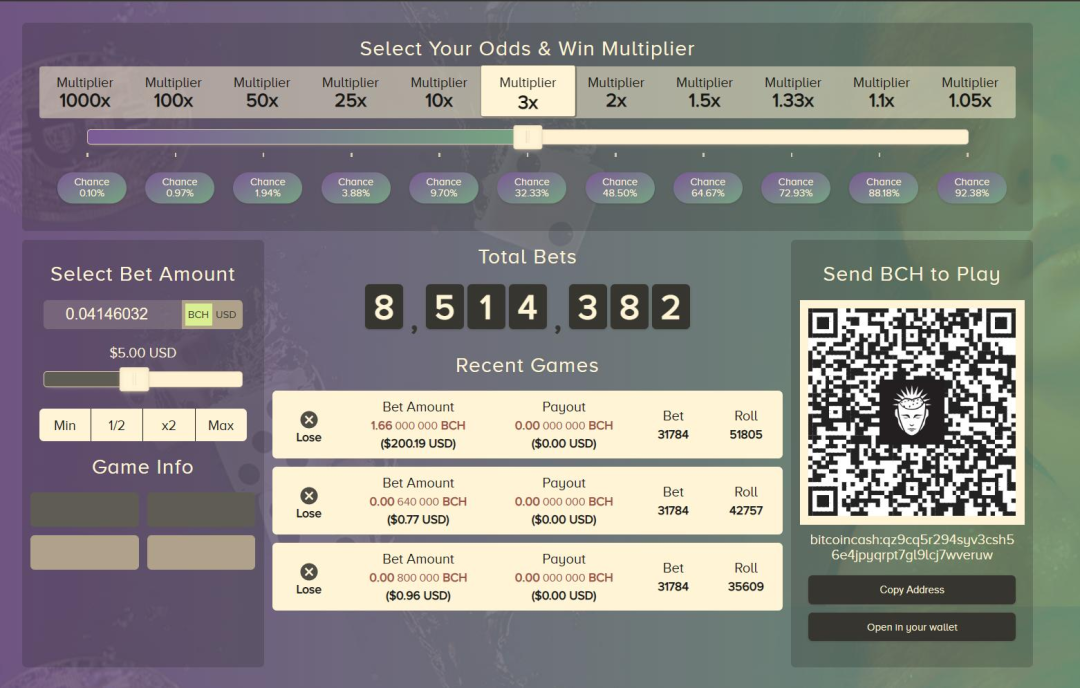
Satoshi Dice homepage screenshot
In 2013, the Ethereum project launched, and its smart contract functionality significantly impacted blockchain gambling. In 2015, Ethereum went live, and blockchain gambling gradually shifted from Bitcoin to Ethereum. Using Ethereum’s smart contracts, developers created more complex and interactive gambling games. This period saw the emergence of platforms like vDice and Etheroll.
In May 2014, Kevin McCoy and Anil Dash created the first known NFT. In 2017, CryptoKitties became the first Ethereum-based non-fungible token (NFT) game to attract massive attention. NFT technology profoundly influenced blockchain gambling, enabling representation of unique in-game assets—such as limited-edition gambling tools or virtual collectibles—and prompting more gambling games to adopt NFTs.
In the summer of 2020, DeFi Summer erupted, launching decentralized finance (DeFi) into prominence. Blockchain gambling entered a new developmental phase, integrating with DeFi protocols to offer richer financial features such as liquidity mining, staking, and lending.
Around the same time, public chain ecosystems exploded—BSC, Polygon, Solana, Tron, and others optimized for Ethereum’s high transaction costs, offering faster and cheaper transactions for users.
As the blockchain gambling market matured, innovative game formats emerged. Prediction markets like Augur and Gnosis allowed betting on future events, using smart contracts and blockchain to create fair, transparent, and trustless environments.
Gambling games were, in fact, the first applications on blockchain. They are naturally fully on-chain because comparing numbers or guessing digits boils down to mathematical calculations, and verifiability can be achieved through simple hash functions. History offers lessons. Despite negative perceptions of gambling, one must remember: fully on-chain games started here.
The Present of Fully On-Chain Games—High-Performance Chains Make Them Viable

Comparison of select high-performance public chains
With the rise of high-performance Layer 1 blockchains and Ethereum Layer 2 scaling solutions, fully on-chain games are becoming practically feasible. Exploration in this space has deepened, and the emergence of Dark Forest marks a milestone in the evolution of fully on-chain games.
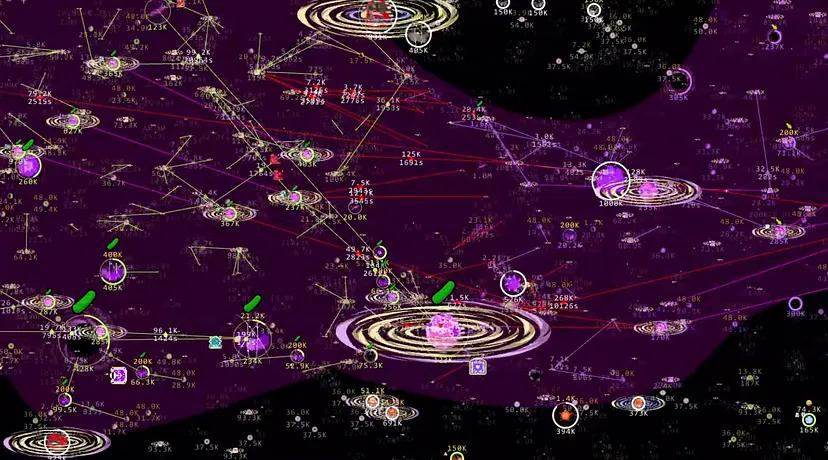
Dark Forest game screenshot
Dark Forest is the first fully on-chain game featuring incomplete information. It leverages blockchain’s transparency and verifiability while using ZK-SNARKS to hide gameplay-critical information, enabling imperfect-information gameplay that simulates the "dark forest" environment described in the sci-fi novel *The Three-Body Problem*.
As an open MMO strategy game, Dark Forest encourages players to innovate both in-game and around the game, fostering a vibrant community ecosystem. Players formed guilds and made significant contributions in plugin development, exploration, and event planning. As a real-time strategy game, every player action is executed via smart contract calls, updated in real time across players, with ZK-SNARKS-powered “fog of war” enabling hidden information and strategic depth.
Dark Forest proved the feasibility and playability of fully on-chain games—truly opening the door to this new frontier.
Major blockchains are actively cultivating fully on-chain gaming, but Starknet stands out as the most active. On Starknet, games like LootRealms, GO L2, Isaac, and Unstoppable Games have emerged, gaining significant traction. However, given Starknet’s persistently high gas fees, mainnet launches remain distant.
Current trends suggest two dominant themes: strategy-based competitive games similar to Dark Forest, and financially oriented casual mini-games. Given high gas fees, only games offering tangible economic incentives can attract users. Thus, the latter may reach mainnet faster.
The Future of Fully On-Chain Games—From Gaming Toward an On-Chain Society?
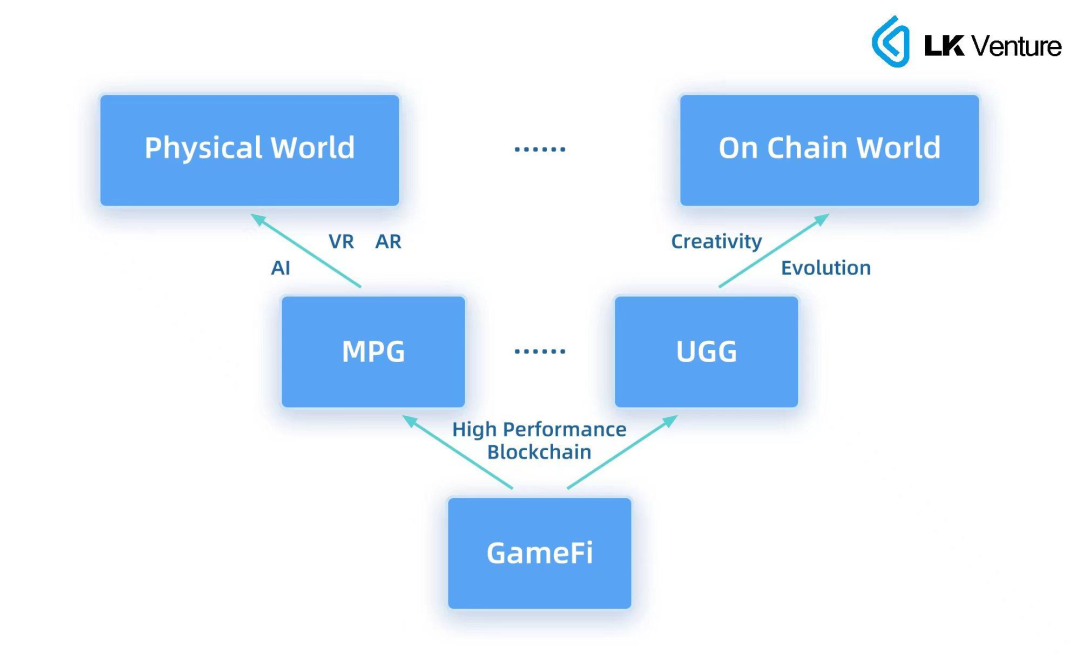
Evolution roadmap of the fully on-chain game ecosystem
In the short term, Ethereum scaling solutions like rollups remain limited. Being anchored to Ethereum exposes games to negative externalities—such as MEV bot attacks during volatile crypto markets causing gas spikes—making complex fully on-chain games prohibitively expensive. Without strong economic incentives, gameplay alone may not attract users. Meanwhile, high-performance Layer 1 chains often lack EVM compatibility, limiting developer pools and user bases.
Therefore, in the near term, GameFi with strong economic incentives will likely dominate.
In the medium term, we believe Ethereum’s dominance will fragment. More high-performance Layer 1 chains will attract users with lower costs and better experiences. ZK-Rollup technology will mature, reducing gas fees to levels comparable with traditional digital transactions. Specialized application-specific chains will emerge to avoid congestion from unrelated activities. On this foundation, complex fully on-chain games will finally launch on mainnet, exploring new frontiers in gameplay.
In the long term, games may transcend entertainment to generate real-world value. Player interactions and strategic decisions within games could serve as training data for AI, benefiting real-life applications. Blockchain-based ownership ensures users retain control over their data and earn rewards from on-chain activity. For example, driver reaction data from racing games could improve autonomous driving systems, especially by providing rare edge cases difficult to encounter in real life. The rise of UGGs may gradually transform games into social ecosystems.
After all, human society itself emerged from individuals exploring and creating under a core set of natural laws. Who’s to say an on-chain society can’t evolve in the same way?
Join TechFlow official community to stay tuned
Telegram:https://t.me/TechFlowDaily
X (Twitter):https://x.com/TechFlowPost
X (Twitter) EN:https://x.com/BlockFlow_News
 LK Venture