The best on-chain social is not Lens, but Dune; the best full-chain game is not Dark Forest, but Uniswap.
TechFlow Selected TechFlow Selected
The best on-chain social is not Lens, but Dune; the best full-chain game is not Dark Forest, but Uniswap.
The problem with crypto non-financial applications isn't "lack of mass adoption," but the failure to serve the native needs of crypto itself.
 Navigating Web3 tides with focused insights
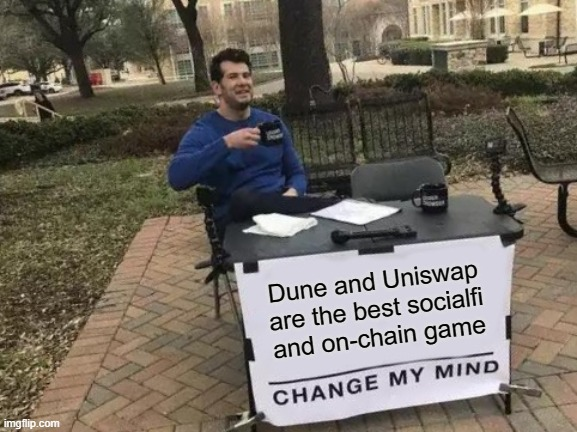
The best on-chain social is not Lens Protocol, but Dune. The best fully on-chain game is not Dark Forest, but Uniswap Labs.
The issue with crypto non-financial applications isn't "lack of mass adoption," but rather failing to serve native crypto needs. It's not that the products are bad—it's that the users are.
First, the term "best" here must meet the following three criteria:
1. Still active today (FOMO3D, Binance Chain, etc., do not count);
2. Maintains user engagement logic without token emission expectations, potentially generating fees or trading volume;
3. The product genuinely embodies the essential attributes of a social network or gaming product (note: essence, not superficial resemblance).
Frankly speaking, there has yet to be a fundamentally innovative product in the so-called "Web3 social" space. I know what you’re going to say—Lens and its ecosystem (see image below):
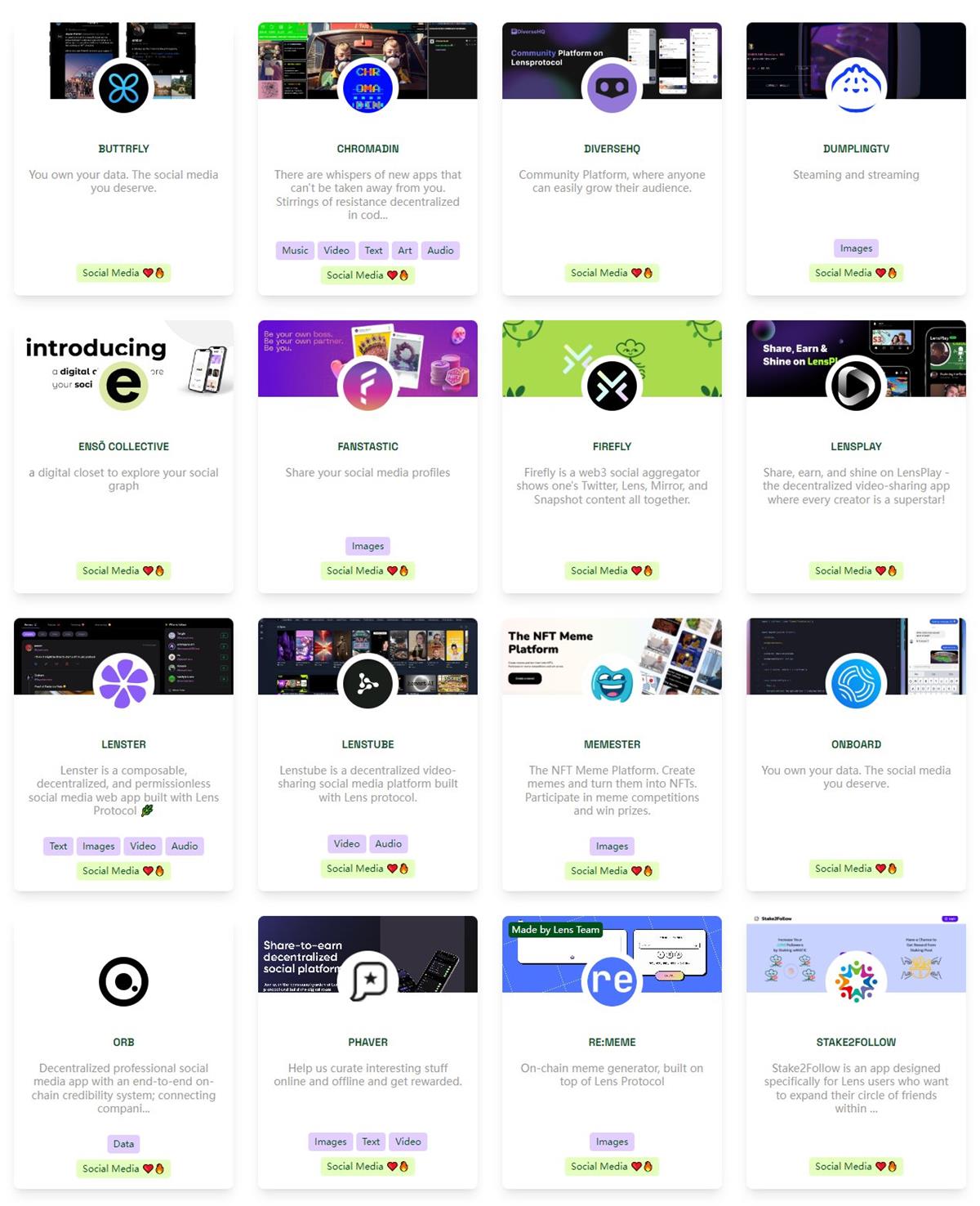 where:
-
YouTube/Spotify clones: 4;
-
Twitter/Instagram clones: 6;
-
One Web3 Imgflip;
-
And even a referral Ponzi scheme built on Lens;
Only Firefly, a social feed aggregator, shows some innovation.
You might ask: So what? They still have users.
History has taught us repeatedly: without a revolutionary breakthrough capable of disrupting existing user relationships, social clones rarely survive—Vine vs Musical.ly, Tencent Weibo vs Sina Weibo, Threads vs Twitter. The last decentralized social revolution, Damus—do you still open it today? Users won’t become more loyal just because you’re doing crypto.
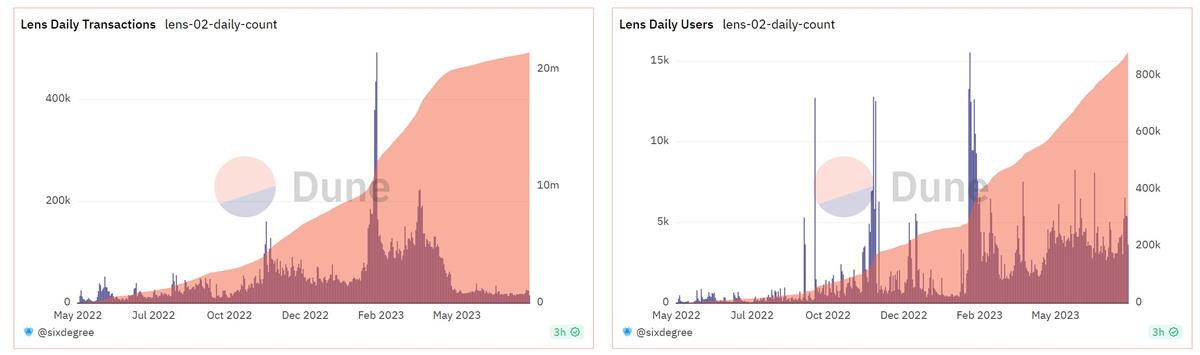
Lens currently has over 110,000 profiles, but both transaction volume and daily active users are declining. It’s clear that beyond airdrop farming, Lens struggles to maintain sustained daily engagement.
Why? What breakthrough scenario does Lens offer that its Web2 counterparts cannot?
To this day, crypto projects still only have official Twitter accounts—not “official Lens” pages—even this most crypto-native use case hasn’t migrated.
Like Lens, many Web3 “products that look like social apps” overly emphasize the narrative of “data sovereignty,” yet fail to answer basic questions:
-
Demand: Will users migrate just for “data ownership” to do the same things they do on Twitter/YouTube, but with less content?
-
Users: Do regular users care about their few-dollar CPC value?
-
Creators: Does creator content retain value outside algorithmic distribution?
-
Matching: Can a feed mechanism sustain user attention time?
Why is Dune currently the best crypto social?
-
Demand: Hunting for alpha through on-chain data—data equals money, something nonexistent in Web2;
-
Users: The entire Web3 ecosystem is hunting for alpha;
-
Creators: Creators use Dune tools to build dashboards—the data itself holds objective value;
-
Matching: No feed; search by keyword, ranked by stars.
It controls the value chain, achieving at least a GitHub-level professionalized social platform, with no Web2 competitor.
Lens lacks a native feed content-matching solution. Who sees what content and when depends entirely on curation apps due to decentralized social graphs.
Not bad—but this dramatically raises the traffic cost threshold for creators. Only information with direct monetization potential will prevail. And what kind of information has the highest unit monetization value? You already know the answer from your Twitter feed flooded with airdrop spam.
In other words, building an independent native crypto social graph + feed stream + curation may be like carving a boat to find a lost sword—thinking within a Web2 mindset.
-
Crypto social should not target the same user base or needs served by Web2 products.
-
Crypto social is a market based on information/data asymmetry.
Just like Dune—turning dashboards into products, monetized via credit subscriptions. Perhaps in the future, credits become tokens, enabling wizards to Dashboard-to-Earn.

The ironic yet true insight: The core idea behind non-financial applications is identifying a demand scenario that Web2 cannot (fully) solve (e.g., discovering and sharing alpha), then finding a transaction model driven by information asymmetry and scalable with usage (e.g., subscriptions, pay-as-you-go), forming a social flow (following experts) around that value.
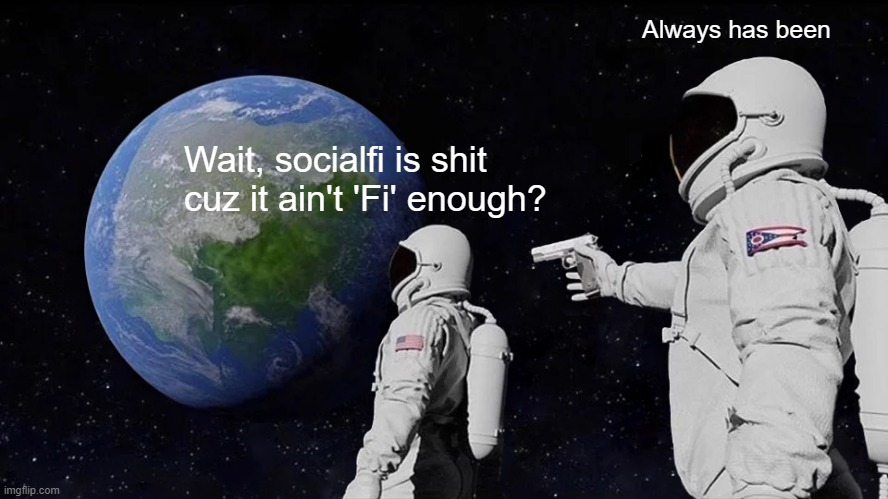
The reason SocialFi fails isn’t that it’s not social enough—it might be that it’s not financial enough.
The same logic applies to games—and even fully on-chain games. Dark Forest is great, but it remains a niche geek game.
But really—do you think a Clash of Clans, LOL, or GTA5 player actually cares about “owning your items permanently, combining them, deciding the game’s direction because the engine runs on magical blockchain?”
WTF? I’m here to farm crystals.
I’m bullish on fully on-chain games, but not on developers forcing their priorities onto users.
A game, per Wikipedia, is an activity governed by rules to achieve incentives, which can be material or simply pleasure, with outcomes dependent solely on skill, strategy, or luck.
That’s it—true throughout history. Any adjective prefixed before “game” is merely wishful thinking.
What makes a game fun?
Because of uncertainty. The first time parachuting precisely, marveling at an 8x scope—once mastered, everything becomes routine, novelty fades, and fun disappears.
Then, what kind of game stays fresh forever? Games of博弈 (strategic competition):
-
Bo (Gambling) - Probability sets the stage, cost to enter;
-
Yi (Strategic Play) - Zero-sum confrontation, only one winner.
Infinite possibilities, yet every round delivers the same adrenaline rush.
Chips pushed to the center, hole cards unseen—everything possible, victory or defeat hinging on a single decision. Adrenaline spikes at the moment of reveal. The allure of gambling was never just about winning money—it’s the thrill. Complex mechanics and flashy visuals may only be sufficient but unnecessary conditions for “fun.” Have you ever wondered why casino games have remained essentially unchanged for millennia?
Because they possess objectively near-50:50 fair win/loss mechanisms, probabilistic uncertainty, room for skill to influence outcomes, and time-tested robustness. Being invited to the table is the highest honor for any game—because it’s not just fun, it has consensus. Consensus trumps all, and on-chain trading is the game with the strongest consensus. View Uniswap through this lens.
Uniswap is such a game:
- Game engine fully deployed on-chain
- Win/loss rules absolutely transparent and objective
- Infinite tables, each with different variants (trading pairs), equally intense
- Operates 24/7
- Diverse strategies (meme coin pumping, quant trading, LP providing)
- Rewards settled instantly.
Be like Uniswap.
But would you sell this game to a Genshin Impact fanboy? Of course not!
See my point? Trying to educate and reshape players whose perception of “games” is already fixed in the Web2 world is utterly unrealistic. Expecting users to “enter Web3” via game products competing in Web2 giants’ core expertise has no statistical chance of success.
Instead, serve those “players” experiencing their first virtual-world adrenaline peak in Crypto—keep them high. I believe this is the first principle of fully on-chain gaming.
As someone who lived through Axie’s rise, a GameFi pioneer in 2020, and a market maker across multiple games and SocialFi projects in 2021, my conclusion in 2023 is:
-
Drop the illusions, face reality;
-
Prioritize Crypto first, then applications;
-
Liquidity before user count.
Think from crypto’s first principles. Don’t get sidetracked by Web2 products or users. Let go of attachments. Stop carving boats to find swords. The native is the strongest.
Join TechFlow official community to stay tuned
Telegram:https://t.me/TechFlowDaily
X (Twitter):https://x.com/TechFlowPost
X (Twitter) EN:https://x.com/BlockFlow_News
 @thecryptoskanda