








Comdex: Seamless DeFi Deployment on Cosmos
TechFlow Selected TechFlow Selected
Comdex: Seamless DeFi Deployment on Cosmos
Comdex is the Layer 1 infrastructure layer of the Cosmos ecosystem, designed to facilitate the seamless deployment of DeFi applications within the Cosmos ecosystem.
 Navigating Web3 tides with focused insights
Author: Revelo Intel
Translation: TechFlow

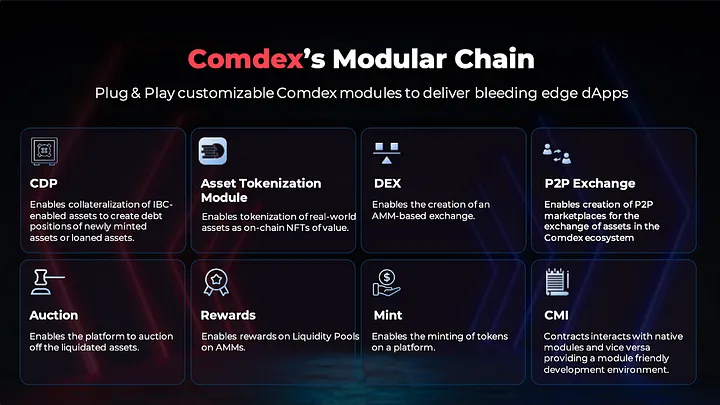
Comdex is the Layer 1 infrastructure layer of the Cosmos ecosystem, designed to facilitate seamless deployment of DeFi applications within the Cosmos ecosystem and enable multi-chain communication and capital transfer between CeFi and DeFi. To achieve this, Comdex provides customizable plug-and-play modules such as:
-
CDP module for creating debt assets using IBC-enabled assets as collateral.
-
Asset tokenization module to represent RWAs (real-world assets) as on-chain NFTs.
-
DEX for building AMM-based decentralized exchanges that facilitate asset swaps between IBC-supported assets.
-
P2P trading to create on-chain peer-to-peer markets.
Roadmap
-
Founded in 2018 and deployed on Cosmos to meet scalability and privacy requirements for its enterprise trading platform, which eventually launched a year later.
-
In 2020, due to regulatory hurdles with cross-border fiat payment channels (e.g., in-person KYC/AML) and lack of native DeFi on Cosmos, the team shifted focus and began building the Comdex chain.
-
By Q4 2021, Comdex's mainnet was ready and the native CMDX token was deployed.
-
Comdex’s initial product suite includes Harbor Protocol, a CDP platform supporting the CMST stablecoin; cSwap, an AMM DEX based on a hybrid order book model; and Commodo, a decentralized money market protocol. These three initial primitives were deployed between November 2022 and January 2023. Over time, the ecosystem will expand to support broader applications such as synthetic assets, trade finance, perpetual futures, and more.
Token Overview


Comdex Ecosystem
Harbor Protocol - CMST
Harbor Protocol is a cross-chain stablecoin protocol that allows users to create CDPs (collateralized debt positions) by locking whitelisted collateral assets to mint CMST. CMST is Comdex’s native IBC-compatible, fully collateralized stablecoin.
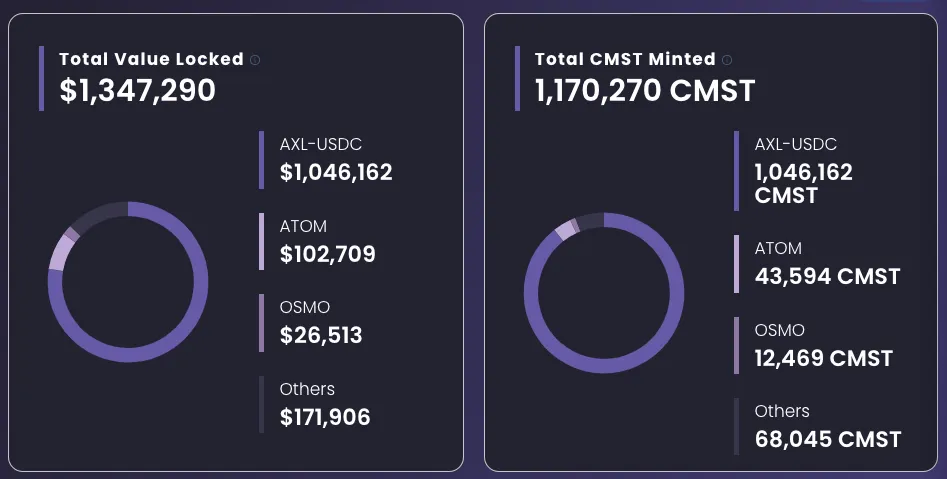
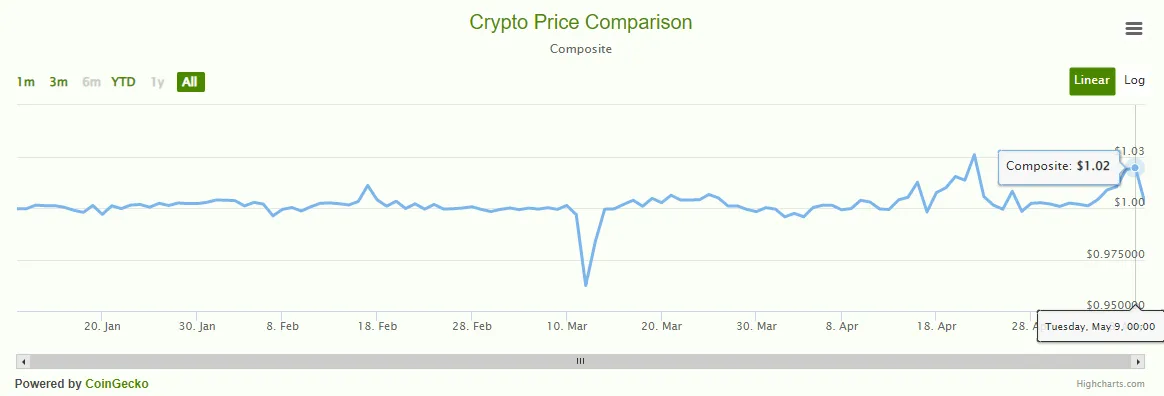
Composite (CMST) is a stablecoin designed to represent purchasing power, soft-pegged at 1 USD per unit. Its mechanism follows the MakerDAO standard used for DAI: CMST can be minted permissionlessly through over-collateralized CDPs to back its value.
-
CMST serves as a store of value that does not depreciate over time. As a stablecoin, it aims to represent the token holder’s purchasing power.
-
CMST acts as the unit of account and standardized measure within the Comdex ecosystem, achieved via its soft peg to 1 USD.
-
CMST functions as a medium of exchange, facilitating the purchase and sale of goods and services across various Comdex and IBC-enabled platforms.
Harbor Protocol consists of three main modules:
-
Vault module, allowing users to mint CMST using whitelisted collateral assets.
-
Locker module, enabling users to earn interest on their CMST holdings.
-
Collector module, collecting fees and conducting auctions when the total amount exceeds a certain threshold.
cSwap
cSwap is an order-book-based cross-chain DEX built on Comdex.
As an IBC-enabled DEX, cSwap offers cross-chain markets combining AMM-based liquidity pools with order-book mechanisms. This enables features like limit orders and equal-weighted pools, facilitating low-cost trading.
cSwap differentiates itself from most liquidity pools by integrating an order book that tracks buy and sell orders.
cSwap’s order book supports two types of orders:
-
Limit orders are trades executed only at a specified price.
-
Market orders are trades executed at the best available market price.
Commodo
Commodo is an IBC-native lending platform built on Comdex; users can deposit collateral to draw debt from lending pools or lend out protocol assets.
Lenders can supply assets to the protocol’s lending pool, making them available to borrowers and earning variable interest payments without needing to negotiate loan terms such as maturity, interest rate, or collateral requirements with peers or counterparties.
Potential use cases for Commodo include:
-
Shorting assets. For example, a user bullish on one asset can borrow another they wish to short, sell the borrowed asset on a DEX like cSwap expecting its price to drop, then repurchase it later at a lower price to repay the loan and realize profit.
-
Leverage acquisition. For instance, OSMO can be deposited and CMST or ATOM borrowed. These assets can then be swapped back into more OSMO and redeposited, repeating the cycle multiple times.
-
Capturing token incentives added to specific markets, or generating income from yield-bearing assets via liquidity mining.
-
Boosting staking rewards. For example, ETH can be staked as stETH to earn staking rewards, then used as collateral to take out an ETH loan, restaked for higher returns, and the process repeated. Similarly, users can stake ATOM as stATOM via Stride, lend it through Commodo, borrow ATOM, and repeat.
The protocol does not guarantee liquidity; instead, it relies on an interest rate model to incentivize liquidity:
-
When demand for a particular asset increases, liquidity (the number of tokens available for depositors to withdraw or borrowers to borrow) decreases. Therefore, interest rates rise to attract more depositors and discourage borrowing.
-
When demand for an asset decreases, liquidity increases. Thus, interest rates decrease to attract more borrowers and reduce depositor incentives.
Comdex Enterprise
Comdex’s enterprise trading platform leverages digital assets as collateral to facilitate cross-border transactions of physical commodities and RWAs (real-world assets). The vision of Comdex Enterprise is to revolutionize the foundational processes of global commodity trading by minimizing settlement time and maximizing efficiency.
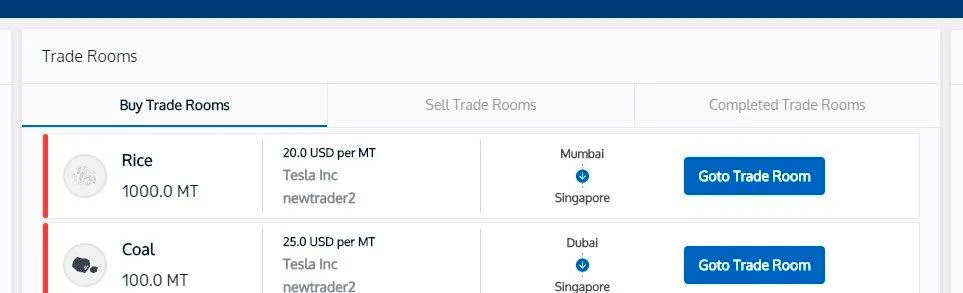
Comdex Enterprise offers the following solutions:
-
Trade workflow management: Traders can maintain and exchange key trade documents and information, all securely and immutably stored on the blockchain.
-
Real-time trading using features such as live chat, shared document views, document annotations, and e-signatures.
-
Blockchain-based trade settlement at a fraction of the cost and time.
-
Trade financing with advanced features such as trade workflow visibility or reputation scoring.
These products offer clear advantages in reducing settlement time, KYC, AML, membership checks among trading parties, and optimizing trade workflows, with critical information processed securely and tamper-proof.
Enterprise Trade was Comdex’s first launched platform; historically, it attracted 18 organizations from Southeast Asia as initial clients, tokenizing over $160 million worth of commodities. However, the platform’s long-term vision is to enable payment settlements and financing via CMST. Currently, however, CMST remains in early stages.
cAsset
cAsset is a synthetic protocol allowing traders exposure to on-chain synthetic assets. This enables users to trade commodities and speculate on price movements without dealing with associated logistical friction. There are four types of commodities:
-
Agricultural: wheat, sugar, cotton, rice, corn, etc.;
-
Livestock/meat: beef, pork, chicken, etc.;
-
Energy: oil, electricity, ethanol, natural gas, etc.;
-
Metals: gold, silver, platinum, copper, lead, aluminum, etc.
By combining the concept of synthetic assets with decentralized technology, cAsset aims to become a revolutionary trading platform that transforms how market participants engage in commodity trading.
Users will be able to conveniently trade, borrow, and earn yields on synthetic commodities from personal devices.
Minters can create and open CDPs (collateralized debt positions) to obtain newly minted cAssets. CDPs accept whitelisted collateral assets and must maintain a minimum collateral ratio to avoid liquidation (default 150%).
Liquidity providers add equal amounts of cAsset and CMDX to corresponding cSwap pools. In return, they earn protocol fee revenues and external incentive rewards based on their share of liquidity in the pool.
ShipFi
ShipFi is a platform that enables tokenization of real-world investment instruments and their exchange using trusted stablecoins. This functionality serves three primary purposes:
-
Providing a decentralized platform for issuing and raising funds for investment instruments.
-
Issuing fungible tokens representing ownership of investment instruments.
-
Ensuring stablecoins deliver consistent returns based on earnings generated by liquidity providers.
When someone uses stablecoins to provide liquidity to an investment instrument listed on ShipFi, the user receives a fungible token representing ownership of that deposit. Subsequently, users can stake LP tokens to earn stablecoin yield and SHIP token rewards.
Since investment instruments on ShipFi will undergo off-chain transactions after deployment, maintaining an authoritative source of real data about these instruments is crucial. This will be achieved through a proof-of-deployment system tracking all transaction records and legal documents related to each investment instrument.
Zenscape
Zenscape is Comdex’s validator division, aiming to increase Comdex’s participation and visibility across the entire Cosmos ecosystem. Zenscape collaborates with Comdex to provide infrastructure support services such as:
-
IBC relayer setup and maintenance to ensure reliable inter-chain communication and allow users to transfer assets between chains.
-
Snapshots for Tendermint-based chains.
-
Public RPC (remote procedure call) endpoints to ensure high availability for Cosmos Hub and other ecosystems.
Token Distribution
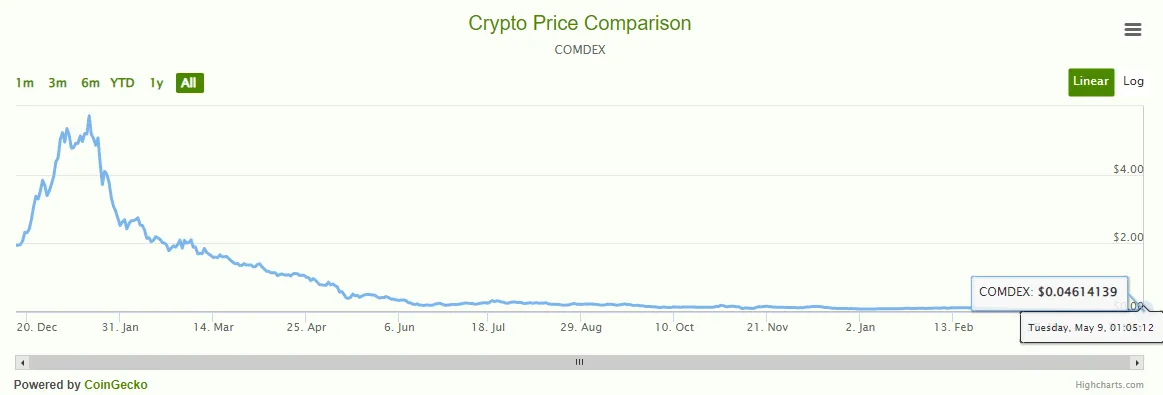
Comdex’s token distribution is divided into several components, with 100 million CMDX tokens minted at genesis and unlocked over 48 months.
Airdrop: 12.5% (12.5 million CMDX):
-
2.5 million CMDX will unlock at listing, followed by 2.5 million CMDX every three months until the full 12.5 million CMDX allocation is distributed.
-
Every 3 months equates to $140,000 at $0.056/CMDX.
Community Development Fund: 12.5% (12.5 million CMDX):
-
CMDX allocated to the community development fund unlocks three months after listing and releases equal quarterly amounts until 30 months post-listing.
-
Each quarter equates to $93,000 at $0.056/CMDX.
Rewards: 25% (25 million CMDX):
-
Rewards for early liquidity providers.
-
5 million CMDX of the total incentive pool will unlock at listing, followed by 3 million CMDX each in the next two quarters.
-
Subsequently, 2 million CMDX will unlock each quarter for the following four quarters.
-
Then, 1 million CMDX will unlock each quarter for the next six quarters.
According to the unlock schedule, each quarter equates to:
-
First two quarters: $168,000 each, at $0.056/CMDX.
-
Next four quarters: $112,000 each, at $0.056/CMDX.
-
Following six quarters: $56,000 each, at $0.056/CMDX.
Treasury: 25% (25 million CMDX):
-
Funds used for operating and maintaining the protocol.
-
5 million CMDX tokens unlock at listing, followed by 1.25 million CMDX each quarter until 48 months post-listing.
-
Equates to $70,000 unlocked each quarter at $0.056/CMDX.
Team and Advisors: 25% (25 million CMDX):
-
Tokens allocated to team members and advisors will vest over 3 years, with a 12-month cliff starting from TGE, followed by monthly unlocks over the subsequent 24 months.
-
After unlocking begins, equates to $58,000 monthly at $0.056/CMDX.
Join TechFlow official community to stay tuned
Telegram:https://t.me/TechFlowDaily
X (Twitter):https://x.com/TechFlowPost
X (Twitter) EN:https://x.com/BlockFlow_News
 Revelo Intel






