








Exclusive Interview with Dr. Mo Dong, Founder of Celer: Bridging Everything, What Has Changed and Remained the Same for Celer Behind ZK
TechFlow Selected TechFlow Selected
Exclusive Interview with Dr. Mo Dong, Founder of Celer: Bridging Everything, What Has Changed and Remained the Same for Celer Behind ZK
Celer Network has always been at the forefront of blockchain trends, but its original mission has never changed.
 Navigating Web3 tides with focused insights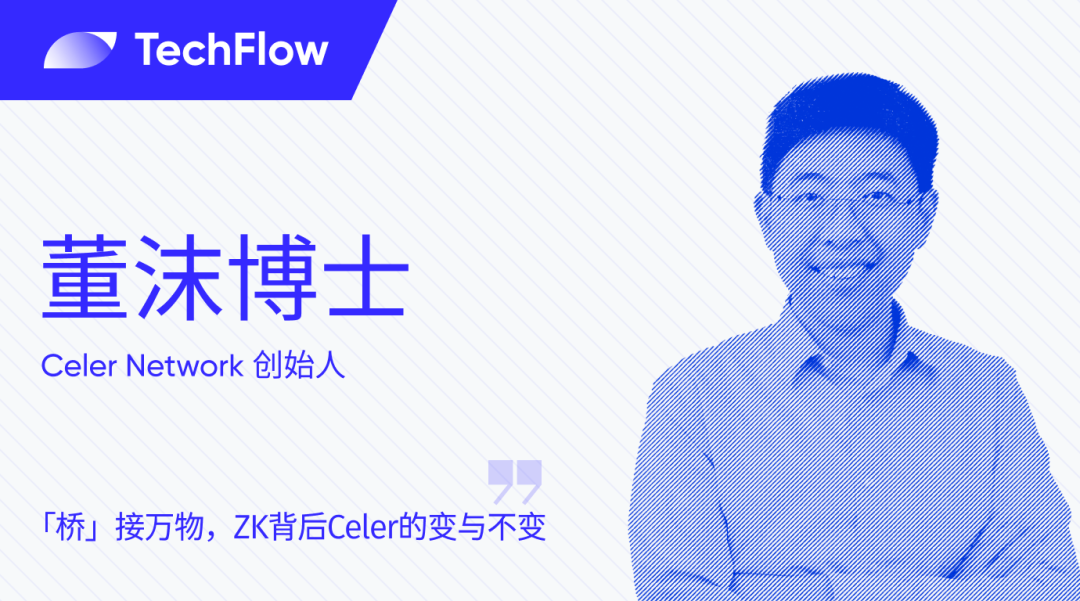
Interview: Claudia
Editing: Claudia&Zolo
“Binance’s third Launchpad project,” “cBridge—the cross-chain bridge with no security incidents to date,” “a pioneer in blockchain interoperability”...
If you’ve spent a few years in the blockchain industry, you’ve definitely heard of Celer Network.
From Bitcoin, Ethereum, DeFi, new public chains, cross-chain bridges, Layer 2, to ZK—cryptocurrency never lacks new narratives. Celer Network has also continuously adapted to evolving demands and actively built its multi-chain ecosystem.
Over five years, Celer has passed several milestones. Reviewing Celer's development history allows us to see how an industry pioneer adapts to changing times while staying true to its original mission.
From L2 state channel scaling in 2018, to the cBridge cross-chain bridge, to the recently launched Brevis—Celer Network has consistently stood at the forefront of blockchain trends. Are they chasing fads like kites in the wind? Or are they truly at the cutting edge of their era?
Amid the Hong Kong crypto boom, TechFlow conducted an exclusive interview with Dr. Mo Dong, founder of Celer Network, who traveled from the U.S. Join us as we discuss blockchain technology, policy waves, and dive into the ZK narrative behind Celer Network’s evolution with Dr. Dong.
From State Channels to a ZK-Powered Full-Chain Data Computation & Verification Platform—All to Meet Real User Needs
TechFlow: Welcome, Dr. Dong. Could you please introduce yourself to our audience?
Dr. Mo Dong: Let me briefly introduce myself. Before starting Celer, I pursued my PhD at UIUC, focusing on distributed systems and networking. During that time, I co-founded a company with my advisor specializing in network formal verification—a part of cybersecurity—with major banks and enterprises as clients. The company was later acquired by VMware. Meanwhile, I continued my research in distributed and network systems.
My research has always followed open-source principles, and the results have been adopted by companies like Google and YouTube. For example, part of the communication code inside Google Chrome today originated from our research—and it’s entirely open source.
After graduation, I started building what is now Celer together with three other co-founders, all close friends from Silicon Valley.
From 2018 until now, through bull and bear markets, we've seen many teams come and go. But our team has remained remarkably stable, thanks to our shared vision on key issues.
Back then, the biggest challenge in blockchain was scalability, with two main schools of thought:
- One approach focused on building faster public chains or sidechains;
- The other aimed to preserve Ethereum’s underlying security via Layer 2 scaling solutions.
Celer chose the second path because we strongly believe in decentralization and inheriting Ethereum’s base-layer security. This led us to build state channels—what some might call a generalized version of Lightning Network.
While Lightning Network only handles payments, state channels allow arbitrary program logic to run within the channel—not just payments.
However, after some time, we realized state channels had high developer barriers: developers needed to rewrite existing smart contracts according to state channel architecture and maintain traditional backend services for fast execution. Ideal use cases were limited to low-cost streaming or conditional payments (e.g., pay-as-you-go or machine-to-machine micropayments based on task conditions). However, between 2020 and 2021, traditional finance and payment regulations created bottlenecks, leaving blockchain payments stuck at the "last mile" of user onboarding.
We concluded that state channel-based scaling was ahead of its time—it required deeper integration with traditional financial infrastructure to enable free, low-cost blockchain access. Still, we remain confident in the long-term potential of state channels.
Meanwhile, we noticed community developers repurposing parts of our state channel tech stack for multi-chain interactions. One component, the State Guardian Network (SGN), could securely relay off-chain information onto-chain. Naturally, this made it ideal for cross-chain message passing. As cross-chain demand grew, Celer naturally expanded into cross-chain interoperability.
In recent years, we’ve done well in the cross-chain space. A wide variety of applications now run on the Celer ecosystem. Celer’s cBridge has processed over $13.7 billion in cross-chain volume, peaked at $900 million TVL, and currently maintains around $240 million TVL, with thousands of daily users.
Today, Celer powers many top-tier apps and protocols: MetaMask, the world’s largest crypto wallet, integrated Celer’s bridge functionality into its latest version under the new “bridge” feature.
Beyond supporting over 40 public chains, Celer serves as the official cross-chain bridge for notable projects including Japan’s Astar chain, Oasys (backed by SEGA and Square Enix), and Metaverse World (a sidechain by Korean gaming giant Netmarble). Developers in the Celer ecosystem have built nearly 100 cross-chain applications across metaverse, NFTs, DeFi, and governance.
TechFlow: In March, Celer Network launched Brevis—a ZK-powered full-chain data computation and verification platform. But the concept feels abstract. Can you explain what Brevis is in simple terms with real-world examples?
Dr. Mo Dong: In simplest terms, Brevis gives smart contracts the same kind of full-chain data access, computation, and usage capabilities that tools like Dune, DefiLlama, and Nansen offer to humans.
Believe it or not, despite being native to blockchain, smart contracts are essentially “blind.”
Humans can use tools like Dune and Nansen to analyze historical blockchain data—Uniswap’s trading volume over the past week, ETH-USDC prices, individual trader activity, whether someone is a professional player, NFT ownership transfers, social and financial relationships, etc.
But smart contracts suffer from “three blind spots”:
- They cannot see data on other blockchains;
- They cannot access historical data on their own chain;
- They cannot view private data stored in other contracts.
This severely limits blockchain application potential. These data constraints mirror Web2 limitations, where data is siloed within each app. There’s no sharing, no portability, no way to generate new use cases from existing data. Yet in Web3, all data is publicly visible—but the heart of blockchain applications, smart contracts, can’t access or use it. It’s paradoxical.
This is exactly what Brevis aims to solve: enabling trustless access, computation, and usage of all on-chain data across all chains by smart contracts, without relying on any third party.
For example, a DeFi DEX may want to dynamically adjust its liquidity pools—an extremely common scenario. Platforms like Sushi or Pancake typically rely on off-chain governance (manual parameter tuning) based on daily trading volume, LP count, and active traders. This process is slow—sometimes adjusted only once every few months.
But if there were an on-chain method to trustlessly retrieve this data and let smart contracts directly observe it, the contract itself could autonomously make these adjustments.
Another common application is ZK-based DID systems—for rewarding loyal users, managing user lifecycle, offering retention incentives for big spenders in games, or incentivizing professional liquidity providers in DeFi. It also enables recoverable account abstraction based on social and financial relationships.
You might ask: “I can already see this data on Nansen or Dune—why not just feed that data into the contract?” But doing so requires trusting a centralized third party—which defeats the purpose.
TechFlow: But on-chain data volume is massive. Can current infrastructure realistically support your vision?
Dr. Mo Dong: Excellent question. What’s the most naive way to get this data without Brevis? Every blockchain has block headers containing a field called the state root, which represents the entire world state.
For instance, if I want to know Uniswap’s historical active user count, theoretically I could compute it directly on-chain using state roots—unfolding each root down to leaf nodes, scanning transactions, verifying interactions with relevant contracts, and aggregating results. While theoretically possible, economically it’s unfeasible—the gas cost of unpacking and analyzing state roots on-chain would be astronomical.
And that’s just one chain. Reading data across chains is even more complex.
To trustlessly verify another blockchain’s block header—for example, validating BNB Chain’s state on Ethereum—you must verify multiple validator signatures. Doing this directly on-chain would cost over 1 million gas per validator—utterly impractical.
That’s why Brevis uses ZK: zero-knowledge proofs solve performance and computational cost issues by moving expensive computations off-chain—where costs are minimal—and generating succinct cryptographic proofs. Thanks to strong mathematical guarantees, only the validity of the result needs to be verified on-chain.
TechFlow: From early state channel scaling to cross-chain bridges, Celer Network’s core narrative seems to keep shifting. Opinions are divided—some say you’re iterating with the crypto landscape, others accuse you of chasing hype. What’s your real motivation? Why shift focus toward ZK now?
Dr. Mo Dong: Moving into ZK was a natural progression. We identified new application demands during the evolution of Celer’s cross-chain system.
Currently, our cross-chain system relies on a relayer chain to pass messages. Can we reduce reliance on this intermediate chain? We noticed many use cases don’t require ultra-low latency, so we explored ways to minimize trust. That’s how we developed Celer ZK Bridge—and began exploring broader ZK applications.
Precisely because we work deeply in cross-chain,we understand the ecosystem intimately and constantly hear real demands from various chains and dApps. We don’t chase trends—we chase genuine needs.
If you think of the blockchain as a CPU, Brevis acts more like a DPU (data processing engine), helping applications better handle and utilize data—including both on-chain and selective off-chain data. For example, if you want to prove Twitter account ownership or verify limited off-chain logs, Brevis can help validate those too.
TechFlow: Zero-knowledge proofs play critical roles in two major areas of crypto: scalability and privacy. How does Brevis leverage ZKP technology?
Dr. Mo Dong: We don’t address privacy. Our use of ZKP focuses solely on computational migration. In fact, even ZK-Rollups fundamentally rely on this property—moving on-chain computation off-chain. At its core, ZK enables efficient computation relocation.
First Principles Thinking: Understanding the Logic Behind ZK
TechFlow: Today, ZK is a dominant narrative in crypto, especially in a depressed funding market, where ZK startups often command high valuations. Yet many ZK projects feel VC-driven. As an experienced builder in this space, how do you evaluate a ZK project?
Dr. Mo Dong: The value framework is relatively straightforward. We must clarify what problem ZK actually solves. Returning to first principles: ZK exists either to enhance privacy or to enable computational offloading.
If a project uses ZK but doesn’t aim to enable privacy or reduce computational costs, it’s likely a poor fit. For example, ZK-powered poker games make sense—they need privacy. But forcing ZK into something like Axie Infinity, where gameplay transparency is desired, makes little sense.
TechFlow: The ZK space is fiercely competitive. Even claiming the title of 'first fully functional open-source zkEVM' sparked intense rivalry among zkSync, Polygon zkEVM, and Scroll. With so many zkEVM approaches, what will determine the ultimate winner?
Dr. Mo Dong: First, it’s important to recognize that ZK is a tool—and tools serve different purposes. Competition varies across domains. Right now, the fiercest battleground is zkEVM. But ZK can be applied across many fields—data attestation, reflection, cross-chain (which is a form of data attestation), or privacy. Each domain has different levels of competition.
Data attestation is seeing new entrants, but it’s far from a bloodbath.We’re not competing directly with zkEVM players—we actually have great relationships with Scroll, Consensys zkEVM, and zkSync.
Though zkEVMs are Layer 2s, they’re essentially building blockchain ecosystems. And blockchains derive value from two aspects:
- Utility value—related to technical merit and developer-friendliness;
- Consensus value—how well a chain transitions from a centralized dev team to a decentralized community. This isn’t a technical issue—it’s a human one.
TechFlow: Within the ZK landscape, StarkWare stands out—while others like zkSync, Aztec, Loopring, and Scroll use SNARKs, StarkWare uses ZK-STARK. What’s your take on the ZK-STARK approach?
Dr. Mo Dong: ZK-STARK’s advantage lies in faster computation and more efficient proof generation. However, the final step still requires compressing the proof for on-chain verification. People choose it mainly for its speed in proof creation.
SNARKs, on the other hand, benefit from stronger developer ecosystems. The Ethereum Privacy and Scaling Exploration (PSE) group has heavily supported SNARKs. Their dev tooling, while imperfect, is more mature than STARKs’ and more developer-friendly for certain tasks. Overall, I believe both technical paths are highly active and viable.
I agree with 0xParc’s perspective: the future proving architecture will likely be composable zero-knowledge proofs. Implementing a full ZK app directly on EVM is hard, but with Brevis, you can plug in different query engines—some using STARKs, others SNARKs—as long as they can recursively converge into a unified verification format.
Brevis not only enables developers to query on-chain data but also provides APIs for building custom query engines that others can reuse.
TechFlow: Recently, zk-Rollup projects have gained momentum—Polygon zkEVM and zkSync have launched mainnets. Yet Optimistic Rollups like Arbitrum are already building robust ecosystems.
In early February, Offchain Labs co-founder Steven Goldfeder criticized ZK Rollups and zkEVMs, arguing against the popular belief that ZK Rollups will inevitably replace Optimistic Rollups. He pointed out that zkEVMs haven’t yet proven themselves in production, and currently, zk-Rollups are more expensive and less compatible than OP Rollups.
Given this, how do you assess the scalability race between ZKR and OR? Who do you favor?
Dr. Mo Dong: We believe both have merit. It’s a philosophical divide—one optimistic (OP), one pessimistic (ZK). The pessimistic view assumes things will likely go wrong, so ZK proofs are essential to prevent sequencer manipulation of on-chain data. The optimistic view assumes things usually work fine, so skipping proofs keeps costs lower. In the short term, success will depend on who offers lower fees and better performance to support more applications. Medium-term, I believe the two may converge technologically. Will Arbitrum adopt a ZK-Rollup scheme someday? Entirely possible. In the long run, consensus value will decide winners—that human, community-driven aspect we mentioned earlier.
Right now, OP Rollups have advantages: lower onboarding costs and earlier market entry. But ZK isn’t without strengths: higher security and instant asset/message transfers—no 7-day withdrawal wait. That waiting period in OP Rollups is frustrating. Still, bridges partially mitigate this by enabling faster exits—though at high cost.
So it’s hard to declare a clear winner. OP Rollups trade low entry cost for difficult exits; ZK Rollups charge more upfront but offer freedom of movement. Different use cases suit different models—that’s my view.
Through Crypto’s Storms, Celer Stays True to Its Mission
TechFlow: Recently, Hong Kong has become a hot topic—partly due to increasingly unfriendly U.S. crypto policies, while Hong Kong opens its arms to entrepreneurs. As a long-time Silicon Valley founder, what’s your experience in the U.S.?
Dr. Mo Dong: Yes, the tightening of U.S. crypto regulations is understandable—it’s a knee-jerk reaction after trusted figures ("golden boys") failed spectacularly. Betrayal stings the most. So increased scrutiny is expected.
On the other hand, the core issue in the U.S. is jurisdictional conflict—SEC vs. CFTC, each pushing different agendas, with no coherent regulatory framework. Ultimately, I believe the U.S. government doesn’t see blockchain as a high priority, hence the fragmented oversight.
In terms of community energy, events like Eth Denver remain vibrant. Hong Kong clearly reflects a desire for an Asian blockchain hub. Currently, Asia lacks a true center—Singapore has few developers. But Hong Kong boasts rich developer talent from top universities and innovation hubs.
The U.S. is already an innovation hub; Hong Kong could become Asia’s equivalent. We’ll see. We’re here to learn firsthand what’s really happening.
TechFlow: What’s your impression after visiting?
Dr. Mo Dong: Honestly, I’m still in awe—I wouldn’t say I fully grasp it yet.
TechFlow: Some complain the event focused too much on non-technical, superficial topics.
Dr. Mo Dong: True—many sessions were more like trade shows. No one can truly explain ZK in a presentation, so we shortened our slides—from a long ZK deep dive to just one or two pages. Whether a place becomes an innovation hub depends on participants—if it hosts hackathons, that signals real innovation. Here, tourists dominate. We’re tourists too. Many old friends are just wandering through Hong Kong’s steel jungle.
But Hong Kong sends a signal—it matters for attracting Asian developers and communities. As Chinese founders, though our team includes many non-Chinese members, we know how tough it is for Chinese blockchain tech communities to grow. We should support each other. Seeing an Asian innovation hub emerge would fulfill a long-held hope—even if we’re unsure Web3 will truly take root in Hong Kong.
TechFlow: Last question back to Celer—I find it hard to summarize Celer Network in one sentence. What will Celer Network ultimately become?
Dr. Mo Dong: Returning to Celer’s初心 (original intention), everything we do stems from belief in blockchain technology and the desire to bring more people into blockchain. Our consistent thread is identifying new needs atop existing foundations, always asking: how can we make blockchain technology or data easier to use, enabling better integration across blockchain components?
Celer’s core slogan remains Bring Mass Adoption to Blockchain. In truth, watching Celer evolve is like watching blockchain itself evolve
Join TechFlow official community to stay tuned
Telegram:https://t.me/TechFlowDaily
X (Twitter):https://x.com/TechFlowPost
X (Twitter) EN:https://x.com/BlockFlow_News
 深潮TechFlow






