MAP Protocol: The Pioneer of Active Relay Chain Cross-chain Interoperability
TechFlow Selected TechFlow Selected
MAP Protocol: The Pioneer of Active Relay Chain Cross-chain Interoperability
Layer 1 can process and finalize transactions on its own blockchain and comes with a native token used to pay for transaction fees. Ethereum is a giant in this space, but it cannot dominate the market alone. Due to technological, ecological, and competitive reasons, each mainchain operates like an isolated island, unable to interconnect or transfer assets between one another.
 Navigating Web3 tides with focused insights
Project Background
1. Layer 1 and Closed Silos
-
Layer 1 refers to the underlying blockchain networks
-
Examples include Ethereum, Bitcoin, Solana, Polkadot, Near, Cosmos, Aptos, Sui, etc.
-
They serve as the primary networks within their respective ecosystems
-
Layer 1 blockchains can process and finalize transactions independently on their own chains, and have native tokens for paying transaction fees
-
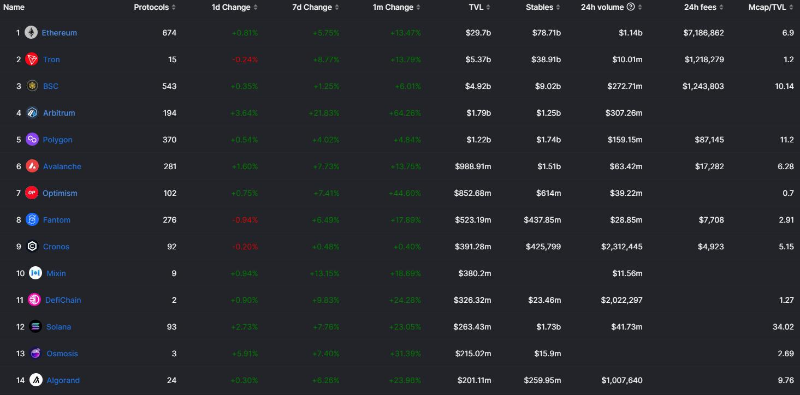
Ethereum dominates, but cannot monopolize the market


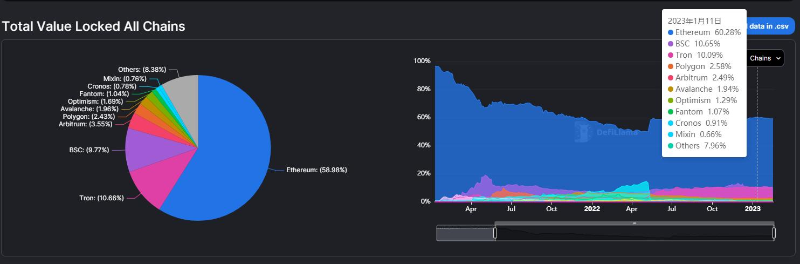

https://defillama.com/chains
- L1 ecosystems are thriving and continuously eroding Ethereum's ecosystem share

2. Cross-Chain Technology
-
Cross-chain technology enables interoperability among multiple chains, primarily involving token exchange, token transfer, and information transmission
-
The current siloed state of blockchains limits diversified user demands and blockchain scalability
-
With the continuous growth of new dApps, there is an increasing need for asset transfers and data interoperability
-
Cross-chain technology is considered the "holy grail" of the blockchain field and a key enabler for universal chain connectivity
-
Its importance can be compared to TCP/IP in the internet era—just as TCP/IP connected networks into the Internet, cross-chain connects blockchains into Web3
-
Huge demand from Web3
1. The total TPS required by Web3 could reach tens of billions, which even numerous L1s together may fail to support
2. There is a strong demand to aggregate all L1s into one unified system
3. Cross-Chain Paradigms
1. Hash Time-Locked Atomic Swaps
- Basic principle
User A generates a random secret r, computes its hash m = hash(r), and sends m to User B;
Meanwhile, User A initiates a transaction to send 1 BTC to User B, conditional upon User B revealing r; otherwise, the transaction automatically fails after a preset time;
Upon seeing User A’s transaction, User B also initiates a transaction to send 10 ETH to User A, conditioned on User A revealing r;
After observing B's transaction, User A reveals r, allowing B’s transaction to succeed and receive the 10 ETH, thereby disclosing r;
User B then uses the revealed r to unlock A’s transaction, receiving the 1 BTC;
If the timeout (hash time lock) expires, both transactions fail;
-
The hash value and time lock enable trustless atomic swaps between two parties without any intermediary or trust assumptions—since hash functions are irreversible, knowing m does not allow derivation of r
-
The transactions are coupled into a single event: either both succeed or both fail, preventing scenarios where A pays B successfully while B fails to pay A
-
Both parties must be online simultaneously and strictly follow the process—if no counterparty is available, users must wait
-
Relatively high transaction fees
-
Cannot support token transfers or broader cross-chain information messaging
-
Often used in combination with other cross-chain technologies
2. Multi-Party Validators (Witnesses)
-
Validators may be permissioned or open-access
-
User trust in validators may stem from their reputation or over-collateralization
-
Validators can be designated, rotated, or randomly selected
-
This model is relatively easy to implement, highly versatile, and low-cost to adapt
-
If hackers breach validator servers, they can steal all locked cross-chain funds
-
Project operators could misappropriate funds
-
The entire validation process cannot fully eliminate malicious behavior risks
-
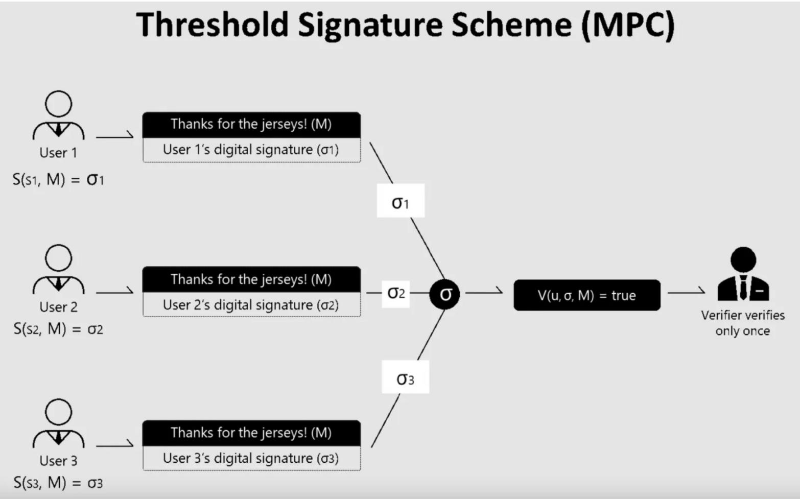
In 2022, cross-chain bridges suffered $2 billion in theft losses, with MPC-based projects being hit hardest
-
Mainstream cross-chain solutions such as Multichain, Celer, and Axelar adopt MPC
3. Centralized Oracle Models
-
Oracles and relayers operate independently and verify each other
-
Chainlink’s oracle submits source chain cross-chain information (receipts) to the destination chain, while the relayer also submits cross-chain data (blockhash and blockreceiptsRoot). The destination chain’s verification contract checks the consistency between the receipt submitted by the relayer and the receiptsRoot submitted by the oracle (note: order mismatch needs confirmation). If verified, the receipt is deemed legitimate and forwarded to upper-layer protocols, triggering subsequent cross-chain operations
-
It must be assumed that relayers and oracles act independently—an assumption that cannot hold indefinitely, making collusion fundamentally unpreventable
-
Relayers are ranked by staking amount and randomly chosen, but still represent centralized authorities, leaving risk of collusion between oracles and authoritative figures
-
Oracle data feeds lack precision and sufficient decentralization to provide cryptographic proofs, enabling potential collusion among third parties
-
An example project using this model is LayerZero
-
Not fully decentralized
4. Light Clients
4.1 What Are Light Clients?
-
Also known as light clients
-
A lightweight node that stores only block header information
-
Does not store all transactions on the chain, but can verify message authenticity from the source chain via block headers
-
The general process is as follows:
When Chain A (e.g., SOL) requests to transmit a cross-chain transaction to Chain B (e.g., ETH), the sender submits the transaction details, block height, and SPV proof (Merkle path of the transaction) to Chain B;
The light client contract of Chain A deployed on Chain B recalculates the block header hash using the SPV proof;
This computed hash is compared with the corresponding block header hash stored in the light client; if they match, the transaction is confirmed to exist in that block; otherwise, it is invalid;
4.2 Two-Way Pegged Dual Light Clients
-
Both chains are independent mainnets with consensus mechanisms and native tokens, each providing security guarantees
-
The relationship between source and destination chains is relative—either chain can act as the source in different messages
-
In a cross-chain message event, the originating chain is called the source chain, and the receiving chain is the target chain
-
By embedding each other’s light clients, two chains can read each other’s data and achieve mutual connectivity—a structure known as two-way pegging
-
Relayer groups exist in both directions to relay information
-
Representative project: MAP Protocol, which establishes two-way pegging with every connected chain
4.3 Subnet Two-Way Pegging
-
Subnets communicate with parent chains via light clients, as seen in Polkadot and its parachains, Cosmos and its zones, or Aurora and its subnets
-
Subnets lack independent consensus and native tokens—their security relies entirely on the parent chain, creating unidirectional dependency. Sidechains, however, are independently operated blockchains whose relationship with the mainchain is bidirectional
4.4 Relay Chain Architecture
-
Establishing direct two-way pegged light clients between every pair of chains leads to exponential growth in connections and integration costs as the number of chains increases
-
Solution: Build a dedicated relay chain containing light clients for all other mainchains. Then deploy the relay chain’s light client on each individual chain. This reduces connection complexity from n(n−1)/2 to just n (where n is the number of chains)
4.5 Advantages of Relay Chain-Based Light Clients
- Shared Mainnet Security
The relay solution is a variant of two-way pegging, sharing mainchain security;
Transaction verification through block headers is cryptographically guaranteed—transaction validity does not depend on validators, ensuring full decentralization;
The verification logic of the light client matches that of the source network, inheriting its security;
Relayers cannot forge block headers because the light client contract can rigorously validate blocks like a full node—fake headers will fail verification;
If malicious relayers collude, the only feasible attack is submitting headers from a forked chain—but in a healthy network, forks won’t become the longest chain;
Only if the source or destination chain itself undergoes reorganization would the light client contract be compromised;
- Fully Decentralized
Unlike validators, relayers are governed by smart contracts, eliminating centralization;
No reliance on privileged or authorized third parties for legitimacy verification;
- Lower Operational Costs, Broader Decentralization Future
Relayers in light-client sidechains do not require over-collateralization like witnesses, enabling cheaper issuance of cross-chain anchored assets;
Light clients do not require powerful hardware or high bandwidth like full nodes—can run on smartphones or embedded devices, promoting greater decentralization;
-
Enables lightweight verification of transaction validity across ledgers
-
Uses mutually embedded light client contracts for independent self-verification
-
Highly scalable and currently the most widely adopted cross-chain approach
4.6 Disadvantages of Relay Chains
-
Different integration schemes must be developed based on the characteristics of each connected chain, requiring active compatibility efforts and significant workload
-
Varying levels of security across chains introduce cross-chain credit risk management challenges to protect the overall network
-
As new blockchains emerge with novel features, new adaptation modules must be developed accordingly
4.7 Vision for Full-Chain Connectivity via Relay Chains
-
Full-chain connectivity represents the future of multi-chain systems—an ultimate solution to cross-chain problems
-
Truly achieving universal interconnection among all chains
-
A single relay chain could become layer0 in the blockchain world, with other chains connecting as layer1, layer2, etc.
-
The relay chain is more than just a bridge—it acts as a central hub ("chain hub") responsible not only for message passing but also for inter-chain routing and message sequencing
-
dApps, protocols, and users across different mainchains interact seamlessly and transparently, greatly enhancing user experience
-
Connects users and assets across all blockchains, ending ledger fragmentation
-
Represents the optimal growth strategy for dApps in a multi-chain landscape and a key driver for Web3 expansion
-
In an increasingly competitive multi-chain future, full-chain infrastructure may prove even more critical than L2 scaling solutions
4.8 Dominant Relay Chains: Polkadot and Cosmos
-
Polkadot’s parachains and Cosmos’ Hub exemplify “two-way pegging” relationships, embodying relay concepts aimed at universal connectivity
-
Cosmos’ Inter-Blockchain Communication (IBC) protocol verifies cross-chain messages via light client contracts built into recipient chains. In contrast, Polkadot’s XCMP does not use light clients but relies on shared validators
-
Neither Polkadot’s relay chain nor Cosmos Hub is Turing-complete and cannot execute smart contracts natively. Polkadot introduced Substrate, while Cosmos created the Cosmos SDK. These cross-chain SDKs require integration at the base layer of other chains. For established blockchains like Ethereum, BNB, Klaytn, Polygon, and Avalanche built without these tools, deep structural modifications are needed to achieve compatibility—posing extremely complex technical challenges. As a result, no thriving L1 has yet achieved interoperability with Polkadot or Cosmos Hub
-
To connect with Polkadot’s relay chain, a chain must surrender its accounting authority—and thus its security—to the relay chain, which prosperous L1 ecosystems cannot accept
-
For dApp developers, using Polkadot or Cosmos requires first launching their own L1 before deploying applications. However, building an L1 is not a core requirement—reaching more users and assets is. From development cost, learning curve, and security perspectives, this path is inefficient and uneconomical
-
Although Polkadot and Cosmos employ secure light client mechanisms, they function more like closed internal ecosystems. Their actual performance in enabling true interconnectivity and expanding dApp reach remains suboptimal. Their architectural designs make it difficult to interoperate with major chains like Ethereum and BNB. While they offer convenient chain-launching tools, they fail to address dApps' fundamental need for broad user and asset coverage
-
Any mainchain wishing to link with Polkadot or Cosmos must proactively adapt
-
To date, there has been no sign of motivation or movement toward mutual compatibility
MAP Protocol Project Analysis
1. Project Overview
-
MAP Protocol’s mainchain (Relay Chain) serves as a relay chain hosting light clients for all other major chains
-
MAP Protocol has already installed its own light client on its mainchain
-
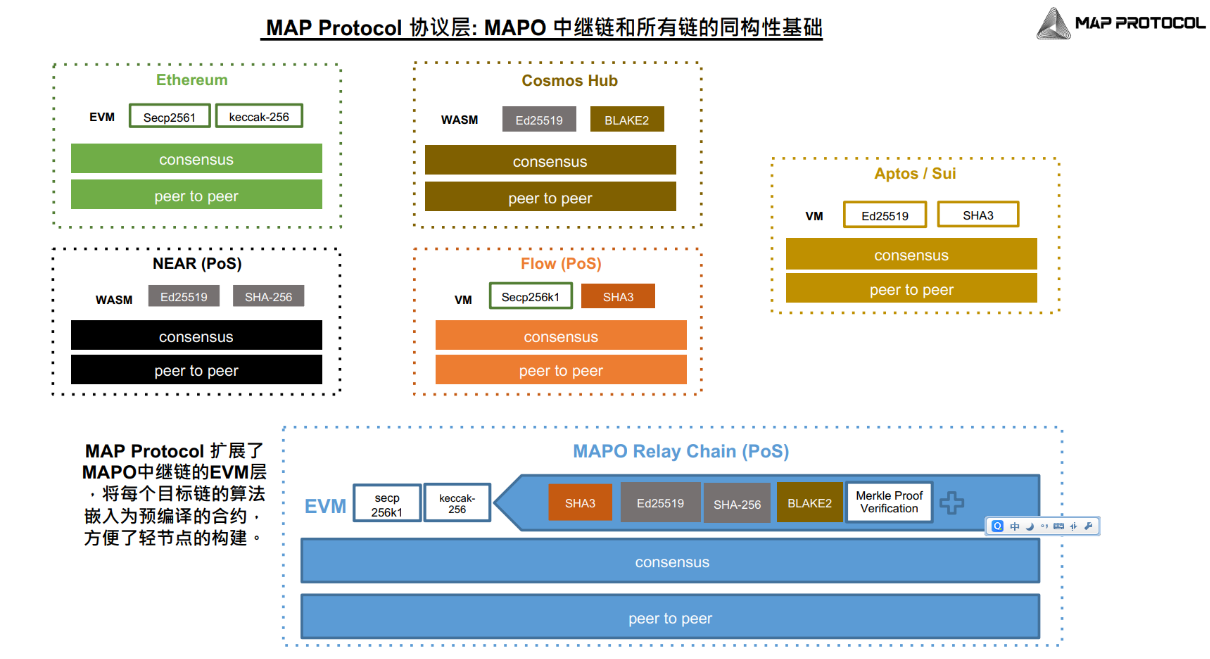
MAP Protocol proactively pre-compiles signature algorithms and hash functions of various thriving L1s into its relay chain’s contract layer
-
It comprehensively connects mainstream EVM and non-EVM chains such as Ethereum, Polygon, BNB Smart Chain, Klaytn, and NEAR. It deploys MAP Protocol’s light client as a smart contract on each of these L1s
-
Through light clients and existing relay chain light clients on mainchains, all L1s become isomorphic with the relay chain, achieving cross-light-client validity verification
2. Project Architecture
1. Protocol Layer – Core Foundation
-
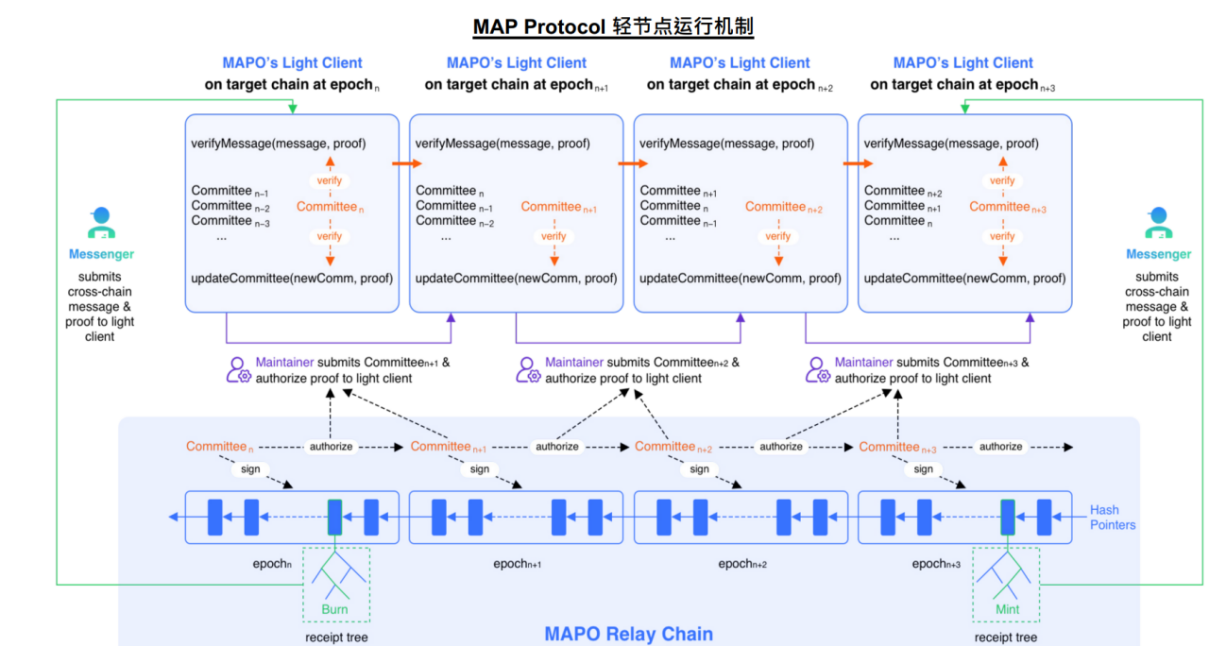
Composed of the MAP Relay Chain, light clients deployed across chains, and the inter-chain message maintainer program (Maintainer)
-
The MAP Relay Chain’s virtual machine layer incorporates major L1 signature algorithms, hash functions, and Merkle Tree proofs via precompiled contracts, turning the relay chain into a “super-language machine” fluent in multiple blockchain protocols. This enables seamless communication between chains and lays a foundation for isomorphic interoperability
- Light clients feature independent self-validation and instant finality. Based on the isomorphic foundation of the MAP Relay Chain, the cross-validating light client network shares a common data language, enabling easy deployment as smart contracts on any compatible L1 for decentralized cross-chain validation
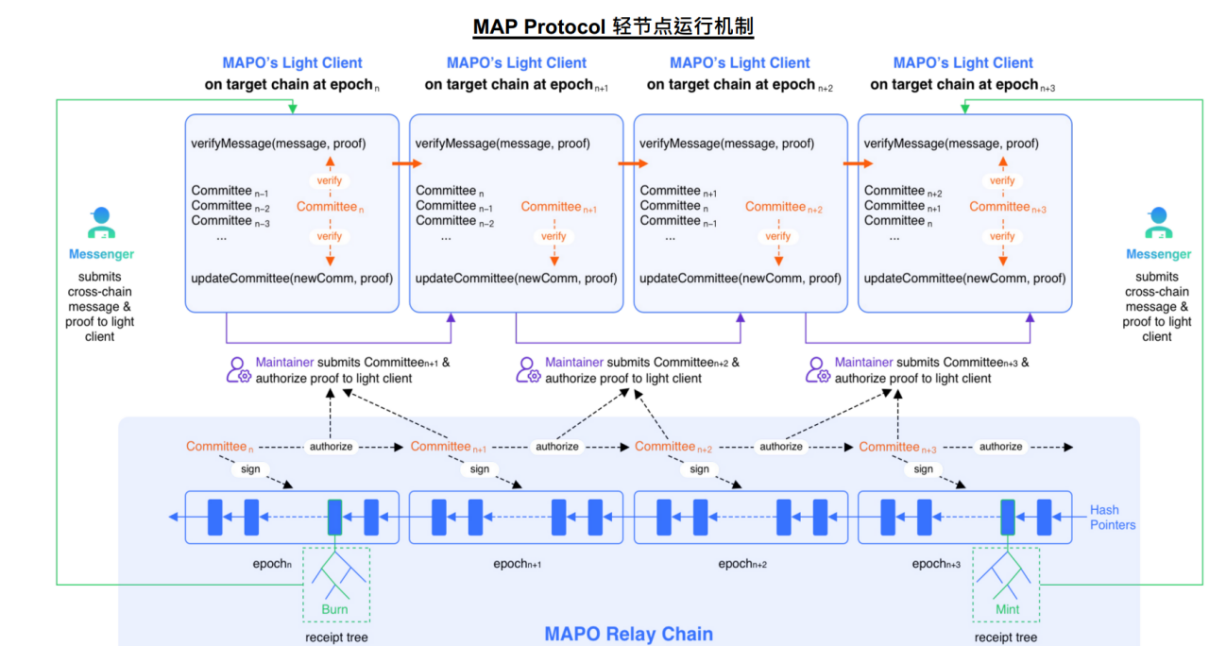
- Maintainer is an independent inter-chain message program responsible for updating the latest state of light clients. It writes consensus-layer block headers (validator signatures) from various chains into the corresponding origin-chain light client contracts on target chains, ensuring alignment between the light client and the origin chain’s validator set

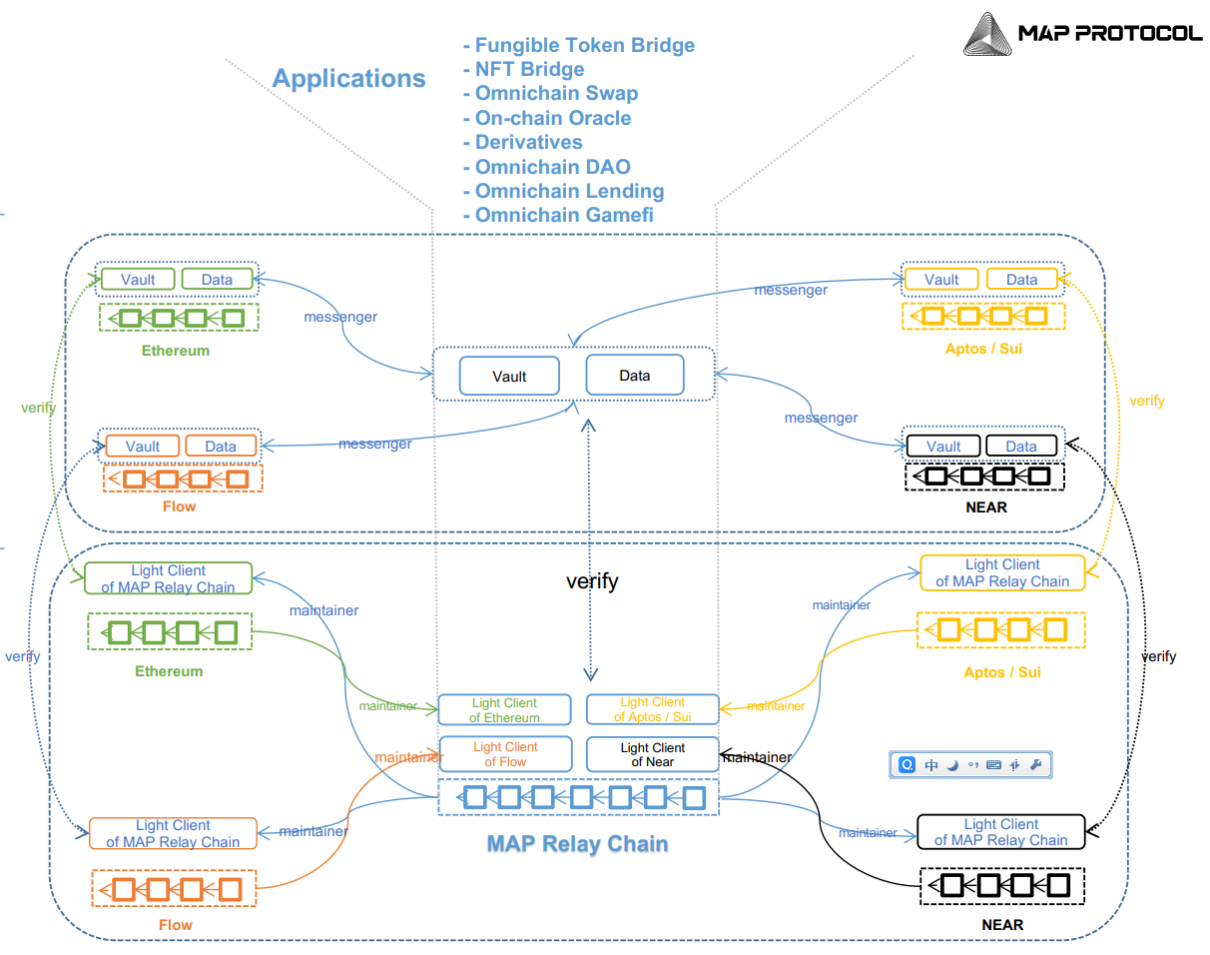
2. MOS – Omnichain Service Layer
-
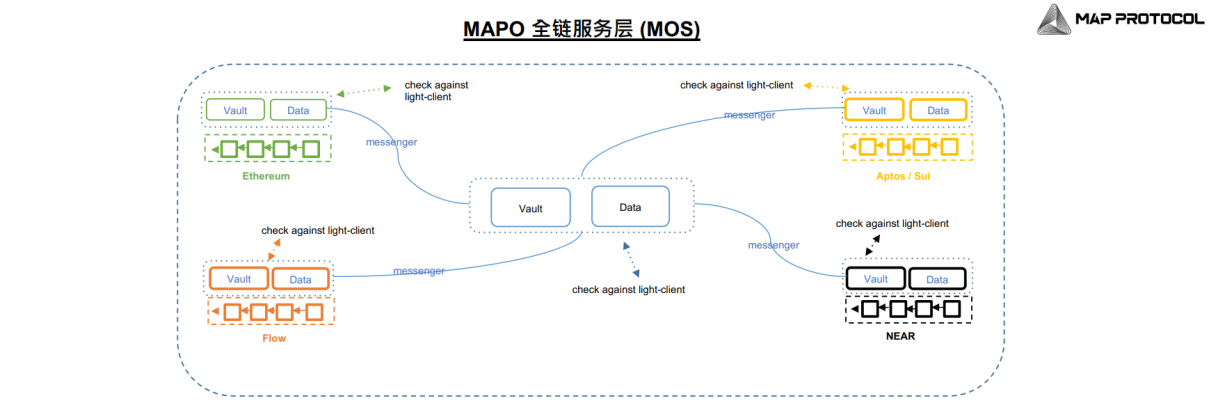
MAP Omnichain as a Service Layer
-
Analogous to Google Mobile Services for Android, providing full-chain development services for dApp developers
-
This layer includes cross-chain asset locking smart contracts and the Messenger inter-chain messaging component deployed across blockchains. Developers can directly leverage this layer to build omnichain applications or further customize components, significantly reducing development and learning costs
-
All smart contracts in this layer are open-source and audited by CertiK, so developers can use them safely without worrying about security or cost
3. Omnichain Application Layer
-
Omnichain Application Layer
-
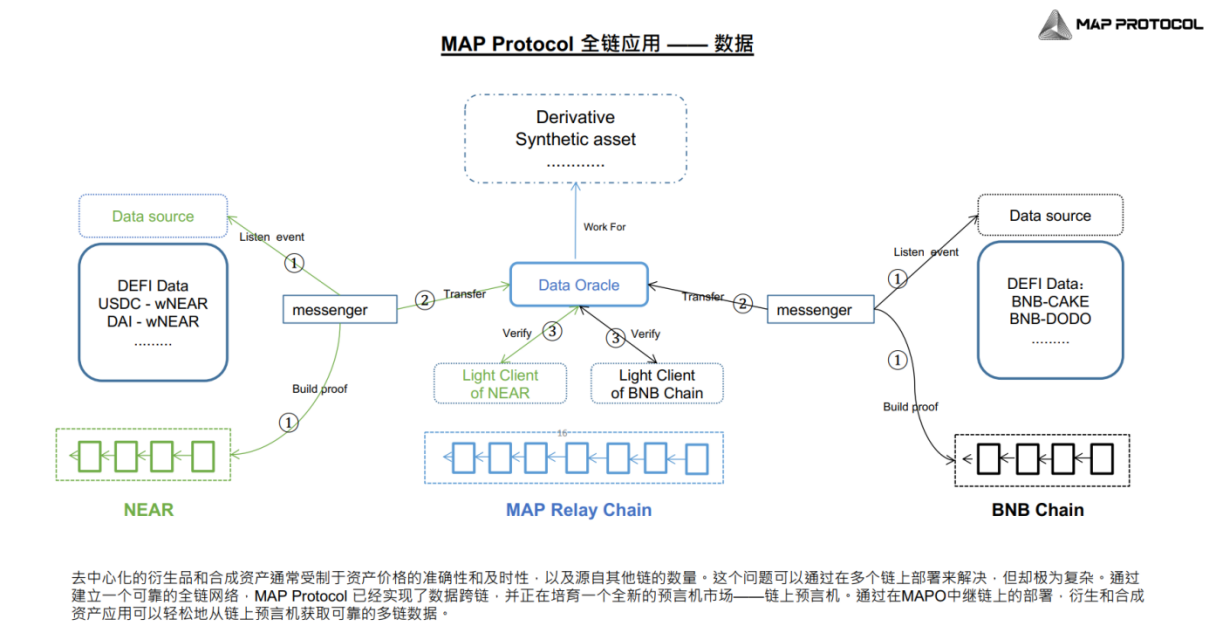
Take decentralized derivatives and synthetic assets as examples—they are currently constrained by inaccurate or delayed price and quantity data from other chains. Off-chain oracles cannot deliver precise, timely information, resulting in poor liquidity and user experience
-
While multi-chain deployment can mitigate this issue, it is time-consuming, labor-intensive, and adds unnecessary development overhead
-
By deploying on the MAP Relay Chain, decentralized derivatives and synthetics can access accurate multi-chain data via MAP Protocol’s on-chain oracle, overcoming data flow barriers and enabling smooth cross-chain asset movement
-
Other potential use cases include omnichain DID, omnichain lending, omnichain swap, omnichain GameFi, omnichain DAO governance, omnichain tokens, and omnichain NFTs. Regardless of where a dApp’s core contract resides, developers can easily build applications capable of reaching users and assets across all chains using MAP Protocol
4. zk Technology Integration
-
Signature Verification: Merkle proofs for specific Merkle roots, hash linking, and cumulative work checks are suitable for authentication via zkSNARKs
-
In light client construction, zk techniques simplify storage of large validator group info or block headers
-
Commitments represent validator sets (PoS) or latest block headers (PoW), updated whenever the set changes
-
zkSNARKs prove that transitions from old to new commitments reflect valid changes in validator or block header sets
-
Constraints enforced by zkSNARKs mainly involve checking whether enough previous validators approved the new set and whether voting weight meets a threshold
3. Full-Chain Use Case Examples
1. Cross-Chain Lending
- Currently, if a user holds funds on Chain A but wants to stake on Chain B, they must go through nine steps:
Pledge on Chain A → Borrow → Bridge (fee) → Swap (fee) → Stake on destination chain → Swap back (fee) → Bridge back (fee) → Repay loan → Unstake;
- With MAP Protocol: Pledge on Chain A, borrow, stake, repay, and unstake directly on the destination chain—skipping four bridge and swap fees
2. Omnichain Swap
-
Omnichain Swap connects top-tier cross-chain DeFi protocols, enabling token exchanges at far lower fees than traditional DEXs
-
Developers can build a truly decentralized omnichain exchange using MAP Protocol, allowing users to swap any token on any chain
-
Omnichain Swap can aggregate liquidity from major DEXs for unified cross-chain swapping
-
Existing AMMs can be wrapped to enable full-chain asset swaps without modifying underlying code
-
Users can swap ETH on Ethereum to NEAR on NEAR in a single transaction from the source chain
-
In MAP-based omnichain swaps, users can add multi-chain tokens to a single pool, enabling liquidity provision across token pairs from different chains
-
Users can directly swap tokens across different chains without intermediate stablecoins, achieving the shortest possible conversion path
-
Butter Swap is the first truly decentralized cross-chain network enabling swaps between any tokens on any chains. It is currently in testing and soon to launch
3. Omnichain GameFi
-
With MAP Protocol, GameFi projects can deploy tokens across multiple chains and allow users from other chains to securely and efficiently transfer assets to their game chain
-
For example, a BNB Chain GameFi project deploying tokens on Polygon and WAX allows users from BSC and Polygon to bridge assets to WAX and participate, multiplying user base
-
Another scalable approach with good gameplay experience is direct deployment on the MAPO Relay Chain. Thanks to MAPO’s interoperability, GameFi projects automatically connect securely and efficiently with all EVM and non-EVM chains. The MAPO Relay Chain actively integrates upcoming chains, allowing GameFi teams to focus on UX rather than scalability or security concerns
4. On-Chain Data: On-Chain Oracles and Derivatives
-
MAP Protocol enables data cross-chain and is fostering a new oracle market—the on-chain oracle
-
By deploying on the MAPO Relay Chain, derivative and synthetic asset applications can easily obtain reliable multi-chain data from on-chain oracles
5. Omnichain Governance
-
Take Aave as an example
-
As stated by its developers, a proposal executed on Ethereum (ETH) is sent to Polygon FxPortal. The mechanism reads Ethereum data and forwards it to Polygon for validation. Then, Aave’s cross-chain governance bridge contract receives and decodes the data, queues the action, and waits for timelock completion. Aave’s cross-chain governance bridge is built generically and can easily adapt to operations with any EVM-compatible chain supporting cross-chain messaging
-
Currently, the repository supports contract bridging with Polygon and Arbitrum. On Aave, users can submit Aave Improvement Proposals (AIPs) targeting various platform functionalities. With MAP Protocol’s universal chain interoperability, secure cross-chain infrastructure enables full-chain governance across all EVM and heterogeneous chains
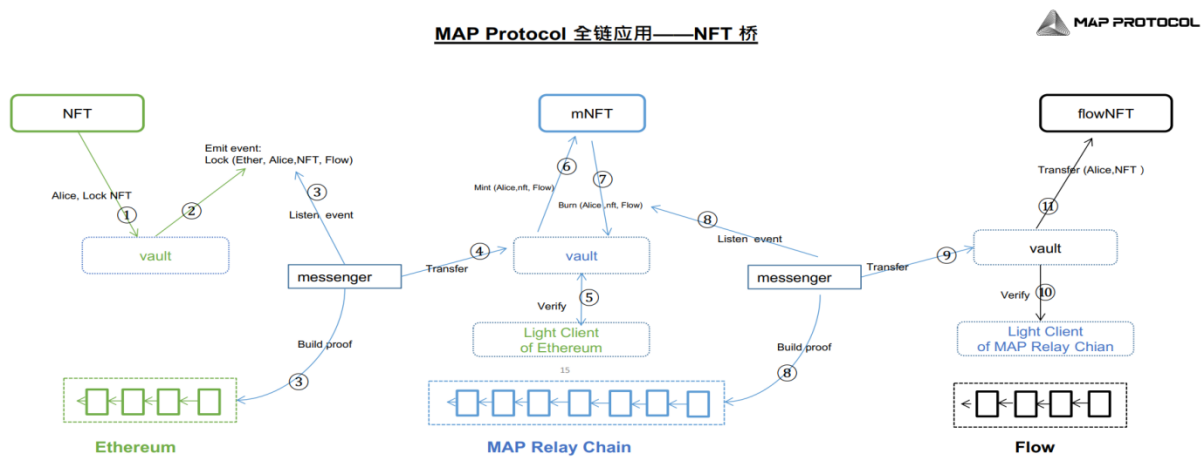
6. Fungible Token and NFT Bridges
-
Cross-chain bridges and NFT bridges no longer need to build their own infrastructure or rely on MPC
-
Using MAPO’s underlying cross-chain verification network with instant finality and the MOS developer service suite, bridge developers can easily build NFT or fungible token bridging applications
4. Project Advantages
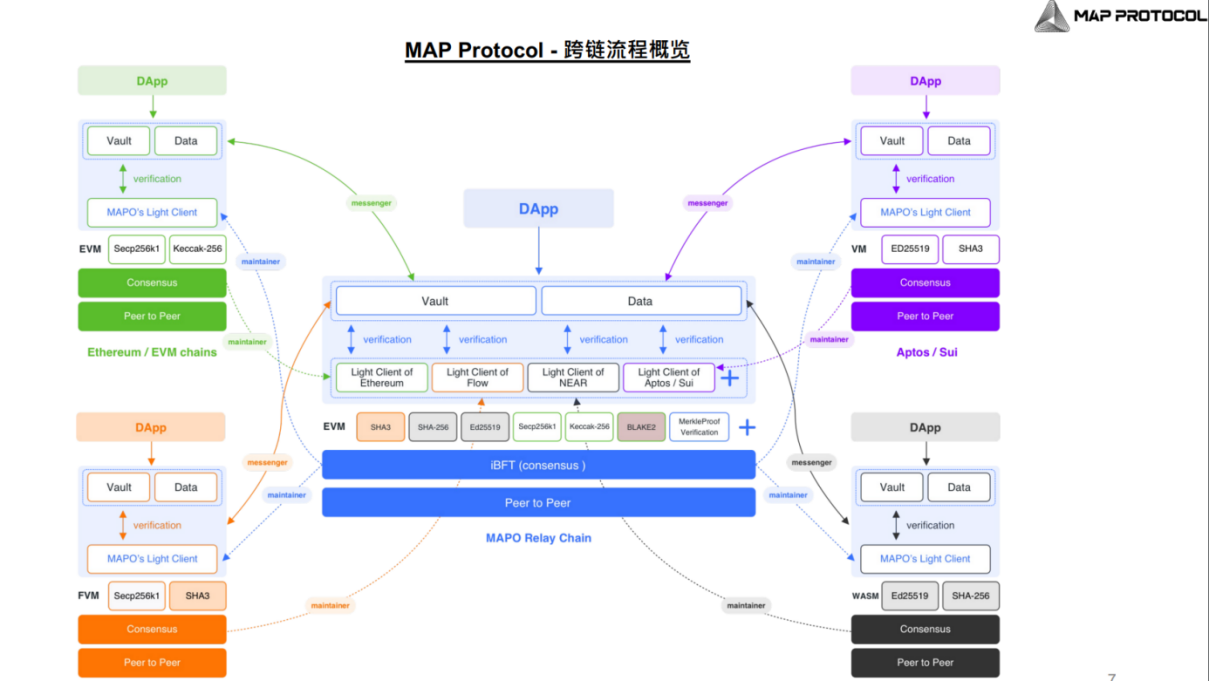
1. Full-Chain Interoperability and Universal Cross-Chain Support
-
Unlike Cosmos, Polkadot, or Aurora, MAP Relay Chain achieves isomorphism with all chains, connecting all L1s—not just those within its ecosystem. It is the only full-chain infrastructure in the market offering complete chain coverage and the highest level of security
-
Through the relay chain, fragmented public ledger systems become a unified distributed ledger
-
NEAR’s Rainbow Bridge, Polkadot, Cosmos IBC, and MAP Protocol all use 100% Nakamoto consensus and mathematically provable light-client self-verification. However, Polkadot, Cosmos IBC, and NEAR’s Rainbow Bridge cannot support all chains—only their own ecosystems. For instance, Polkadot and Cosmos IBC cannot facilitate cross-chain interactions with heterogeneous chains like Ethereum, BNB Chain, or Polygon. Rainbow Bridge currently only supports Aurora (NEAR’s EVM)
2. Fully Decentralized, No Privileged Roles, 100% Nakamoto Consensus
-
The triad of light clients, Maintainer, and Messenger mutually verify each other, ensuring authenticity and security throughout the cross-chain validation process. The design inherently prevents malicious behavior by Messenger and Maintainer. This is a blockchain-level cross-chain verification mechanism under 100% Nakamoto consensus—fully provably decentralized, relying neither on off-chain data nor on privileged third-party roles
-
LayerZero includes light clients, but only for intra-chain verification, not cross-chain validation, and involves ambiguous privileged roles (oracles)
3. Shared Mainchain Security
- MAP Relay Chain adopts a relay model via two-way light client anchoring. The verification logic of the light client exactly mirrors that of the source network. This dual-mainnet verification mechanism is cryptographically secured—only malicious fork attempts could compromise the light client contract, making it the most secure cross-chain solution available today
4. Compatible with Both EVM and Non-EVM Chains
- The relay chain pre-integrates signature and hash algorithms of various public chains, enabling not only multi-chain expansion but also seamless linking between EVM and non-EVM chains, supporting secure and frictionless cross-chain communication and asset transfer
5. Developer-Friendly Design
-
Compatible with nearly all blockchains and supports native dApp deployment on the relay chain
-
Provides a light-client-based cross-chain SDK that allows direct integration at the base layer of any blockchain
-
Offers proprietary SDKs that reduce dApp development complexity
-
Features a unique zero-knowledge-proof-based light client design that lowers development difficulty for heterogeneous chains while ensuring cross-chain message security
6. Lower Operating Costs, Broader Decentralization Outlook
-
Relayers in light-client sidechains do not require over-collateralization like validators, enabling more efficient issuance of cross-chain anchored assets at lower cost
-
Optimizes data verification costs via ZK + light client cross-chain validation, reducing gas fees
5. Team
-
MAP Protocol was founded in 2019
-
It is a team entirely driven by a culture of hacker engineers and researchers
6. Social Engagement and Promotion
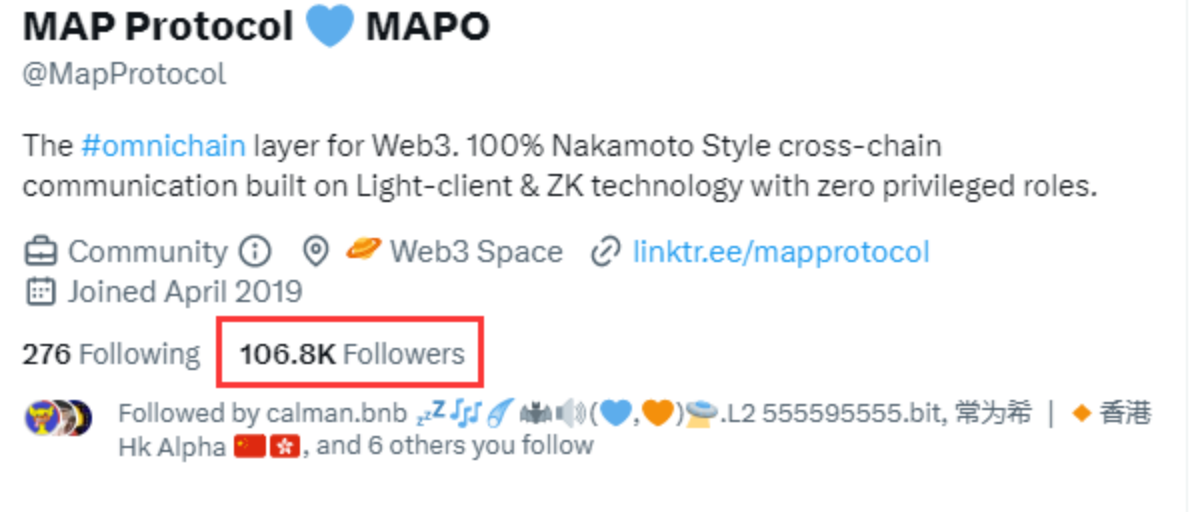
- Twitter followers: 106,000
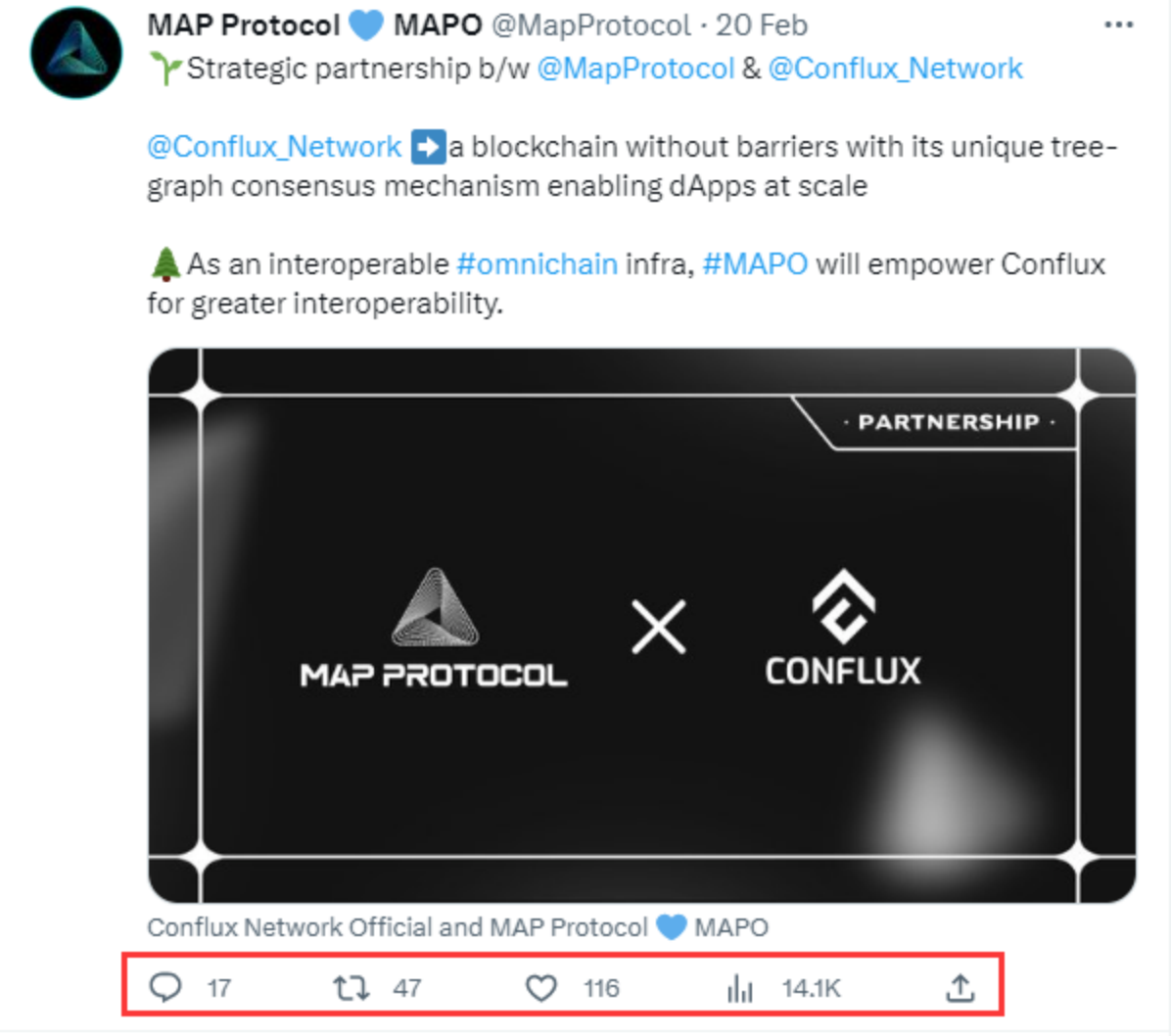
- High tweet engagement
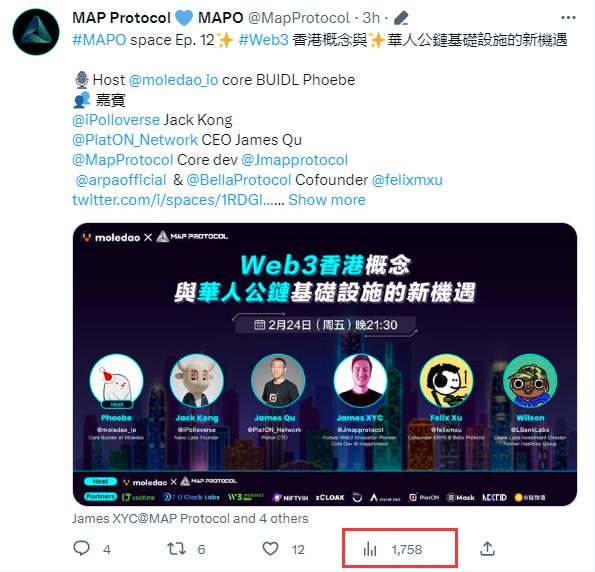
- Founders actively participate in various events
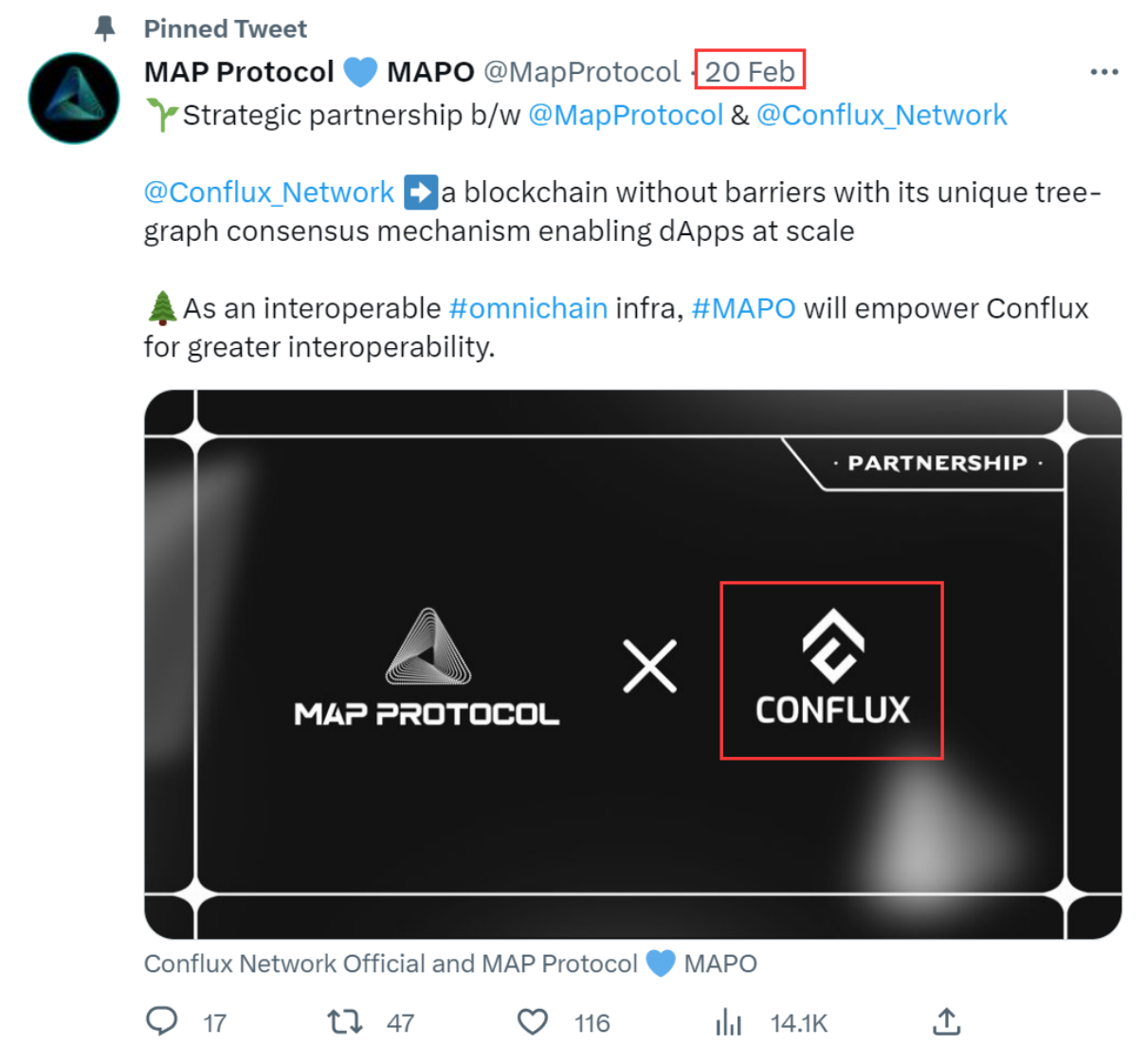
- Proactive collaboration with other projects
7. Tokenomics
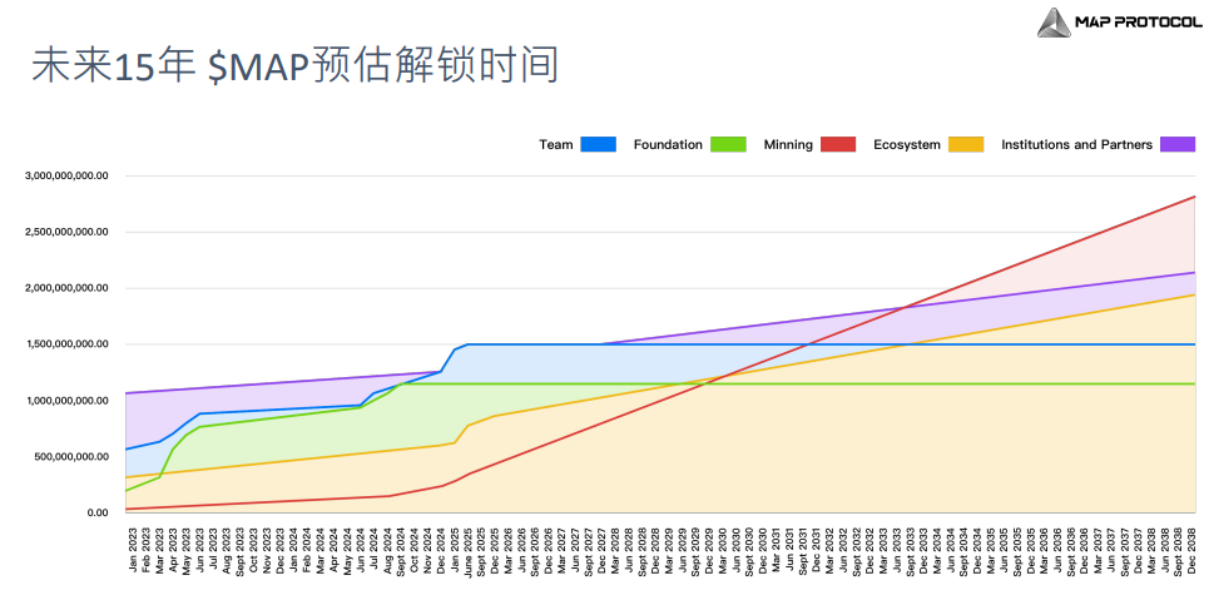
Total supply: 10 billion
-
15% allocated to team incentives
-
21% allocated to Ecosystem DAO
-
12% held by MAP Protocol Foundation
-
22% for investors and early supporters
-
30% reserved for mining rewards
8. Market Valuation
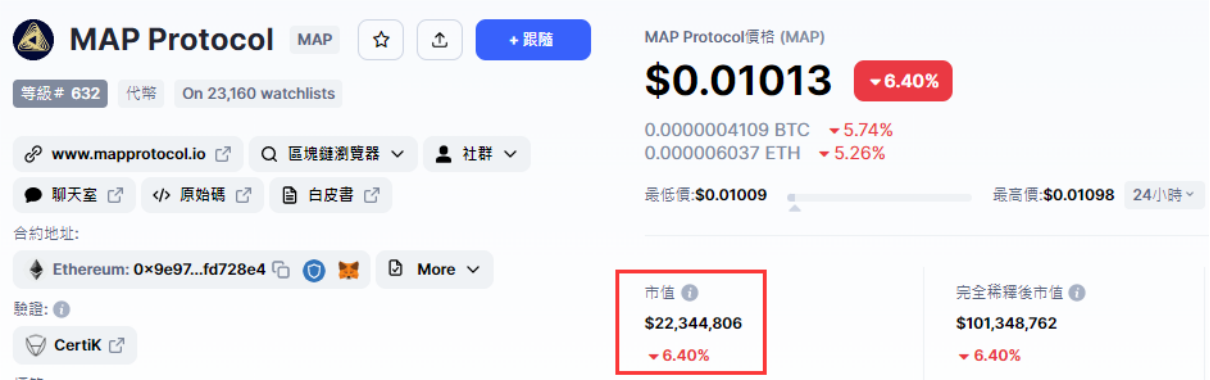
-
Market Cap: $22,342,490
-
Circulating Supply: 2,228,621,190
-
Circulation Rate: 22.3%
-
Fully Diluted Valuation: $101,348,762
9. Holder Distribution

10. Code Development Status
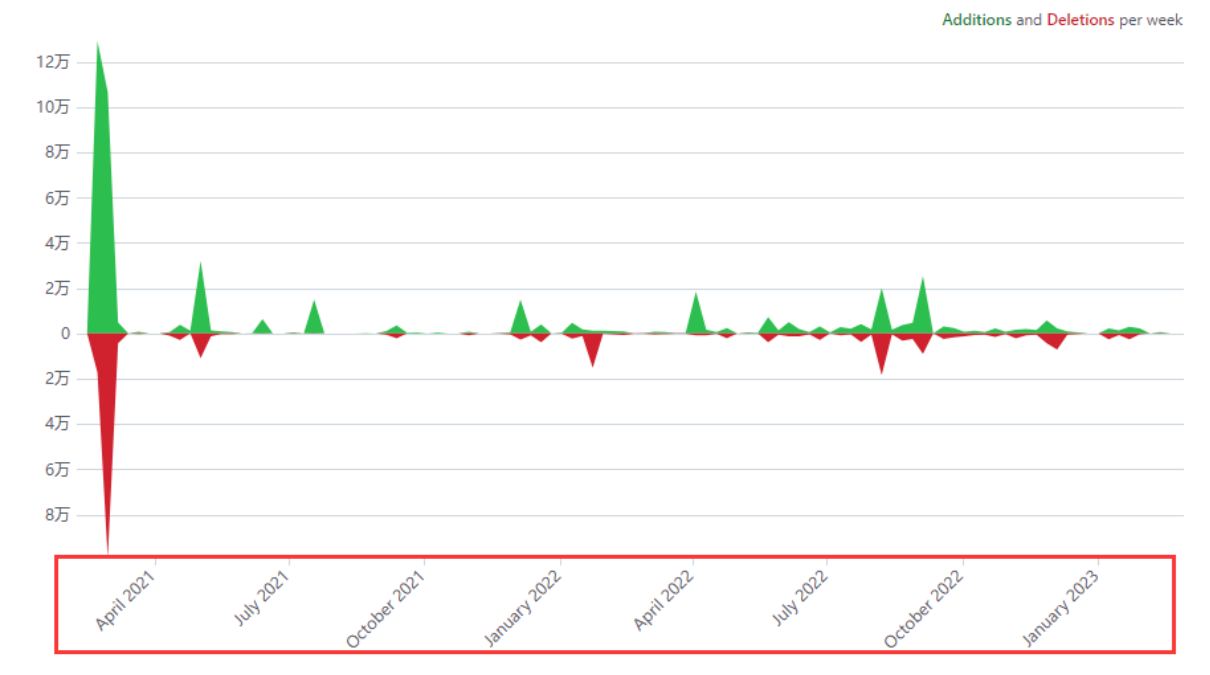
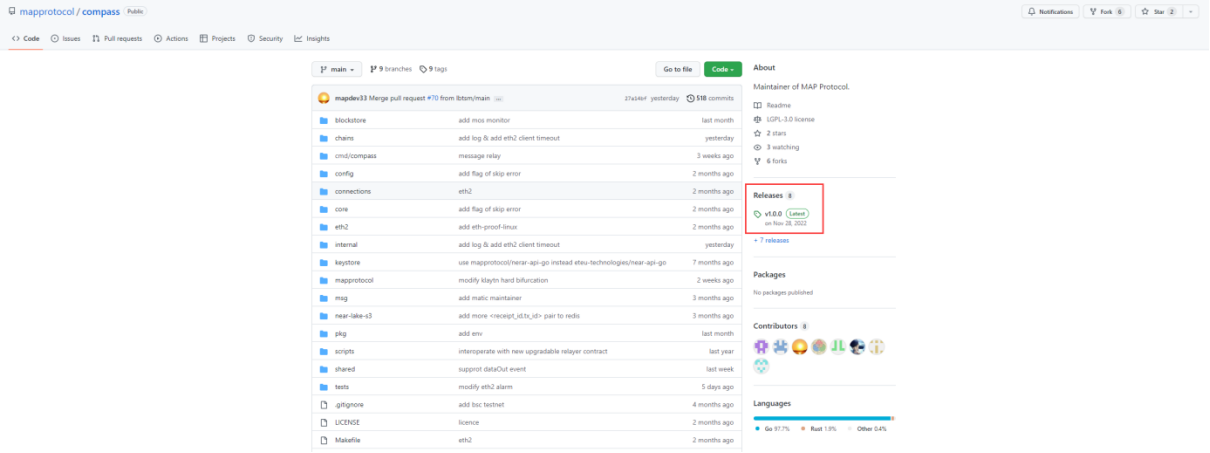
- Code development began in 2021 and has continued uninterrupted, with frequent updates
-
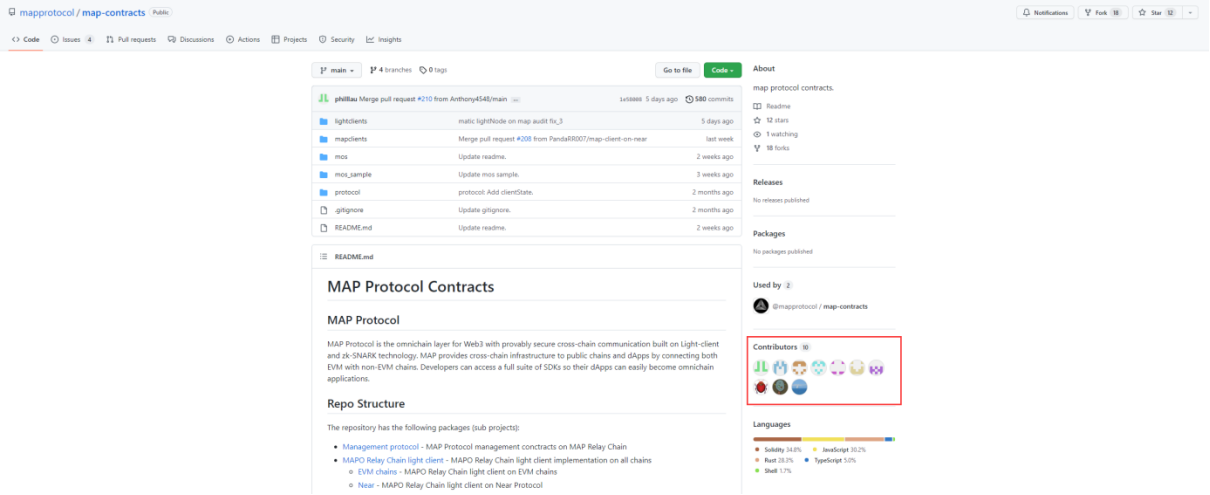
10 contributors involved in code development
-
Eight version iterations completed
11. Expert Evaluations
1. Bohao Tang, Chief Developer at Flow
- MAP Protocol is helping Flow build infrastructure for a full-chain application experience. Its cross-chain verification eliminates privileged roles and supports all EVM and non-EVM chains. We believe it can bring richer possibilities to the Flow ecosystem
2. Professor Yang Liu, Director of Cybersecurity Lab at Nanyang Technological University
-
MAP Protocol’s full-chain interoperability offers superior security, compatibility, and developer-friendliness compared to other cross-chain solutions. “MAP Protocol’s mature, innovative, and stable cross-chain design enables secure and seamless communication and asset transfer between EVM and non-EVM chains. Compared to centralized, no-relay-chain solutions like Axelar and Celer, MAP Protocol’s relay chain not only simplifies multi-chain architecture scalability but also avoids risks associated with super-administrators controlling inter-chain communications.”
-
“Compared to decentralized relay-chain solutions like Polkadot and Cosmos, MAP Protocol uniquely integrates zero-knowledge proofs, using smart-contract-based light clients to verify inter-chain messages. This lightweight implementation eliminates the need for SDK embedding or structural compatibility at the base layer of heterogeneous chains, while guaranteeing message security and confidentiality—enabling interoperability with virtually all blockchains.”
-
“Most importantly, MAP Protocol’s innovative design allows dApps to develop and natively deploy directly on the relay chain. By integrating assets from various blockchains, MAP Relay Chain becomes a pivotal component for cross-chain asset and data interaction—and stands a strong chance of becoming the true future of cross-chain solutions.”
12. Conclusion
-
A high-quality solution for cross-chain connectivity (shared mainchain security, decentralized)
-
Universal cross-chain and full-chain interoperability with vast potential
-
Team with years of deep technical accumulation
-
High-quality project, yet currently undervalued
References:
https://files.mapprotocol.io/pdf/mapprotocol_Litebook_cn.pdf
https://www.panewslab.com/zh/articledetails/D62579631.html
https://foresightnews.pro/article/h5Detail/19308
https://view.inews.qq.com/k/20230206A02IC400?web_channel=wap&openApp=false
Join TechFlow official community to stay tuned
Telegram:https://t.me/TechFlowDaily
X (Twitter):https://x.com/TechFlowPost
X (Twitter) EN:https://x.com/BlockFlow_News