Will Bitcoin and blockchain drive a new decentralized space race?
TechFlow Selected TechFlow Selected
Will Bitcoin and blockchain drive a new decentralized space race?
Blockchain is breaking the tracks.
 Navigating Web3 tides with focused insights
Author: Sandy Carter
Translation: Block unicorn
Summary
Blockchain technology is democratizing space by enabling decentralized ownership and governance, shifting control from traditional institutions to public participation.
Key projects include SpaceCoin building a satellite-based blockchain network (DePIN) and Copernic Space tokenizing real-world space assets and lunar domain names.
The TON blockchain pioneered "space democracy" by selecting civilian astronauts for a Blue Origin flight through on-chain voting, enabling global public involvement in space travel.
Introduction
From Bitcoin's first space transaction to tokenized lunar domains, blockchain is driving a new decentralized space race, making access and ownership more accessible.
As a child, I wanted to become an astronaut. I dreamed of floating in zero gravity, watching Earth spin beneath me, and perhaps one day walking on the Moon. Although I never made it to space, my life came full circle later while working at AWS, when I helped land the "Rover" on Mars alongside a colleague.
That experience taught me there are many ways to explore new frontiers—and today, one of the most exciting paths isn't through rockets, but through code. Blockchain, a technology that began with digital currency, is now extending into space orbits.
Space has always captured human imagination. For decades, it remained the exclusive domain of governments, billionaires, and aerospace giants.
Now, a quiet revolution is bringing blockchain into everyday life. Blockchain is moving beyond finance into space, laying the foundation for a decentralized space economy.
What Is Decentralized Space?
Decentralized space is the fusion of blockchain and space exploration. It leverages smart contracts, tokenization, and decentralized governance to allow anyone with a digital wallet to participate in the space economy.
Rather than relying on a few large institutions, decentralized space enables communities, creators, and investors to co-own and co-govern assets such as satellites, payloads, and even lunar missions. It brings transparency and inclusivity to a long-exclusive field, creating an open network that extends access and ownership beyond Earth.
It combines space technology with Web3 principles of transparency, inclusivity, and verifiable ownership, forming an open network where anyone can contribute to humanity’s journey beyond Earth.
According to PwC, space is predicted to become the first new trillion-dollar asset class of the 21st century—and the first asset class that can natively exist on-chain.
Why Is Decentralized Space Related to Bitcoin?
The origins of decentralized space trace back to Bitcoin. In 2019, a SpaceChain blockchain node launched into orbit aboard a SpaceX Falcon 9 rocket. This node enabled multi-signature Bitcoin transactions in space—the first-ever blockchain and Bitcoin transactions conducted in orbit. Bitcoin recently hit new highs, then pulled back—just like a rocket!

The origins of decentralized space trace back to Bitcoin. (Image courtesy of Dan Kitwood/Getty Images)
This milestone proved blockchain could operate beyond Earth without relying on terrestrial infrastructure. It sparked a wave of projects exploring how digital assets and decentralized systems could support future space missions.
What began with Bitcoin has now expanded into a full ecosystem where tokens, domains, and smart contracts connect people to space in unprecedented ways.
Three Pioneering Projects Leading This Transformation
SpaceCoin is building a blockchain infrastructure powered by satellites.
Copernic Space is tokenizing space assets and digital domains linked to lunar missions.
The Open Network (TON), the blockchain behind Telegram, supports on-chain voting to select real astronaut seats on Blue Origin flights.
Together, they demonstrate how the future of space can be more widely shared.
SpaceCoin and DePIN in Orbit—More Than Just Bitcoin
SpaceCoin’s vision is simple yet radical. It aims to create a satellite network that transmits blockchain transactions directly through space, eliminating reliance on Earth’s internet. In a recent test, SpaceCoin successfully achieved intercontinental data transfer using only satellite links. That data wasn’t just a signal—it was a blockchain record transmitted across orbits.
This concept belongs to a new category called Decentralized Physical Infrastructure Networks (DePIN). These projects use blockchain to power real-world infrastructure, not just digital systems. SpaceCoin’s network can serve remote areas, censored regions, and space devices requiring secure communication independent of terrestrial internet.
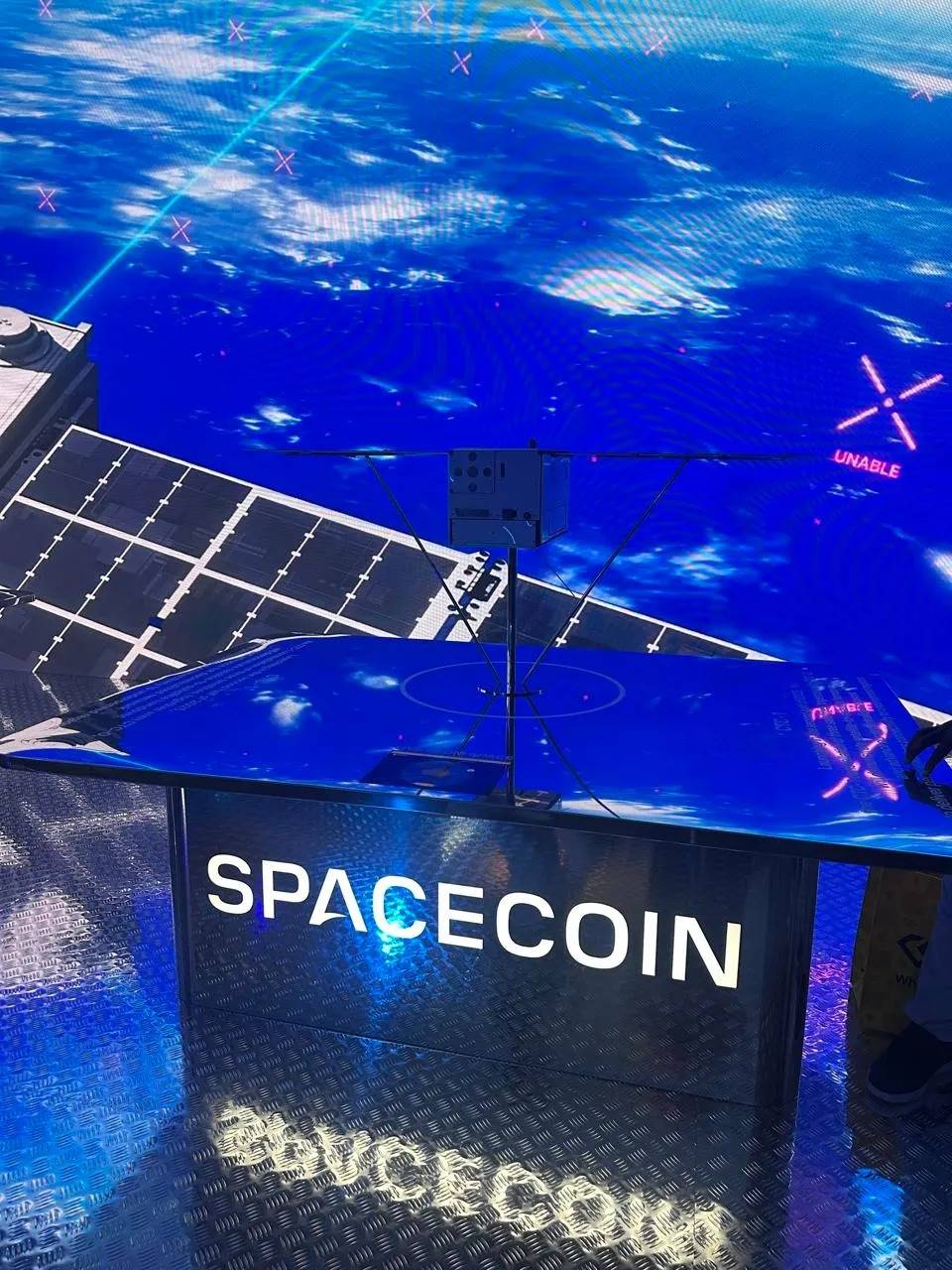
SpaceCoin demonstrating how DePIN works in space at Token 2049 - Sandy Carter
The implications are profound.
At the Token 2049 conference, I spoke with SpaceCoin founder and CEO Taekyung Oh, who told me: "Space is the ultimate frontier of decentralization. With DePIN, we're turning satellites into nodes of a global network where connectivity, computing, and coordination transcend borders—and even Earth."
If blockchain can run in orbit, transaction, identity, and governance systems will no longer be bound by Earth. Space-based blockchains could enable global connectivity resilient to censorship or natural disasters, preparing us for an era of interplanetary communication. While challenges remain—satellite costs, regulation, reliability—the idea of blockchain reaching for the stars is no longer science fiction.

From Bitcoin to the Moon: Copernic Space and the Tokenized Space Economy - Sandy Carter
From Bitcoin to the Moon: Copernic Space and the Tokenized Space Economy
If SpaceCoin provides the infrastructure, Copernic Space delivers ownership and financial infrastructure to power this new economy. The company connects real-world space assets to global capital markets via blockchain, pioneering the tokenization of missions, payloads, and even digital identities—transforming how space assets are represented, funded, and traded.
Did you know? Copernic Space has partnered with SpaceChain to build a commercial marketplace for tokenized space assets. This collaboration builds on SpaceChain’s earlier work proving blockchain technologies like Bitcoin can function beyond Earth.
Recently, Copernic Space teamed up with Unstoppable Domains (my employer) to launch the .LUNAR domain extension—the first domain tied to real space missions. Each .LUNAR badge will be sent to the Moon during scheduled missions in 2026–2027. This makes each domain a tokenized real-world asset connected to space. Owning a domain means holding a verified digital identity that will truly fly beyond Earth.
Copernic Space has already demonstrated this model in action. Its commercialized rocket and its first lunar mission earlier this year sold out, with over 2,000 tokenized payloads—including individuals and companies landing on the Moon—generating revenue and returns for early participants.
In a conversation with Copernic Space CEO Grant Blaisdell, he told me: "Decentralization returns space to humanity. For the first time, people around the world can own a small but meaningful stake in space ventures. By combining blockchain with space missions and projects, we’re creating a transparent, participatory ecosystem where the next great discovery belongs to everyone—not just a few institutions."

Grant Blaisdell, CEO of Copernic Space, pioneer of decentralized space - Grant Blaisdell
Copernic Space positions itself as a platform for buying, selling, and investing in tokenized space projects. This model opens the door for individuals to participate in the space economy through blockchain-based ownership. The idea is to turn space into an open, accessible market where anyone can join. It redefines our understanding of digital property—not just owning a website, but owning a domain representing a rocket, satellite, or lunar payload.
But it’s not just about collectibles. By enabling fractional ownership of real missions and infrastructure, Copernic Space makes participation in the space economy more transparent, liquid, and inclusive. While regulations around space ownership are still evolving, the shift is already underway.
For the first time, space is becoming a market for everyone—not just governments and big corporations.
TON, SERA, and the New Space Democracy
While SpaceCoin focuses on infrastructure and Copernic Space on assets, TON is opening direct pathways into space. The TON Foundation, the organization behind the Telegram blockchain, has partnered with the U.S. Space Exploration & Research Agency (SERA) to launch a mission control center.
The program uses blockchain to select real civilian astronauts for Blue Origin flights through an on-chain voting system.
SERA has secured six seats on an upcoming New Shepard mission in 2026. Five of these seats are reserved for citizens from underrepresented countries such as India, Nigeria, Brazil, Thailand, and Indonesia.
The sixth seat will go to a global participant chosen via voting on the TON blockchain. Participants earn points and vote using the TON wallet built into Telegram. Every vote is recorded on-chain, ensuring transparency and fairness.

Max Crown, President and CEO of the TON Foundation, pioneer of the next generation of decentralized space
"SERA isn’t just another crypto project—it’s something truly unique. It’s more like an experiment exploring the spark when cryptocurrency meets experience-driven, participatory culture," said Max Crown, President and CEO of the TON Foundation. "They’re actually sending people to space, and all you need is Telegram and a wallet to get involved. It’s insane. I’ve always believed people don’t care only about how tech works—they care about what it does and how it makes them feel. That’s what matters. We’re not talking about changing lives with tech—we’re actually doing it. This is the moment blockchain transforms from pure technology into lived experience."
This initiative is historic. It marks the first time blockchain technology directly influences who gets to go to space. Instead of relying on government committees or corporate sponsors, the program is open to the global public. TON calls this "space democracy," where users can win space travel opportunities by participating in a transparent, tokenized process.
The significance goes beyond a single mission.
It shows how blockchain can extend inclusivity from financial systems to space exploration. TON’s integration with Telegram gives it massive reach, bringing billions closer to their space dreams. This isn’t just about technology—it’s about participation.
Future Outlook for Bitcoin and Blockchain in Decentralized Space
The road ahead won’t be smooth—regulation remains the biggest unknown.
There are still no clear answers on who governs tokenized lunar assets or how liability works in orbit. Technical hurdles like satellite lifespan, launch costs, and communication delays will test every innovation.
Market adoption also depends on proving real utility beyond hype.
Ethical concerns are involved too. Space must not become another arena for inequality or exploitation. If blockchain opens space participation, it must do so fairly and sustainably. Emerging industries must balance ambition with responsibility.
Despite the challenges, the direction is clear.
The space economy is rapidly expanding, and blockchain is becoming part of its infrastructure. SpaceCoin, Copernic Space, and TON are showing how decentralization can make this final frontier more open and inclusive.
This matters because it signals a shift in power and possibility. The same technology that once made finance more inclusive is now bringing similar change to exploration and discovery.
As these projects grow, we may soon witness the first blockchain transaction from orbit, the first domain name landing on the Moon, and the first astronaut fully selected through decentralized voting.
The distance between cyberspace and outer space is shrinking. The blockchain and Bitcoin revolution has officially left Earth’s orbit.
Join TechFlow official community to stay tuned
Telegram:https://t.me/TechFlowDaily
X (Twitter):https://x.com/TechFlowPost
X (Twitter) EN:https://x.com/BlockFlow_News
 Forbes