When RaaS services rise: Can the OP Stack threaten Cosmos' moat?
TechFlow Selected TechFlow Selected
When RaaS services rise: Can the OP Stack threaten Cosmos' moat?
The launch of the OP Stack and the development of Cosmos have validated the feasibility of "Rollup as a Service" and "Appchains-as-a-Service."
 Navigating Web3 tides with focused insights
Author: Yu Zhong Kuang Shui
OP Stack is a software stack introduced by Layer2 Optimism for the modular blockchain sector. When the OP Stack concept was first proposed, market reaction to the technology was lukewarm.
Ultimately, this stemmed from two factors: first, the proposal emerged amid the aftermath of FTX's collapse, leaving market confidence low; second, in the Rollup race, Arbitrum had consistently held the lead. Thus, OP Stack appeared more like a self-rescue strategy for Optimism—or, more bluntly, a way for Optimism to PUA (manipulate) the market.
This perception persisted until February 23, when Coinbase announced its upcoming Layer2 network Base, built on OP Stack.
Suddenly, the castle in the air seemed to gain a foundation—and new possibilities.
OP Stack represents an exploration into modular blockchains. Simply put, we can broadly divide blockchains into three layers: consensus, settlement, and execution. The consensus layer can be further split into data availability (DA) and derivation layers. Traditionally, developers building blockchains must write code from scratch. OP Stack’s function is to deconstruct and recombine these functional layers, offering them as services via API-based software stacks. In other words, developers leveraging OP Stack’s ready-made codebase also gain flexibility in emphasizing different layers, such as replacing Ethereum’s DA layer with Celestia.
Thanks to greater flexibility, various Layer2 networks built on OP Stack will possess unique characteristics. For example, Coinbase’s Layer2 Base may implement transaction monitoring and anti-money laundering measures—achieved through a more centralized sequencer. Perhaps, on-chain activities could even come under U.S. government regulation in the future.
Following Optimism’s Bedrock upgrade, a “Superchain” concept will be introduced. The Superchain aims to solve cross-chain interoperability issues, much like Cosmos. It could act as a central hub, enabling message passing between Layer2 chains through this central node, while relying on Ethereum for security—a bridge connecting infinite chains.
Additionally, it's worth noting that OP Stack’s Superchain will adopt a decentralized sequencer to address cross-chain MEV issues.
From an architectural standpoint, OP Stack resembles Cosmos SDK, both expanding multi-chain ecosystems through a central hub model. However, OP Stack offers higher customizability and does not require attracting validators to stake for consensus maintenance—this is why Base doesn’t need a new token. In contrast, Cosmos appchains require new validators to secure their chains, although Cosmos is working to resolve this via Interchain Security.
Theoretically, Cosmos’ market share may face challenges from OP Stack. Will this actually happen?
Developer Ecosystem Comparison
Cosmos enjoys first-mover advantage and has already accumulated a significant developer base. Some major applications like dYdX have begun migrating to the Cosmos ecosystem. According to Token Terminal data, Cosmos has maintained a stable number of daily active developers over the past year.
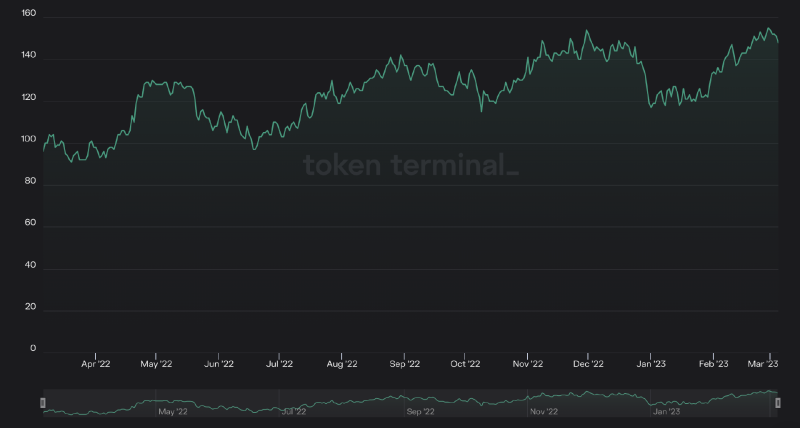
In contrast, the OP Stack ecosystem is only beginning to expand, with Base being its first chain.
Although OP Stack is still nascent, the underlying EVM developer ecosystem behind it cannot be ignored. OP Stack benefits from EVM’s large market share and widespread adoption, which translates into a rich pool of developers. Layer2s built on OP Stack, like other Layer2s, originate from and depend on Ethereum, making the EVM development community more inclined to adopt the convenient and flexible OP Stack framework.
As TechFlow noted in a July 2021 article: "Ethereum possesses something other public chains dare not boast—the unwavering commitment to decentralization ideology. True believers won't compromise or tolerate decentralization for speed and low cost, and this uncompromising belief is driving massive innovation." Compared to other Layer1s, being able to build Layer2s—especially in a more accessible way—is a better choice for developers committed to decentralization.
Progress of Cosmos
Cosmos is actively addressing issues within its ecosystem by launching features such as Interchain Security, Interchain Scheduler, and Interchain Allocator. This progress has led some in the Cosmos community to view OP Stack critically—seeing it as someone picking low-hanging fruit, learning from Cosmos’ developmental challenges and delivering a more refined solution.
Alt Layer1 vs Ethereum Layer2
At its core, OP Stack remains an extension of Rollups. This means blockchains built on OP Stack are still Layer2s—executing computation and storage off-chain, compressing numerous transactions into one, and recording it on the base layer, Ethereum. Final security is thus provided by Ethereum. Such Layer2s sacrifice some autonomy and reduce the need for native tokens, just as Base will not issue one. $OP cannot capture value from OP Stack’s growth; instead, $ETH will benefit.
Conversely, Cosmos’ Appchains-as-a-Service essentially enables developers to build true Layer1s. Although OP Stack simplifies blockchain construction, its design remains centered around Ethereum and will continue to be influenced by future Ethereum upgrades. Cosmos SDK, however, allows developers to rewrite default architectures, designing blockchains with custom consensus mechanisms, token standards, and smart contract platforms. Layer1s built with Cosmos SDK enjoy greater autonomy.
Nonetheless, fundamentally, the emergence of OP Stack symbolizes the competition between the Ethereum and Cosmos ecosystems in the future direction of modular blockchains. Greater expectations for OP Stack-based Layer2s lie in Ethereum’s upcoming EIP-4844, Proto-Danksharding, and Danksharding, which promise higher scalability and lower fees.
The rise of OP Stack and the evolution of Cosmos also validate the feasibility of “Rollup as a Service” and “Appchains-as-a-Service.” We must also acknowledge other players in this space, such as Avalanche, whose subnet service offers high customizability. Or Celestia, which enables rapid blockchain deployment through its modular blockchain toolkit Rollkit. Notably, Cosmos appchains can also use Celestia as their consensus layer. This means Celestia, beyond OP Stack, could become a competitor to Cosmos as well.
Join TechFlow official community to stay tuned
Telegram:https://t.me/TechFlowDaily
X (Twitter):https://x.com/TechFlowPost
X (Twitter) EN:https://x.com/BlockFlow_News
 雨中狂睡Sleeping in the Rain